Artificial intelligence is becoming part of everyday healthcare. Yet many AI tools still focus on isolated tasks and struggle with real-world complexity. Healthcare teams are often left stitching together disconnected systems that fail to understand full clinical context or individual patient needs.
This is where Agentic AI in healthcare begins to change the conversation.
Unlike traditional tools, agentic systems are designed to act with greater autonomy, adapt as conditions change, and support smarter decision-making across the entire care journey. By combining data from clinical systems, patient interactions, and operational workflows, these systems enable AI-driven care pathways and more effective AI-powered patient care management. The result is a care experience that feels connected, personalized, and proactive.
At the same time, innovation must be balanced with responsibility. Ethical use, data privacy, and regulatory oversight remain essential. With the right governance, proactive healthcare AI can improve outcomes, reduce clinician burden, and help close gaps in access to quality care.
The Shift Toward Agentic AI in Modern Healthcare
Healthcare is moving beyond basic automation into an agentic era. In this era, AI systems work alongside clinicians to support reasoning, coordination, and decision-making using clinical decision intelligence.
Powered by advanced language models and intelligent analytics, modern AI builds on decades of progress. This includes early rule-based systems and recent advances in machine learning and medical imaging. Despite this progress, many AI tools still fall short in clinical environments.
Common challenges include:
- Limited understanding of clinical context
- Poor workflow integration
- Difficulty meeting regulatory expectations
These gaps reduce real-world impact.
Agentic systems offer a practical way forward. By enabling clinical decision intelligence and intelligent care coordination, agentic AI helps healthcare teams anticipate needs rather than react to problems. When designed as safe and scalable agentic AI in healthcare systems, these technologies support proactive, patient-centered care pathways that clinicians trust and organizations can scale with confidence.
How Agentic AI Differs from Traditional AI
Traditional AI agents in healthcare rely on fixed rules. They perform well for predictable tasks such as answering standard questions or applying static clinical guidelines. However, they struggle when patient conditions change or when deeper context is required.
Agentic AI in healthcare works differently.
Key differences include:
- Context awareness
Agentic AI uses language-based reasoning to understand patient history, ask follow-up questions, and adapt responses in real time. - Multi-task capability
Traditional AI is usually built for one task. Agentic AI can support diagnostics, summarize radiology reports, and enable AI-driven care pathways within the same system. - Adaptive decision-making
Instead of following static rules, agentic systems update recommendations as new patient data becomes available. This enables agentic AI for predictive patient care management. - System integration
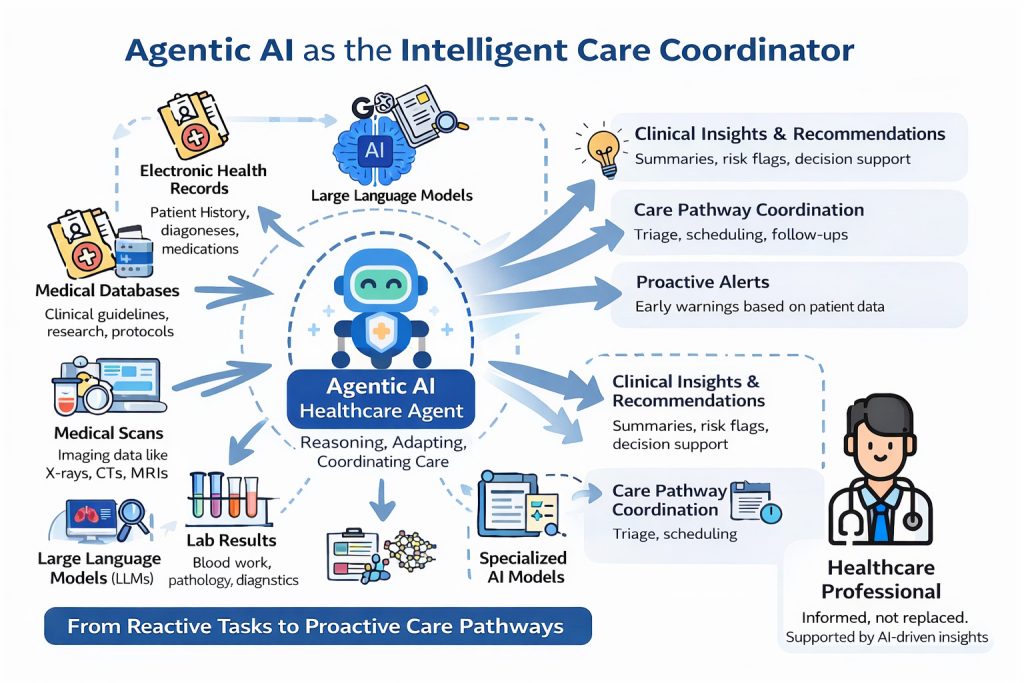
Traditional tools often work in isolation. Agentic AI connects EHRs, lab results, imaging systems, and medical knowledge to enable intelligent care coordination.
When supported by strong AI governance in healthcare, autonomous AI in healthcare enables scalable, patient-centered care without compromising safety.
Technical Overview of Agentic AI
Agentic AI systems are designed to think and act by combining multiple AI components. At the core is a large language model responsible for reasoning and decision-making, supporting clinical decision intelligence across complex care scenarios. This model receives inputs from other AI systems that process text, images, and structured clinical data.
Some systems use open-source language models, offering greater transparency into how decisions are made. Others rely on proprietary models that may deliver strong performance but provide less visibility. What matters most is how well these components work together to support adaptive, context-aware decisions in Agentic AI in healthcare deployments.
A major strength of agentic AI is its modular design:
- Models can be added or replaced as needs evolve
- Tools can be updated without rebuilding the system
- Architectures scale more easily over time
This flexibility is critical for long-term adoption in complex healthcare environments.
Why AI Agents Matter in Healthcare
Healthcare generates massive volumes of data from medical imaging, wearables, remote monitoring, and digital health records. While this data can improve care, it also increases complexity for clinicians.
At the same time, workforce shortages continue to strain healthcare systems.
AI agents help by:
- Reducing administrative workload
- Supporting clinical decision-making
- Improving coordination across care teams
When used responsibly, autonomous AI in healthcare allows clinicians to focus more on patients and less on paperwork, while improving consistency and quality of care.
Key Features of Agentic AI in Healthcare
Autonomy
Agentic AI systems can operate independently based on defined goals and real-time data.
Examples include:
- Analyzing medical scans and selecting appropriate diagnostic methods
- Generating initial radiology reports
- Detecting language needs and applying translation tools in multilingual settings
These capabilities speed up workflows and reduce manual effort.
Adaptability
Unlike single-purpose systems, agentic AI evolves as clinical needs change.
For example, an agent trained on X-ray data can later adapt to MRI or CT imaging, helping organizations stay current as technologies advance.
Scalability
Using cloud platforms and federated learning, agentic AI processes large and diverse datasets in real time. This is essential for telemedicine and distributed care models.
Probabilistic Decision-Making
Agentic AI continuously refines its conclusions as new information becomes available. Diagnoses and recommendations evolve as lab results, patient history, or population data are added. This supports safer, more context-aware care decisions.
Together, these features allow agentic AI to deliver efficient, flexible, and reliable support across healthcare settings.
Core Functional Areas of AI Agents in Healthcare
Healthcare-focused AI agents support the full care journey, including:
- Diagnosis
- Clinical decision support
- Treatment and patient care
- Patient monitoring and engagement
- Operations and administration
- Drug discovery and research
- Robot-assisted surgery
Across each area, agentic AI improves data analysis, decision support, and operational efficiency.
AI Agents in Diagnosis
AI agents support clinicians by:
- Analyzing medical images and patient data
- Flagging potential abnormalities
- Generating preliminary insights within clinical context
These tools reduce workload, improve diagnostic accuracy, and support earlier, more personalized diagnoses.
Challenges and Recommendations for Agentic AI in Healthcare
Data Availability and Privacy
Healthcare data is fragmented, sensitive, and highly regulated.
Approaches such as federated learning, explainable AI, and bias mitigation are essential but complex to implement.
Regulation and Compliance
AI evolves faster than healthcare regulations.
Continuous validation, monitoring, and human oversight are required to ensure safety and compliance.
Workflow Integration and Trust
Legacy systems, limited AI literacy, and poor explainability slow adoption.
Successful deployment depends on clinician training, interpretable outputs, and real-world validation.
Infrastructure and Cost Constraints
Advanced AI requires significant compute resources and funding.
Cloud platforms, open-source models, and scalable architectures can improve access.
Security and Adversarial Risks
AI systems may be vulnerable to manipulation.
Robust testing, secure design, and defensive safeguards are critical.
Ethical and Legal Accountability
Unclear responsibility for AI-driven decisions raises ethical concerns.
Clear documentation, governance frameworks, and explainable outputs are required.
Human Oversight and Governance
As systems become more autonomous, oversight becomes harder.
Hybrid human-in-the-loop models and strong AI governance in healthcare help balance autonomy with control.
Future Directions for Agentic AI in Healthcare
Agentic AI will continue to evolve toward more general, multimodal, and proactive healthcare AI systems that assist clinicians rather than replace them.
Future progress will depend on:
- Human-AI collaboration
- Transparency and explainability
- Ethical governance
- Seamless workflow integration
Edge AI, federated learning, and secure data sharing will expand access, especially in resource-limited environments. Over time, how agentic AI enables proactive care pathways will define the next generation of preventive, personalized, and connected healthcare systems.
Key Takeaways
Agentic AI represents a major shift in how healthcare uses data, intelligence, and automation. Its value lies not in replacing clinicians, but in helping them make better, faster, and more informed decisions across diagnosis, treatment, operations, and patient care.
At Prolifics, this aligns directly with a focus on practical AI that delivers real clinical and business value. Through trusted partnerships, deep domain expertise, responsible AI practices, and strong integration capabilities, Prolifics helps healthcare organizations move from experimentation to measurable impact.
Agentic AI in healthcare will succeed only when it is transparent, secure, and designed around real clinical workflows. With the right governance, human oversight, and implementation strategy, agentic AI becomes a powerful enabler of better outcomes, more efficient systems, and more equitable access to care.