

AI projects don’t fail because algorithms are weak. They fail because the data feeding those algorithms is unreliable. If your AI model is producing biased, inaccurate, or unpredictable results, the root cause is often hidden in your data. This is why quality data for AI is a non-negotiable requirement for long-term success.
Before chasing bigger models or newer frameworks, it’s time to look at the real foundation and quality data for AI.
Data Quality Shapes AI Intelligence
Organizations invest heavily in AI tools, cloud infrastructure, and talent. Yet many still struggle to move from pilot projects to real business impact. Why?
Because data quality in artificial intelligence is often treated as a cleanup task instead of a strategic priority, even though quality data for AI directly determines outcomes.
AI doesn’t understand intent, context, or business meaning. It learns patterns exactly as they exist in the data. If the data is incomplete, inconsistent, outdated, or biased, the AI will faithfully reproduce those flaws at scale. This is why the importance of data quality in AI cannot be overstated.
What “Quality Data for AI” Actually Means?
Quality data is not just clean data. For AI systems, it must be:
- Accurate – Correct values, labels, and measurements
- Complete – No critical gaps in features or records
- Consistent – Same definitions across systems and time
- Relevant – Aligned with the problem the AI is solving
- Timely – Updated frequently enough to reflect reality
Together, these attributes protect machine learning data integrity, which directly impacts model performance and trust.
Relationship Between Data Quality and AI Accuracy
There is a straight line between AI model accuracy and data quality. The cleaner and more reliable the data, the better the model performs.

Even the most advanced model cannot compensate for flawed input. In fact, complex models often make data issues worse, making errors harder to detect and explain.
This is why teams focusing on training AI with high quality data consistently outperform those chasing algorithmic sophistication alone.
Poor Data Quality Impacts AI Models
Let us understand how poor data quality affects AI models helps justify early investment in data foundations.
The most common outcomes include:
- Biased predictions due to unrepresentative data
- Low generalization when models fail outside training scenarios
- Unstable performance caused by inconsistent data sources
- Erosion of trust among business users and stakeholders
In regulated industries, poor data quality can also lead to compliance risks and ethical concerns.
Strategic Importance of AI Data Preparation
AI outcomes are fundamentally shaped by the quality, structure, and relevance of the data used. Careful AI data preparation ensures that AI systems learn meaningful patterns rather than noise or bias. This phase includes data profiling and validation, handling missing values, standardizing formats and definitions, and performing labeling and annotation of quality checks.
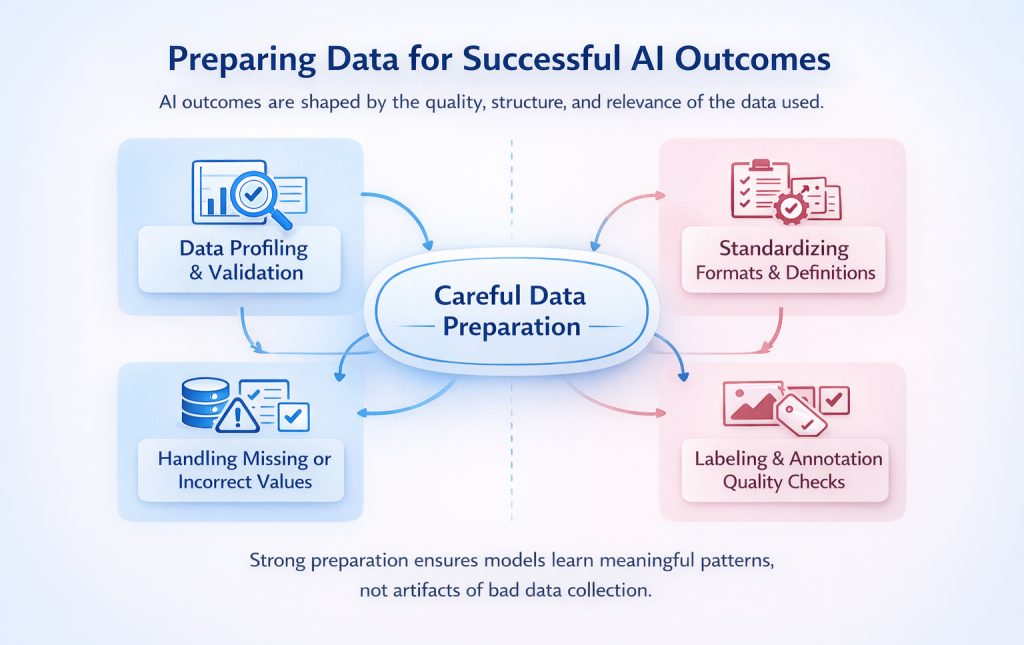
Strong preparation ensures that models learn from reality, not from artifacts of bad data collection.
Data Quality Management for AI Is a Continuous Process
Sustained AI performance depends on continuous data validation and governance. Without ongoing data quality management, AI systems gradually lose reliability.
As data sources evolve, business rules change, and user behavior shifts; data quality can degrade silently. Continuous monitoring, automated checks, and clear ownership are essential to keep AI systems reliable over time.
Organizations that treat data quality as a living system; not a project; build more resilient AI capabilities.
Best Practices for Ensuring Data Quality in AI
If you are asking why quality data is critical for AI success, these best practices provide the answer,
- Define data standards for early
Agree on common definitions, formats, and quality thresholds before model development begins. This ensures consistency and prevents confusion across teams and data sources. - Embed quality checks into pipelines
Validate data during ingestion, transformation, and model training stages. Early detection of issues reduces downstream errors and rework. - Track data lineage and ownership
Maintain visibility into where data originates and how it moves across systems. Clear ownership improves accountability and data accuracy. - Monitor model feedback loops
Analyze model outputs to identify unexpected patterns or performance drops.
These signals often reveal hidden data quality problems. - Align data with business context
Ensure data reflects real business scenarios and decision-making needs.
Technical accuracy alone is insufficient without relevance to outcomes.
Following these steps strengthens data quality in artificial intelligence across the entire lifecycle.
Role of Data Quality in Gaining Competitive Advantage
AI models can be replicated, and algorithms can be reused across organizations. However, high-quality, well-governed data remains difficult to reproduce at scale.
Organizations that invest early in data quality develop AI systems that are more accurate, explainable, and scalable, creating sustainable advantages beyond model performance alone.
Conclusion
Quality data is the foundation of every successful AI system. It is not just a technical requirement, but a critical factor that determines whether AI delivers real business value. Without strong and reliable data, even the most advanced AI strategies struggle to produce accurate or trustworthy results.
When organizations prioritize quality data for AI, they improve model accuracy, build confidence among users, and enable better decision-making. Clean, consistent, and well-governed data allows AI systems to scale effectively and remain dependable over time. Ultimately, AI alone does not transform businesses reliably; high-quality data makes that transformation possible.


