

As hybrid and multi-cloud architectures become foundational to enterprise IT – enabling seamless integration between on-premises infrastructure and public and private clouds organisations increasingly rely on AIOps for IT operations to maintain control and resilience. While this architecture drives agility and scale, it also introduces operational complexity that traditional monitoring can no longer manage.
The scale of this challenge is significant. According to Gartner, by 2026, 40% of large enterprises will combine AIOps with observability practices to achieve autonomous IT operations up from less than 10% in 2023. Forrester Research further reports that organisations deploying enterprise-grade AIOps platforms reduce mean time to resolution (MTTR) by an average of 60% and cut alert noise by up to 85% within the first 12 months of deployment. For IT leaders managing increasingly distributed digital estates, these are not incremental gains – they are operational imperatives.
AIOps (Artificial Intelligence for IT Operations) addresses the complexity challenge by applying AI and machine learning to deliver intelligent observability, predictive insights, and automated remediation across complex environments. Integrated with DevOps AI tools, ArgoCD-driven CI/CD pipelines, log monitoring platforms, and frameworks such as MLOps, LLMOps, DataOps, FinOps, and SRE, an AIOps platform strengthens DevSecOps by embedding security into workflows enabling AI-powered IT operations that scale across modern digital ecosystems.

What Is AIOps and Why It Matters in 2026
AIOps for IT operations applies advanced analytics, machine learning (ML), and automation to operational data including logs, metrics, traces, events, and tickets. Instead of relying on siloed tools and manual investigation, AIOps leverages an enterprise-grade AIOps platform to ingest data across the IT estate and automatically correlate signals, detect anomalies, and surface actionable insights.
This shift is critical. Modern IT environments generate enormous operational noise thousands of alerts from disconnected monitoring tools, fragmented dashboards, and handoffs between siloed teams.
AI-powered IT operations supported by AIOps in DevOps pipelines cut through this noise by providing a centralised, intelligent operational view that accelerates incident response, reduces alert fatigue, and enables proactive prevention rather than reactive firefighting. According to IBM’s IT Automation Report, organisations still relying on manual IT operations spend an average of 70% of IT staff time on reactive incident management time that AIOps systematically reclaims for higher-value work.
How AIOps Works: From Data to Decision
AIOps platforms enhance traditional monitoring by layering intelligence and automation across the operational lifecycle:
1. Data Ingestion and Enrichment
Operational data from infrastructure, applications, networks, cloud platforms, and service desks is ingested into a unified AIOps platform. This data is cleaned, normalised, and enriched with contextual metadata including topology, service dependencies, ownership, and historical behaviour supporting predictive IT operations at scale.
2. Correlation and Advanced Analysis
Machine learning models analyse patterns across signals to correlate related alerts into meaningful incidents. This dramatically reduces alert volume while improving accuracy demonstrating how AIOps improves IT operations efficiency and allowing teams to focus on what truly matters.
3. Intelligent Decisioning and Automation
Based on confidence thresholds and predefined runbooks, AIOps platforms can automatically trigger remediation actions such as restarting services, scaling resources, or rolling back deployments or escalate enriched incidents to the right teams with full context already attached.
4. Predictive Insights
Using historical trends and anomaly detection, AIOps identifies early indicators of risk such as capacity saturation or performance degradation enabling teams to resolve issues before users are impacted.
By replacing manual correlation and repetitive tasks with intelligent pattern recognition and automated remediation, AIOps for IT operations fundamentally reshapes how IT leaders manage system health across hybrid and multi-cloud environments.
The Five Stages of AIOps Maturity
AIOps adoption is a journey. Most organisations progress through five maturity stages:

- Reactive – Siloed tools and teams respond after incidents occur.
- Integrated – Operational data sources feed into a shared platform, reducing silos.
- Analytical – Shared insights and metrics support data-driven decisions.
- Prescriptive – ML and automation recommend actions with measurable business impact.
- Automated – Closed-loop automation proactively resolves issues and drives predictive outcomes.
Understanding this maturity curve helps organisations assess their current state, prioritise investments, and accelerate the transition to autonomous operations the ultimate goal of a mature AI-powered IT operations model.
Key Benefits of AIOps for the Enterprise
When implemented effectively, AIOps for IT operations delivers tangible value across IT and the wider business:
- Faster Incident Resolution Automated correlation and root-cause analysis significantly reduce MTTR minimising downtime and operational disruption. Forrester benchmarks show leading AIOps deployments achieving MTTR reductions of 60% or greater within the first year.
- Reduced Noise and Alert Fatigue AIOps suppresses redundant alerts and clusters related events enabling teams to focus on high-impact issues rather than false positives. Alert noise reductions of 80–85% are consistently reported across enterprise deployments.
- Predictive Prevention By identifying emerging anomalies and risk patterns, AIOps enables proactive maintenance and outage prevention – shifting operations from reactive firefighting to intelligent foresight.
- Lower Operational Costs Automation handles routine tasks, allowing organisations to manage complex environments without increasing headcount. IBM data indicates that mature AIOps implementations reduce operational overhead by 25–35% on average.
- Improved Cloud and Hybrid Control AIOps provides consistent visibility across on-premises, cloud, and multi-cloud environments supporting cost optimisation and performance management at scale.
- Enhanced User and Customer Experience Faster recovery times, predictable performance, and improved availability translate directly into better digital experiences and stronger customer satisfaction scores.
Real-World Use Case: AIOps in Financial Services
A top-10 U.S. insurance carrier managing over 2,400 business-critical applications across a hybrid cloud environment partnered with Prolifics to implement an enterprise AIOps platform – replacing 14 disconnected monitoring tools with a single, AI-driven operational intelligence layer.
Key outcomes achieved within 12 months:
- MTTR reduced by 63% – from an average of 4.2 hours to 1.6 hours per critical incident
- Alert volume reduced by 81% – from 47,000 daily alerts to 8,900 actionable signals, eliminating alert fatigue across NOC teams
- Automated remediation handled 34% of all incidents without human intervention – freeing senior engineers for strategic work
- Unplanned downtime reduced by 52% – directly improving policyholder digital experience and reducing SLA breach penalties
- IT operational costs reduced by 29% within the first year – achieved by retiring legacy monitoring tools and reducing on-call staffing overhead
This deployment demonstrated the transformative potential of AI-powered IT operations in a regulated, high-availability environment where system reliability is directly tied to business performance and regulatory compliance.
Real-World AIOps Use Cases Across Industries
AIOps for IT operations delivers value across a wide range of operational scenarios:
- Automated Anomaly Detection – Identifying unusual behaviour in metrics and logs that may signal impending failures
- Root Cause Analysis – Rapidly isolating the underlying cause of incidents from complex, noisy data
- Automated Remediation – Triggering workflows that resolve issues without human intervention
- Cloud Cost Optimisation – Rightsizing resources based on real-time usage and demand patterns
- Observability at Scale – Unifying insights across distributed applications and infrastructure
These use cases enable organisations to build resilient, intelligent observability frameworks that scale alongside digital growth – across finance, healthcare, retail, insurance, and the public sector.
How Prolifics Enables AIOps-Powered Transformation
At Prolifics, we recognise that successful AIOps adoption requires more than tools. It demands the right strategy, deep integration expertise, and a people-centric approach to change. We help organisations realise AIOps value through four core capabilities:
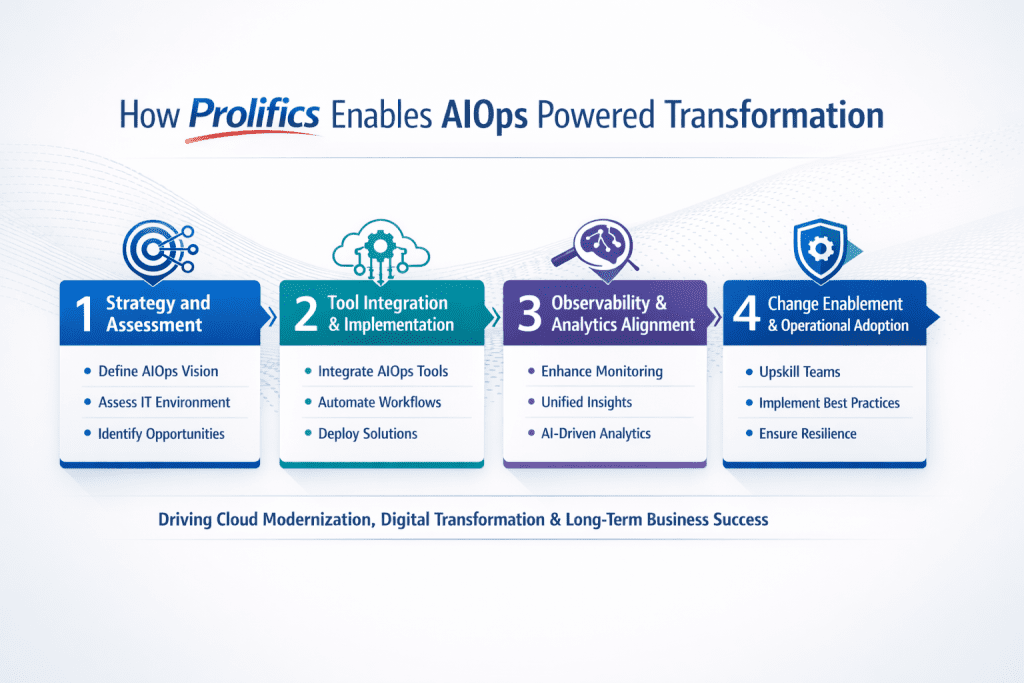
Strategy and Assessment We assess your current operational landscape and define a pragmatic AIOps roadmap focusing on high-impact opportunities for intelligence and automation aligned to your business priorities.
Tool Integration and Implementation Whether deploying leading AIOps platforms or integrating custom solutions, our engineers ensure seamless implementation, robust data pipelines, and strong governance frameworks.
Observability and Analytics Alignment We integrate AIOps with broader intelligent observability practices transforming fragmented telemetry into unified, actionable insights across the full IT estate.
Change Enablement and Operational Adoption We support teams in moving from reactive operations to proactive, data-driven workflows underpinned by clear KPIs, runbooks, and automation guardrails that ensure sustainable adoption.
“With AIOps, we don’t just automate alerts we automate understanding. Prolifics helps organisations turn operational data into confidence and control.”
Our approach ensures AIOps becomes a sustainable capability that supports cloud modernisation, digital transformation, and long-term business outcomes.
Delivering Value Across the Enterprise
By partnering with Prolifics, organisations can leverage AIOps for IT operations to:
- Reduce mean time to resolution (MTTR) by 60%+
- Improve operational efficiency and service quality
- Optimise cloud and hybrid environments with intelligent observability
- Strengthen digital reliability and uptime
- Free skilled teams to focus on innovation rather than incident response
This operational maturity enables Agile delivery, DevOps acceleration, and AI-driven innovation across the enterprise.
Conclusion: AIOps as a Strategic Imperative in 2026
As digital services become the backbone of business performance, AIOps for IT operations is no longer optional it is transformational. AIOps shifts IT operations from manual firefighting to intelligent automation and predictive IT operations management.
With Prolifics as your partner, AI-powered IT operations become a strategic enabler of resilience, agility, and business value. By unlocking actionable insights from operational data and automating decisions at scale, organisations can remain competitive, responsive, and ready for the future of intelligent digital operations.


