

As businesses become increasingly interconnected, software has become far more than code, it fuels the seamless interactions that power global commerce. To manage this complexity, many organizations are now investing in Enterprise Quality Engineering Services to ensure their customer experience platforms and mission-critical ERP systems work at scale.
From real-time analytics to IoT data pipelines, enterprises rely on complex applications that must just work, every time. But with complexity comes risk: bugs, performance bottlenecks, integration breakages, and security gaps can erode customer trust, expose sensitive data, and disrupt operations across the value chain.
This is where enterprise software testing becomes not just a technical necessity but a strategic differentiator. A robust risk-based testing strategy ensures reliability, performance, security, and scalability while enabling innovations that fuel growth. In fact, today’s leaders recognize that enterprise quality engineering services act as a business enabler, not a cost center.
In this post, we explore why enterprise testing matters, what modern enterprises are doing to stay ahead, and how Prolifics’ Digital Transformation QA Strategy empowers organizations to deliver resilient software with confidence.
Why Enterprise Testing Matters
Enterprise applications are vastly different from traditional software. They operate across geographies, devices, user roles, and integrations, every piece weaving into complex, business-critical processes. A failure in these systems can mean:
- Operations grind to a halt
- Revenue leakage
- Reputational damage
- Regulatory compliance issues
Because enterprise systems handle large volumes of data and transactions, every release, even a small update, introduces risk. This means testing must be systematic, scalable, and continuous, not ad-hoc or manual.
At its core, Enterprise Quality Engineering Services protect trust across users, customers, partners, and regulators. It ensures applications perform as intended, scale reliably under pressure, and safeguard sensitive data against evolving threats.
Modern Enterprise Testing: Beyond Bugs to Business Value
Today’s enterprise testing strategies are no longer limited to finding bugs. The goal has expanded to optimizing quality at every step of the software lifecycle using a comprehensive Digital Transformation QA Strategy. This includes:

1. Comprehensive Test Planning
Effective test planning begins with understanding business goals and user journeys. By implementing a risk-based testing strategy, organizations can align quality with business outcomes. A solid plan defines:
A solid plan defines:
- Scope and objectives
- Test types required (functional, performance, security, regression, etc.)
- Resource and tooling needs
- Risk-based priorities
This ensures testing isn’t just about checking boxes, it’s about assuring readiness for real-world use.
2. Shift-Left and Continuous Quality
The shift-left methodology-testing earlier in the lifecycle—is foundational to QA excellence. Integrating continuous testing in CI/CD pipelines catches defects early and accelerates release cycles. Modern enterprises adopt:
Modern enterprises adopt:
- Continuous Testing in CI/CD Pipelines — validating code changes as they happen
- Automated testing through pipelines — consistent, repeatable feedback
- Risk-based test prioritization — focusing first on areas with the highest business impact
This mindset transforms quality into a predictable, measurable process rather than an afterthought.
3. Test Automation at Scale
Automation isn’t an optional add-on; it’s essential. AI-powered test automation frameworks allow enterprises to keep up with the speed of modern development cycles. Automation enables:
Automation enables:
- Regression Testing Automation across various environments
- Consistent cross-platform and cross-device validations
- Early detection of integration regressions
- Reduced human error
When done right, AI-powered test automation frameworks accelerate releases without compromising quality.
4. Non-Functional Testing for Real-World Assurance
Beyond simply verifying functionality, modern enterprises must ensure software meets expectations for:
- Performance under load
- Scalability with user growth
- Security against evolving threats
- Compliance with global regulations
These non-functional aspects determine whether systems can sustain business growth and protect critical data, especially in regulated industries like finance, healthcare, and government.
Prolifics: Engineering Quality That Scales
While many organizations struggle to execute testing strategies, Prolifics provides a complete suite of Enterprise Quality Engineering Services that meet the unique needs of large-scale digital initiatives.
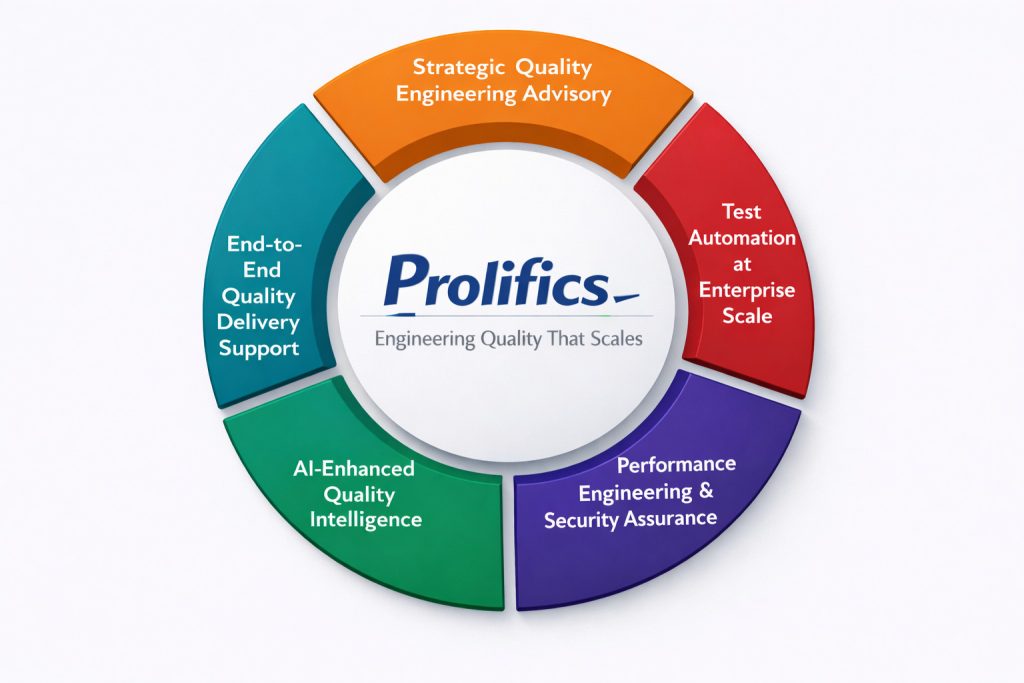
Here’s how Prolifics empowers enterprises to elevate quality:
1. Strategic Quality Engineering Advisory
Prolifics partners early with clients to co-define testing goals. This alignment, often part of a Digital Transformation QA Strategy, accelerates feedback loops from ideation to deployment.
Whether your goal is to modernize legacy systems or adopt DevOps, Prolifics ensures testing is aligned with outcomes.
2. Test Automation at Enterprise Scale
Prolifics builds AI-powered test automation frameworks tailored to your stack and ecosystem. From API and functional automation to performance and regression automation, the goal is to free your team from repetitive tasks and maximize consistency and coverage.
By integrating Continuous Testing in CI/CD Pipelines, Prolifics helps your organization release faster and safer, enabling continuous delivery without quality trade-offs.
3. Performance Engineering and Security Assurance
In a world of 24×7 uptime, enterprise software scalability testing is vital. Enterprise applications must perform reliably under heavy load and defend against complex security threats.
Prolifics brings in:
- Load and stress testing to validate performance at scale
- Security testing (including vulnerability assessments)
- Compliance validation for regulatory standards
These capabilities mitigate risk before it impacts customers or business operations.
4. AI-Enhanced Quality Intelligence
Prolifics leverages AI to drive intelligent testing decisions. By utilizing a risk-based testing strategy, high-risk areas can be identified early and tested thoroughly.
5. End-to-End Quality Delivery Support
From test strategy and planning to continuous execution and monitoring, Prolifics supports the full spectrum of quality engineering needs, including:
- Test management and governance
- Test data strategy
- Cross-platform compatibility testing
- Real-world user simulation
This end-to-end support model ensures that quality is not siloed, it’s embedded across teams and workflows.
Business Outcomes: Quality That Drives Growth
Investing in enterprise testing yields measurable results:
- Fewer production defects
- Lower cost of quality
- Faster time-to-market
- Higher user satisfaction
- Reduced business risk and downtime
But in the digital economy, quality does more than prevent failure, it enables innovation. With reliable systems, enterprises can confidently roll out new experiences, adopt emerging technologies, and respond at market pace.
Conclusion: Quality as a Competitive Advantage
Quality is no longer optional; it’s strategic. The best enterprises treat software testing as a value engine, ensuring enterprise software scalability testing and security while accelerating release cycles. Whether you’re starting your journey or scaling practices, Prolifics provides the enterprise quality engineering services needed to turn quality into a competitive advantage.
Ready to elevate your enterprise quality strategy? Let’s engineer excellence together.


