
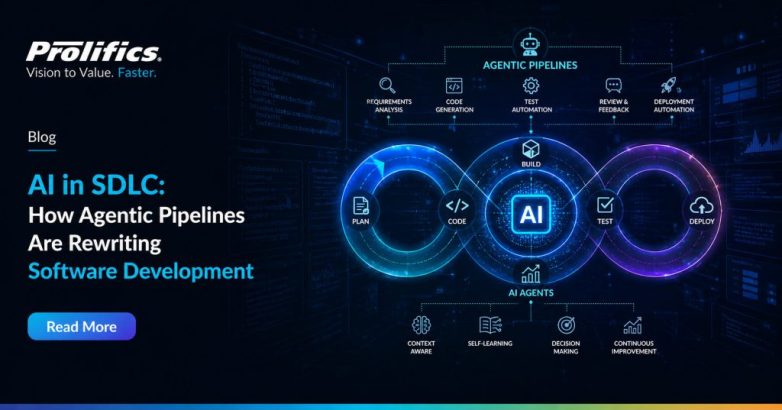
Agentic AI in software development is rapidly evolving from Waterfall to Agile and DevOps, improving speed and collaboration. However, many delivery processes still rely on manual workflows and human decision-making. Today, AI SDLC automation and agentic AI pipelines are transforming software development by automating requirements analysis, code generation, testing, and deployment decisions. This Agent-Driven SDLC enables faster delivery, improved quality, and more intelligent, adaptive software engineering workflows.
At Prolifics, we help enterprises modernize software delivery by combining AI-driven innovation with deep engineering expertise. Working across industries such as healthcare, financial services, retail, and manufacturing, we help organizations implement intelligent, scalable, and governed AI-first development practices. Our focus is not just on accelerating coding, but on building adaptive delivery systems where AI and human expertise work together to improve efficiency, reduce risk, and drive long-term business value.
What Are Agentic Pipelines?
An agentic pipeline is a coordinated network of AI agents that collaborate to execute software engineering tasks from end to end. Unlike traditional automation tools that follow rigid rules, agentic systems operate with context and reasoning. These systems are becoming a core part of modern AI SDLC automation strategies for enterprise engineering teams.
These agents can:
- Interpret business needs into actionable development requirements.
- Generate detailed technical specifications for faster project execution.
- Create scalable architecture recommendations aligned with business objectives.
- Write, optimize, and refactor code for improved performance.
- Generate and execute automated tests for quality assurance.
- Validate deployments to ensure stable and secure releases.
- Monitor production systems for performance, stability, and reliability.
- Trigger rollback or remediation actions during critical system failures.
The most important distinction is autonomy with oversight.
Agentic systems are not simply scripted bots. They analyze goals, break work into smaller tasks, evaluate outcomes, and adjust their behavior within defined governance boundaries. Instead of replacing developers, they reduce repetitive manual work and accelerate decision-making through autonomous coding agents and intelligent orchestration.
Organizations adopting AI-driven SDLC practices are already seeing measurable benefits:
- Accelerate software delivery with intelligent AI-driven development workflows.
- Increase test coverage through automated and continuous quality validation.
- Improve code consistency across teams, platforms, and development environments.
- Reduce deployment risk with predictive validation and monitoring systems.
- Minimize technical debt through continuous refactoring and alignment checks.
- Align business goals with accurate and scalable technical implementation.
Why Traditional SDLC Models Are Reaching Their Limits
Modern software systems are significantly more complex than those built even a decade ago. Applications span cloud platforms, APIs, microservices, data pipelines, AI services, mobile interfaces, and distributed infrastructure.
At the same time, stakeholder expectations continue to increase. Businesses expect faster releases, greater reliability, stronger security, and continuous innovation.
Traditional SDLC frameworks struggle under this pressure because they still rely heavily on sequential, human-driven workflows.
A common development cycle often looks like this:
- Business stakeholders define requirements.
- Product teams translate them into user stories.
- Developers interpret and implement the functionality.
- QA teams validate outputs.
- Operations teams manage deployment and monitoring.
Every stage introduces delays, interpretation gaps, and communication overhead.
This creates several common bottlenecks:
- Unclear requirements cause delays, confusion, and repeated development efforts.
- Manual code reviews slowing software delivery and engineering productivity.
- Incomplete test coverage increases risks of production defects and failures.
- Complex AI-powered CI/CD pipeline environments require constant maintenance and operational oversight.
- Slow incident diagnosis delaying issue resolution after production deployments.
- Architectural drift creating gaps between planned and delivered systems.
Many organizations try to solve these challenges by adding more people, but increasing headcounts often produces diminishing returns. The issue is structural, not simply operational.
Agentic pipelines address this by embedding intelligence directly into the delivery workflow.
From Sequential Development to Autonomous Flows
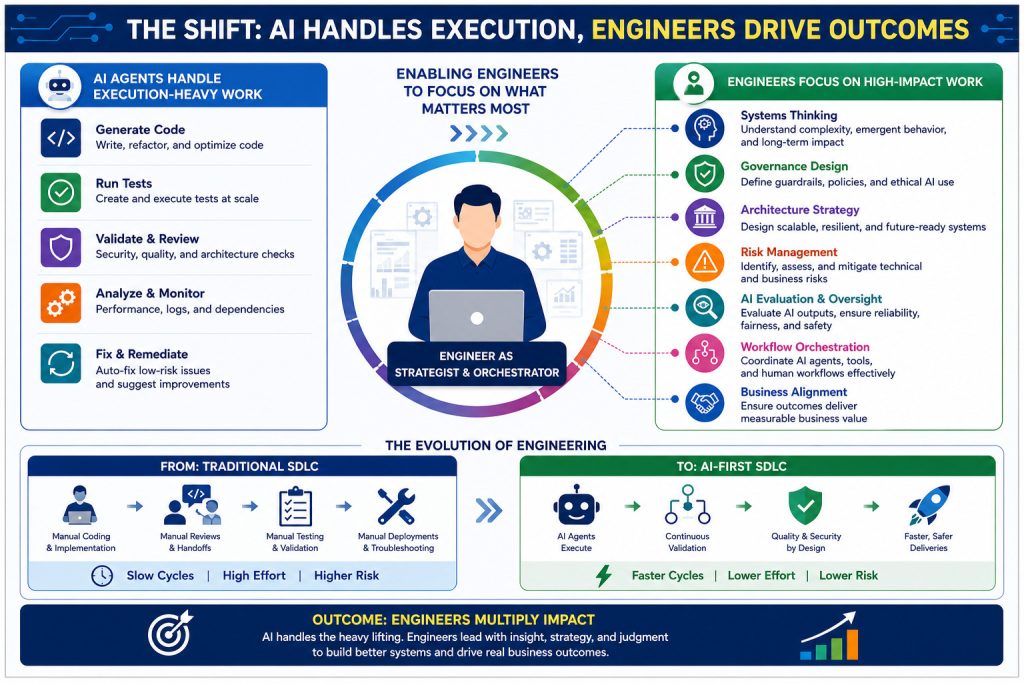
Traditional SDLC models move work from one stage to another in sequence. AI-first SDLC environments operate differently.
In an agentic pipeline, stages communicate continuously rather than waiting for manual transitions. AI agents share context across the lifecycle, allowing feedback and refinement to happen in real time.

For example:
- Requirements can automatically generate acceptance criteria.
- Architecture recommendations can adapt based on system constraints.
- Code generation agents can immediately trigger test generation agents.
- Deployment agents can evaluate production risk before release.
- Monitoring agents can identify anomalies and recommend remediation.
This creates a more adaptive and intelligent delivery system.
Instead of intelligence living solely within individuals, intelligence becomes embedded into the workflow itself.
The core principles of AI-first SDLC include:
- Enable continuous context sharing across every software development lifecycle stage.
- Improve efficiency through intelligent multi-agent collaboration and coordination.
- Support autonomous decision-making within secure governance and operational guardrails.
- Deliver real-time feedback loops for continuous improvement and optimization.
- Maintain human governance and validation for responsible AI-driven development.
Organizations looking to implement agentic AI in DevOps pipeline environments are increasingly adopting these intelligent workflow models to improve agility and resilience.
AI-Driven Requirement Analysis and Design
One of the most expensive problems in software delivery is misunderstanding requirements. Business intent is often translated through multiple layers before reaching engineering teams. By the time implementation begins, gaps and ambiguities may already exist.
AI agents help reduce this problem significantly. Using natural language processing and contextual reasoning, agents can analyze business requirements, user stories, process documentation, and domain knowledge to create structured technical specifications.
These systems can:
- Extract functional requirements from business and technical documentation automatically.
- Generate clear acceptance criteria for accurate feature validation processes.
- Identify missing dependencies before development and deployment activities begin.
- Detect conflicting requirements across systems, teams, and project workflows.
- Cross-reference existing architecture for compatibility and implementation alignment.
- Recommend scalable design patterns based on system and business needs.
This dramatically reduces the amount of rework discovered later in development.
AI agents are also becoming increasingly capable of synthesizing architecture recommendations. Based on an organization’s standards, existing platforms, and infrastructure constraints, agents can generate:
- System architecture suggestions
- Component diagrams
- API structures
- Data flow models
- UX flow recommendations
- Compliance-aware design considerations
Rather than replacing architects, these tools provide faster starting points and reduce repetitive design work.
Autonomous Code Generation and Refactoring
AI coding assistants have already become common in many engineering teams, but agentic SDLC takes this further through coordinated multi-agent workflows powered by autonomous coding agents.
In advanced delivery pipelines, specialized agents perform different responsibilities simultaneously.
For example:
- One AI agent generates code from approved technical specifications.
- Another agent reviews code quality and development best practices.
- Another agent validates security standards and compliance requirements automatically.
- Another agent checks alignment with approved system architecture guidelines.
- Another agent analyzes performance impact and optimization opportunities continuously.
This coordinated approach produces higher-quality outputs than standalone code completion tools.
Organizations implementing AI-driven coding workflows are reporting major productivity gains, particularly for well-defined engineering tasks such as:
- Microservice scaffolding
- API development
- Legacy modernization
- Automated refactoring
- Documentation generation
- Unit test creation
One particularly valuable capability is continuous design-code alignment.
In traditional environments, the implemented system often drifts away from the approved design over time. Agentic pipelines continuously validate the evolving codebase against architectural standards and intended system behavior.
When deviations appear, agents can:
- Flag inconsistencies across code, design, and requirements.
- Recommend corrections to improve accuracy and alignment.
- Suggest refactoring opportunities for cleaner, stronger code.
- Automatically remediate low-risk issues within approved guardrails.
This reduces technical debt accumulation and improves long-term maintainability.
AI-Driven Quality Engineering
Testing has historically been constrained by time, resources, and manual effort.
As release cycles accelerate, QA teams often struggle to maintain sufficient coverage. Agentic quality engineering changes this dynamic substantially.
AI agents can automatically:
- Generate regression tests to validate existing functionality.
- Create unit tests for individual code components.
- Build integration tests across connected systems.
- Identify edge-case scenarios before production release.
- Prioritize testing based on risk and impact.
- Validate acceptance criteria through automated workflows.
These agents use inputs such as:
- Analyze code diffs to identify changes and testing requirements.
- Learn from historical defect patterns to predict potential issues.
- Use specifications to validate expected functionality and system behavior.
- Monitor runtime behavior for stability, performance, and anomaly detection.
- Evaluate system dependencies to reduce integration and deployment risks.
This allows organizations to expand their test coverage while reducing manual effort.
AI systems can also identify high-risk code areas before defects surface in production. By analyzing commit history, complexity metrics, and historical incident data, agents can predict where failures are most likely to occur.
Another emerging capability is self-healing code.
In controlled environments, AI agents can identify runtime failures, generate patches, validate fixes, and apply remediation within predefined safety boundaries.
While fully autonomous production remediation still requires careful governance, these capabilities already provide significant value in development and staging environments.
Intelligent Release and Deployment Management
Deployment remains one of the highest-risk stages of software delivery. Traditional CI/CD pipelines automate execution steps but still depend heavily on human judgment for release decisions. An AI-powered CI/CD pipeline introduces intelligence into release management and operational decision-making.
AI agents evaluate deployment readiness using signals such as:
- Test results
- Security scans
- Infrastructure health
- Dependency stability
- Historical incidents
- System performance metrics
- Traffic patterns
Rather than producing a simple pass-or-fail outcome, agents generate contextual risk assessments and deployment recommendations. This allows teams to make release decisions with greater confidence.
Once deployments occur, monitoring agents continue evaluating production behavior in real time. If anomalies appear, the system can trigger alerts, recommend remediation, execute canary rollbacks, and automatically restore stable versions during critical failures.
This risk-aware automation improves reliability while reducing operational stress.
Measuring AI Developer Productivity ROI
As organizations invest more heavily in AI-driven engineering workflows, leadership teams are increasingly focused on measuring AI developer productivity ROI.
The value of AI SDLC automation extends beyond faster coding. Enterprises are evaluating outcomes such as:
- Reduced software delivery timelines
- Lower operational overhead
- Faster incident remediation
- Improved release quality
- Increased engineering throughput
- Reduced technical debt
- Higher developer satisfaction
By combining autonomous coding agents, AI-powered testing, and intelligent deployment automation, organizations can shift engineering teams away from repetitive work and toward innovation, architecture, and strategic problem-solving.
For many enterprises, AI developer productivity ROI is becoming a critical metric for scaling digital transformation initiatives while maintaining governance and operational efficiency.
The Human Role in an Agentic SDLC
A common misconception is that agentic AI in software development eliminates the need for engineers. In reality, the role of humans becomes even more strategic.
As AI agents handle repetitive and execution-heavy tasks, engineers increasingly focus on:
- Systems thinking
- Governance design
- Architecture strategy
- Risk management
- AI evaluation and oversight
- Workflow orchestration
- Business alignment
This changes what it means to be a software engineer. The most valuable skills in AI-first organizations are no longer limited to writing code manually. Instead, organizations need professionals who can guide intelligent systems effectively and evaluate their outputs critically.
New roles are already emerging, including:
- AI pipeline engineers build scalable, intelligent, end-to-end delivery flows.
- Agentic workflow architects design autonomous, goal-driven system orchestration.
- AI governance specialists ensuring compliance, security, transparency, and ethical AI.
- Autonomous systems reliability engineers maintain stability, resilience, and trust at scale.
The organizations succeeding in this transition are those that treat agentic AI as a transformation in delivery architecture, not simply as a productivity add-on.
Governance, Security, and Responsible AI Delivery
As AI agents gain more autonomy, governance becomes essential. Unlike traditional software systems, agentic systems behave probabilistically. Outputs may vary depending on context, prompts, and environmental factors.
This creates new governance requirements around:
- Ensure explainability for transparent and understandable AI-driven decisions.
- Maintain auditability across autonomous workflows and system activities.
- Implement access controls to protect sensitive enterprise environments securely.
- Strengthen risk management for responsible autonomous software delivery practices.
- Monitor compliance continuously across evolving AI-powered development systems.
- Detect operational drift impacting model accuracy and system reliability.
Enterprise-grade agentic SDLC environments require:
- Maintain tamper-evident audit trails across all AI-generated activities.
- Enforce role-based permissions for controlled access and accountability management.
- Establish human approval checkpoints before high-risk production deployments occur.
- Validate policies continuously across changing AI-driven engineering environments.
- Monitor AI-generated code for vulnerabilities, compliance, and security risks.
Organizations in highly regulated industries such as healthcare and financial services must especially ensure that autonomous pipelines operate within clearly defined governance boundaries.
Agentic SDLC Platform Comparison Considerations
As enterprises evaluate next-generation engineering tools, many are conducting an agentic SDLC platform comparison to determine which solutions best align with their governance, scalability, and automation requirements.
Key evaluation criteria often include:
- Multi-agent orchestration capabilities
- Integration with existing DevOps ecosystems
- AI-powered CI/CD pipeline compatibility
- Security and compliance controls
- Observability and auditability features
- Support for autonomous coding agents
- Scalability across hybrid and multi-cloud environments
- Human-in-the-loop governance capabilities
Organizations should also assess how well platforms support long-term adaptability, operational transparency, and AI governance maturity.
The Future of Software Development
Agentic SDLC is still evolving, but the direction is clear. Over the next several years, advances in long-context models, multi-agent coordination, and multimodal AI systems will continue expanding what autonomous pipelines can accomplish.
We are moving toward environments where:
- AI agents collaborate across the entire lifecycle.
- Pipelines continuously improve themselves.
- Delivery systems adapt dynamically to changing conditions.
- Human-AI co-design becomes the default engineering model.
Organizations that invest now in governance, infrastructure, and workforce readiness will gain significant advantages in software delivery speed, quality, and scalability.
Conclusion
The shift from human-driven SDLC to agent-driven software delivery is reshaping how enterprises design, build, test, and deploy applications. Agentic AI pipelines use intelligent automation, autonomous code generation, AI-driven testing, and adaptive AI-powered CI/CD pipeline workflows to accelerate delivery, improve code quality, and reduce deployment risk across enterprise environments.
At Prolifics, we help organizations modernize software delivery through AI-powered SDLC transformation, platform engineering, DevOps automation, and intelligent quality engineering solutions. With expertise across healthcare, financial services, retail, and manufacturing, we enable scalable, governed, and AI-first engineering practices that drive innovation, operational efficiency, and long-term business value.
Organizations looking to implement agentic AI in DevOps pipeline strategies can leverage Prolifics’ expertise to accelerate adoption, improve governance, and maximize AI developer productivity ROI across the software delivery lifecycle.


