

AI software factories for enterprise delivery combine 10x engineers, AI-driven development pipelines, and repeatable delivery frameworks to accelerate software outcomes. This model shifts enterprises from fragmented AI experimentation to scalable, production-ready delivery with measurable gains in speed, cost, and quality.
AI software factories for enterprise delivery are structured, AI-powered development models that combine highly skilled engineers with automated pipelines and reusable components. They enable faster software delivery, reduce costs by up to 40–60 percent, and improve quality by embedding AI across the full software lifecycle, from design to deployment.
What are AI software factories for enterprise delivery?
AI software factories for enterprise delivery are structured systems that combine people, processes, and AI tooling to deliver software at scale with repeatable outcomes. Instead of relying on individual teams and ad hoc workflows, enterprises use a factory model that standardizes development, embeds automation, and continuously improves delivery velocity.
AI software factories for enterprise delivery is a model where dedicated teams operate within an AI-enabled software development lifecycle, using shared tooling, automation, and reusable components to deliver consistent, high-quality outcomes at scale.
At the core of this model are three integrated layers:
- 10x engineers, who use AI tools across the entire development lifecycle
- AI-powered delivery pipelines, which automate design, coding, testing, and deployment
- Reusable frameworks and components, ensuring each project builds on previous success
This approach addresses a critical gap in enterprise AI adoption. According to the Prolifics Agentic Advantage white paper, many organisations are using AI tools in isolation without achieving measurable business outcomes.
Industry analysts reinforce this. Gartner reports that by 2026, over 75 percent of enterprises will adopt AI-augmented development tools, yet only a fraction will achieve scaled productivity gains due to a lack of structured implementation.
AI software factories solve this by moving from experimentation to industrialized delivery.
How Do 10x Engineers Enable AI Software Factories for Enterprise Delivery?
10x engineers enable AI-driven delivery by fundamentally changing how software is built, using AI as a collaborative partner at every stage rather than a standalone tool.
In the Prolifics model, 10x engineers:
- Decompose complex requirements rapidly using AI
- Generate production-quality code with AI assistance
- Automate testing and validation early in the lifecycle
- Continuously improve output through AI feedback loops
These outcomes align with broader industry findings. Forrester Research shows AI-assisted development can reduce coding time by up to 30 percent while improving defect detection rates.
The real advantage is not just speed. It is consistency. AI ensures repeatable execution, while engineers focus on architecture, decision-making, and business alignment.
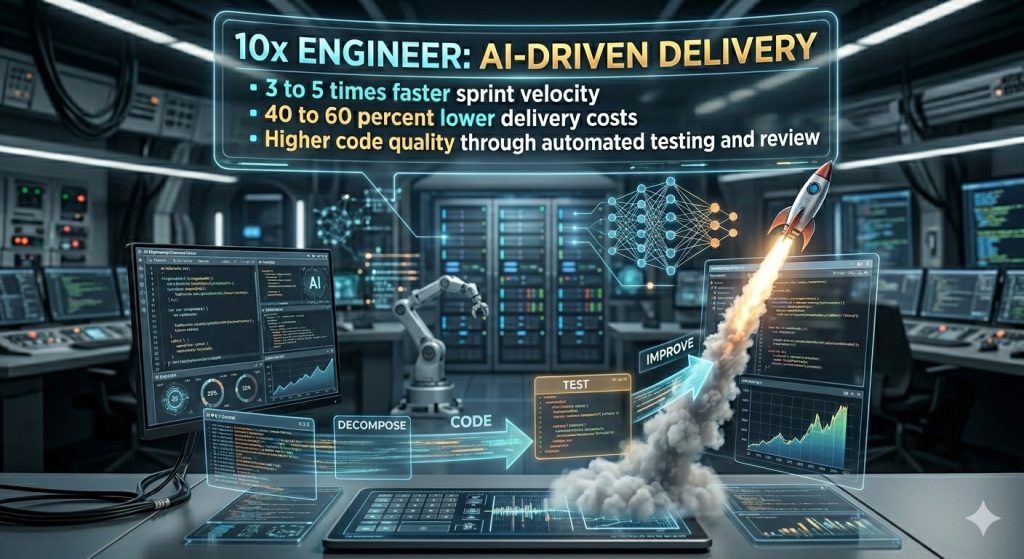
This creates a delivery model where both senior and junior engineers operate at higher productivity levels, making enterprise software development more scalable and predictable.
Why Are Enterprises Moving to AI Software Factories for Enterprise Delivery?
Enterprises are moving to AI software factories because traditional delivery models cannot keep pace with the complexity, cost pressures, and speed demands of modern digital transformation.
Legacy approaches rely on the following:
- Siloed teams
- Manual processes
- Long development cycles
- High dependency on individual expertise
These limitations lead to slow releases, high costs, and inconsistent outcomes.
AI software factories address these challenges by introducing the following:
- Standardised delivery frameworks that eliminate variability
- Automated pipelines that reduce manual effort
- Reusable assets that accelerate future projects
- Continuous improvement loops that increase velocity over time
According to IBM, organisations that adopt AI-driven automation in software delivery can reduce operational costs by up to 30 percent while accelerating time-to-market.
The Prolifics model extends this further by combining AI tooling with structured delivery teams and repeatable frameworks, ensuring that improvements compound across engagements rather than resetting with each project.

This shift is critical for industries like finance and healthcare, where regulatory pressure, system complexity, and customer expectations demand faster, more reliable software delivery.
What is the step-by-step process of an AI software factory?
AI software factories follow a structured, repeatable process that embeds AI into every stage of the software development lifecycle.
Step-by-step AI software factory workflow:
- Requirement decomposition
AI tools break down business requirements into structured specifications and identify dependencies early. - AI-assisted design
Architecture and system models are generated and validated using AI insights. - Automated code generation
AI generates production-ready code, reviewed and refined by engineers. - Continuous testing and validation
Automated test generation ensures coverage and early defect detection. - AI-powered review and security scanning
Code is analysed for vulnerabilities, performance issues, and compliance risks. - Automated deployment and documentation
Release processes, documentation, and reporting are generated automatically. - Feedback and optimisation loop
Performance data feeds back into the system, improving future delivery cycles.
This pipeline creates a repeatable, scalable delivery model where each iteration improves the next.
The Prolifics factory approach ensures that no project starts from scratch, enabling enterprises to build institutional knowledge into their delivery systems.
How do AI software factories compare to traditional development models?
| Aspect | Traditional Development | AI Software Factory |
| Delivery speed | Months per release | Weeks or faster |
| Cost efficiency | High labour costs | 40–60% lower costs |
| Code quality | Variable | Consistently higher |
| Scalability | Limited by team size | Scales with automation |
| Reusability | Low | High, reusable components |
| Risk | High due to manual processes | Lower with automation and validation |
| Time-to-market | Slow | Accelerated |
Traditional models depend heavily on manual execution and individual expertise, which creates bottlenecks and inconsistency.
AI software factories shift delivery to a system-driven model, where outcomes are predictable, repeatable, and continuously improving.
What business value do AI software factories deliver in real industries?
AI software factories deliver measurable business value by accelerating digital transformation, reducing costs, and improving operational efficiency across industries.
Real-world example: Healthcare
A nationwide healthcare distributor working with Prolifics used AI-driven approaches to predict demand and optimise inventory. By embedding AI into their systems:
- Inventory carry costs were reduced
- Demand forecasting improved accuracy
- Cash flow increased through reduced overstock
This reflects a broader trend. McKinsey estimates that AI-driven automation in operations can deliver up to $1 trillion annually in value across industries.
Key enterprise benefits:
- Faster system modernisation
- Reduced technical debt
- Improved customer experience
- Scalable digital platforms
- Better decision-making through data and AI
In finance and insurance, this translates to faster claims processing and fraud detection. In retail, it enables real-time inventory optimisation and personalised customer experiences.
AI software factories make these outcomes achievable at scale by turning AI from a tool into an integrated delivery system.
Which components make up a successful AI software factory?
A successful AI software factory consists of two core components: a structured delivery team and an AI-powered development toolkit.
1. Factory team
A cross-functional team organized around a defined software development lifecycle, including:
- Product owners
- Architects and tech leads
- Developers and QA specialists
This team operates within a repeatable framework rather than a project-specific setup.
2. AI SDLC toolkit
A shared set of AI-driven tools and pipelines that support:
- Code generation
- Test automation
- Security scanning
- Deployment automation
- Documentation
These components ensure that every project benefits from accumulated knowledge and tooling improvements.
The Prolifics model also includes specialised factory types:
- Build factories for new applications
- Modernisation factories for legacy systems
- Migration factories for platform transitions
This layered approach allows enterprises to apply the same core model across different use cases, increasing efficiency and consistency.
Conclusion
AI software factories for enterprise delivery represent a shift from fragmented development to structured, scalable systems that deliver measurable business outcomes. By combining 10x engineers, AI-powered pipelines, and reusable frameworks, enterprises achieve faster delivery, lower costs, and higher quality.
This model is not theoretical. It is already being applied to modernise systems, improve operational efficiency, and drive real business value across industries.
Prolifics is helping organisations implement AI software factories to accelerate digital transformation and turn AI potential into measurable results.
FAQ
What is an AI software factory in simple terms?
An AI software factory is a structured development model that uses AI tools, automation, and repeatable processes to deliver software faster and more efficiently. It replaces manual workflows with AI-driven pipelines, improving speed, cost, and quality across the entire software lifecycle.
How do AI software factories reduce costs in enterprise IT?
AI software factories reduce costs by automating repetitive tasks, improving developer productivity, and reducing rework through early testing and validation. This can lower delivery costs by 40–60 percent while maintaining or improving output quality.
Are AI software factories suitable for legacy system modernisation?
Yes. AI software factories are particularly effective for legacy modernisation because they use automation and reusable frameworks to transform systems incrementally, reducing risk and accelerating time-to-value compared to traditional large-scale rewrites.
What industries benefit most from AI software factories?
Industries with complex systems and high operational demands benefit most, including healthcare, finance, retail, insurance, and the public sector. These sectors require faster delivery, better compliance, and scalable digital platforms.
How do AI software factories improve software quality?
AI software factories improve quality through automated testing, AI-driven code review, and continuous validation. These processes identify defects earlier, increase test coverage, and ensure consistent adherence to standards.


