

Why Business Intelligence Analytics Matters for Modern Enterprises
In a digital economy driven by data, organizations must convert raw information into meaningful insights that support strategic decisions. Business intelligence analytics enables companies to analyze operational data, understand patterns, and drive measurable outcomes across departments. However, traditional analytics models struggle to keep pace with the scale and speed of modern enterprise data.
Today, organizations require AI-driven business intelligence that combines automation, machine learning, and real-time analytics. This approach transforms enterprise data into actionable intelligence that leaders can trust.
Prolifics help organizations modernize their analytics ecosystem by implementing scalable enterprise BI analytics, integrating advanced business intelligence tools, and enabling AI powered insights across complex enterprise environments.
Business Intelligence and Analytics in the Age of AI
Organizations today operate in a data rich environment where insight speed directly impacts competitiveness. Traditional analytics systems were built for static reporting and periodic analysis. In contrast, modern organizations require data analytics for business that support predictive insights, automation, and intelligent decision making.
Artificial intelligence is redefining business intelligence analytics by enabling faster analysis, deeper pattern recognition, and automated insight generation.
- AI accelerates enterprise data analysis with automated intelligence.
- Machine learning enhances predictive insights from complex datasets.
- Real-time analytics improves operational responsiveness across business units.
- Natural language interfaces simplify enterprise data exploration.
Why Traditional BI Is No Longer Enough
Legacy BI systems were designed primarily for reporting historical data. These platforms rely on manual data preparation, static dashboards, and complex query processes. As enterprise data grow exponentially, traditional systems create delays in insight generation.
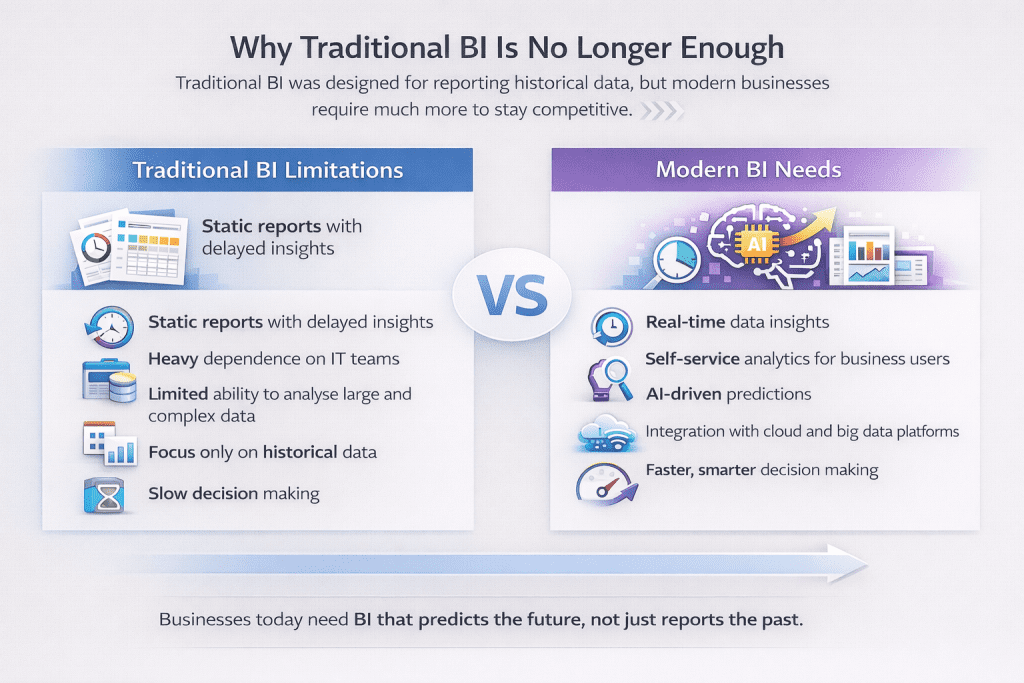
Business leaders now require instant access to reliable data. Without modernization, legacy BI environments often create data silos, slow reporting cycles, and limited analytical capabilities.
Organizations are therefore transitioning toward AI driven business intelligence platforms that support real-time analytics and automated insight generation.
The Evolution of BI From Reporting to Predictive Insights
The modern business environment requires faster decision cycles and deeper data intelligence. Traditional BI platforms focused mainly on descriptive reporting, which explained what happened in the past. However, modern analytics solutions must also predict future outcomes and recommend actions.
The shift toward enterprise BI analytics enables organizations to combine machine learning models, predictive analytics, and automated data pipelines. These capabilities transform BI from a reporting function into a strategic intelligence platform.
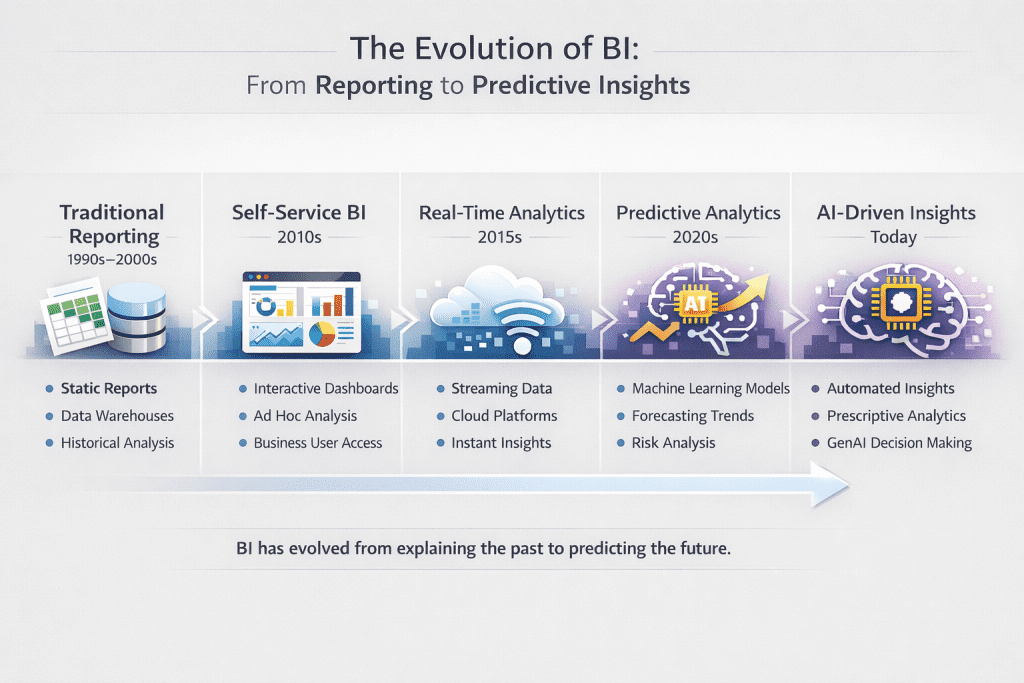
Companies that adopt modern BI architectures gain the ability to detect trends early, forecast operational outcomes, and optimize business strategies with greater accuracy.
- BI platforms now support predictive and prescriptive analytics.
- AI models uncover hidden patterns across enterprise datasets.
- Modern BI integrates machine learning with analytics workflows.
- Predictive insights help businesses anticipate risks and opportunities.
- Data driven strategies improve long-term organizational performance.
From Dashboards to Data Intelligence
Traditional BI environments focused heavily on dashboards and visual reports. While dashboards remain valuable, they represent only a small part of modern analytics capabilities. Today, organizations require systems that automatically analyze data, detect anomalies, and generate insights.
This transformation moves BI from static visualization to intelligent analytics powered by artificial intelligence and machine learning.
Modern AI business intelligence platforms combine automation, advanced analytics, and natural language interfaces to simplify enterprise data exploration.
- Intelligent analytics platforms move beyond static dashboard reporting.
- Automated insights highlight trends without manual analyst intervention.
- AI models continuously analyze enterprise operational data streams.
- Natural language queries simplify access to complex data.
- Intelligent systems generate contextual insights for business leaders.
How AI Is Transforming Business Intelligence
Artificial intelligence introduces a new level of intelligence into enterprise analytics. Instead of relying on manual queries and static reports, AI powered systems automatically analyze data, identify trends, and generate insights.
This shift significantly improves the efficiency and accuracy of enterprise analytics. Organizations can detect operational issues earlier, forecast business performance, and make more informed strategic decisions.
AI powered business intelligence tools now support automated insights, anomaly detection, and conversational analytics.
- AI accelerates enterprise data processing and pattern recognition.
- Machine learning models improve predictive analytics accuracy significantly.
- Natural Language Query for Data enables conversational analytics.
- AI reduces manual reporting and data preparation workloads.
Turning Enterprise Data Into Real Business Intelligence
Enterprise organizations generate massive volumes of operational data across systems, applications, and cloud environments. However, data alone does not create value. The real advantage comes from transforming data into actionable insights.
Modern enterprise BI analytics platforms integrate data from multiple sources, apply advanced analytics, and generate real time intelligence that supports strategic decision making.
Organizations can then align data insights with business goals and operational priorities.
- Integrated analytics platforms unify enterprise data sources.
- AI generates actionable insights from complex datasets.
- Data intelligence improves enterprise strategic decision making.
How Modern BI Platforms Are Redefining Data Analytics
Modern analytics platforms combine data engineering, artificial intelligence, and advanced visualization to create scalable intelligence systems. These platforms integrate structured and unstructured data while supporting automated insights and predictive analytics.
Solutions such as AI/BI Genie Integration and conversational analytics platforms allow users to interact with enterprise data using natural language queries. This capability democratizes analytics across the organization and reduces dependency on specialized data teams.
Organizations adopting modern business intelligence analytics platforms can reduce reporting delays, increase operational visibility, and improve decision accuracy.
Why AI Driven Analytics Defines the Future of BI
The next generation of Business Intelligence is being driven by Artificial Intelligence and advanced analytics. These technologies enable organisations to move from static reporting to intelligent, self-learning decision systems.
- AI driven business intelligence will automate enterprise data insights.
- Generative AI will reduce manual reporting and analysis workloads.
- Natural language analytics will democratize enterprise data access.
- Intelligent analytics platforms will continuously learn from enterprise data.
- AI powered BI ecosystems will enable autonomous business decisions.
Prolifics is helping organisations move into the next era of Business Intelligence by bringing together AI, advanced analytics, and modern data platforms. With strong expertise in data engineering and enterprise analytics, we help businesses turn their data into smarter insights and more confident decisions.
Conclusion
The future of business intelligence analytics lies in the integration of artificial intelligence, advanced analytics, and scalable enterprise data platforms. Organizations that modernize their BI infrastructure gain the ability to transform raw data into strategic intelligence.
By adopting AI driven business intelligence, companies can reduce operational inefficiencies, accelerate insight generation, and improve decision accuracy across the enterprise.
Prolifics helps organizations modernize their analytics architecture through advanced AI business intelligence platforms, scalable business intelligence tools, and integrated enterprise BI analytics solutions.


