

Databricks has announced the General Availability of Databricks Lakebase GA, a modern operational database architecture built to support intelligent applications, real time analytics, and AI driven workloads. Designed as a serverless Postgres service, Lakebase removes traditional infrastructure constraints while integrating natively with the Databricks Data Intelligence Platform. This launch positions Serverless Postgres for AI workloads at the center of enterprise innovation, reinforcing the impact of Databricks Lakebase GA for modern enterprises.
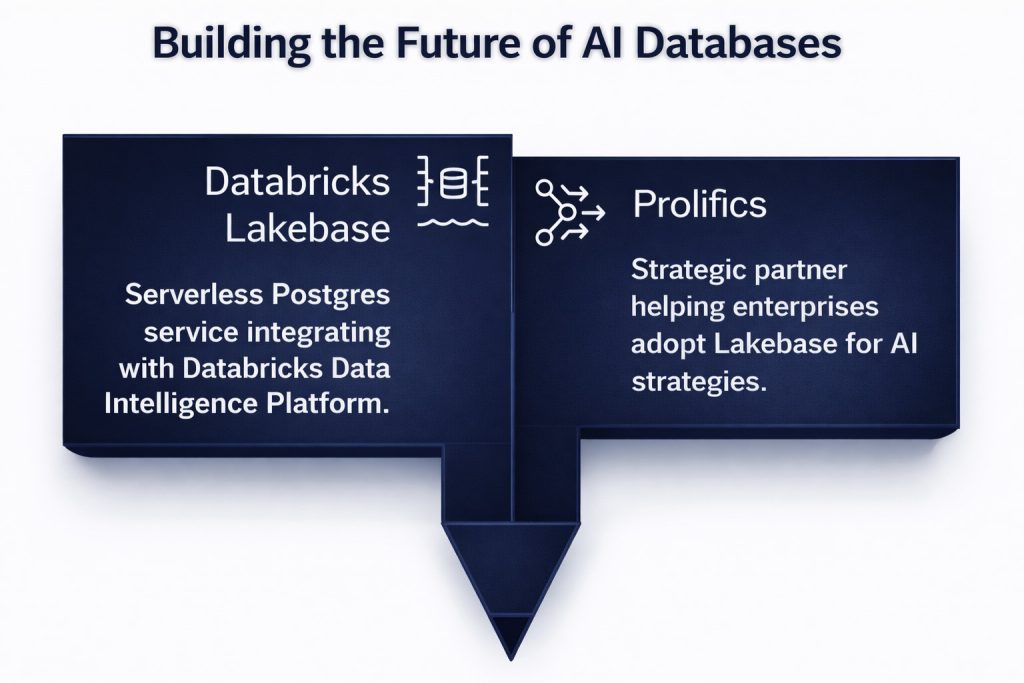
Prolifics, a strategic Databricks partner, helps enterprises adopt Databricks Lakebase GA through a clear modernization roadmap aligned to business goals. With expertise in data engineering, AI enablement, and cloud architecture, we maximize performance, governance, and scalability, while guiding clients in evaluating Databricks Lakebase vs Snowflake Unistore to support long-term AI strategies.
Addressing the Limitations of Traditional Databases
Most traditional operational databases tightly couple compute and storage, a design that has remained standard for decades. While familiar, this model creates limitations that impact scalability, performance, and long-term cost efficiency. As organizations scale digital initiatives, these architectural constraints become more visible and harder to manage, especially when pursuing OLTP and OLAP unification.
- Infrastructure complexity often delays digital transformation progress.
- Shared resources frequently limit scalability and slow performance.
- Legacy systems increase operational costs over time.
- Data silos make unified analytics and AI harder, preventing true OLTP and OLAP unification.
- Manual management reduces team productivity and agility.
This architectural innovation removes the longstanding divide between transactional systems and analytics platforms. As a result, enterprises can reduce data silos, simplify governance, and accelerate development cycles with Databricks Lakebase GA.
Serverless Managed Postgres Built for Modern Workloads
Databricks Lakebase provides a fully managed, serverless Postgres environment optimized for production workloads. It supports automatic scaling based on demand and scales to zero when idle, helping organizations optimize cost without sacrificing performance. This makes it a powerful serverless operational database for AI agents memory and other real-time intelligent applications, further strengthening Serverless Postgres for AI use cases.
The following capabilities strengthen Lakebase for enterprise operational workloads:
- Serverless auto scaling handles fluctuating applications and query workloads.
- Scale to zero functionality minimizes idle infrastructure resource costs.
- Instant database branching enables safe development and testing environments, powered by database branching innovation.
- Zero copy cloning supports rapid environment provisioning without duplication.
- Point in time recovery restores database states quickly through built in Point-in-Time Recovery (PITR).
- Support for Postgres 17 with Postgres 16 compatibility, enabling seamless PostgreSQL 17 Databricks integration.
- Unity Catalog integration enables centralized governance and access control through Unity Catalog operational data governance.
- Sync tables maintain consistency between operational data and lakehouse.
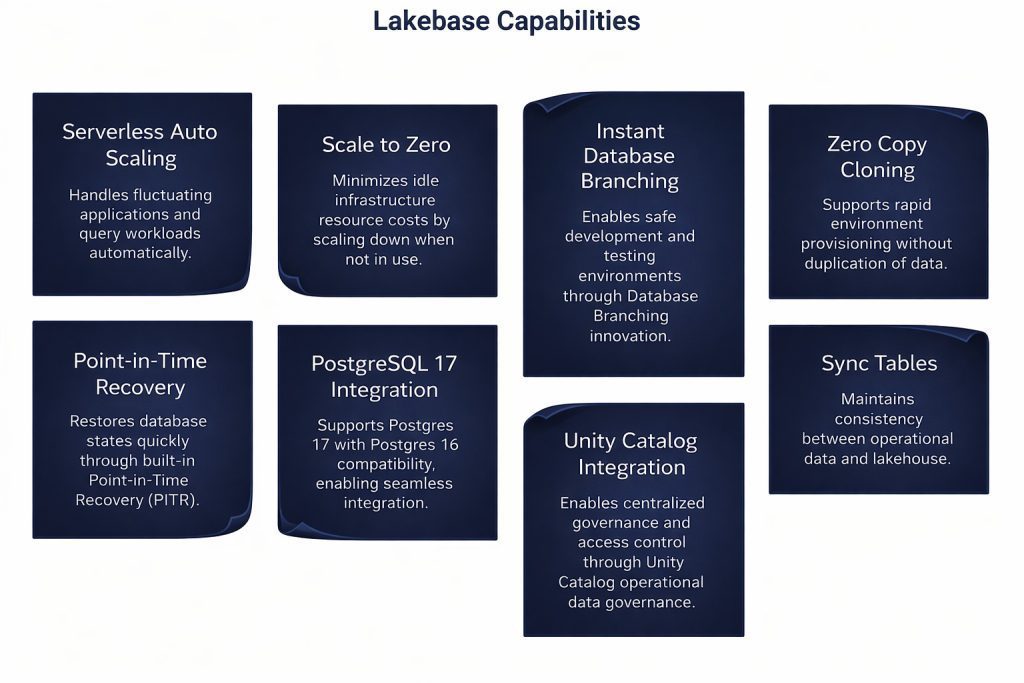
These features make Databricks Lakebase GA suitable for mission critical applications, including real time feature serving, AI agent memory storage, and embedded analytics powered by Serverless Postgres for AI capabilities.
Databricks Lakebase vs Traditional Operational Databases
Databricks Lakebase GA separates compute and storage within a serverless Postgres architecture, enabling automatic scaling, unified governance, and seamless integration with analytics and AI workloads.
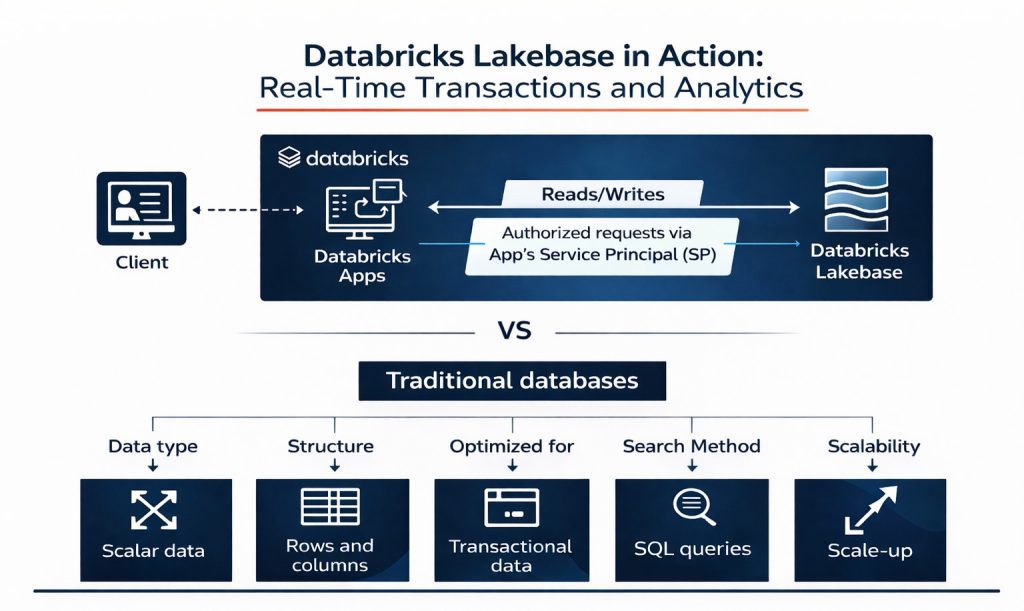
Traditional operational databases tightly couple compute and storage, require manual infrastructure management, and often create data silos that limit scalability, performance, and real time innovation.
Below are the key differences between Traditional Operational Databases and Databricks Lakebase GA:
| Traditional Operational Databases | Databricks Lakebase |
| Compute and storage are tied together, which limits flexibility. | Compute and storage are separated for better flexibility. |
| Scaling requires manual planning and infrastructure changes. | Automatically scales based on real time demand. |
| Performance slows when multiple workloads compete for resources. | Workloads run independently with better performance stability. |
| Teams spend time managing servers and infrastructure. | Fully managed service reduces operational overhead. |
| Data must be copied into separate systems for analytics. | Directly connected to the Databricks lakehouse. |
| Security and governance are handled across multiple tools. | Unified governance through a single framework. |
| Backup and recovery processes require manual effort. | Built in recovery features protect against data loss. |
| Limited support for AI focused workloads. | Designed to support AI, analytics, and modern applications. |
Enabling Intelligent Applications and AI Agents
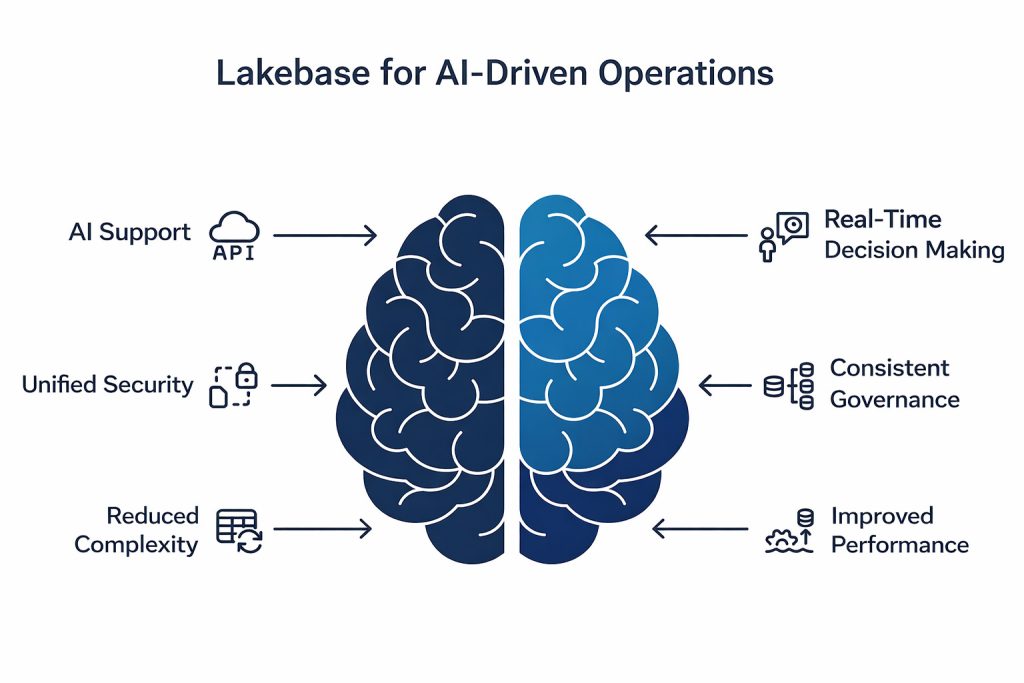
Modern enterprises need operational databases that support AI, machine learning, and real time decision making without adding unnecessary complexity. Databricks Lakebase GA enables applications and AI agents to work directly on trusted, governed data within the Databricks ecosystem, helping teams move from experimentation to production with confidence.
At Prolifics, we work closely with organizations to design practical, scalable data architectures that turn AI strategies into real business outcomes. Our team also advises on how to migrate Postgres to Databricks Lakebase with minimal disruption and clear ROI alignment. We also help clients evaluate Databricks Lakebase vs Snowflake Unistore to determine the best architectural path.
Because Lakebase runs natively on the Databricks platform, organizations benefit from:
- Unified security and access control across enterprise environments.
- Consistent governance across operational and analytical data assets through Unity Catalog operational data governance.
- Reduced need for data replication or complex ETL pipelines.
- Improved performance for low latency, real time workloads.
This unified architecture allows AI models, transactional systems, and analytics workloads to operate from a single source of truth, enabling effective OLTP and OLAP unification.
Enterprise Performance Without Complexity
Many enterprises still rely on legacy database systems that are costly to maintain and difficult to scale. Databricks Lakebase GA provides a streamlined modernization path by offering enterprise grade reliability, automated backups, and enhanced storage capacity.
- Supports up to 8TB storage per instance for scalability.
- Enables advanced Postgres extensions including pgvector for AI.
- Handles demanding, high volume production workloads efficiently.
- Optimized for secure, enterprise grade performance environments.
Organizations evaluating Databricks Lakebase storage limits and pricing 2026 can consider this scalability model when planning long term AI and modernization strategies.
These capabilities make Lakebase a strong foundation for organizations transitioning from legacy SQL Server or monolithic database environments to a modern, scalable platform. General Availability on AWS and beta availability on Azure further demonstrates Databricks’ commitment to delivering enterprise ready capabilities across multi cloud environments.
The Next Evolution of Operational Databases
Databricks Lakebase GA changes the way enterprises think about operational databases. By separating compute from storage and integrating directly with the lakehouse, it brings applications, analytics, and AI together on one connected platform.
Organizations that adopt this architecture can simplify infrastructure, speed up development cycles, and build intelligent applications with greater confidence. When data is unified and governed consistently, innovation becomes faster and more practical.
With the right implementation partner, this shift becomes more than a technical upgrade. It becomes a clear step toward long term digital transformation and measurable business impact.
At Prolifics, we help enterprises turn that vision into reality. From strategy to deployment, we guide organizations in using Databricks Lakebase GA, evaluating Databricks Lakebase vs Snowflake Unistore, and implementing Serverless Postgres for AI to modernize operations and scale AI initiatives.
Conclusion
Databricks Lakebase GA represents a meaningful step forward in operational database architecture, combining serverless Postgres, unified governance, seamless lakehouse integration, and strong support for PostgreSQL 17 Databricks integration within a single platform.
By separating processing resources from storage and aligning operational and analytical workloads, Databricks Lakebase GA enables enterprises to reduce infrastructure complexity, improve scalability, and support AI driven innovation with confidence through Serverless Postgres for AI capabilities.
Modernizing legacy systems or scaling AI requires more than technology, it demands the right execution partner. Prolifics combines strategic insight and technical expertise to implement Databricks Lakebase GA effectively and deliver measurable business value.


