

Many organizations continue using legacy systems because they still “work.” They run core operations, support familiar workflows, and hold years of business-critical data. On the surface, keeping them may seem safer and cheaper than replacing them.
At Prolifics, we work with enterprises that face this challenge every day. As a digital engineering and consulting partner, Prolifics helps businesses modernize outdated systems, reduce technical debt, improve data quality, strengthen security, and create technology foundations that support long-term growth.
The hidden cost of legacy systems grows over time. What begins as routine maintenance can quickly become higher expenses, security risks, poor data quality, and slower innovation.
For business leaders, the question is no longer only “Why do companies still use legacy systems?” The more urgent question is “What is the business losing by keeping them?”
What Makes a System Legacy?
A legacy system is outdated by software, infrastructure, or technology that a business still relies on, even when newer, more secure, and more scalable options are available. It may be custom-built, difficult to integrate, dependent on aging hardware, or supported by a shrinking pool of specialists.
Legacy systems are not always old in age alone. A platform becomes a liability when it limits business performance, creates operational friction, or prevents the company from adapting to new demands.
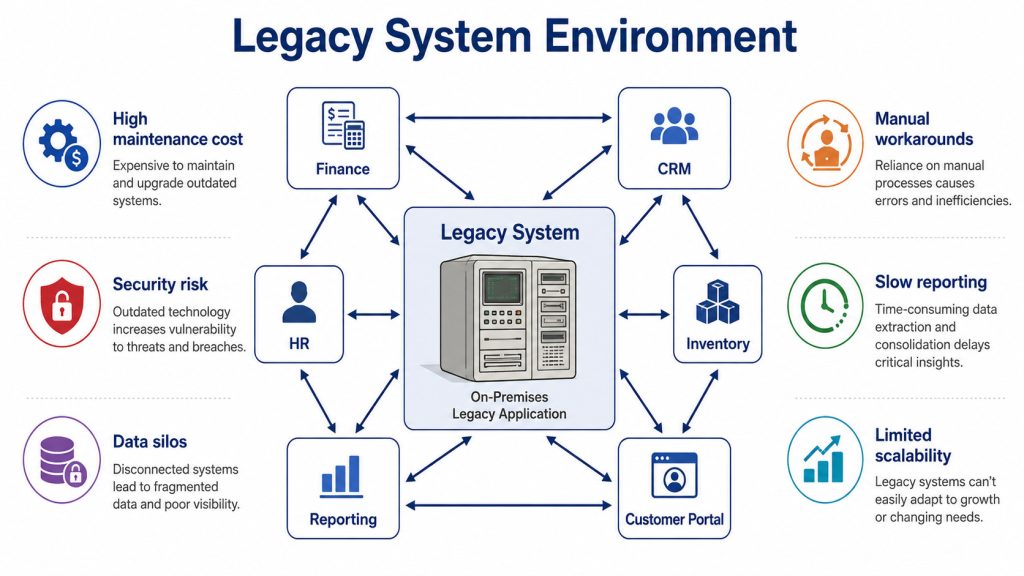
Common signs include:
- Reporting cycles become slower, delaying insights and important business decisions.
- Teams rely on frequent manual workarounds to complete routine processes.
- Limited system integrations make data sharing difficult across business platforms.
- Maintenance expenses continue rising as outdated systems need specialized support.
- Security and compliance gaps increase business risk and audit challenges.
These issues may seem manageable in isolation, but together they create a compounding business problem.
The Hidden Cost of Legacy Systems
The hidden cost of legacy systems is rarely found in one budget line. It spreads across IT, operations, security, finance, customer experience, and decision-making.
A company may pay for maintenance contracts, specialist support, custom patches, outdated infrastructure, and emergency fixes. At the same time, teams lose hours reconciling data, correcting errors, and working around system limitations.
This is where legacy system maintenance cost statistics become important. Direct costs are only part of the picture. The larger financial impact often comes from productivity loss, delayed projects, operational downtime, and missed opportunities.
When systems cannot scale or integrate properly, employees spend more time managing technology than using it to create value. Over time, that slows the entire organization.
Technical Debt and Its Financial Impact
Technical debt builds when organizations delay modernization, patch old systems repeatedly, or keep outdated architecture in place to avoid short-term disruption. While that may solve immediate problems, it often creates larger costs later.
The technical debt financial impact enterprise leaders face can include higher development costs, longer delivery timelines, and reduced innovation capacity. Teams may need extra time to build around outdated platforms. New digital services may take longer to launch. Data initiatives may stall because the underlying systems cannot support modern analytics.
The financial impact becomes especially clear when the business wants to adopt cloud, automation, AI, or advanced analytics. These capabilities depend on clean data, connected systems, and scalable infrastructure. Legacy platforms often make that foundation harder to build.
Data Quality Problems Create Business Risk
Modern businesses rely on accurate and timely data. Strategy notes that 74% of organizations rank data quality as a critical or high priority. The same source explains that reliable data supports smarter decisions across forecasting, performance, and customer experience.
Legacy systems often weaken that foundation. Data may sit in disconnected platforms, appear in inconsistent formats, or require manual extraction. This creates silos that make it harder for leaders to see the full picture.
When data is incomplete or outdated, decisions become less reliable. Forecasts may be inaccurate. Customer insights may be fragmented. Compliance reporting may require extra effort. In fast-moving markets, poor data quality can quickly become a competitive disadvantage.
Security Vulnerabilities Increase Costs
The legacy system risk security vulnerability cost can be significant. Older systems may not support modern security protocols, automated monitoring, or regular vendor updates. They may also be harder to patch without disrupting operations.
This creates risks in several areas. Cybersecurity teams may need extra tools or manual processes to monitor old environments. Compliance teams may struggle to meet evolving regulatory expectations. Business leaders may face higher exposure to downtime, data loss, or reputational harm.
Security is not only an IT concern. It is a business continuity issue. If an outdated system supports critical operations, every vulnerability can carry financial, operational, and customer impact.
Why Do Companies Still Use Legacy Systems?
There are practical reasons why companies continue using legacy systems. Many are deeply embedded in daily operations. Some contain years of customized business logic. Others support critical workflows that employees understand well.

Common reasons include:
- System replacement feels too disruptive for daily business operations.
- Migration appears too expensive compared to short-term maintenance.
- Internal expertise is limited for complex modernization projects.
- Business users resist change due to familiar workflows.
- Data migration seems complex, risky, and time-consuming.
These concerns are valid. Modernization does require planning, investment, and change management. However, avoiding change does not remove cost. It often shifts the cost into maintenance, risk, inefficiency, and missed growth opportunities.
The Cost of Not Modernizing Legacy IT Infrastructure
The cost of not modernizing legacy IT infrastructure goes beyond IT budgets. It affects business speed, data visibility, security, customer experience, and long-term growth.
When outdated platforms remain in place, teams often face slower reporting, manual workarounds, limited integrations, and delayed access to insights. These issues make it harder to improve operations, launch new services, or adopt modern technologies such as automation, cloud, and AI.
Key business impacts include:
- Slower reporting delays timely insights and better business decisions.
- Manual tasks reduce team productivity and increase operational inefficiency.
- Poor integration limits data visibility across critical business platforms.
- Security gaps increase business risk and create compliance challenges.
- Outdated systems slow AI adoption and limit automation opportunities.
Modernization helps organizations move toward a more scalable, secure, and future-ready technology foundation. It is not only about replacing old software, but about helping the business operate, compete, and grow more effectively.
When Should a Business Replace Legacy Software?
When should a business replace legacy software? The answer becomes clear when the cost, risk, and limitations of keeping it outweigh the value it provides. This does not always mean a full replacement must happen immediately. In many cases, a phased modernization approach is more practical.
Key warning signs include:
- Maintenance costs keep rising without improving legacy system performance.
- Frequent downtime affects daily business operations and customer service.
- Security updates are limited, increasing security vulnerability cost.
- Integrations become difficult, costly, and harder to maintain.
- Reporting requires manual effort and delays business insights.
- User productivity declines due to slow, outdated legacy software workflows.
- Vendor support is ending, increasing operational and compliance risks.
If several of these issues are present, leadership should assess whether the current system can support future business needs. The goal is not modernization for its own sake. The goal is to reduce risk, improve agility, and create a stronger technology foundation.
A Practical Approach to Modernization
Successful modernization starts with assessment. Businesses should identify which systems create the most risk, which processes depend on them, and which outcomes modernization should support.
A practical roadmap may include:
- Audit current system dependencies to identify business-critical technology risks.
- Prioritize high-risk applications based on cost, security, and performance.
- Clean and map business data before migration planning begins.
- Plan phased migration stages to reduce disruption and downtime.
- Strengthen governance and security across modernized technology environments.
- Train users before rolling out to improve adoption and confidence.
This approach helps reduce disruption while creating measurable progress. It also allows the business to modernize clear priorities, such as cost reduction, better analytics, stronger security, improved customer experience, or AI readiness.
Conclusion
Legacy systems may feel stable, but stability can be misleading. Behind familiar interfaces, they often carry growing maintenance costs, security vulnerabilities, technical debt, poor data quality, and operational inefficiency.
The hidden cost of legacy systems is not just what the business spends to keep them running. It is also what the business loses by moving slowly, relying on fragmented data, and delaying innovation.
Companies do not need to replace every legacy system at once. They do need a clear modernization strategy. By understanding the true cost of outdated technology, leaders can make better decisions, reduce risk, and build a stronger foundation for future growth.
FAQs
What are the hidden costs of legacy systems?
Legacy systems carry costs far beyond routine maintenance including security vulnerabilities, lost productivity, compliance penalties, integration failures, and missed revenue opportunities that rarely appear on standard IT budgets. Prolifics helps enterprises uncover and eliminate these hidden drains.
How much does legacy system maintenance cost enterprises annually?
Enterprises spend up to 70–80% of their IT budget maintaining legacy systems, with global technical debt exceeding $1.52 trillion. Prolifics works with organizations to redirect that spend toward modern, scalable infrastructure.
Why do companies still use legacy systems despite the rising risks?
Companies delay modernization due to high upfront migration costs, fear of operational disruption, lack of internal expertise, and uncertainty around ROI even when the cost of inaction is significantly higher. Prolifics bridges that gap with structured modernization roadmaps.
When should a business replace legacy software?
A business should replace legacy software when maintenance consumes over 60% of the IT budget, when security vulnerabilities go unpatched, when system integrations repeatedly fail, or when the platform can no longer support business growth. Prolifics helps you assess readiness and act decisively.


