

Downtime is not just an operational inconvenience. It is a direct hit to productivity, customer experience, revenue, and trust.
And what makes downtime even more frustrating is this: much of it is preventable.
Most organizations already have the signals they need: sensor data, system logs, performance metrics, incident history, maintenance records, service desk tickets. The problem is not a lack of data. The problem is that operations teams are often stuck reacting to issues after they have already escalated into outages.
That is where AI-led operations change the game.
At Prolifics, we see AI-led operations as the shift from reactive firefighting to proactive reliability. It is not “AI for the sake of AI.” It is AI that helps teams predict issues earlier, reduce downtime with AI, improve reliability, and operate with more confidence and speed.
What AI-led Operations Really Means
AI-led operations is the practical use of AI, machine learning, and automation to improve operational performance across systems, infrastructure, applications, and industrial environments through AI-driven operations management.
In simple terms, it means:
- detecting early warning signs before failure happens
- connecting signals across tools and systems to see the full picture
- identifying root cause faster
- automating repeatable response actions
- continuously learning to improve reliability over time
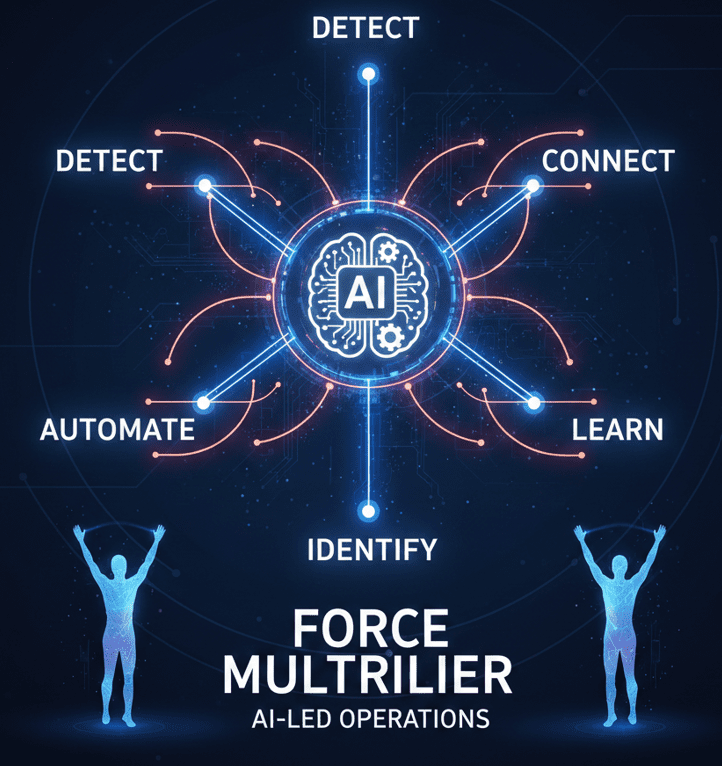
AI-led operations is not a replacement for operations teams. It is a force multiplier. It gives teams better visibility, better prioritization, and faster paths to resolution across modern AI for IT operations environments.
Why Downtime Still Happens (Even with Monitoring in Place)
Many organizations already have monitoring tools, alerts, dashboards, and ticketing systems. Yet downtime persists.
That is because traditional operations often suffer from three common challenges:
1) Too many alerts, not enough insight
Operations teams are flooded with alarms, but those alarms do not always answer the real question:
What matters most right now, and what should we do about it?
Alert fatigue is real. And when everything looks urgent, teams end up spending time chasing symptoms instead of preventing incidents, which directly impacts AIOps reliability.
2) Siloed data across IT and operations
For many enterprises, critical operational data is scattered across systems. OT data lives in one world. IT data lives in another. Application performance data lives somewhere else entirely.
When a disruption occurs, teams often spend more time hunting for information than solving the issue.
3) Manual triage slows down response
Even when teams detect issues quickly, triage can be painfully slow. It relies on tribal knowledge, manual correlation, and repetitive runbooks.
That delay directly impacts two reliability metrics that matter most:
- MTTD (Mean Time to Detect)
- MTTR (Mean Time to Resolve), making mean time to resolve (MTTR) reduction a critical priority
How AI-led Operations Reduce Downtime
How AI-led operations reduce downtime is by turning operational signals into early action. Instead of waiting for failure, AI models help teams anticipate, prioritize, and prevent.
Here are the most impactful ways AI makes that happen.
1) Predictive maintenance and early warning detection
In industrial and operational environments, equipment rarely fails without warning. There are usually early indicators, vibration changes, temperature spikes, pressure shifts, and performance degradation.
AI-led operations help teams detect these signals early by analyzing patterns across time and identifying behavior that historically leads to failure through predictive maintenance using AI.
Instead of:
“Fix it when it breaks,”
AI enables:
“Fix it before it breaks.”
This reduces:
- unplanned downtime
- emergency repairs
- last-minute part sourcing
- operational disruption
At Prolifics, we help clients operationalize predictive insights by connecting data sources and building analytics that lead to real action, not just reports.
2) Real-time anomaly detection
Threshold-based monitoring has limits. Many outages do not begin with a clear threshold breach. They begin with subtle, compounding anomalies.
AI models can detect “abnormal” behavior patterns in real time, even when metrics stay within acceptable ranges using AI-driven anomaly detection for operations.
That is crucial for reliability because it allows operations teams to catch issues early, when intervention is faster and less costly.
This is where AI-led operations deliver immediate value:
- fewer “surprise” outages
- faster early response
- improved stability during peak demand
3) Noise reduction and intelligent alert correlation
One of the most practical reliability wins in AI-led operations is reducing alert chaos.
AI helps operations teams by:
- grouping related alerts
- correlating signals across systems
- identifying probable incident clusters
- surfacing the most meaningful alerts first through intelligent alert correlation
Instead of 200 alerts hitting a team at once, AI-led operations help reduce noise and elevate what matters.
This has a direct impact on:
- faster triage
- reduced fatigue
- improved incident prioritization
- more consistent response
4) Faster root cause analysis
When downtime occurs, speed matters. But in many organizations, root cause analysis is slow because the information needed is spread across tools, teams, and environments.
AI-led operations accelerate root cause analysis by correlating:
- logs
- traces
- events
- incident tickets
- infrastructure and application performance metrics
This gives teams clearer answers faster, including:
- What failed
- What changed
- What is most likely causing the issue
- What to do next
Reliability improves when teams not only fix incidents but also learn from them and prevent recurrence, supporting AI-led operations for reliability improvement.
5) Automated remediation and self-healing operations
Not every issue needs a war room. Many operational disruptions follow predictable patterns and can be resolved through repeatable steps.
AI-led operations enable automated remediation, such as:
- restarting services
- scaling resources
- rerouting traffic
- triggering workflows
- creating and routing tickets
- executing runbooks automatically
This reduces downtime because resolution happens faster, often before users are impacted.
At Prolifics, we view automation as a core part of AI-led operations because AI insights are only valuable when they drive action.
Reliability Improvements That Leaders Actually Care About
Reducing downtime is important. But reliability is bigger than uptime.
AI-led operations improve reliability in ways leaders care about:
- improved SLA performance
- fewer critical incidents
- reduced outage costs
- improved customer experience
- stronger operational resilience
- higher productivity for engineering and operations teams

The most important shift is this:
Instead of teams spending their energy on constant incident response, AI-led operations give them the space to focus on reliability improvements, modernization, and operational excellence.
Where AI-led Operations Create the Biggest Impact
AI-led operations deliver value across industries, but certain environments see especially strong results.
Manufacturing and industrial operations
- predictive maintenance
- equipment reliability
- production continuity
- quality stability
Retail and peak season environments
- performance stability under demand spikes
- faster incident response
- fewer revenue-impacting outages
Financial services and digital platforms
- reduced application downtime
- faster root cause identification
- improved customer experience reliability
Enterprise IT operations
- improved service reliability
- reduced alert fatigue
- faster incident resolution
Across all these scenarios, the pattern is the same:
AI-led operations reduce downtime by increasing operational intelligence and response speed.
AI-led Operations That Drive Real Outcomes
At Prolifics, we help organizations operationalize AI-led operations in a way that is practical, measurable, and aligned to business value.
That includes:
- building reliable data foundations across operational systems
- integrating OT + IT environments for unified visibility
- applying AI/ML models for anomaly detection and predictive insights
- automating response workflows to reduce MTTR
- improving reliability through continuous operational learning
Our goal is not to create another dashboard.
Our goal is to help clients build operations that are smarter, faster, and more resilient.
Because in today’s world, reliability is not optional. It is a competitive advantage.


