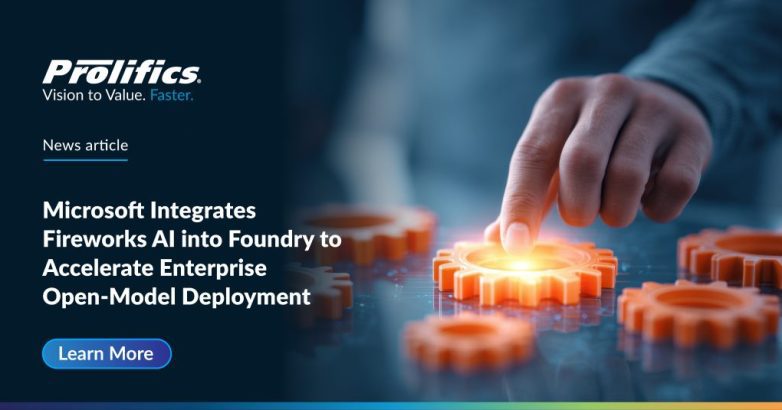
The race to operationalize generative AI is accelerating, and Microsoft has taken another major step forward. The company recently announced the integration of Fireworks AI into Microsoft Foundry, enabling organizations to deploy and scale open AI models faster and more efficiently within the Azure ecosystem.
For enterprises exploring AI adoption, this development signals an important shift. Open models are becoming easier to deploy, govern, and scale in production environments.
Simplifying the Enterprise AI Lifecycle
- Microsoft Foundry serves as a unified platform designed to streamline the entire AI development lifecycle.
- It enables model evaluation, deployment, and governance within a centralized environment.
- The platform integrates model management, agent development, deployment pipelines, and governance into a single control plane.
This unified approach eliminates the need for fragmented tools and infrastructure layers. It helps organizations move beyond experimentation and transition AI initiatives from pilot projects to production-ready solutions faster.
Fireworks AI Brings High-Performance Inference
- Fireworks AI introduces advanced inference capabilities into the Foundry ecosystem.
- Its infrastructure is optimized to serve large AI models at high speed and scale.
- The platform processes over 13 trillion tokens daily and supports around 180,000 requests per second.
- It can generate more than 1,000 tokens per second for large models.
With this integration, developers can access high-performance inference directly through Azure endpoints. This removes the need to build custom serving architectures, reducing complexity and accelerating deployment.
Expanding Access to Leading Open Models
- Foundry provides access to a growing catalog of open AI models.
- Developers can evaluate and deploy models such as DeepSeek V3.2, GPT-OSS-120B, Kimi K2.5, and MiniMax M2.5.
- Models can be tested, compared, and deployed within the same governed environment.
This flexibility allows organizations to select the most suitable model for their use cases while maintaining enterprise-grade control and compliance.
Flexible Deployment for Experimentation and Production
- Microsoft is introducing flexible deployment options for different stages of AI adoption.
- Developers can use serverless, pay-per-token inference for rapid experimentation.
- This approach eliminates the need for upfront infrastructure provisioning.
As projects scale, organizations can seamlessly transition from experimentation to full production workloads without changing platforms.
A Strategic Move in Microsoft’s Open AI Ecosystem
- The integration aligns with Microsoft’s broader strategy to support open AI models within Azure.
- Enterprises are increasingly adopting open models for better customization, cost control, and compliance.
- Foundry simplifies the infrastructure required to deploy and manage these models at scale.
By combining high-performance inference with governance capabilities, Microsoft is positioning Foundry as a central hub for enterprise AI development.
What This Means for Enterprises
- Organizations can accelerate AI adoption with simplified deployment pipelines.
- Access to scalable infrastructure reduces operational complexity.
- Integrated governance ensures compliance and trust in AI systems.
As AI adoption grows across industries such as finance, healthcare, retail, and manufacturing, the ability to deploy open models quickly and securely will become a key competitive advantage.
Microsoft’s integration of Fireworks AI into Foundry reflects a broader industry trend. The future of enterprise AI lies in platforms that combine model innovation with operational simplicity and scalability.
Media Contact: Chithra Sivaramakrishnan | +1(646) 362-3877 | chithra.sivaramakrishnan@prolifics.com