

Agentic AI is a new class of artificial intelligence that can independently plan, decide, act, and adapt to achieve business goals with minimal human intervention. Unlike traditional AI systems that respond to prompts or predefined workflows, Agentic AI combines reasoning, memory, orchestration, and autonomous execution to manage complex enterprise tasks across applications, data systems, and business processes.
As enterprises accelerate digital transformation, Agentic AI is emerging as the next major shift after cloud computing and automation. It enables organizations to move from reactive systems to intelligent operational ecosystems capable of autonomous IT management, customer engagement, workflow optimization, and decision support at enterprise scale.
Quick answer:
Agentic AI refers to autonomous AI systems that can understand goals, make decisions, execute multi-step actions, and continuously learn from outcomes. Enterprises are adopting Agentic AI to improve enterprise automation, reduce operational costs, accelerate decision-making, modernize IT operations, and create intelligent business workflows across finance, healthcare, retail, insurance, and public sector environments.
What Is Agentic AI?
Agentic AI is an AI architecture designed to operate with autonomy, contextual awareness, reasoning, and goal-driven execution. Instead of waiting for human instructions at every step, Agentic AI systems can interpret objectives, plan workflows, coordinate tools or applications, and dynamically adjust actions based on outcomes.
Agentic AI is built on several core capabilities:
- Large Language Models (LLMs)
- Workflow orchestration
- Memory and contextual reasoning
- API and system integration
- Autonomous task execution
- Continuous feedback loops
Traditional AI models primarily generate outputs based on prompts. Agentic AI systems go further by independently managing sequences of actions. For example, an enterprise AI agent could monitor cloud infrastructure, identify performance issues, open service tickets, trigger remediation workflows, notify stakeholders, and generate audit reports without requiring manual intervention.
Agentic AI is an enterprise AI approach where autonomous software agents can reason, plan, act, and adapt across systems to achieve defined business objectives with limited human oversight. These systems combine generative AI, automation, analytics, and orchestration technologies to enable intelligent enterprise operations.
According to Gartner, autonomous and agent-based AI systems are expected to become a foundational capability for enterprise operations and digital business transformation over the next several years.
Why Is Agentic AI the Next Big Enterprise Shift?
Agentic AI is becoming the next major enterprise shift because organizations are reaching the limits of traditional automation and fragmented AI deployments. Enterprises need systems that can operate across siloed data environments, make contextual decisions, and continuously optimize operations without constant human supervision.

Several business drivers are accelerating adoption:
1. Enterprise Complexity Is Increasing
Modern enterprises operate across hybrid cloud environments, SaaS applications, legacy systems, APIs, and distributed data ecosystems. Managing these environments manually creates operational inefficiencies and delays.
Agentic AI introduces intelligent orchestration that can coordinate actions across multiple systems in real time.
2. Traditional Automation Has Limitations
Robotic Process Automation (RPA) and rules-based workflows depend heavily on predefined conditions. They struggle with ambiguity, dynamic decision-making, and unstructured data.
Agentic AI combines reasoning and adaptability with automation, enabling systems to handle exceptions, changing conditions, and multi-step enterprise workflows.
3. Businesses Need Faster Decision-Making
Enterprises increasingly rely on real-time analytics, predictive insights, and operational intelligence. Agentic AI can analyze enterprise data continuously and execute actions faster than human-led processes.
4. Generative AI Created the Foundation
The rise of LLMs and generative AI platforms made natural language interaction scalable. Agentic AI extends this capability by adding planning, execution, and enterprise workflow integration.
According to IBM, organizations adopting AI-driven automation can significantly improve operational efficiency while reducing repetitive manual work across IT and business operations.
How Does Agentic AI Work in Enterprise Environments?
Agentic AI works by combining AI reasoning engines, enterprise data systems, automation frameworks, and orchestration layers into a unified operational model. These systems operate similarly to human teams but at machine speed and enterprise scale.
A typical agentic AI workflow includes:
- Understanding a business objective
- Accessing enterprise data sources
- Creating an execution plan
- Coordinating actions across systems
- Monitoring outcomes
- Adjusting workflows dynamically
- Reporting results and learning continuously
For example, in a healthcare environment, an agentic AI system could:
- Analyze patient intake data
- Identify missing insurance information
- Trigger verification workflows
- Schedule appointments
- Recommend next-best clinical actions
- Generate compliance documentation
- Alert care teams about risks
This level of autonomous coordination reduces administrative burden while improving patient experience and operational efficiency.
In financial services, Agentic AI can support fraud detection by continuously monitoring transactions, identifying anomalies, escalating suspicious activities, generating compliance records, and initiating remediation workflows automatically.
What Is the Difference Between Traditional AI and Agentic AI?
| Capability | Traditional AI | Agentic AI |
| Interaction Model | Prompt-response | Goal-driven execution |
| Workflow Handling | Single task focused | Multi-step orchestration |
| Decision-Making | Limited | Contextual and adaptive |
| Autonomy | Low | High |
| Learning Capability | Static or periodic | Continuous feedback-based |
| Enterprise Integration | Partial | Deep cross-system integration |
| Automation Scope | Task automation | End-to-end enterprise automation |
| Human Dependency | Frequent intervention | Minimal oversight |
Traditional AI systems are effective for prediction, classification, and content generation. Agentic AI introduces operational intelligence capable of independently managing enterprise processes.
This shift is similar to the evolution from isolated applications to cloud-native enterprise platforms. Organizations are no longer looking for standalone AI tools; they need intelligent operational ecosystems.
How Are Enterprises Using Agentic AI Today?
Enterprises across industries are already deploying Agentic AI for high-value operational use cases.
Healthcare
Healthcare providers are using AI agents for patient scheduling, claims processing, clinical documentation, diagnostic assistance, and care coordination. Autonomous workflows help reduce administrative overhead and improve patient outcomes.
Financial Services
Banks and insurance providers use Agentic AI for fraud detection, risk modeling, underwriting support, customer service automation, and compliance management.
Retail
Retail organizations deploy intelligent AI agents for inventory optimization, supply chain coordination, personalized customer engagement, and dynamic pricing strategies.
Public Sector
Government agencies are exploring Agentic AI for citizen service automation, case management, document processing, and operational modernization initiatives.
A Prolifics-relevant enterprise use case involves integrating Agentic AI with hybrid cloud infrastructure and enterprise data platforms to automate IT service management. AI agents can monitor infrastructure performance, identify anomalies, trigger remediation workflows, and improve system resilience without manual escalation.
According to Forrester, enterprises increasingly prioritize AI systems that combine automation, orchestration, and operational intelligence to support large-scale business transformation initiatives.
Which Technologies Power Agentic AI?
Agentic AI depends on a combination of modern enterprise technologies working together as an integrated ecosystem.
Key enabling technologies include the following:
- Large Language Models (LLMs)
- Enterprise AI platforms
- Workflow orchestration engines
- Cloud-native infrastructure
- API management platforms
- Vector databases and knowledge retrieval
- Data integration frameworks
- Machine learning operations (MLOps)
- Enterprise security and governance tools
Cloud migration and system integration are critical enablers because Agentic AI relies heavily on real-time data access and interoperability across enterprise applications.
Organizations with fragmented infrastructure, disconnected data systems, or limited governance maturity may struggle to scale Agentic AI initiatives effectively.
This is why many enterprises focus first on data readiness, IT modernization, API integration, and cloud transformation before implementing autonomous AI systems.
How Can Enterprises Implement Agentic AI Successfully?
Successful Agentic AI adoption requires more than deploying AI models. Enterprises need a structured modernization strategy that aligns technology, governance, operations, and business goals.
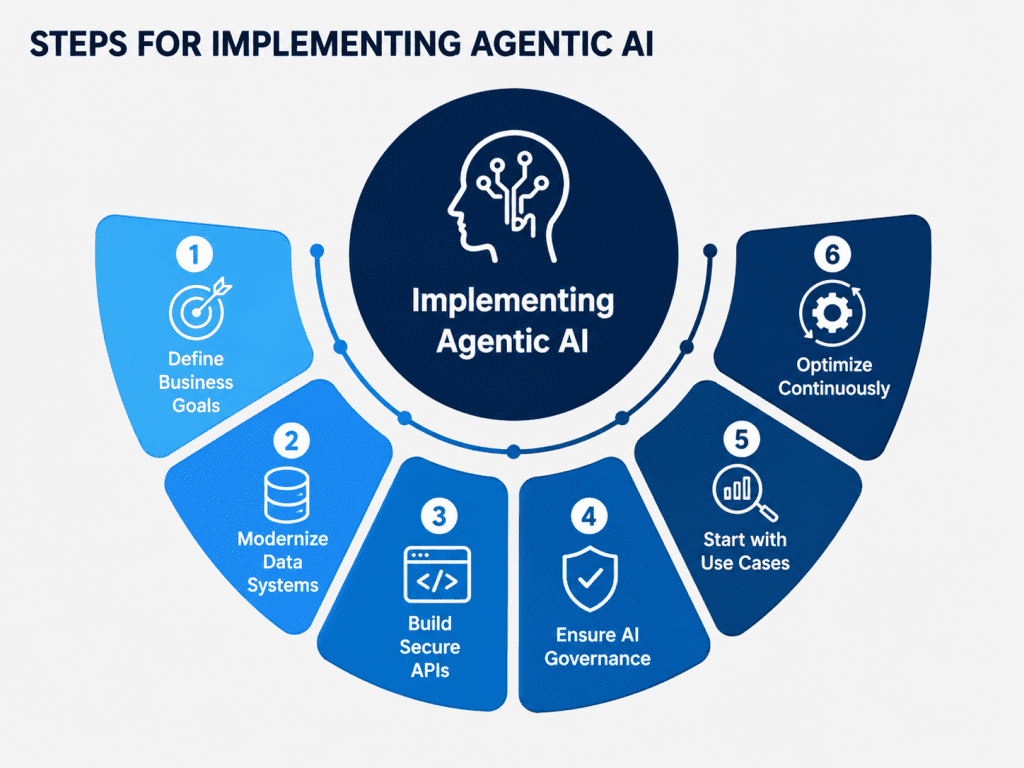
- Define high-value business outcomes
Identify operational bottlenecks, customer experience gaps, or workflow inefficiencies where autonomous AI can create a measurable impact. - Modernize enterprise data infrastructure
Ensure enterprise data is accessible, integrated, governed, and real-time ready. - Build secure integration frameworks
Create API-first architectures that allow AI agents to interact safely across systems and applications. - Establish governance and oversight
Implement monitoring, compliance, security controls, explainability standards, and human review processes. - Start with targeted use cases
Deploy Agentic AI in specific operational areas before scaling enterprise wide. - Continuously optimize workflows
Monitor outcomes, retrain models, refine orchestration logic, and improve business alignment over time.
Enterprises that approach Agentic AI strategically are more likely to achieve scalable operational transformation rather than isolated pilot successes.
Why Does Data Readiness Matter for Agentic AI?
Agentic AI systems are only as effective as the enterprise data environments supporting them. Poor data quality, fragmented systems, and inconsistent governance can significantly reduce the accuracy and reliability of autonomous decision-making.
Agentic AI requires:
- Unified enterprise data access
- Real-time analytics capabilities
- Metadata governance
- Strong cybersecurity controls
- Scalable cloud infrastructure
- High-quality structured and unstructured data
According to IBM research, poor data quality costs organizations trillions of dollars annually through inefficiencies, compliance risks, and operational failures. Reliable enterprise AI systems require trusted, governed, and integrated data ecosystems.
For organizations pursuing digital transformation, data modernization becomes a foundational requirement for scaling autonomous AI initiatives successfully.
FAQ
What is Agentic AI in simple terms?
Agentic AI is an advanced form of artificial intelligence that can independently make decisions, complete tasks, and adapt workflows to achieve business goals. Unlike standard AI tools that only respond to prompts, Agentic AI systems can manage complex enterprise processes with limited human intervention.
How is agentic AI different from generative AI?
Generative AI primarily creates content such as text, images, or code based on prompts. Agentic AI combines generative AI with reasoning, planning, memory, orchestration, and autonomous execution to complete multi-step operational tasks across enterprise systems.
Which industries benefit most from Agentic AI?
Industries with complex operations and large-scale workflows benefit significantly from Agentic AI, including healthcare, finance, retail, insurance, manufacturing, and public sector organizations. Common use cases include enterprise automation, fraud detection, IT operations, customer service, and workflow orchestration.
What are the biggest challenges in implementing Agentic AI?
The main challenges include poor data readiness, fragmented systems, governance concerns, security risks, integration complexity, and lack of operational alignment. Enterprises must modernize infrastructure and establish strong governance frameworks before scaling autonomous AI initiatives.
Is Agentic AI replacing human workers?
Agentic AI is primarily designed to augment human teams rather than replace them entirely. It automates repetitive and operational tasks, enabling employees to focus on strategic decision-making, innovation, customer engagement, and high-value business activities.
Conclusion
Agentic AI represents a major evolution in enterprise technology by combining autonomous reasoning, workflow orchestration, and operational intelligence into scalable business systems. Organizations are moving beyond isolated AI deployments toward intelligent ecosystems capable of managing complex workflows, accelerating decision-making, and improving enterprise efficiency.
As digital transformation initiatives continue to expand, enterprises that modernize their data infrastructure, cloud environments, and integration strategies will be better positioned to scale Agentic AI successfully. The shift toward autonomous enterprise operations is already underway across healthcare, finance, retail, insurance, and public sector environments.
Prolifics helps enterprises build the modern data, integration, cloud, and AI foundations required to implement Agentic AI at scale through secure, enterprise-grade digital transformation strategies.


