

Digital transformation has evolved from a technology initiative into a core business strategy. Organisations today must be faster, more connected, and more customer-centric. Achieving this level of maturity requires more than cloud adoption or application modernisation. It requires a strong digital backbone that enables seamless integration, scalability, and innovation. API development and management form that backbone.
Application Programming Interfaces (APIs) act as the connective tissue of modern digital enterprises. They allow systems, applications, and data to communicate securely and efficiently. When API development and management are planned strategically and governed effectively, organisations can modernise operations, accelerate innovation, and deliver consistent digital experiences across channels.
This article explains why API development and management matter for digital transformation, and how organisations can use APIs to build scalable, agile, and future-ready digital ecosystems.
Building the Foundation: An API-First Approach to Digital Strategy
Every successful digital transformation starts with clear business goals. These goals may include improving customer experience, enabling new revenue streams, increasing operational efficiency, or supporting partner ecosystems. APIs must align with these objectives from the beginning.

An API-first approach for digital transformation ensures digital capabilities are:
- Designed as reusable services instead of isolated features
- Easy to consume across teams, platforms, and channels
- Consistent, scalable, and aligned with long-term business strategy
By treating APIs as strategic products, organisations strengthen their API strategy for digital transformation and support continuous innovation.
Connecting the Enterprise: Seamless Integration and Interoperability
Modern enterprises rely on a mix of legacy systems, cloud platforms, SaaS tools, and third-party applications. API development and management for digital transformation enable these environments to connect without fragile point-to-point integrations.
How APIs Enable Enterprise Integration
APIs support integration by:
- Enabling real-time data exchange
- Removing data silos and manual processes
- Automating end-to-end workflows
- Supporting hybrid and multi-cloud environments
This approach allows organisations to modernise gradually while maintaining operational stability. It also supports a scalable API architecture that grows with business needs.
Speed as a Competitive Advantage: Accelerating Innovation and Delivery
Speed to market is critical in today’s competitive landscape. APIs help teams move faster by enabling reuse, modular design, and parallel development.
Innovation Benefits of API-Driven Development
With strong API development services, organisations can:
- Launch new digital services quickly
- Reuse existing capabilities across applications
- Enable parallel development across teams
- Simplify partner and B2B integrations
This flexibility highlights the benefits of API management for enterprises, especially when innovation speed directly impacts business growth.
Experience at the Core: Powering Modern Customer Journeys
Customers expect seamless, real-time, and personalised experiences. APIs make this possible by connecting backend systems to customer-facing channels.
Role of APIs in Customer Experience
APIs allow organisations to:
- Deliver consistent experiences across web, mobile, and partner platforms
- Personalise interactions using real-time data
- Support omnichannel engagement
- Roll out new features without re-architecting core systems
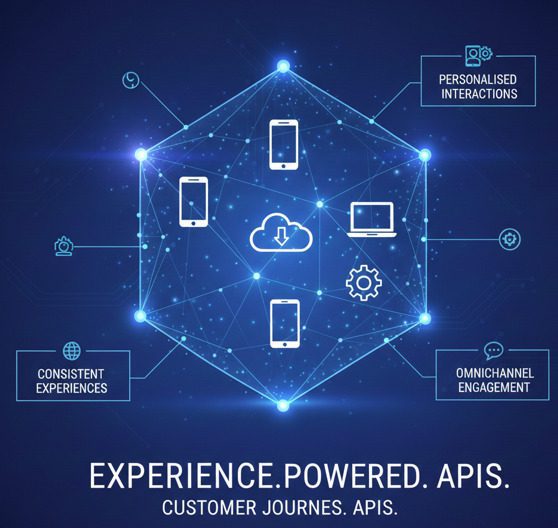
These capabilities are central to successful API development and management for digital transformation initiatives.
Control at Scale: Security, Governance, and API Management
As API usage increases, governance and security become essential. API management solutions provide the structure needed to manage access, performance, and reliability across the API lifecycle.
Key Capabilities of Effective API Management
A strong API lifecycle management framework includes:
- Authentication, authorisation, and access control
- Traffic management and rate limiting
- Performance monitoring and analytics
- Versioning, lifecycle management, and documentation
Together, these practices strengthen API governance and security while enabling APIs to scale safely.
From Data to Decisions: Insights and Continuous Optimisation
APIs are not just integration tools; they are valuable sources of operational and business intelligence. By analysing API usage and performance data, organisations gain insights that drive continuous improvement.
What API Analytics Enable
API insights help organisations:
- Identify performance bottlenecks
- Understand consumer behaviour and adoption trends
- Optimise services based on real-world usage
- Align technology performance with business goals
This feedback loop ensures that APIs remain relevant, efficient, and aligned with evolving business needs.
Designing for the Future: Agility and Scalability by Design
Digital transformation is not a one-time initiative but an ongoing journey. As new technologies, platforms, and business models emerge, organisations need architectures that can evolve without constant reinvention.
API-driven architectures support:
- Cloud-native and microservices development
- Integration with AI and data platforms
- Incremental modernisation
- Long-term scalability and resilience
By investing in strong API development and management practices, organisations future-proof their digital foundations and remain agile in the face of change.
Key Takeaways
API development and management are critical enablers of digital transformation. They help organisations integrate complex systems, accelerate innovation, enhance customer experiences, and operate securely at scale. An API-first mindset ensures digital capabilities remain reusable, governed, and aligned with business goals.
By investing in structured API strategies, robust API management solutions, and scalable architectures, organisations can build resilient digital ecosystems. At Prolifics, we help enterprises design, build, manage, and optimise APIs that deliver lasting business value and measurable transformation.


