Is your company doing all it can to grow and thrive in today’s new normal? Your data may hold the key. Big digital transformation investments have given way to smaller projects that focus on lowering costs and customer churn, and increasing margins and sales. It starts with data – finding your data, knowing you can trust it, and who uses it.
Brian Kordelski, Global Sales Leader with Prolifics, and Rolf Heimes, Global Head of Channel with Talend, invite you to an interesting and informative conversation about the data journey and how to “give your organization the data it deserves.”
The term “garbage in, garbage out” is as relevant to your data today as it was 20 years ago. If your company’s data is in chaos – incomplete, fragmented, trapped in siloes, hidden in legacy systems, poorly identifiable, duplicated – anything you try to do with that data will be, unfortunately, garbage.
Four Ways Your Data Chaos Will Hurt You – Badly
The pandemic shutdown exposed or exacerbated problems with cost optimization, cost efficiency, business continuity and disaster recovery. As companies reopen and retool post-lockdown, it’s more important than ever that you have clean and complete data – everything starts with having a handle on your data. If it’s in chaos, it will hurt you.
1) The drip, drip, drip of legacy systems
It’s kind of a “Catch-22” scenario – your data situation is in chaos because of your legacy systems, but you don’t think you can move from the legacy systems because of how deeply ingrained your data is. But legacy systems cost more to maintain, things take longer, and opportunities are missed. Data is growing exponentially at a time when you need speed and efficiency – but that new data is going into chaos. Whether moving to the cloud or staying on-prem, it’s time for application modernization and integration. You don’t need to do it all at once – but you better start soon, or the drips will keep on coming.
2) The data privacy movement
The EU’s General Data Protection Regulation (GDPR) and California’s Consumer Privacy Act (CCPA) and laws like it give individuals a level of control over how companies use their collected data. This includes the “right to be forgotten” – a company must delete a requestor’s information in its systems as mandated. Fines can add up – in CCPA it’s $2,500 per compliance violation, going up to $7,500 if the violation is deemed intentional. If you don’t know what data matches to which customers, or all the nooks and crannies where that data is and how to get to it, the penalties could add up fast.
3) Entity resolution
“Wizard of Data” Jeff Jonas defines entity resolution as “who is who and who is related to who” in data. The common terms identity resolution; record linking, matching and deduplication; and “merge-purge” are forms of ER. Entity resolution means you have a single version of something that your business must deal with, like a customer or a vendor, or you understand the relationship between somethings, like which salesman belongs with which vendor. If your data is garbage, and entity resolution is difficult, you’re setting yourself up for problems from bad customer experiences and cost inefficiencies to outright fraud.
4) Advanced and predictive analytics
Companies today are using artificial intelligence and machine learning (AI/ML) tools to automatically detect sophisticated data patterns to predict potential outcomes, giving them better decision-making insight and abilities. For example, a financial organization using AI/ML can analyze its entire historical loan portfolio on an ongoing basis, learning and recognizing patterns of factors in real time that lead to a much higher rate of default. If a new loan application has those factors, the AI/ML program would flag it for denial. AI/ML is for “what’s next” questions, like which current customers will likely buy your new product or when will a piece of equipment break down. These insights can have you crushing your competition – unless your data is in chaos. Then the competition will be crushing you.
Get a handle on your data
Prolifics experts can help you with your data, systems modernization and integration, and cloud and hybrid cloud platforms. Visit www.prolifics.com or email solutions@prolifics.com.
Coffee with Talend
Join data experts Brian Kordelski (Prolifics) and Rolf Heimes (Talend) for a discussion on how companies are striving to be leaner and more efficient when it comes to housing and managing data. They’ll also look at how migrating to an opensource framework can be cost-effective and quickly deployed. More information and registration here 4 Ways Your Data Chaos Will Hurt You.
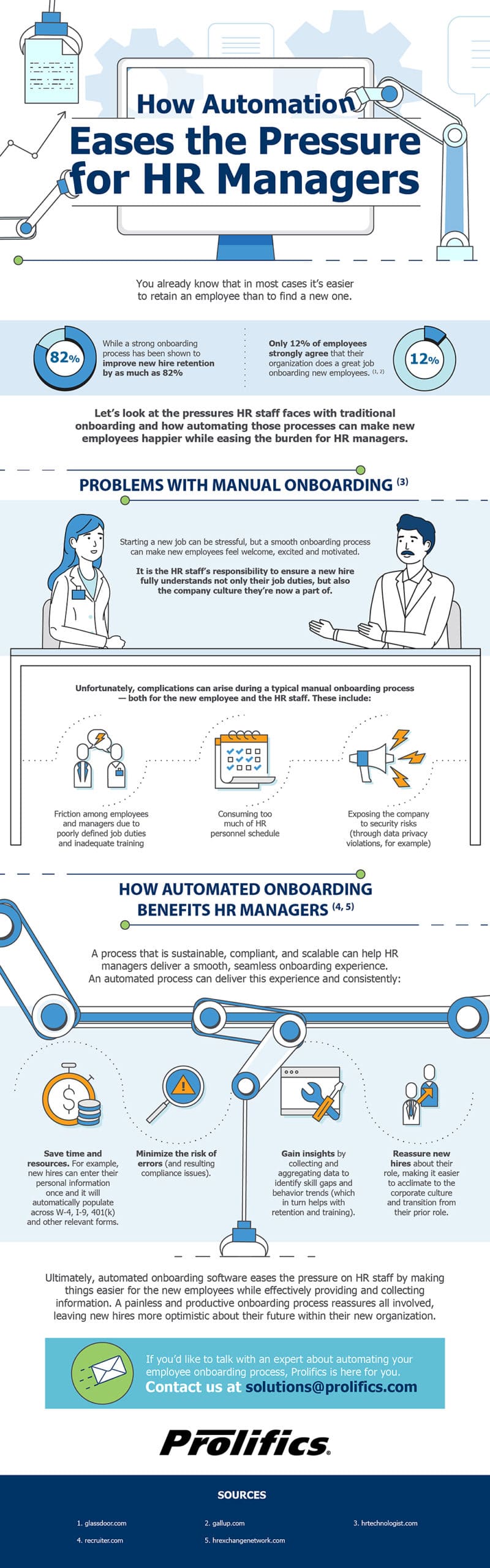
You already know that in most cases, it’s easier to retain an employee than to find a new one.
Still, while a strong onboarding process has been shown to improve new hire retention by as much as 82%, only 12% of employees strongly agree that their organization does a great job onboarding new employees.
This month’s infographic shows the pressures HR staff faces with traditional onboarding and how automating those processes can make new employees happier while easing the burden for HR managers.
Problems With Manual Onboarding
Starting a new job can be stressful, but a smooth onboarding process can make new employees feel welcome, excited and motivated.
It is the HR staff’s responsibility to ensure a new hire fully understands not only their job duties, but also the company culture they’re now a part of.
Unfortunately, complications can arise during a typical manual onboarding process — both for the new employee and the HR staff. These include:
Friction among employees and managers due to poorly defined job duties and inadequate training
Consuming too much of HR personnel schedule
Exposing the company to security risks (through data privacy violations, for example)
How Automated Onboarding Benefits HR Managers
Streamlined processes, better decision making and empowered employees – that’s what intelligent automation brings to your onboarding process. Advances in intelligent automation can create efficiencies and scalabilities for your business that were unheard of before.
A process that is sustainable, compliant, and scalable can help HR managers deliver a smooth, seamless onboarding experience. An automated process can deliver this experience and consistently:
Save time and resources. For example, new hires can enter their personal information once and it will automatically populate across W-4, I-9, 401(k) and other relevant forms.
Minimize the risk of errors (and resulting compliance issues).
Gain insights by collecting and aggregating data to identify skill gaps and behavior trends (which in turn helps with retention and training).
Reassure new hires about their role, making it easier to acclimate to the corporate culture and transition from their prior role.
Ultimately, automated onboarding software eases the pressure on HR staff by making things easier for the new employees while effectively providing and collecting information. A painless and productive onboarding process reassures all involved, leaving new hires more optimistic about their future within their new organization.
We’re in the era of data – tsunamis of data, in fact, that are growing exponentially. With it comes concerns about what we can learn from the data – separating the melody from the noise – as well as overcoming worries surrounding privacy and fraud. Entity resolution (ER) is an important tool used to address these data issues.
On the cutting edge of ER technology is Jeff Jonas, CEO and Chief Scientist for Senzing, Inc., an artificial intelligence‐based (AI) software company focused on ER.
What Is Entity Resolution (ER)?
In the book “Entity Resolution and Information Quality,” writer Terry Talley states:
Entity resolution is the process of probabilistically identifying some real thing based upon a set of possibly ambiguous clues. Humans have been performing entity resolution throughout history. Early humans looked at footprints and tried to match that clue to the animals that made the tracks.
In the same book, writer John R. Talburt gives it a more formal, scientific view:
Entity resolution is about determining when references to real-world entities are equivalent (refer to the same entity) or not equivalent (refer to different entities). Linking is appending a common identifier to reference instances to denote the decision that they are equivalent.
Other related terms include identity resolution, record linking, record matching, record deduplication, merge-purge, and entity analytics, all of which represent particular forms or aspects of ER.
Jeff Jonas gives ER a simpler and more understandable definition:
ER determines “who is who and who is related to who” in data.
Why Is Entity Resolution Important?
Entity resolution is important to a business because it helps create a single version of the “truth” for any given entity that the business deals with.
The Single Customer View Example
Many companies can relate to the idea of a single customer view. Multiple systems may store separate pieces of information — purchase history, demographics, credit info, loyalty programs, and more — for the same person.
Example: If your systems send an email blast to K. Coggs, KT Coggs, Katie Coggs, and Kathryn Coggs — are they one annoyed customer receiving four emails or four separate people?
Benefits of Clean Data
Having a single, unified customer view improves data accuracy for advanced and predictive analytics. Without it, you might send the wrong offer or communication — for example, sending Katie Coggs’ product recommendation to her mother, Kathryn.
Detecting Fraud and Ensuring Privacy
ER also plays a vital role in fraud detection — such as when multiple people use the same assets as loan collateral at different branches.
In addition, ER supports compliance with data privacy laws like the EU’s GDPR and California’s CCPA, which grant individuals control over their data — including the “right to be forgotten.”
For example, if KT Coggs requests deletion of her data, failure to recognize that K. Coggs and KT Coggs are the same person could lead to non-compliance fines.
Jeff Jonas – “Wizard of Big Data”
Jeff Jonas addresses all these ER challenges and more as CEO and Chief Scientist at Senzing, Inc. His work ranges from identifying duplicate contacts to uncovering criminal identities in real time across thousands of data sources.
The nickname “Wizard of Big Data” originated from a 2014 National Geographic article that profiled his innovative ER work. Some of his high-profile cases include:
Identifying potential terrorists
Detecting fraudulent behavior in casinos
Connecting loved ones after natural disasters
Modernizing voter registration systems
Privacy and Legal Data Use
As National Geographic described, Jonas’ systems use only legally obtained data and include privacy safeguards. They connect data points — such as addresses, job applications, and loyalty program details — to detect hidden links between people.
Making ER Accessible
Jonas’ goal is to make high-quality ER technology available to mainstream businesses. Senzing offers both a plug-and-play real-time ER desktop app and an advanced API for developers — removing the need for million-dollar budgets or large IT teams.
Jonas continues to collaborate with government leaders, think tanks, and global executives on innovation, national security, and privacy. He holds over a dozen patents and is one of only five people in the world who have completed every Ironman triathlon currently on the global circuit.
See Jeff Jonas live on “Innovation Sandbox, Powered by Prolifics”
Jeff Jonas will be the first guest for the inaugural season of “Innovation Sandbox, Powered by Prolifics,” a new YouTube Live series featuring today’s brightest minds, latest technologies, and creative ideas.
📅 Date: Thursday, July 9 🕙 Time: 10–10:30 a.m. ET 📺 Where: Prolifics TV
The episode, “We’re LIVE to see the Wizard!”, will be hosted by Greg Hodgkinson, Prolifics’ CTO and Innovation Center leader.
Join us for a dynamic discussion on how entity resolution impacts everyday life, plus insights from Jonas on innovation, AI, and even Ironman training during a pandemic.
Data privacy laws and regulations, like the EU’s General Data Protection Regulation (GDPR) and California’s Consumer Privacy Act (CCPA), are just getting started. That means more customers will control how companies use their collected data. Understandably, companies are struggling to understand and comply with these new laws.
Challenge
The American Bureau of Shipping (ABS) collects a substantial amount of data from customers and business partners through its operations in 70 countries. ABS needed to understand what laws applied to them and how best to move toward compliance. But, instead of waiting for each government mandate to roll out, ABS needed a bigger picture solution – one that was applicable, repeatable and would address a large percentage of whatever government data privacy rules come next. ABS also needed the solution to help distinguish its brand in the marketplace as being a good steward of its customers’ data.
About ABS
ABS is one of the world’s leading ship classification organizations, committed to setting standards for safety and excellence so that the marine and offshore industries can operate safely, securely and responsibly. For more than 150 years, ABS has worked alongside its partners to tackle the most pressing technical, operational and regulatory challenges.
Action
Prolifics provided data integration and data management solutions that helped ABS modernize data delivery and data consolidation for its 200 offices around the world.
We first worked with ABS to deploy our rapid Data Privacy Assessment, to identify issues and opportunities for data integration and a larger data solution for continuity.
We then introduced Prolifics’ Data Governance Framework solution, to give ABS a unified platform to deliver data governance, analytics and compliance on a global scale. The Data Governance Framework centralizes both structured and unstructured data from across ABS, so that the company can gain a more complete understanding of the information it owns and act on regulatory requests. With this insight, the company can target sensitive data for action, move toward better compliance, and avoid regulatory infractions that impact both the bottom line and the brand’s image.
Result
As a result of the Data Governance Framework solution, ABS is closer to compliance with GDPR, CCPA, and other regulations as they emerge.
The solution provides ABS with extensive cost savings in infrastructure capital expenditure in the first three years by centralizing onto a single platform. ABS expects a 10 percent improvement in service utilization, with a projected revenue growth of 20 percent over the next three years.
A foundation of reputable, high-quality data prepares ABS to adopt cutting-edge technologies that leverage artificial intelligence and machine learning (AI/ML) to drive innovation. Potential use cases include regular, automated data remediation and risk reporting, as well as larger AI/ML-powered initiatives across the business.
Closer compliance with GDPR and CCPA
10% service utilization improvement
AI/ML-powered use cases
ABS used the Data Governance Framework solution to:
Develop and enable a data privacy and governance roadmap, used to design and implement a fully featured data governance program
Create data transparency by identifying structured and unstructured data across organizational silos
Track, analyze and report the lineage of this data, which allows insight into the history and metadata of this information
Perform risk analysis to determine personally identifiable information and associated risk, with a data risk dashboard enabling executive review and monitoring of key risk factors
Design a roadmap of future AI/ML use cases, with confidence in the underlying data quality and compliance adherence
Technology
The Data Governance Framework solution brings together a number of Prolifics and IBM technologies to create a unique capability. Our combination of software, integration, governance framework, and forward-looking focus on innovation enables the Data Governance Framework solution to understand and respond to data problems as a whole – creating compelling long-term value for the client.
Specific technologies implemented with ABS included:
Prolifics’ rapid Data Privacy Assessment – identifies issues and opportunities for data integration into the larger data solution
Prolifics’ Data Governance Framework and assets – developed through extensive experience in solving data challenges
IBM Information Server and Information Governance Catalog – consolidates data from across the enterprise into a format that is ready for use in analytics and reporting
IBM QualityStage – cleanses data to ensure high data quality
IBM StoredIQ – gathers unstructured data from across the enterprise; combines that unstructured data with structured data gathered using IBM Information Server to provide a full view of the customer information within the environment
IBM Cognos Analytics – performs data visualizations and reporting
Using these technologies, Prolifics provided ABS:
A data mart that stores information regarding customers’ personal data, metrics, and progress
A data glossary housing information about transactions, service availabilities, rates, relevant business terms, and more
Integration with an information data governance catalog to consume and export business terms and steward relevant data for lines of business. It also provided a systematic data remediation approach.
Configurable information analysis to provide details about risk that is associated with compliance according to regulatory standards. The solution provided enterprise data inventory, data mapping, and data lineage capabilities that support compliance goals.
Reporting, analytics, and auditing capabilities
Unstructured data discovery to understand compliance risks surrounding big data and unstructured data repositories such as Outlook and other cloud applications
Remediation controls to satisfy company data privacy policies and prepare for regulatory data subject access requests
Learn more
At Prolifics, we provide end-to-end data analytics services, at any point you want them, for whatever condition your data is in. Visit our Data & Analytics services page or email us at solutions@prolifics.com.
Around the country, sweeping data privacy regulations are compelling businesses to rethink every aspect of their data governance capabilities.
If your organization complied with General Data Protection Regulation (GDPR) standards set by the European Union in 2016, you may have a head start. However, compliance with the GDPR will not be sufficient for compliance with the new state regulations. If your data lifecycle management process hasn’t changed in recent years—or if you never had a holistic, company-wide process to begin with — it’s time to stop kicking that can down the road.
Our new infographic shows you how three states are changing their data privacy landscape. You’ll also see steps your company can take to avoid unexpected penalties in the future.
California Consumer Privacy Act (CCPA)
Enacted in 2018, the California Consumer Privacy Act (CCPA) requires transparency concerning the hosting and exchange of personal data, which includes a range of individual, or household, identifiers.
As of July 2020, companies have 30 days to comply once notified of a violation; otherwise they are subject to civil penalties of up to $2,500 per violation and $7,500 per “intentional violation.”
Act to Protect the Privacy of Online Consumer Information (Maine)
Maine’s Act to Protect the Privacy of Online Consumer Information requires broadband internet service providers (ISPs) to obtain customer consent before selling or sharing their data with a third party.
While the CCPA gives customers the right to opt-out, Maine’s law prohibits ISPs from using customer data unless the customer opts in.
Stop Hacks and Improve Electronic Data Security Act (New York)
The Stop Hacks and Improve Electronic Data Security Act (SHIELD Act) requires any businesses that maintain New York residents’ private information to take concrete steps intended to prevent data breaches.
To comply, businesses must take reasonable protective measures, including:
risk assessments
workforce training
incident response planning and testing
Failure to implement a compliant program is enforced by the New York State Attorney General and may result in injunctive relief and civil penalties.
Federal Privacy Laws
The United States does not yet have a comprehensive federal-level privacy law that reaches the scope of the GDPR in the European Union. Still, there are several vertically focused federal laws that businesses must be aware of if they deal with private consumer data. These include:
Privacy Act of 1974: Gives individuals a way to access and correct their records, and sets forth various agency record-keeping requirements.
Health Insurance Portability and Accountability Act (HIPAA): Regulates the collection and disclosure of patient health information and requires health care providers to protect data from unauthorized use.
Children’s Online Privacy Protection Act (COPPA): Enforced by the Federal Trade Commission, outlines the appropriate use of information of children under the age of 13.
Gramm-Leach-Bliley Act (GLBA): Requires financial institutions to protect customers’ data by limiting how information is shared with third parties.
Steps Toward Compliance
Your organization’s data quality and data governance team should discuss your approach tomanaging data assets. A methodical approach to making sure your organization is compliant will involve the following process:
Determine how much data exposure is present in your environment and which state/federal rules apply to your business.
Determine who in your organization needs to be involved and to what extent.
Identify the utilities and software solutions needed to facilitate compliance.
Identify the processes required to move toward compliance and the options you have to maximize your investments.
Build a roadmap toward compliance with minimal requirements and timeline.
The COVID-19 pandemic has reshaped the job market, with unemployment numbers not seen since the Great Depression. More than 36 million people are currently unemployed. A critical question now: when businesses begin hiring again, how will millions of people be vetted and onboarded efficiently?
Many companies are preparing for mass hiring, which means mass onboarding. The challenge? Most onboarding processes are still manual—reviewing I-9s and W-4s, validating direct deposit information, entering data into multiple systems, notifying departments, and managing training schedules. The process is slow, error-prone, and overwhelming at scale.
That’s why organizations are turning to automated onboarding solutions. But not all solutions are equal. Here are five questions to ask before choosing one.
1. Can it recognize and organize paperwork?
New hires often send poorly labeled documents like “scandoc2020-04-17”. When you’re dealing with a handful of employees, it’s a nuisance. With hundreds, it becomes a nightmare.
Your onboarding solution should:
Read and categorize emails and attachments.
Identify form types automatically.
Route documents to the right system or department without manual review.
2. Does it catch mistakes, inconsistencies, and blanks?
Errors like “Tommy” in one form and “Thomas” in another, missing phone numbers, or unsigned W-4s slow down the process.
Look for a solution that performs:
Data validation checks.
Consistency reviews across forms.
Semantic checks for completeness and correct formatting.
This prevents small issues from snowballing into big problems later.
3. Will it integrate across systems and departments?
True onboarding efficiency goes beyond collecting forms. Your solution should seamlessly connect with:
Payroll and benefits systems.
HR and employee profile databases.
Security and facilities teams (for access badges, equipment, etc.).
If you still have to send manual emails for every new hire’s key card, the solution isn’t doing enough.
4. Can it learn and adapt?
Basic robotic process automation (RPA) is powerful—it handles repetitive tasks with speed and accuracy. But the real advantage comes when RPA is combined with artificial intelligence and machine learning (AI/ML).
AI/ML can:
Adapt to your company’s unique onboarding workflows.
Learn from exceptions and apply those insights.
Navigate HR systems with greater intelligence.
A strong tech provider should be able to deliver AI/ML customizations in just 10–14 days.
5. Does it handle “the extras”?
Think beyond paperwork. A comprehensive solution should:
Identify equipment and supplies new hires need (including protective gear).
Automatically schedule training sessions based on job role.
Enforce compliance with new workplace safety regulations.
The goal is to automate as much as possible, with HR professionals stepping in only when necessary.
Prolifics Can Help
Meet Leia, our digital employee onboarding officer. Leia completes onboarding in minutes, not days. She can:
Identify and process forms and documents.
Connect with HR systems.
Enroll hires in payroll, benefits, and training.
Notify managers, security, and facilities.
Leia helps you manage applicant volumes, reduce errors, and speed up onboarding—leading to happier managers and new hires.
The COVID-19 pandemic has triggered a massive shift in the global job market—from record-low unemployment to millions suddenly out of work.
A recent Guardian article highlights the severity of the situation:
“The latest figures from the U.S. Labor Department mean more than 36 million people have filed for unemployment benefits in the last two months. The rate of claims is slowing, but the record-breaking pace of layoffs has already pushed unemployment to levels unseen since the Great Depression of the 1930s.”
This situation raises two important questions:
Is anyone hiring during this time?
When the pandemic eases, how will millions of people rejoin the workforce?
Hiring Now – and a Glut on the Way?
While the pandemic has disrupted several industries, others continue to hire actively.
The Glassdoor blog “54 Companies Actively Hiring During COVID-19” (by Dominique Fluker, May 1) lists organizations filling roles — with some even experiencing a hiring surge.
Industries with high demand include:
Healthcare and life sciences
Technology and IT services
Food and essential goods
Financial institutions
Local news outlets also report numerous openings in regional markets, providing a ray of hope amid uncertainty.
As for the post-pandemic future, HR departments are already planning for a changed landscape. According to Roy Maurer, Online Manager/Editor for the Society for Human Resource Management (SHRM), in his article “CHROs Plan for an Abundant Talent Market Post-COVID” (April 22, 2020):
“The employment situation has shifted dramatically in the last few weeks since the coronavirus outbreak shut down large portions of the economy. HR leaders have had to pivot from recruiting amid the lowest unemployment on record to managing a sea change in how people work while planning for a very different post-COVID future.”
He adds that a talent surplus could be one of the biggest challenges for HR and talent acquisition teams.
In the HR Technologist blog “15 Tips to Hire Talent Post the Coronavirus (COVID-19) Pandemic,” Jeanniey Mullen, Chief Innovation Officer at DailyPay, emphasizes:
“Industries need to immediately shift to a heavy reliance on digital for all aspects—from recruitment, interview, onboarding, and even termination pay.”
She explains that anticipating a re-emergence means focusing on digital-first processes to ensure continuity and resilience.
Similarly, Kimberly Houston, in her JotForm article “Online Onboarding and Training for New Employees During COVID-19” (April 29, 2020), notes:
“We’re living in a new reality — one where online onboarding and training for new employees is no longer simply a perk or a tool for tech-savvy companies, but the new normal.”
This highlights the growing need for cloud-based HR solutions and AI-driven onboarding systems that can match pre-pandemic efficiency levels.
Why Current Onboarding May Not Be Up for the Task
Despite advancements in HR tech, many companies still rely on manual or paper-based onboarding.
This includes processes like:
Entering data into different HR systems
Completing forms such as W-4s, I-9s, and payroll information
Assigning equipment and access
Setting up new-hire training paths
Without digital automation, organizations risk lost time, higher costs, and reduced productivity — especially during large-scale hiring surges.
To remain competitive, companies must embrace technology that simplifies and accelerates onboarding while ensuring compliance and accuracy.
How AI and Automation Simplify Employee Onboarding
The post-COVID era demands speed, scalability, and accuracy. Intelligent automation can help by:
Streamlining form recognition and data input
Integrating seamlessly with HR, payroll, and training systems
Improving data security and employee satisfaction
Reducing administrative workloads
By adopting AI-driven onboarding, organizations can deliver a faster, more personalized employee experience and free up HR teams to focus on strategic tasks.
Prolifics Can Help
Meet Leia — your digital Employee Onboarding Officer.
Leia automates the entire onboarding process in just two minutes. She can:
Identify and process HR forms and documents
Connect with multiple systems (payroll, benefits, training)
Notify facilities, IT, and security teams automatically
Ensure data accuracy and compliance
Leia helps manage applicant volumes, reduce manual errors, and accelerate onboarding — creating a smoother experience for managers and new hires alike.
Connect with Leia at solutions@prolifics.com to see how she can help you onboard faster and smarter.
Patient data is at the foundation of any well-functioning healthcare system. Physicians cannot make well-informed diagnoses, patients can’t choose the right care, and payers can’t make strategic financial decisions without the right information.
The last decade or so has seen an explosion in the use of health information technology (health IT) to store patient data. In 2008, 9 percent of hospitals could demonstrate meaningful use of electronic health records (EHR). In 2018 this had risen to 96 percent.
However, a key barrier preventing full use of this data within the healthcare ecosystem has been a lack of consistency and rigor in data format. This has, in turn, meant a lack of data ‘interoperability’: An inability for different IT systems to exchange and make use of the data.
In order to advance the interoperability of healthcare data, Health Level 7 introduced the FIHR (pronounced ‘fire’) specification. In recent years it has become one of the most popular protocols for promoting the free exchange of health data.
In simple terms, FHIR is a framework which sets common standards for the exchange of healthcare information via Application Programming Interfaces (APIs). It determines both the way in which data is shared, as well as what that data looks like. The current release of FHIR defines 145 APIs, and ensures common definitions of core healthcare concepts such as patient and practitioner, clinical observational data, diagnostics, and healthcare financials.
What are the potential benefits of FHIR?
FHIR enables data interoperability, but why is this so important? Key benefits of FHIR include:
Empowering patients. FHIR promotes standardized health information which can improve clinical diagnostics, and improve the basis on which patients make their own healthcare decisions;
Reducing the financial/economic burden of healthcare. The United States has the highest health care costs per person in the world. Our annual health insurance premiums average $19,616 per family (according to the Kaiser Family Foundation). Transparency of cost information means a more competitive market and, eventually, lower costs for all of us;
Unlocking the power of data. FHIR means healthcare datasets which are suitable for data analytics and AI applications. Enormous datasets can be analyzed to predict conditions based on common symptoms, recommend medications or procedures, or identify where resources are being mis-used.
What is the MyHealthEData initiative?
FHIR provides a key tool for building healthcare data solutions. But it does not, in itself, require any actor in the healthcare ecosystem to do anything. This is where various government initiatives come into play.
The 21st Century Cures Act became law in December 2016. Through this law, the Office of the National Coordinator for Health IT (ONC) and the Center for Medicare & Medicaid Services (CMS) were directed to develop policies that support and encourage interoperability in data exchange, and prohibit blocking of patient data access.
In March 2018, the Trump government demonstrated that it, in turn, supported interoperable patient data with the MyHealthEData initiative: An initiative with the stated aim of promoting data interoperability in order to:
empower patients through access to their own data;
increase competition; and
encourage innovation.
Initially, the focus was on encouraging private actors to adopt data interoperability voluntarily. Note also that the initiative was specification-agnostic: It did not mandate the use of FHIR.
The sole compulsory data sharing policy, to date, has been Blue Button 2.0 .An API, utilizing FHIR, which contains four years of healthcare data for Medicare beneficiaries.
What is the Interoperability and Patient Access final rule?
CMS confirmed on April 21 that it is expanding data interoperability through the Interoperability and Patient Access final rule (CMS-9115-F, ‘the rule’). This rule regulates the Medicare Advantage (MA), Medicaid, CHIP, and Qualified Health Plan (QHP) issuers on the Federally-facilitated Exchanges (FFEs). That is, it regulates the activity of CMS-regulated payers.
The rule contains a range of policies that improve data accessibility and interoperability within the healthcare system. We consider each policy in turn:
The Patient Access API (applies from January 1, 2021): This requires CMS-regulated payers to share claims, cost, clinical and identification data, with patients. Through this API, the patient can transfer their data to other parties via a third party application of their choice. Patients could utilize this data in changing their healthcare plans or changing providers;
The Provider directory API (applies from January 1, 2021). This requires CMS-regulated payers to make their provider information publicly available;
Payer-to-Payer Data Exchange (applies from January 1, 2022). This means that CMS-regulated payers are required to exchange core healthcare data with other payers, where requested to do so by the patient;
Digital Contact Information (applies from late 2020). Under this provision, any providers that do not update their contact information (including FHIR API information), in the specified national registry, will be publicly reported;
Admission, Discharge, and Transfer Event Notifications (applies from fall 2020). This requires that patient event notifications (admission, discharge, and transfer information) be shared by Medicare and Medicaid participating hospitals with primary care providers and certain other specified parties.
Unlocking data through interoperability standards, such as FHIR, has the potential to transform the healthcare system, both in terms of health outcomes and the financial burden of healthcare. Both the current and previous federal administrations have promoted this outcome via the 21st Century Cures Act and the MyHealthEData initiative respectively. With implementation of the Interoperability and Patient Access final rule over the next two years, we should expect to see a proliferation of new FHIR solutions enabling better patient, provider, and payer, data use.
Do you do business with anyone who’s considered a legal resident of California … and do you hold data on California customers that’s categorized as personal identifiable information (PII) under the California Consumer Privacy Act (CCPA)? If so, it’s not too late to ensure your company is compliant with the CCPA.
Being compliant requires a controlled methodology and industry-leading solutions to ensure your company is able to comply with the CCPA mandate both now and in the future. Prolifics’ CCPA Jump Start can get you on the right track.