

Continuous application modernization is the ongoing, structured improvement of enterprise software systems, reducing technical debt, modernizing legacy architecture, and aligning applications with evolving cloud, AI, and business requirements. Unlike one-time cloud migrations, it is a sustained operating model that keeps applications secure, scalable, integrated, and future-ready.
For CIOs and IT leaders, technical debt is no longer a background concern. Gartner projected that enterprises would direct 40% of IT budgets toward technical debt by 2025, and for many, that prediction arrived on schedule. Every dollar absorbed by legacy maintenance is a dollar unavailable for AI enablement, cloud-native development, or competitive product delivery.
This guide covers what continuous application modernization means and why it outperforms lift-and-shift; how it reduces technical debt systematically; what a strong modernization roadmap includes; which industries benefit most; and the key questions enterprise buyers should ask before selecting a modernization partner. It also introduces the Prolifics CLEAR Framework, a structured model for sustainable modernization outcomes.
What Is Continuous Application Modernization – and Why Does It Matter?
Continuous application modernization is the systematic, ongoing improvement of legacy and business-critical enterprise applications through technical debt reduction, cloud optimization, microservices adoption, API-led integration, DevSecOps enablement, quality engineering, and AI readiness. It replaces episodic migration projects with a permanent IT operating model focused on measurable business value.
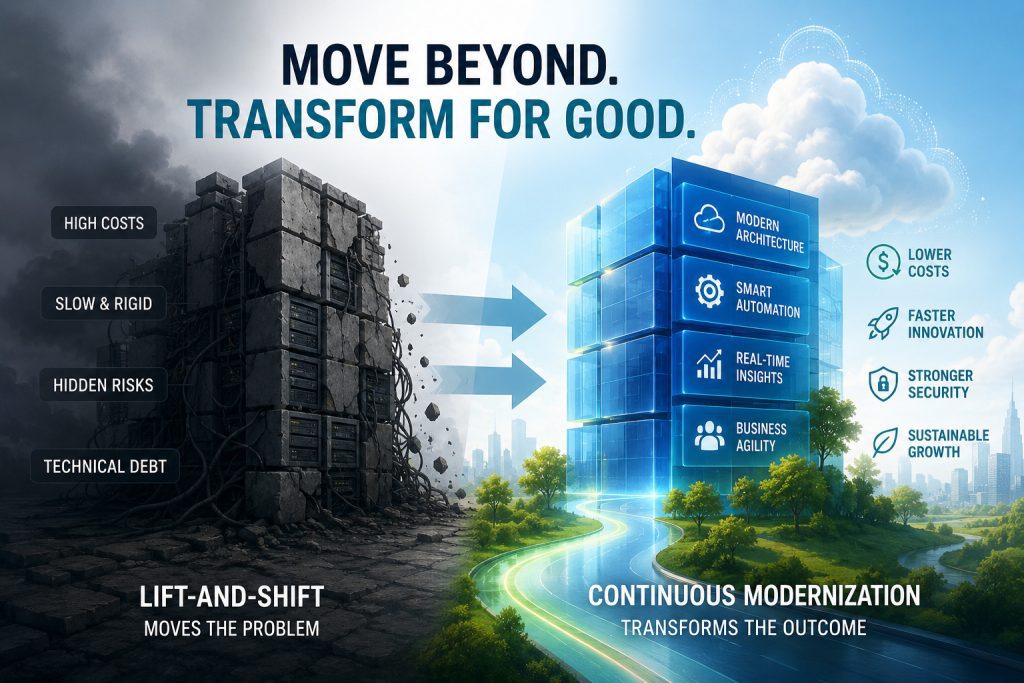
The distinction from a traditional project mindset is fundamental. A lift-and-shift migration may move an application from an on-premises data center to AWS, Microsoft Azure, or Google Cloud, but it rarely eliminates the aging code, brittle integrations, manual testing cycles, and compliance gaps that were accumulating long before the migration was planned.
Continuous modernization treats applications as living digital assets. It asks not just where an application runs, but whether it is easy to change, cost-effective to operate, secure, observable, integrated with the right data sources, and capable of supporting AI-powered business processes.
“Application modernization remains a critical priority for enterprises as they continue their journey to the cloud and beyond.” Forrester Wave: Application Modernization and Multicloud Managed Services.
Key takeaway: Migration changes where an application runs. Continuous modernization changes how well it supports the business.
How Does Continuous Application Modernization Reduce Technical Debt?
Continuous application modernization reduces technical debt by making it visible, scoring it by business impact, and resolving it through repeatable improvement cycles. Rather than waiting for a major transformation program every few years, enterprises continuously identify debt in architecture, integrations, testing, infrastructure, and data and address it as part of normal IT execution.
Technical debt accumulates across multiple layers. It appears as aging monolithic architecture, brittle middleware, limited test automation, unsupported platforms, manual release processes, insecure dependencies, and data silos that block AI enablement. IDC research shows that 47% of IT leaders cite technical debt as a major contributor to overspending on cloud and digital infrastructure.
A structured modernization approach addresses debt across six dimensions:
- Architecture: Evaluating whether applications should be rehosted, replatformed, refactored, re-architected into microservices, rebuilt, replaced with SaaS, or retired.
- Integration: Replacing fragile point-to-point connections with API-led integration, event-driven architecture, and governed data movement.
- Quality Engineering: Implementing automated testing, continuous testing pipelines, performance engineering, and AI-assisted test maintenance to reduce manual effort.
- Cloud & Infrastructure: Continuous optimization of scalability, resilience, observability, cost efficiency, and security across hybrid and cloud-native environments.
- Data & AI Readiness: Establishing governed data flows, analytics pipelines, and the integration patterns needed to support AI-powered business processes.
- Managed Services: Sustaining reliability, compliance, security, and performance improvement after initial modernization phases are complete.
Key takeaway: McKinsey research found that enterprises tackling technical debt alongside migration reported 30–50% reductions in operational overhead and significantly faster development cycles.
The Prolifics CLEAR Framework for Continuous Modernization
The CLEAR Framework is Prolifics’ structured model for enterprise application modernization. It organizes modernization activity across five connected dimensions: Classify, Liberate, Evolve, automate, and Retain. Each phase reduces technical debt, improves system quality, and builds momentum toward AI-ready enterprise architecture.
| CLEAR Phase | Focus Area | Key Actions | Business Outcome |
| Classify | Portfolio Assessment | Score applications by risk, debt, cost, and business value | Prioritized modernization backlog |
| Liberate | Architecture Modernization | Refactor monoliths, adopt microservices, containerization (Kubernetes, Docker) | Faster deployments, reduced coupling |
| Evolve | Integration & Data | API-led integration, event-driven architecture, governed data flows | Connected ecosystems, AI readiness |
| Automate | Quality & Delivery | CI/CD pipelines, automated testing, DevSecOps, observability | Faster releases, fewer defects |
| Retain | Managed Services | Ongoing monitoring, security, compliance, and continuous improvement | Sustained ROI, reduced operational risk |
What Should a Continuous Application Modernization Roadmap Include?
A continuous application modernization roadmap should include portfolio assessment, technical debt scoring, business value mapping, modernization pattern selection (rehost, replatform, refactor, re-architect, rebuild, replace, retire), integration planning, quality engineering, cloud optimization, and managed services governance. Every component should map to measurable business outcomes and quarterly review cycles.
A strong modernization roadmap follows eight structured steps:
- Assess the Full Application Portfolio – Inventory business-critical applications, dependencies, ownership, compliance requirements, cost, usage, and current architecture. Identify high-debt, high-risk systems first.
- Score Technical Debt by Business Impact – Rank debt based on maintenance cost, release friction, security exposure, regulatory pressure, integration fragility, and user experience impact.
- Select the Right Modernization Pattern – Apply the Six Rs framework: Rehost, Replatform, Refactor, Re-architect, Rebuild, Replace, or Retire. Not every application needs the same path.
- Modernize Integrations and Data Flows – Replace fragile middleware with API-led integration platforms, adopt event-driven architecture, and establish governed data pipelines for analytics and AI.
- Build Automation into Delivery – Implement DevSecOps practices, CI/CD pipelines, automated and continuous testing, observability tooling, and release governance frameworks.
- Optimize Cloud and Infrastructure Continuously – Monitor performance, cost, resilience, security, and compliance across hybrid cloud environments using infrastructure-as-code and cloud-native tooling.
- Sustain Improvement via Managed Services – Maintain application reliability, security, and compliance after initial modernization phases with ongoing operational support.
- Measure Modernization Value Quarterly – Track release velocity, defect reduction, technical debt scores, system availability, cloud cost savings, user adoption, and business impact KPIs.
What Is the Difference Between Lift-and-Shift and Continuous Application Modernization?
Lift-and-shift is a single migration tactic that relocates workloads to a new environment with minimal code change. Continuous application modernization is a long-term operating model that improves applications, reduces technical debt, modernizes integrations, automates delivery, and builds AI-ready infrastructure over time. The first moves applications. The second transforms them.
| Dimension | Lift-and-Shift Migration | Continuous Modernization |
| Primary Goal | Relocate workloads to cloud | Improve applications for sustained business value |
| Timeframe | One-time project or migration wave | Ongoing portfolio operating model |
| Technical Debt | Carried forward to new environment | Identified, scored, and reduced continuously |
| Architecture | Minimal change | Refactoring, microservices, cloud-native evolution |
| Integration | Existing dependencies remain | API-led, event-driven, governed data movement |
| Quality Engineering | Manual or fragmented testing | Automated, continuous, AI-assisted testing |
| Cloud Value | Infrastructure relocation | Scalability, cost optimization, AI readiness |
| Operations | Reactive support model | Proactive managed services with observability |
| Best Fit | Low-risk workloads needing fast exit | Business-critical systems that must keep evolving |
Which Industries Benefit Most from Continuous Application Modernization?
Financial services, healthcare, retail, insurance, and the public sector benefit most from continuous application modernization because their applications support high-volume transactions, strict compliance obligations, mission-critical operations, and evolving customer expectations. In these industries, legacy system failures directly affect revenue, regulatory standing, and public trust – making sustained modernization a business imperative.
In banking, Prolifics supported the modernization of more than 110 banking applications, replacing outdated systems with secure, agile, and compliant architectures. The program targeted operational efficiency, risk reduction, and accelerated innovation – outcomes that could not have been achieved through rehosting alone.
The same principle applies across sectors:
- Healthcare: Claims processing systems, EDI modernization, patient access platforms, inventory forecasting, and regulatory reporting require continuous improvement to meet HIPAA requirements and interoperability mandates.
- Insurance: Claims automation, underwriting platforms, policy administration systems, fraud detection, and customer service applications need regular modernization to handle increased data volumes and new AI use cases.
- Retail: Ecommerce platforms, loyalty systems, inventory visibility, supply chain resilience, and peak-demand performance require ongoing modernization to meet consumer expectations and omnichannel requirements.
- Public Sector: Government agencies face aging mainframe infrastructure, complex compliance requirements, and public accountability – making continuous modernization essential to service delivery.
Key takeaway: In banking alone, legacy system maintenance consumes 70% of IT budgets on average. Continuous modernization redirects that spend toward innovation, compliance, and customer value.
When Should Enterprises Move from Migration to Continuous Modernization?
Enterprises should move from migration to continuous modernization when legacy systems, technical debt, rising cloud costs, integration gaps, or slow delivery begin limiting business agility. The transition point often arrives before leaders recognize it, because applications may still function while quietly blocking innovation, AI adoption, and competitive responsiveness.
IBM connects modernization directly to cost efficiency, customer experience, developer productivity, and innovation — framing it as a hybrid cloud and AI enablement strategy, not just an infrastructure upgrade. The warning signs for action are typically visible across multiple dimensions:
- Release cycles are slower than business needs require
- Cloud costs are rising without corresponding value delivery
- Manual testing delays production changes and increases risk
- Integrations are fragile, expensive to maintain, or blocking data access
- Security and compliance exceptions recur despite remediation efforts
- Teams spend more than 30% of sprint capacity on legacy support and bug fixes
- Data cannot be easily accessed, trusted, or used for AI and analytics workloads
- Business teams maintain parallel workarounds outside core enterprise systems
Practical rule: If an application is important enough to migrate, it is important enough to modernize continuously. Migration creates the platform. Continuous modernization creates long-term business value.
What Questions Should Enterprise IT Buyers Ask Before Modernizing?
Enterprise IT buyers should ask questions that connect modernization decisions to measurable business value, risk reduction, and continuous improvement – not just technical delivery milestones. The best modernization partners explain how they reduce technical debt and sustain improvement over time, not just how they move or refactor applications in a fixed engagement.
Key evaluation questions for enterprise IT leaders:
- Which applications create the highest business risk or operational drag today – and how do you prioritize them?
- Where is technical debt slowing delivery, increasing cloud cost, or creating compliance exposure?
- How will the Six Rs framework (Rehost, Replatform, Refactor, Re-architect, Rebuild, Replace) be applied across our specific application portfolio?
- How will integration modernization improve business process speed, data governance, and partner connectivity?
- How will quality engineering reduce defects, testing effort, and release risk using automated and AI-assisted approaches?
- How will modernization improve AI readiness and data accessibility for analytics and intelligent automation use cases?
- How will managed services sustain improvement, security, and compliance after the initial modernization engagement ends?
Which KPIs will prove that modernization is reducing cost, delivery friction, and technical debt over time?
Common Modernization Mistakes Enterprises Should Avoid
Even well-funded modernization programs fail when they treat technical problems as purely technical. The most frequent mistakes that derail enterprise modernization initiatives include:
- Starting with technology selection before completing portfolio assessment and debt scoring
- Treating lift-and-shift as modernization moving debt rather than eliminating it
- Modernizing architecture without modernizing integration, testing, and delivery pipelines
- Setting no measurable KPIs for release velocity, defect reduction, or debt scorecard improvement
- Failing to align IT modernization roadmaps with business transformation goals
- Underinvesting in quality engineering manual testing remains a ceiling on deployment speed
Neglecting managed services – most modernization value is destroyed in the 18 months after go-live if operational support is not sustained.
CONCLUSION
From Migration to Modernization: Building Enterprises That Keep Evolving
Lift-and-shift migration was never the destination. It was a starting point a way to exit aging data centers and begin the cloud journey. The real value of cloud, AI, and digital transformation is unlocked when enterprises commit to the next step: continuous application modernization that eliminates technical debt, strengthens integration, automates quality, and builds architecture that can adapt.
The data is consistent across Gartner, McKinsey, Forrester, and IDC: enterprises that treat modernization as an ongoing operating model reduce costs, accelerate delivery, improve compliance, and gain a measurable AI advantage over competitors still running on unmodernized legacy stacks.
Looking ahead to 2027 and beyond, three trends will intensify the urgency: agentic AI systems that require real-time, governed data access across integrated enterprise platforms; quantum-safe security standards that will require architectural upgrades to cryptographic dependencies; and composable enterprise architecture that demands modular, API-connected systems as the baseline for any new product or capability.
Enterprises that establish continuous modernization as an operating discipline today will be better positioned to adopt and monetize every technology wave that follows.
Prolifics helps enterprises connect cloud-first modernization, AI-powered solutions, digital integration, quality engineering, enterprise automation, and managed services into a continuous modernization model designed for measurable business value at every stage.
FREQUENTLY ASKED QUESTIONS
What is continuous application modernization?
Continuous application modernization is the ongoing improvement of enterprise applications to reduce technical debt, improve scalability, enhance security, and align systems with cloud-native and AI-ready architectures. Unlike one-time upgrades, it is a long-term operating model focused on continuous business and technology optimization.
How is continuous application modernization different from lift-and-shift?
Lift-and-shift moves applications to the cloud with minimal changes, often retaining inefficiencies. Continuous application modernization, however, transforms applications through architectural upgrades, DevSecOps, and integration improvements, ensuring better performance, scalability, and long-term business value.
Why is technical debt critical in application modernization?
Technical debt increases maintenance costs, slows innovation, and creates security risks. It also limits integration with modern platforms and AI systems. Reducing technical debt through continuous modernization enables faster releases, better scalability, and improved ROI from digital transformation initiatives.
What should a modern application modernization roadmap include?
A strong roadmap includes application assessment, technical debt analysis, business value mapping, modernization strategy (e.g., replatforming, refactoring), API-led integration, cloud optimization, DevSecOps implementation, and continuous performance monitoring tied to business KPIs.
How does application modernization support AI adoption?
Application modernization enables AI by breaking down legacy silos and creating scalable, API-driven, cloud-native architectures. This allows AI systems to access clean, real-time data, improving model performance, accelerating deployment, and increasing the success rate of enterprise AI initiatives.


