

Managed testing services play a critical role as enterprise software now sits at the core of how modern businesses operate. From customer engagement and supply chain optimization to regulatory compliance and AI-driven decision making, software reliability directly affects performance and growth.
When software fails, the impact is immediate:
- Revenue and operational efficiency take a hit
- Customer trust and retention decline
- Compliance risks increase
- Digital transformation initiatives stall
Industry research shows that organizations facing frequent production issues experience higher downtime and customer churn than those that invest early in quality assurance. As systems grow more interconnected and release cycles accelerate, even small defects can create enterprise-wide disruption.
This is why leaders are rethinking how software testing services are delivered and governed. Managed testing services are no longer optional support functions. They are becoming a strategic necessity for enterprises navigating scale and complexity.
The Evolution of Software Testing in the Enterprise
Software testing has shifted from a final checkpoint to a continuous discipline embedded across the development lifecycle.
Historically, testing focused on:
- Manual validation late in the release cycle
- Isolated QA teams operating independently from development
- Limited automation and fragmented tooling
Today, enterprise systems demand a very different approach.
Modern software testing services must support continuous integration, frequent releases, and real time feedback loops. This shift has led to the rise of enterprise testing solutions that emphasize automation, governance, and alignment with business outcomes.
Insight: Industry analysts consistently note that organizations practicing continuous testing detect defects earlier, reduce rework, and improve release confidence.
Why Traditional QA Models Are Under Pressure
As digital ecosystems grow more complex, traditional in-house QA models struggle to keep pace.
Enterprises face mounting pressure from:
- Rapid adoption of cloud, SaaS, and microservices architectures
- Increasing regulatory and security requirements
- Growing reliance on data and AI driven applications
These pressures expose structural gaps in many QA organizations.
Key Challenges Enterprises Encounter
- Difficulty hiring and retaining specialized QA talent
- High costs associated with maintaining testing tools and environments
- Inconsistent testing practices across teams and platforms
- Limited visibility into quality metrics and risk exposure
These challenges explain the growing shift toward outsourced software testing and structured managed QA services that offer scalability and expertise.
What Managed Testing Services Deliver That Traditional Models Cannot
Managed testing services introduce a fundamentally different operating model. Instead of supplementing internal teams, they provide ownership, accountability, and continuous improvement.
A comprehensive managed testing model typically includes:
- A defined quality assurance strategy for enterprises
- Test automation and QA management embedded into DevOps pipelines
- Centralized governance, metrics, and reporting
- Proactive risk identification and optimization
This approach allows enterprises to standardize quality while remaining flexible enough to support innovation.
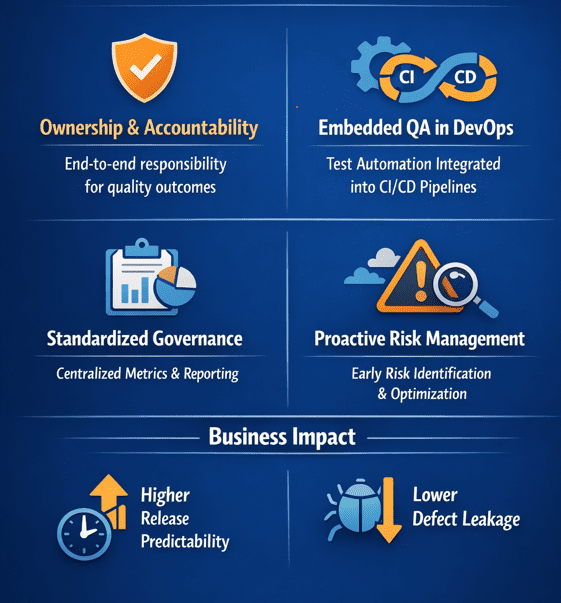
Insight: Organizations using managed testing models report higher predictability in release cycles and lower defect leakage into production.
Why Managed Testing Services Are Important for Enterprises Today
For enterprise leaders, the question is no longer whether testing is needed, but how it is delivered.
Understanding why managed testing services are important for enterprises starts with recognizing that quality failures carry real business consequences.
The Business Benefits of Managed Testing Services
- Accelerated time to market through automation and continuous testing
- Improved software stability and reduced production disruptions
- Predictable costs compared to fluctuating in house QA expenses
- Access to specialized expertise without long term hiring risk
These are not just technical gains. They directly support revenue growth, customer satisfaction, and operational resilience.
Enterprise Impact Across Industries
Different industries face different risks, but the role of quality remains universal.
QA testing services for enterprises are critical in:
- Financial services, where regulatory compliance and system uptime are non-negotiable
- Healthcare, where data accuracy and system reliability impact patient outcomes
- Retail, where performance and user experience drive conversion and loyalty
Across industries, enterprise testing solutions help organizations reduce risk while supporting innovation at scale.
Insight: Enterprises with centralized quality governance outperform peers in both release velocity and production stability.
Managed Testing Services as a Foundation for Digital Transformation
Digital transformation initiatives introduce new layers of complexity that traditional testing models struggle to address.
Managed testing services for digital transformation support:
- Validation of cloud migrations and platform modernization
- Testing of complex integrations and data pipelines
- Assurance for AI driven systems, models, and automated decisions
By embedding quality early, enterprises avoid costly rework and post-deployment failures that derail transformation programs.
What to Look for in a Managed Testing Partner
Choosing the right provider is essential to realizing value from managed QA services.
Enterprises should prioritize partners that offer:
- An automation first approach aligned with modern delivery models
- Proven experience across enterprise platforms and technologies
- Strong governance, metrics, and transparency
- A business outcome driven mindset
The right partner acts as a strategic extension of the enterprise, not just a testing vendor.
Final Perspective
At Prolifics, we believe quality assurance is no longer a downstream activity. It is a core component of business strategy. As enterprises scale digital initiatives, modernize platforms, and adopt AI driven solutions, testing must evolve to enable speed, trust, and long-term resilience.
Through our managed testing services, Prolifics helps organizations embed quality across the delivery lifecycle. Our approach focuses on automation, governance, and measurable business outcomes, enabling enterprises to reduce risk, accelerate transformation, and turn quality into a true competitive advantage.
For organizations navigating complexity at scale, Prolifics partners with clients to ensure quality becomes a foundation for sustained innovation and growth.


