
Enterprise software development is entering a new era where natural language prompts replace complex coding as the starting point for innovation. By enabling teams to build applications through simple, conversational inputs, organizations can accelerate delivery, enhance collaboration, and unlock unprecedented agility in how software is designed, developed, and scaled.
At Prolifics, we see this as a strategic inflection point, one that empowers enterprises to build faster, innovate smarter, and scale securely.
| IDC predicts that, by 2028, 80% of foundation models used for production-grade use cases will include multimodal AI capabilities to deliver improved use case support, accuracy, depth of insights, and inter-mode context. The following predictions highlight key trends that will shape AI adoption, automation, and business transformation across Asia/Pacific: 1. Small models: By 2026, 90% of Asia-based top 1000 (A1000) enterprises’ use cases for LLMs will be dedicated to training SLMs because of cost, performance and expanded deployment options. 2. AI Adoption Inflection Point: By 2027, AI adoption barriers will become indistinct due to the AI infrastructure commoditization, advanced LC/NC tools and security frameworks, leading to reduction of AI build costs by nearly 70%. 3. Dawn of Enterprise AI Agents: By 2025, 60% of A1000 organizations will use enterprise agents configured for specific business functions, instead of focusing on individual co-pilot technologies to achieve faster business value from AI. 4. Hybrid Cloud Inferencing: By 2026, 70% of A1000 enterprises will adopt hybrid edge-cloud inferencing as organizations fully integrate edge into cloud infrastructure and management strategy. |
From Code-Centric to Intent-Centric Development
Traditional development focuses on how to build software, languages, syntax, architecture. But natural language prompts shift the focus to what needs to be built.
Instead of writing hundreds of lines of code, teams can now instruct AI systems using plain English:
- Build a secure customer onboarding workflow
- Create a predictive analytics dashboard
- Generate APIs with authentication and validation
AI models interpret these prompts and generate functional code, accelerating development cycles dramatically.
This shift reduces dependency on deep coding expertise and opens the door for business users, analysts, and product teams to actively contribute to software creation.
The Rise of Prompt-Driven Development
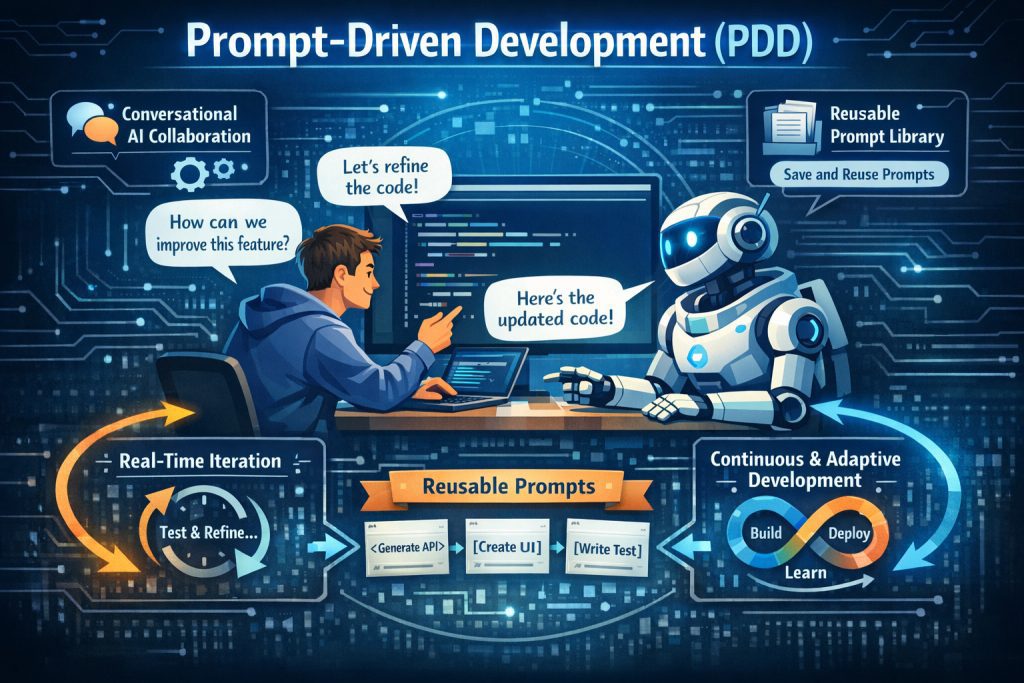
Natural language prompts are powering a new approach: Prompt-Driven Development (PDD).
In this model:
- Developers collaborate with AI systems conversationally
- Prompts become reusable assets
- Iteration happens in real time
- Development becomes continuous and adaptive
This approach eliminates traditional bottlenecks in software engineering, manual coding, misinterpreted requirements, and delayed feedback loops.
At Prolifics, we extend this concept into enterprise-grade delivery, combining AI-driven development with cloud-native architectures, DevOps automation, and governance frameworks to ensure outcomes that are not just fast but scalable and secure.
What are Natural Language Prompts?
Natural language prompts are short pieces of text that provide context and guidance to machine learning models, particulary in natural language processing (NLP) tasks. They can be simple queries, commands, or more complex statements that include context, instructions, and conversation history. The effectiveness of these prompts significantly influences the quality of the AI’s responses.
Why Enterprises Are Embracing Natural Language Prompts
The impact of natural language-driven development is already visible across industries. Enterprises are leveraging it to:

1. Accelerate Time-to-Market
AI-powered prompting compresses development cycles from weeks to days, sometimes even hours. By automating repetitive coding tasks, teams can focus on innovation rather than execution.
2. Democratize Software Development
Non-technical users can now participate in building applications, breaking down silos between IT and business teams. This democratization fosters cross-functional collaboration and faster decision-making.
3. Enable Rapid Prototyping
Ideas can be quickly transformed into working prototypes, allowing enterprises to validate concepts early and reduce rework.
4. Improve Software Quality
AI-assisted development enhances testing, documentation, and code reviews, ensuring higher quality outputs with fewer defects.
5. Reduce Development Costs
With fewer manual efforts and faster delivery cycles, enterprises can significantly lower development and operational costs.
Beyond Speed: The Need for Enterprise-Grade Control
While the benefits are compelling, enterprise adoption requires more than speed. It demands:
- Security and compliance
- Scalability across systems
- Integration with existing IT ecosystems
- Robust governance frameworks
This is where many organizations struggle. AI-generated code, if not governed properly, can introduce risks, technical debt, vulnerabilities, and compliance gaps. At Prolifics, we address this challenge head-on.
The Prolifics Approach: AI-Powered, Enterprise-Ready
We don’t just enable prompt-driven development, we operationalize it for the enterprise.
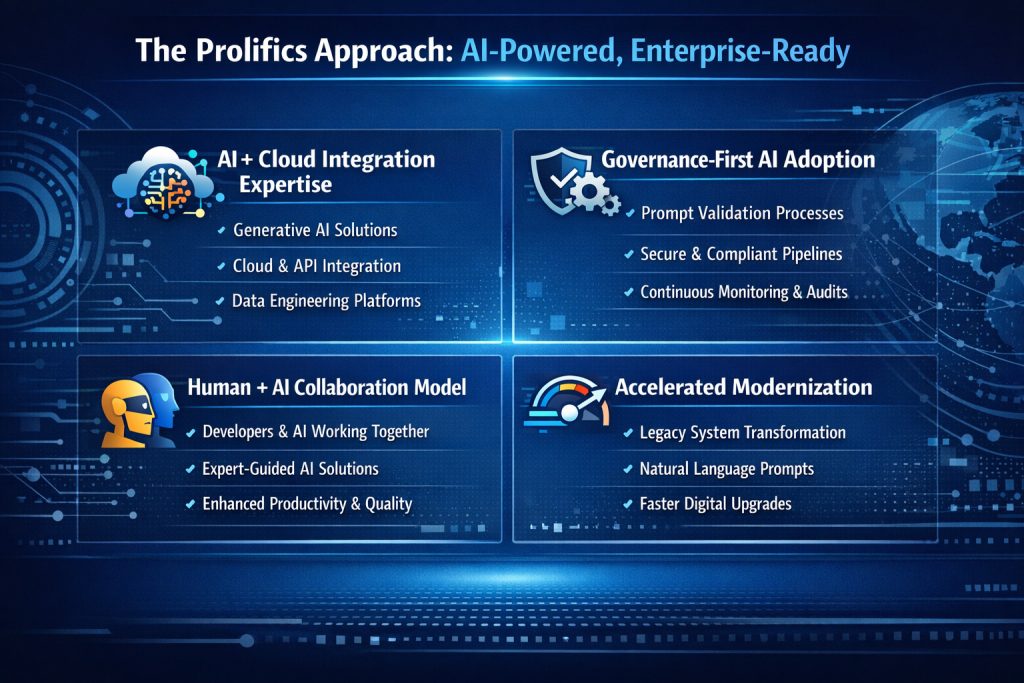
1. AI + Cloud + Integration Expertise
Prolifics combines Generative AI with deep expertise across:
- AWS, Google Cloud, and Salesforce ecosystems
- API-led integration strategies
- Data engineering and AI platforms
This ensures that AI-generated solutions are fully integrated, production-ready, and future-proof.
2. Governance-First AI Adoption
We embed AI governance frameworks into every stage of development:
- Prompt validation and versioning
- Secure code generation pipelines
- Compliance monitoring and auditability
This aligns with enterprise requirements for security, privacy, and regulatory compliance.
3. Human + AI Collaboration Model
AI doesn’t replace developers, it augments them.
Our approach ensures:
- Developers validate and refine AI-generated code
- Architects guide system design and scalability
- Business teams collaborate through intuitive interfaces
This hybrid model maximizes productivity while maintaining control.
4. Accelerated Modernization
Natural language prompts are not just for new applications, they are transforming legacy modernization.
Enterprises can:
- Rebuild legacy systems faster
- Generate APIs for older platforms
- Migrate applications to cloud-native architectures
This accelerates digital transformation without disrupting existing operations.
Real-World Enterprise Impact
Organizations adopting natural language-driven development are already seeing measurable outcomes:
- Faster transition from concept to production
- Reduced rework through early validation
- Increased innovation across departments
- Enhanced collaboration between business and IT teams
By enabling teams across product, design, and operations to contribute directly, enterprises are unlocking new levels of agility and creativity.
Best Practices for Success
To fully realize the potential of natural language prompts, enterprises must adopt a structured approach:
- Write Detailed Prompts
Clear, context-rich prompts produce better results.
- Establish Governance
Implement guardrails for AI usage, including security and compliance checks.
- Iterate Continuously
Use feedback loops to refine outputs and improve accuracy.
- Validate AI Outputs
Always review and test AI-generated code before deployment.
- Align with Business Objectives
Ensure prompt-driven development aligns with strategic goals, not just technical efficiency.
The Future: Software Built at the Speed of Thought
Natural language prompts are not just enhancing software development, they are redefining it.
As AI continues to evolve, we are moving toward a future where:
- Software is built conversationally
- Innovation is accessible to everyone
- Development cycles are near-instantaneous
- Enterprises operate with unprecedented agility
This is more than automation, it’s a new operating model for digital enterprises.
Why Prolifics?
At Prolifics, we help enterprises move beyond experimentation to real, scalable AI adoption.
We enable organizations to:
- Harness Generative AI for software development
- Modernize applications with speed and precision
- Build secure, compliant, and scalable systems
- Drive measurable business outcomes
Natural language prompts are just the beginning. With Prolifics, you don’t just adopt AI, you transform how your enterprise builds, innovates, and grows.
Ready to Build the Future of Software?
The question is no longer if enterprises will adopt natural language-driven development, it’s how fast they can do it.
Partner with Prolifics to unlock:
- Faster innovation
- Smarter development
- Scalable transformation
Let’s turn your ideas into enterprise-grade software, at the speed of thought.


