As enterprises accelerate digital modernization, IBM Consulting has introduced a powerful solution designed to transform how organizations manage and evolve their SAP environments. The IBM Consulting Application Management Suite (ICAMS), launched amid rising demand for AI-driven innovation, is rapidly becoming a cornerstone of Intelligent SAP transformation initiatives and a core Enterprise SAP transformation strategy for global organizations.
With the global shift toward SAP S/4HANA and increasingly hybrid ERP landscapes, organizations face mounting complexity in SAP application management. Managing legacy systems, extensive custom code, and continuous operational demands has slowed adoption, with only a fraction of enterprises completing full SAP S/4HANA transformation programs due to scale, risk, and cost concerns key challenges addressed through AI-driven SAP modernization.
IBM addresses these challenges head-on with ICAMS, an AI-infused solution that simplifies the entire SAP application management lifecycle, from implementation to continuous operations. Built on generative and agentic AI, the suite enables AI-powered SAP operations that significantly reduce manual effort while improving system agility and resilience critical for any long-term enterprise SAP transformation strategy.
Key AI-Driven Capabilities of ICAMS
At its core, ICAMS applies AI across six critical areas of SAP operations, positioning it as an AI-driven SAP application management suite that supports scalable modernization:
Synthetic data generation for accelerated and reliable regression testing
Automated documentation to reduce dependency on manual knowledge transfer
Process flow reverse engineering for improved system understanding
Comprehensive impact analysis to minimize risks during changes
Proactive monitoring with AI-driven remediation to prevent disruptions
Adaptive script and story generation to support ongoing development needs
Together, these capabilities position IBM ICAMS as a powerful accelerator for intelligent SAP transformation, delivering measurable productivity gains, faster time-to-value, and stronger SAP application management outcomes across complex enterprise environments.
Client-aligned delta code generation: ICAMS translates complex change requirements into compliant, client-specific delta code, significantly reducing development cycles while mitigating regression risks, critical during SAP S/4HANA migrations and ongoing AI-powered SAP operations.
Automated testing and impact analysis: Built-in automation enhances release confidence by proactively identifying dependencies and risks, ensuring stability across every SAP release cycle.
Strategic enablement through IBM Consulting Advantage: More than a management tool, ICAMS serves as a scalable innovation platform that evolves with business needs, supporting AI-driven SAP modernization and automated SAP lifecycle management beyond static maintenance models.
Designed for hybrid enterprise ecosystems: As highlighted by recent Forbes insights, enterprises increasingly require seamless integration between SAP and non-SAP analytics platforms. ICAMS supports this shift through strong governance, cross-platform alignment, and optimized architectures, especially in Generative AI–enabled SAP environments.
Intelligent automation for enterprise resilience: By reducing operational overhead and improving integration across SAP and adjacent systems, ICAMS enables faster insights, smarter decision-making, and stronger operational resilience, demonstrating how AI simplifies SAP S/4HANA migration while future-proofing the enterprise.
Future-ready SAP transformation: As SAP support timelines evolve and system landscapes grow more complex, ICAMS plays a critical role in unlocking sustained business value post–go-live, leveraging Agentic AI to power continuous SAP operations and long-term enterprise modernization.
Where Prolifics Fits In
As organizations adopt solutions like ICAMS, Prolifics serves as a trusted transformation partner, helping enterprises operationalize intelligent SAP transformation at scale. With deep expertise in SAP application management, AI-driven SAP modernization, analytics integration, and enterprise transformation, Prolifics enables clients to maximize the value of IBM’s innovations.
By combining IBM Consulting technologies with Prolifics’ delivery excellence, organizations can move confidently from SAP S/4HANA transformation to sustained business outcomes long after initial go-lives.
In today’s digital economy, data is the engine that powers innovation, intelligence, and competitive advantage. Yet, moving data, whether from legacy systems to modern cloud environments or between platforms, remains one of the most complex technical and business challenges that enterprises face. AI-driven data migration has emerged as a critical enabler for enterprises looking to modernize faster and smarter.
Data migration projects are notorious for overrunning timelines, exceeding budgets, and jeopardizing data quality and security without a clear enterprise data migration strategy. Gartner research indicates that a significant majority of data migration initiatives exceed budget or fail outright without careful strategy and execution.
This is where Prolifics AI Data Solutions plays a transformational role. Prolifics combines industry expertise, artificial intelligence (AI), automation, and deep engineering capabilities to not just migrate data, but to modernize data ecosystems through AI-powered data migration, boost business value, and accelerate digital transformation through AI-powered data migration approaches.
Why Data Migration Remains Challenging
Before we explore Prolifics’ solutions, it’s essential to understand why many data migrations falter:
1. Data Integrity and Loss Migrating large volumes of data across systems can lead to data loss or corruption if formats, schemas, or validation rules aren’t perfectly aligned. Such inconsistencies can disrupt analytics, reporting, and downstream processes, especially during cloud data migration for enterprises.
2. Compatibility and Schema Differences Legacy systems and modern platforms often use disparate data structures. Without thorough data mapping and transformation logic, data may become unusable after migration, weakening efforts toward data modernization with AI.
3. Downtime and Disruption Traditional migration techniques can cause systems to go offline, compromising business continuity and potentially leading to revenue loss, especially in mission-critical environments such as cloud data migration for enterprises.
4. Security and Compliance Risk Sensitive data moving between environments must remain secure at all times. Inadequate encryption, weak access control, or a lack of compliance governance can expose organizations to breach risks and regulatory penalties during AI-driven data migration.
5. Budget Overruns and Project Delays Analysts report that many data migration efforts exceed cost estimates by double digits, often due to unforeseen complexities and insufficient planning tied to an ineffective enterprise data migration strategy.
6. Post-Migration Challenges Even after successful transfer, organizations can face compatibility issues, missing data, and user adaptation problems if remediation and validation practices aren’t incorporated.
Best Practices for Successful Data Migration
To counter these challenges, market best practices help frame a successful migration driven by data modernization with AI:
Comprehensive Planning & Assessment: Establishing a clear roadmap with business and technical stakeholders ensures all data sources, quality issues, and dependencies are well documented.
Data Profiling & Cleansing: Identifying data quality issues early reduces the risk of migrating irrelevant or corrupt data.
Incremental Migration & Testing: Phased migration with ongoing validation minimizes risk and enables early error detection.
Security & Governance: Encrypting data in transit and at rest, enforcing access controls, and embedding compliance measures protect sensitive information throughout AI-powered data migration initiatives.
Automated Validation: Using AI-powered validation tools strengthens data migration automation and ensures data integrity is preserved before, during, and after migration.
Post-Migration Support: Organization readiness, user training, and production-level support ensure seamless adoption of the new environment.
While these practices are widely recognized, successfully applying them at scale requires intelligent tooling that clearly demonstrates how AI improves enterprise data migration outcomes.
Prolifics’ Approach to AI-Driven Data Modernization
Prolifics delivers end-to-end AI and data solutions that help enterprises not just move data, but unlock its full value through AI-driven data migration. With industry-leading capabilities spanning strategy, engineering, analytics, and governance, Prolifics accelerates data transformation while mitigating risk using AI-powered data migration capabilities.
1. AI-Powered Migration Automation: Prolifics ADAM
One of the signature offerings in the Prolifics portfolio is ADAM (Automated Data and Migration), an AI-accelerated framework that automates critical migration tasks and strengthens data migration automation such as:
Schema conversion and normalization
Data transformation and cleansing
Automated validation and reconciliation
Business continuity with minimal downtime
ADAM leverages AI to reduce manual effort, decrease errors, and drastically shrink migration timelines, supporting automated data migration solutions and often achieving over 50% faster execution compared to traditional approaches.
2. Cloud & AI Data Cloud Migrations
Prolifics specializes in moving data to leading cloud platforms such as Snowflake, ensuring that migrations deliver more than just a new home for data they deliver a modern analytics foundation through cloud data migration for enterprises. These cloud migrations include:
Legacy warehouse modernization
End-to-end pipeline transformation
Rebuilding or refactoring analytics stacks
Integration with BI tools and ML workflows
A structured, AI-augmented migration plan ensures minimal risk, optimized performance, and measurable ROI at every stage of an enterprise data migration strategy.
3. Intelligent Data Engineering & Analytics
Post-migration, the work of extracting business value begins. Prolifics’ AI-powered data engineering and analytics services help enterprises do just that through data modernization with AI:
Automated data preparation and enrichment
AI-enabled anomaly detection and data quality monitoring
Real-time analytics and predictive insights
Cloud-native, scalable data pipelines
These capabilities reduce manual effort by 60-70% and accelerate time-to-value for data insights, demonstrating how AI improves enterprise data migration outcomes.
4. Security, Compliance & Governance
Prolifics embeds robust data governance frameworks into every migration and analytics engagement, ensuring that data privacy, regulatory compliance, and security controls are upheld throughout secure AI-driven cloud data migration design, execution, and operations.
5. Industry-Focused Expertise
Whether in banking, healthcare, retail, manufacturing, or government, Prolifics brings domain knowledge that aligns data initiatives with unique industry challenges and regulatory landscapes, ensuring outcomes that are both strategic and achievable while advancing enterprise data modernization.
Business Impact: Turning Data Challenges into Strategic Advantage
By integrating AI with engineering rigor and business empathy, Prolifics helps organizations eliminate the friction typically associated with data migration and modernization through AI automation for legacy data migration. The result is more than a technical transition it’s a platform for competitive differentiation.
Reduced Costs and Faster Time-to-Value AI automation and repeatable frameworks preserve budget and schedule commitments by reducing manual toil and unexpected remediation cycles.
Improved Data Trust and Accuracy Automated validation, cleansing, and governance layers ensure that data remains consistent and reliable, amplifying confidence in analytics and reporting.
Enhanced Business Continuity Minimizing downtime and ensuring smooth cutovers means core business functions stay online during migrations, protecting operations and customer experience.
Tangible Outcomes and ROI Organizations that partner with Prolifics often see measurable improvements in agility, insight velocity, and strategic alignment, supported by AI-ready data ecosystems that fuel innovation.
Conclusion
Data migration doesn’t have to be a project burdened by risk, uncertainty, and hidden costs. By combining best practices with AI-driven data migration, automation, and deep engineering expertise, Prolifics AI Data Solutions turns data modernization into a strategic growth enabler.
Whether modernizing legacy systems, enabling cloud data migration for enterprises, or building a foundation for AI-driven analytics, Prolifics delivers a roadmap that is agile, secure, scalable, and aligned to business value.
Government agencies across federal, state, and local levels face growing pressure. Case volumes continue to rise. Eligibility rules are becoming more complex. Staffing constraints limit the ability to scale operations. At the same time, citizens expect services that are timely, transparent, and responsive. Many now compare government experiences to those they receive from AI-powered government services in the private sector.
Over the past decade, automation and workflow tools have helped streamline individual steps in government processes. These efforts supported early government automation with AI initiatives. However, many agencies remain locked in reactive operating models. Case backlogs grow faster than they can be resolved. Eligibility decisions take weeks or even months. Fraud and risk are often identified only after damage occurs.
Agentic AI in government represents a fundamental shift. Rather than automating isolated tasks, agentic AI enables systems to reason across policies, documents, and data. These systems act within defined guardrails and support human decision makers with transparency and accountability. This approach plays a key role in AI for public sector modernization.
Understanding Agentic AI in a Government Context
Agentic AI refers to AI systems designed to pursue defined objectives through reasoning, decision-making, and coordinated actions. Unlike rule-based automation, which follows fixed logic paths, agentic systems can interpret context, adapt to new information, and operate across multiple steps in a workflow.
This difference matters in government environments. Public-sector workflows are rarely linear. A single case may involve multiple programs, overlapping eligibility criteria, missing documents, and frequent policy changes. Agentic AI in government is designed to manage this complexity while remaining constrained by governance frameworks, compliance requirements, and human oversight.
Importantly, agentic AI does not replace public servants. It acts as a digital workforce. These systems support case workers, investigators, and administrators by handling repetitive analysis, surfacing insights, and documenting decisions. This directly strengthens intelligent case management in government and supports audit readiness.
Eligibility Determination Agents
The operational challenge
Eligibility determination is one of the most demanding government functions. Programs covering healthcare, income assistance, housing, education, and social services rely on detailed rules. These rules vary by jurisdiction and individual circumstances.
Case workers must gather data from multiple systems. They validate documents, interpret policy language, and ensure decisions are applied consistently. Manual processing increases delays and errors. These challenges directly contribute to backlogs, highlighting how agentic AI reduces government case backlogs.
How agentic AI supports eligibility determination
Eligibility determination agents interpret policy logic and apply it consistently across cases. These agents analyze structured and unstructured data from approved sources. They evaluate eligibility criteria, identify missing or conflicting information, and route exceptions to human reviewers. This approach reflects using agentic AI for eligibility determination in government.
Each step is fully documented. The agent records:
Which policy rules were applied
Which data sources were referenced
Why a recommendation was generated
This creates a clear audit trail. It supports transparency, compliance, and fairness through explainable AI for government.
Autonomous Document Routing and Summarization
The document burden in government
Government agencies manage large volumes of unstructured documents. These include applications, evidence, correspondence, and records. They arrive through many channels and formats. Manual review slows processing. It pulls staff away from higher-value work and increases compliance risk.
Agentic AI in document workflows
Agentic AI can classify and route documents automatically. It generates structured summaries while maintaining full case context and policy relevance. With clear document lineage and early detection of missing information, agencies reduce rework and improve accuracy. This strengthens government automation with AI while improving service delivery.
Fraud and Risk Detection with Transparent, Auditable Decisions
The complexity of fraud detection in government
Fraud and risk detection must balance effectiveness with fairness. Agencies must detect suspicious activity early. At the same time, they must avoid opaque models that cannot be explained to auditors, courts, or the public.
Agentic AI treats fraud and risk detection as a continuous and explainable process. Agents analyze patterns across cases, transactions, and documents. When anomalies are detected, they are flagged for review.
Each flag includes a clear explanation. The system shows why a case was identified, which indicators were used, and what evidence supports the finding. This enables transparent AI systems for public sector decision making and aligns with OECD and NIST guidance.
Where Prolifics Fits in the Agentic AI Journey for Government
Applying agentic AI in government requires more than technology. It demands a deep understanding of public-sector operations, regulatory environments, and real-world agency constraints.
Prolifics follows a policy-first, use-case-driven approach. Agentic systems are designed as part of a connected ecosystem that spans data, integration, automation, and governance. This supports AI for public sector modernization at scale.
A Practical and Responsible Approach
Prolifics works with agencies to identify high-impact, low-risk entry points, such as:
Eligibility screening
Document intake
Fraud risk analysis
Each use case is mapped to existing policies and compliance requirements before automation begins. Solutions are built as policy-driven AI systems and are designed to:
Operate within defined policy guardrails
Integrate with existing platforms
Support human decision makers
Maintain transparency and auditability
Engineering Trust and Scalability
Governance and trust are embedded into solution design. Every agent action is traceable. This includes data sources used, policy logic applied, and reasoning behind recommendations. This approach strengthens responsible AI in government without adding operational burden.
By aligning agentic AI with broader modernization initiatives, Prolifics helps agencies scale capabilities while maintaining control and consistency across programs.
Enabling Proactive Citizen Services
When agentic AI spans eligibility, documentation, and risk detection, agencies gain a holistic view of citizen needs. This allows a shift from reactive processing to proactive service delivery.
Agencies can:
Identify eligibility renewals before benefits lapse
Notify citizens of missing information earlier
Prioritize high-risk or high-impact cases
These outcomes improve equity, reduce frustration, and optimize resource allocation through AI-powered government services.
Governance, Guardrails, and Responsible AI
Responsible AI is essential in government. Agentic AI systems operate within strong governance frameworks. These include human-in-the-loop oversight, role-based access controls, continuous monitoring, and full audit trails.
This design aligns with standards such as the NIST AI Risk Management Framework and global governance models. It reinforces trust in explainable AI for government.
A Practical Path Forward for Agencies
Agencies do not need to replace existing systems. They can start with focused pilots and integrate agentic capabilities into current workflows. Over time, they can expand as maturity and confidence grow.
Well-defined use cases help agencies prove value, build internal trust, and establish governance practices that support long-term transformation in intelligent case management in government.
Key Takeaway
Government agencies are at a critical inflection point. Demand is rising. Resources are constrained. Citizen expectations continue to grow. New service models are required.
Prolifics helps agencies apply agentic AI in government responsibly. By combining intelligent automation with governance-driven design, agencies can move beyond backlogs toward proactive, citizen-focused services. When implemented thoughtfully, agentic AI strengthens integrity, reduces administrative burden, and empowers public servants to deliver lasting public value.
Modern manufacturing is changing fast. Factories are no longer limited by human work shifts or manual checks. Instead, they are moving toward lights-on manufacturing, where production runs all the time, without stopping, and makes smart decisions on its own. The key to this change is agentic AI in manufacturing, a new type of artificial intelligence that can think and act independently.
In this blog, we will explain how continuous autonomous operations work, why they are important, and how agentic AI in manufacturing is transforming the future of 24/7 smart manufacturing and intelligent industrial environments.
What Are Lights-On Operations in Modern Manufacturing?
Lights-on operations refer to manufacturing environments that function 24/7 with minimal or no human intervention, even during nights, weekends, or holidays. The term originates from the idea that factories no longer need constant human presence or even physical lighting to operate, a core principle of lights-on manufacturing.
In a lights-on factory, machines check their own health, and production lines adjust automatically to demand. Quality is monitored in real time, and issues are fixed or escalated without human help, enabling autonomous manufacturing systems to operate reliably at scale.
• Machines self-monitor performance and health • Production lines automatically adjust to demand • Quality checks happen in real time using vision systems • Exceptions are handled autonomously or escalated digitally
This approach is essential for AI-driven smart factories, where speed, accuracy, and reliability make all the difference. Continuous autonomous operations allow manufacturers to meet global demand, keep processes consistent, and handle disruptions instantly without waiting for human intervention, strengthening intelligent manufacturing operations across facilities.
Role of Agentic AI in Achieving 24/7 Efficiency
Agentic AI in manufacturing enables factories to run continuously without human involvement. Through real-time decision-making, adaptive responses, and seamless process coordination, agentic AI delivers the speed, precision, and resilience required for uninterrupted 24/7 smart manufacturing and large-scale autonomous manufacturing systems.
What Makes Agentic AI Different?
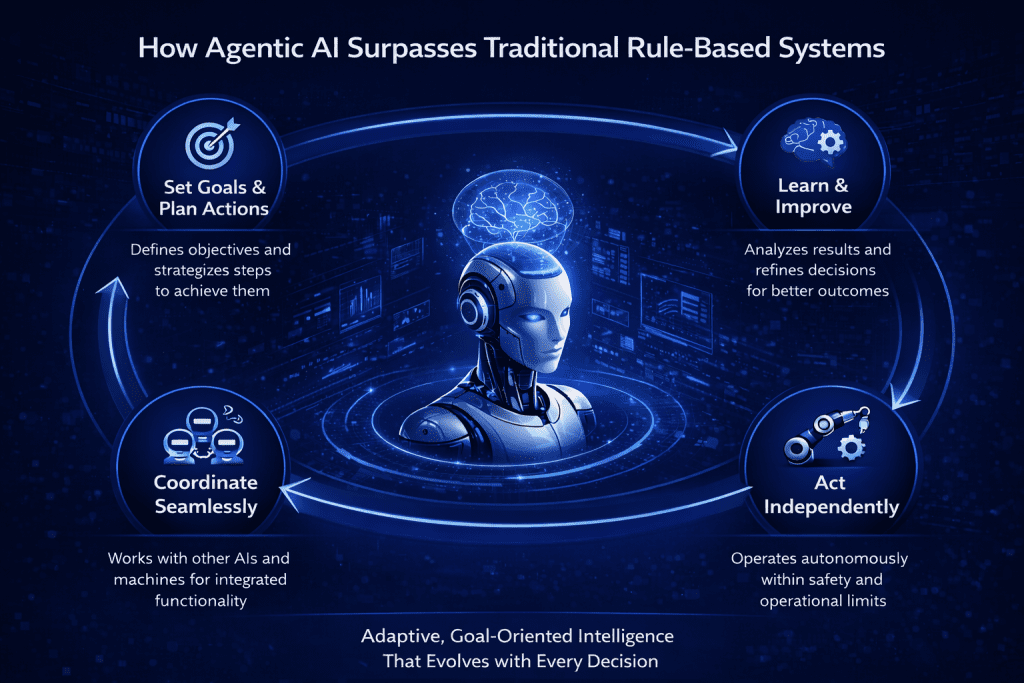
Agentic AI surpasses traditional rule-based systems by introducing adaptive, goal-oriented intelligence that evolves with every decision. It can be:
• Set goals and plan actions to achieve them • Learn from outcomes and improve decisions over time • Coordinate with other AI agents and machines for seamless operations • Act independently within defined safety and operational constraints
This intelligence layer is foundational for intelligent manufacturing operations that require minimal human oversight while maintaining high performance.
Key Benefits from Predictive Maintenance to Zero Downtime
Predictive maintenance allows manufacturers to address issues before equipment failure occurs, minimizing unplanned downtime. This supports smoother operations, improved efficiency, and more reliable production in AI-driven smart factories.
Predictive Maintenance
Agentic AI for predictive maintenance in factories analyzes sensor data, vibration patterns, and historical failures to predict breakdowns before they occur. Maintenance becomes proactive rather than reactive, significantly extending equipment life.
Reduced Downtime
By anticipating failures and optimizing schedules, factories move closer to near-zero unplanned downtime, a major cost saver in high-volume lights-on manufacturing environments.
Optimized Workflows
AI agents dynamically balance workloads across machines, adjust production sequences, and eliminate bottlenecks without manual planning, enabling self-optimizing manufacturing systems.
Cost and Energy Efficiency
Continuous optimization reduces waste, minimizes scrap, and lowers energy consumption by running machines only when needed and at optimal settings, strengthening 24/7 autonomous manufacturing operations with AI.
Consistent Quality
AI-driven inspection systems detect defects in real time, ensuring uniform quality even at high production speeds within autonomous manufacturing systems.
Challenges and Considerations for Implementation
Despite its promise, implementing lights-on operations powered by agentic AI in manufacturing is not without challenges. Organizations must address issues such as integrating data from legacy systems and ensuring strong cybersecurity measures. In addition, workforce upskilling and clear governance frameworks are essential to build trust in autonomous decision-making systems.
Data Integration
Factories often operate with fragmented legacy systems. Integrating PLCs, MES, ERP, and IOT platforms into a unified data fabric is complex but essential for intelligent manufacturing operations.
Cybersecurity Risks
Autonomous, connected systems expand the attack surface. Strong cybersecurity architectures, real-time monitoring, and zero-trust models are mandatory for AI-driven smart factories.
Workforce Adaptation
Lights-on manufacturing does not eliminate jobs; it changes them. Workers must transition from manual control to roles focused on supervision, AI training, system design, and exception handling.
Governance and Trust
Giving AI decision-making authority requires clear boundaries, explainability, and auditability to ensure safety and compliance.
Workforce Skills and Change Management
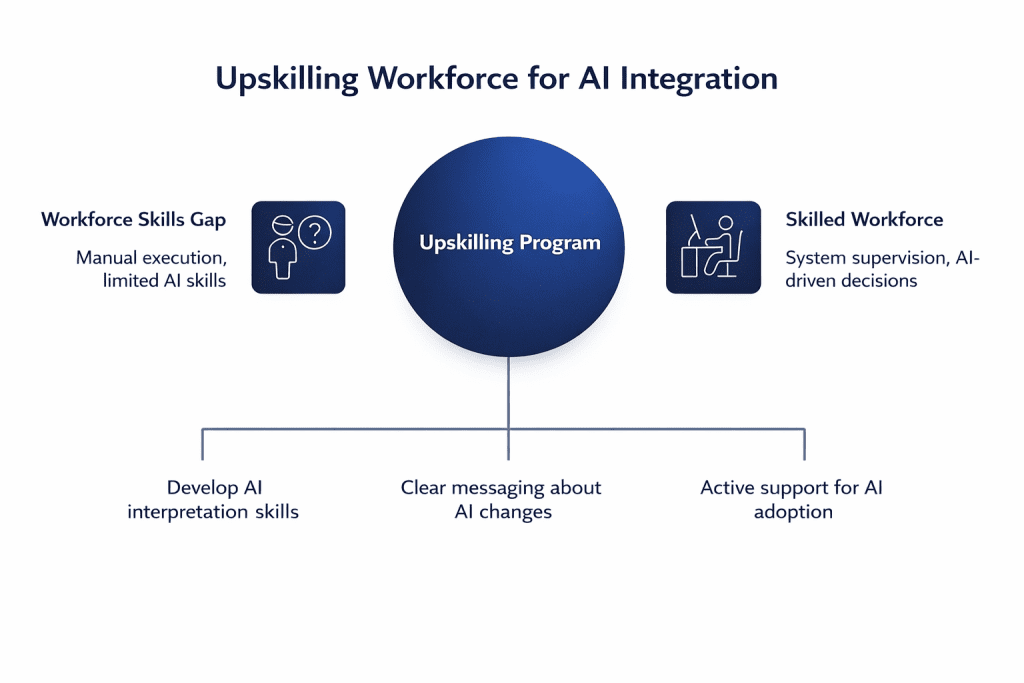
As factories adopt lights-on manufacturing and agentic AI in manufacturing, the role of the workforce shifts from manual execution to system supervision and decision support. Employees must be upskilled to work alongside intelligent systems, interpret AI-driven insights, and manage exceptions.
Effective change management, including training, clear communication, and leadership support, is essential to ensure smooth adoption and long-term success.
Scaling Agentic AI Across Global Manufacturing
As manufacturers scale globally, agentic AI in manufacturing will evolve from isolated deployments to networked intelligence across plants, regions, and supply chains.
Key trends shaping the future include:
• Digital twins that simulate entire factories in real time • Multi-agent systems coordinating across production, logistics, and procurement • Self-optimizing supply chains that adapt instantly to demand shocks • Deeper integration with Industry 4.0 standards and, eventually, Industry 5.0’s human-centric focus
In the coming years, competitive advantage will no longer come from automation alone but from autonomous intelligence at scale within 24/7 smart manufacturing ecosystems.
Conclusion
Lights-on operations powered by agentic AI in manufacturing represent a significant shift in modern manufacturing, enabling continuous, intelligent, and reliable production. By combining predictive maintenance, autonomous decision-making, and optimized workflows, manufacturers can reduce downtime, improve efficiency, and remain competitive in a rapidly evolving industrial landscape.
Learn how cloud-based ERP modernization supports scalable, intelligent manufacturing by exploring this SAP S/4HANA Cloud modernization case study.
While challenges around technology, security, and workforce adaptation remain, organizations that invest thoughtfully in these areas will be best positioned to lead the next phase of intelligent manufacturing operations.
In today’s data-saturated world, the organisations that win are those that don’t just collect information; they activate it. Making smarter decisions faster, automating with precision, and uncovering patterns that competitors miss isn’t just an advantage anymore: it’s a requirement.
But here’s the truth many leaders overlook, AI by itself is not the game-changer; data is. And to truly harness AI’s transformative power, enterprises need a modern data analytics architecture built on Azure data analytics for enterprises.
Many businesses rush toward fancy AI models without solving the core problem: messy, fragmented data spread across multiple systems. Inconsistent quality, siloed storage, and manual data preparation create bottlenecks that slow enterprise AI transformation and limit progress for AI-driven organizations.
And yet, when data is clean, unified, and easily accessible, everything changes for AI-driven organizations:
Predictive decisions replace reactive reporting.
Automations emerge as operational norms.
Decision-making processes become proactive instead of lagging.
To get there, organizations need a platform built not just for analytics, but for enterprise-grade AI intelligence, which is exactly what Azure delivers through its unified Azure data platform.
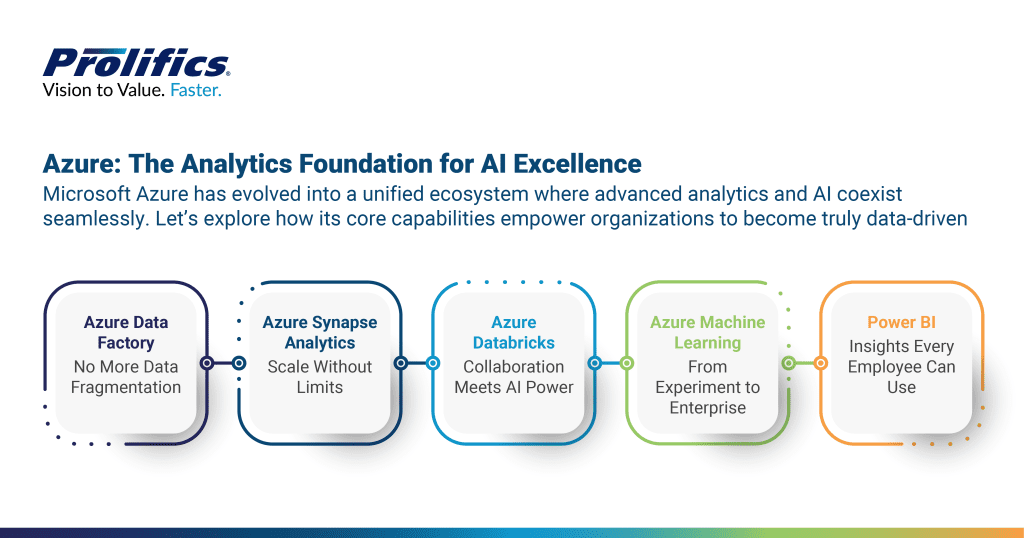
Azure: The Analytics Foundation for AI Excellence
Microsoft Azure has evolved into a unified ecosystem where advanced analytics and AI coexist seamlessly, enabling AI and data analytics on Azure at enterprise scale. Let’s explore how its core capabilities empower organizations to become truly data-driven through comprehensive Azure analytics solutions.
1. Azure Data Factory – No More Data Fragmentation
Azure Data Factory removes the barriers of disconnected systems by enabling:
Hundreds of native connectors for SaaS and on-premises sources
Scheduled and automated ETL/ELT workflows
Structured and unstructured data orchestration
This centralized ingestion and transformation engine creates a reliable, accurate data pipeline – the single source of truth every enterprise data analytics and AI on Microsoft Azure strategy demands.
2. Azure Synapse Analytics – Scale Without Limits
Whether your organization needs:
Petabyte-scale data warehousing
Real-time analytics
SQL-based reporting
Spark-powered big data processing
Azure Synapse combines these capabilities into one scalable, flexible solution within broader Azure analytics solutions. Teams can analyze massive datasets with blazing performance, enabling Azure analytics for enterprise decision making with speed and confidence.
3. Azure Databricks – Collaboration Meets AI Power
AI innovation requires collaboration between data engineers and data scientists. Azure Databricks provides:
A unified workspace for experimentation and model training
High-performance computing backed by Apache Spark
Integration with Delta Lake and MLflow
This ensures organizations can iterate quickly, deploy AI solutions faster, and continuously refine models as part of their broader enterprise AI transformation journey.
4. Azure Machine Learning – From Experiment to Enterprise
Building models is one thing, operationalizing them at scale is another. Azure ML closes that gap with:
Real-time and batch scoring for production environments
This turns AI from “nice to have” into a strategic operational capability powered by AI and data analytics on Azure.
5. Power BI – Insights Every Employee Can Use
True AI adoption doesn’t stop with data scientists, it ripples across the entire enterprise. With Power BI, teams benefit from:
Intuitive, interactive dashboards
Natural language insights
Embedded visual analytics
By democratizing information, Power BI ensures that everyone-from the C-suite to frontline operators-can act on insights generated through Azure data analytics for enterprises.
AI expands opportunity and risk. Azure’s governance tools, such as Purview and Entra, enable strong enterprise AI governance and security by making it possible to:
Track data lineage
Classify and protect sensitive information
Ensure regulatory compliance across models
This responsible approach builds trust and minimizes operational risk across AI-driven organizations.
Strategic Impacts of Azure Data Analytics
With Azure’s analytics ecosystem fully in place, organizations gain competitive advantages in four strategic areas:
1. Predictive Intelligence Across the Organization
No more waiting for last quarter’s report, Azure powers:
Demand forecasting
Customer churn prediction
Supply chain anomaly alerts
Machine failure predictions
These predictive insights enable proactive strategies using Azure analytics solutions.
2. Intelligent Automation of Routine Tasks
Manual data work becomes automated with Azure’s analytics + AI integration. Examples include:
Automated invoice classification
Predictive maintenance triggers
AI-generated executive reports
This efficiency unlocks higher-value innovation across AI-driven organizations.
3. Breaking Down Silos with a Unified Data Estate
Azure enables organisations to consolidate data from disparate systems into a unified lakehouse or data warehouse, strengthening the Azure data platform while eliminating silos and reducing integration costs.
4. Responsible AI Through Governance and Security
AI expands opportunity-and risk. Azure’s governance tools reinforce enterprise AI governance and security by enabling:
Track data lineage
Classify and protect sensitive information
Ensure regulatory compliance across models
This responsible approach reinforces trust across enterprise AI transformation initiatives.
Make Azure Analytics Work for You, Partner with Prolifics
Building a world-class analytics foundation on Azure is one thing. Achieving business impact from it is another.
As a strategic digital transformation partner, Prolifics helps enterprises unlock the full value of Azure data analytics for enterprises through scalable data engineering, advanced analytics, and AI.
Why Businesses Partner with Prolifics:
✔ End-to-end data engineering and analytics solutions – End-to-end data engineering and analytics solutions to support Azure data analytics for enterprises ✔ AI-powered transformation – Integrating machine learning and automation into every stage of your data workflow to accelerate innovation and insight generation. ✔ Accelerated digital outcomes – Faster deployment, lower operational costs, and measurable ROI with AI-enabled analytics solutions. ✔ Industry-specific expertise – From healthcare to finance, retail to manufacturing, Prolifics tailors Azure data solutions to deliver impact where it matters most. ✔ Microsoft partnership – Prolifics leverages deep collaboration with Microsoft to implement best-in-class cloud and data strategies that scale.
Whether your organization is just starting its AI journey or looking to take it to the next level, Prolifics provides the guidance, execution excellence, and proven frameworks to help you succeed.
Conclusion
In the race to become AI-driven, data analytics isn’t optional, it’s foundational. Microsoft Azure provides the technology stack, but to convert that technology into measurable business value requires strategy, skills, and execution.
That’s where Prolifics shines-turning complex data ecosystems into engines of insight, innovation, and competitive advantage through Azure data analytics for enterprises.
Ready to unlock the full power of Azure Data Analytics and AI?
Partner with Prolifics today and transform your data into your greatest strategic asset.
Artificial intelligence is becoming part of everyday healthcare. Yet many AI tools still focus on isolated tasks and struggle with real-world complexity. Healthcare teams are often left stitching together disconnected systems that fail to understand full clinical context or individual patient needs.
This is where Agentic AI in healthcare begins to change the conversation.
Unlike traditional tools, agentic systems are designed to act with greater autonomy, adapt as conditions change, and support smarter decision-making across the entire care journey. By combining data from clinical systems, patient interactions, and operational workflows, these systems enable AI-driven care pathways and more effective AI-powered patient care management. The result is a care experience that feels connected, personalized, and proactive.
At the same time, innovation must be balanced with responsibility. Ethical use, data privacy, and regulatory oversight remain essential. With the right governance, proactive healthcare AI can improve outcomes, reduce clinician burden, and help close gaps in access to quality care.
The Shift Toward Agentic AI in Modern Healthcare
Healthcare is moving beyond basic automation into an agentic era. In this era, AI systems work alongside clinicians to support reasoning, coordination, and decision-making using clinical decision intelligence.
Powered by advanced language models and intelligent analytics, modern AI builds on decades of progress. This includes early rule-based systems and recent advances in machine learning and medical imaging. Despite this progress, many AI tools still fall short in clinical environments.
Common challenges include:
Limited understanding of clinical context
Poor workflow integration
Difficulty meeting regulatory expectations
These gaps reduce real-world impact.
Agentic systems offer a practical way forward. By enabling clinical decision intelligence and intelligent care coordination, agentic AI helps healthcare teams anticipate needs rather than react to problems. When designed as safe and scalable agentic AI in healthcare systems, these technologies support proactive, patient-centered care pathways that clinicians trust and organizations can scale with confidence.
How Agentic AI Differs from Traditional AI
Traditional AI agents in healthcare rely on fixed rules. They perform well for predictable tasks such as answering standard questions or applying static clinical guidelines. However, they struggle when patient conditions change or when deeper context is required.
Agentic AI in healthcare works differently.
Key differences include:
Context awareness Agentic AI uses language-based reasoning to understand patient history, ask follow-up questions, and adapt responses in real time.
Multi-task capability Traditional AI is usually built for one task. Agentic AI can support diagnostics, summarize radiology reports, and enable AI-driven care pathways within the same system.
Adaptive decision-making Instead of following static rules, agentic systems update recommendations as new patient data becomes available. This enables agentic AI for predictive patient care management.
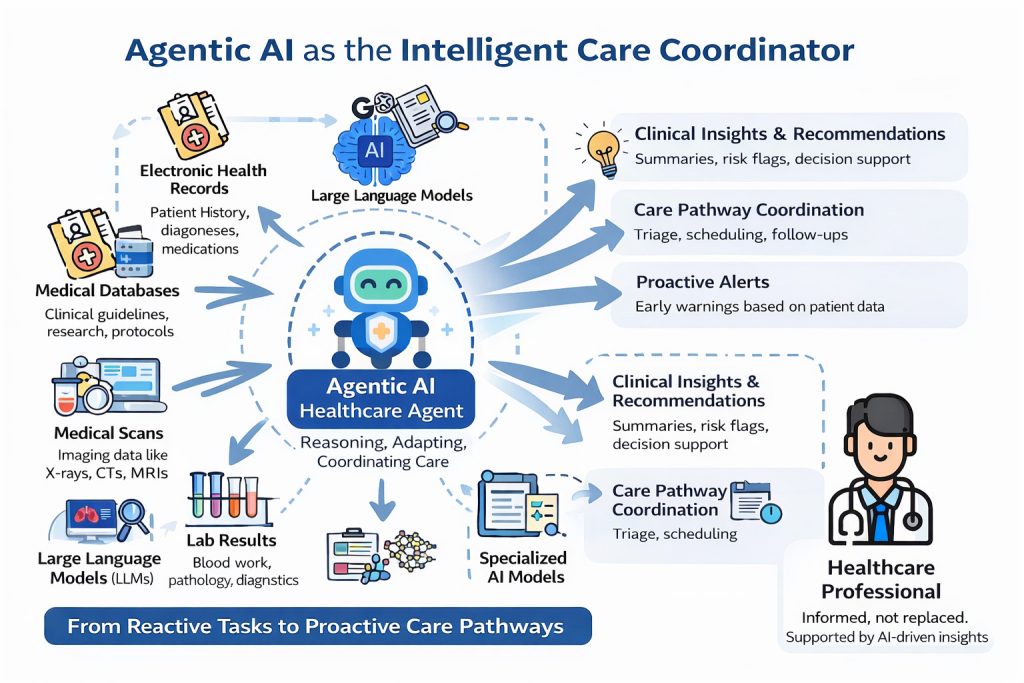
System integration Traditional tools often work in isolation. Agentic AI connects EHRs, lab results, imaging systems, and medical knowledge to enable intelligent care coordination.
When supported by strong AI governance in healthcare, autonomous AI in healthcare enables scalable, patient-centered care without compromising safety.
Technical Overview of Agentic AI
Agentic AI systems are designed to think and act by combining multiple AI components. At the core is a large language model responsible for reasoning and decision-making, supporting clinical decision intelligence across complex care scenarios. This model receives inputs from other AI systems that process text, images, and structured clinical data.
Some systems use open-source language models, offering greater transparency into how decisions are made. Others rely on proprietary models that may deliver strong performance but provide less visibility. What matters most is how well these components work together to support adaptive, context-aware decisions in Agentic AI in healthcare deployments.
A major strength of agentic AI is its modular design:
Models can be added or replaced as needs evolve
Tools can be updated without rebuilding the system
Architectures scale more easily over time
This flexibility is critical for long-term adoption in complex healthcare environments.
Why AI Agents Matter in Healthcare
Healthcare generates massive volumes of data from medical imaging, wearables, remote monitoring, and digital health records. While this data can improve care, it also increases complexity for clinicians.
At the same time, workforce shortages continue to strain healthcare systems.
AI agents help by:
Reducing administrative workload
Supporting clinical decision-making
Improving coordination across care teams
When used responsibly, autonomous AI in healthcare allows clinicians to focus more on patients and less on paperwork, while improving consistency and quality of care.
Key Features of Agentic AI in Healthcare
Autonomy
Agentic AI systems can operate independently based on defined goals and real-time data. Examples include:
Analyzing medical scans and selecting appropriate diagnostic methods
Generating initial radiology reports
Detecting language needs and applying translation tools in multilingual settings
These capabilities speed up workflows and reduce manual effort.
Adaptability
Unlike single-purpose systems, agentic AI evolves as clinical needs change. For example, an agent trained on X-ray data can later adapt to MRI or CT imaging, helping organizations stay current as technologies advance.
Scalability
Using cloud platforms and federated learning, agentic AI processes large and diverse datasets in real time. This is essential for telemedicine and distributed care models.
Probabilistic Decision-Making
Agentic AI continuously refines its conclusions as new information becomes available. Diagnoses and recommendations evolve as lab results, patient history, or population data are added. This supports safer, more context-aware care decisions.
Together, these features allow agentic AI to deliver efficient, flexible, and reliable support across healthcare settings.
Core Functional Areas of AI Agents in Healthcare
Healthcare-focused AI agents support the full care journey, including:
Diagnosis
Clinical decision support
Treatment and patient care
Patient monitoring and engagement
Operations and administration
Drug discovery and research
Robot-assisted surgery
Across each area, agentic AI improves data analysis, decision support, and operational efficiency.
AI Agents in Diagnosis
AI agents support clinicians by:
Analyzing medical images and patient data
Flagging potential abnormalities
Generating preliminary insights within clinical context
These tools reduce workload, improve diagnostic accuracy, and support earlier, more personalized diagnoses.
Challenges and Recommendations for Agentic AI in Healthcare
Data Availability and Privacy
Healthcare data is fragmented, sensitive, and highly regulated. Approaches such as federated learning, explainable AI, and bias mitigation are essential but complex to implement.
Regulation and Compliance
AI evolves faster than healthcare regulations. Continuous validation, monitoring, and human oversight are required to ensure safety and compliance.
Workflow Integration and Trust
Legacy systems, limited AI literacy, and poor explainability slow adoption. Successful deployment depends on clinician training, interpretable outputs, and real-world validation.
Infrastructure and Cost Constraints
Advanced AI requires significant compute resources and funding. Cloud platforms, open-source models, and scalable architectures can improve access.
Security and Adversarial Risks
AI systems may be vulnerable to manipulation. Robust testing, secure design, and defensive safeguards are critical.
Ethical and Legal Accountability
Unclear responsibility for AI-driven decisions raises ethical concerns. Clear documentation, governance frameworks, and explainable outputs are required.
Human Oversight and Governance
As systems become more autonomous, oversight becomes harder. Hybrid human-in-the-loop models and strong AI governance in healthcare help balance autonomy with control.
Future Directions for Agentic AI in Healthcare
Agentic AI will continue to evolve toward more general, multimodal, and proactive healthcare AI systems that assist clinicians rather than replace them.
Future progress will depend on:
Human-AI collaboration
Transparency and explainability
Ethical governance
Seamless workflow integration
Edge AI, federated learning, and secure data sharing will expand access, especially in resource-limited environments. Over time, how agentic AI enables proactive care pathways will define the next generation of preventive, personalized, and connected healthcare systems.
Key Takeaways
Agentic AI represents a major shift in how healthcare uses data, intelligence, and automation. Its value lies not in replacing clinicians, but in helping them make better, faster, and more informed decisions across diagnosis, treatment, operations, and patient care.
At Prolifics, this aligns directly with a focus on practical AI that delivers real clinical and business value. Through trusted partnerships, deep domain expertise, responsible AI practices, and strong integration capabilities, Prolifics helps healthcare organizations move from experimentation to measurable impact.
Agentic AI in healthcare will succeed only when it is transparent, secure, and designed around real clinical workflows. With the right governance, human oversight, and implementation strategy, agentic AI becomes a powerful enabler of better outcomes, more efficient systems, and more equitable access to care.
Enterprise AI readiness – Databricks has delivered a reality check that the enterprise AI world has been waiting for. With the launch of Databricks OfficeQA, a new open-source benchmark, Databricks shifts the conversation from theoretical AI brilliance to real-world business reliability, where mistakes aren’t merely academic but are also expensive. This marks a critical moment for enterprise AI readiness across industries.
Unlike popular benchmarks such as ARC-AGI-2 or Humanity’s Last Exam, which emphasize abstract reasoning, OfficeQA focuses on AI benchmarks for enterprises by testing what truly matters in real organizations: whether AI agents can reason accurately over large, messy, and evolving business documents.
This level of intelligence is essential for enterprise AI decision making in finance, compliance, operations, and analytics domains where “almost right” can mean regulatory risk, financial loss, or strategic missteps and directly impact AI reliability for business.
What Makes OfficeQA Different?
OfficeQA is built around grounded reasoning, which enables AI to answer questions using real, heterogeneous document collections rather than simplified prompts. To make this challenge authentic, Databricks used nearly 89,000 pages of U.S. Treasury Bulletins, spanning over 80 years of revisions, tables, and historical financial data.
The benchmark includes 246 rigorously verified questions, divided into “easy” and “hard” categories based on frontier model performance.
The Results: A Wake-Up Call for Enterprise AI
Even the most advanced AI agents struggled.
GPT-5.1 Agent achieved 43.1% accuracy overall
Claude Opus 4.5 Agent reached 37.4% accuracy
On the OfficeQA-Hard subset, scores dropped below 25%
Without access to documents, accuracy fell to ~2%
These numbers are striking and intentional. OfficeQA exposes a critical truth: strong performance on academic benchmarks does not translate to enterprise readiness.
Where AI Still Falls Short
Error analysis reveals persistent gaps that enterprises can no longer ignore:
Difficulty parsing complex financial tables
Poor handling of revised and versioned data
Weak visual reasoning, especially with charts and graphs
Misinterpretation of historical trends and key figures
In business environments, these aren’t edge cases, they’re everyday realities. And when AI gets them wrong, the consequences are real.
OfficeQA: Not a Scoreboard, but a Diagnostic Tool
Databricks positions OfficeQA not as a leaderboard but as a diagnostic instrument, a way to identify where AI systems break down and how they can be improved. Its focus on realistic documents and automatically verifiable answers makes it uniquely valuable for enterprises building production-grade AI.
To accelerate adoption and innovation, Databricks is launching the Grounded Reasoning Cup 2026, inviting researchers and industry leaders to expand OfficeQA beyond Treasury data and apply it to broader enterprise scenarios.
Why This Matters for Enterprises
OfficeQA reinforces a powerful message:
Enterprise AI success depends on data grounding, governance, and architecture, not just model size.
For organizations serious about deploying AI at scale, this benchmark highlights the need for platforms that combine:
High-quality data pipelines
Robust document intelligence
Governance-ready AI architectures
Continuous evaluation in real business contexts
OfficeQA is open-source, freely available, and already reshaping how the industry measures AI success. With this launch, Databricks isn’t just testing AI, it’s redefining what “AI-ready for business” truly means.
In a world where customer expectations evolve faster than ever, businesses need more than traditional software, they need a comprehensive platform that connects sales, marketing, service, and industry-specific workflows into one intelligent ecosystem. Salesforce Cloud is a suite of cloud-native solutions that help organizations of all sizes drive growth, deliver remarkable experiences, and innovate with confidence.
Whether you’re looking to supercharge sales, elevate customer service, streamline e-commerce, or tailor solutions for unique industry challenges, Salesforce Cloud has you covered.
What Is Salesforce Cloud? A Unified Platform for Digital Success
At its core, Salesforce Cloud refers to Salesforce’s comprehensive suite of cloud-based applications designed to automate and optimize key business processes. Built on a shared, secure infrastructure, these solutions allow teams to work smarter, collaborate seamlessly, and deliver personalized experiences across every touchpoint.
From core CRM functions like sales automation to deep industry-specific workflows, Salesforce Cloud empowers organizations to innovate faster and scale with agility using AI-powered CRM solutions.
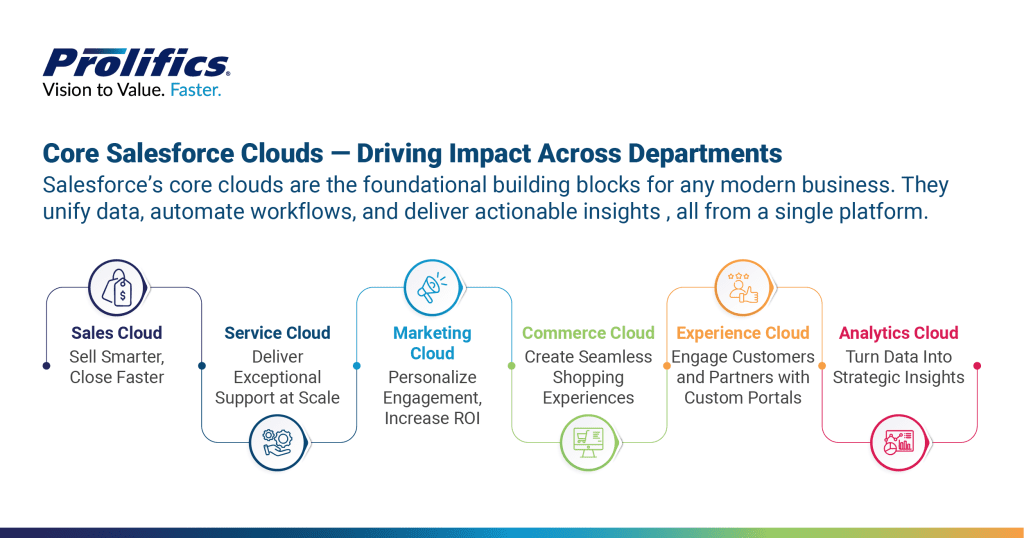
Core Salesforce Clouds – Driving Impact Across Departments
Salesforce’s core offerings are the foundation of modern Salesforce CRM solutions, unifying data, automating workflows, and delivering actionable insights from a single platform.
1. Sales Cloud – Sell Smarter, Close Faster
Sales Cloud is Salesforce’s flagship CRM solution. It is designed for sales teams that want to accelerate revenue growth. It helps businesses manage leads, track opportunities, forecast revenue, and streamline complex sales cycles with intelligent automation and insights, all while delivering a 360° view of the customer.
Key Benefits:
Lead and opportunity management
Advanced sales forecasting
AI-powered insights for prioritizing deals
Real-time dashboards and performance tracking
Ideal For: Sales teams seeking to convert more leads and win more deals using Salesforce Sales Cloud.
2. Service Cloud – Deliver Exceptional Support at Scale
Customer service can make or break a business. Service Cloud equips support teams with tools to manage cases, deliver omni-channel support, and resolve issues faster, whether customers reach out via chat, email, voice, or social. AI and automation guide agents with recommendations and streamline workload distribution for better outcomes.
Key Capabilities:
Omnichannel routing and case management
Smart chatbots and automation
Centralized knowledge base
Customer self-service portals
Ideal For: Support teams aiming to boost satisfaction and reduce resolution times.
3. Marketing Cloud – Personalize Engagement, Increase ROI
Marketing Cloud brings marketing automation, data-driven insights, and cross-channel campaign orchestration together in one powerful platform. Marketers can design personalized customer journeys, from email and mobile to social, and optimize every engagement for higher conversions.
What It Helps You Do:
Build personalized customer journeys
Automate campaigns across all digital channels
Track campaign performance with analytics
Leverage AI for smarter segmentation
Ideal For: Marketing teams looking to deepen engagement and maximize ROI.
Commerce Cloud helps brands deliver unified shopping experiences across web, mobile, and in-store touchpoints. From order management to personalized recommendations, it’s built to scale retail operations while delighting customers.
Features Include:
Unified storefront management
Omnichannel order processing
AI-enabled personalization
Inventory visibility across channels
Ideal For: Retail, B2B, and B2C businesses scaling online commerce.
5. Experience Cloud – Engage Customers and Partners with Custom Portals
Formerly known as Community Cloud, Experience Cloud enables businesses to create branded portals for customers, partners, and employees. Whether it’s a customer self-service hub or a partner collaboration workspace, Experience Cloud brings people together around shared content and workflows.
Highlights:
Custom portal design and personalization
Integrated CRM data in user-friendly interfaces
Knowledge sharing and collaborative spaces
Ideal For: Organizations building engagement hubs and collaborative communities.
6. Analytics Cloud – Turn Data Into Strategic Insights
Also known as Tableau CRM, Analytics Cloud converts business data into intuitive dashboards and visualizations. With AI-driven insights and mobile-ready analytics, leaders can spot trends, forecast outcomes, and make data-backed decisions more confidently.
Benefits:
Advanced data modeling and visualization
Predictive analytics with AI
Insights across all Salesforce Clouds
Ideal For: Teams needing unified visibility across sales, marketing, and service metrics.
Specialized & Industry Clouds – Tailored for Your Unique Business Needs
While the core clouds support broad business functions, Salesforce goes even further with specialized and industry-focused clouds built for the challenges and compliance requirements of specific sectors through Salesforce Industry Cloud. These solutions provide pre-built workflows, industry data models, and features tailored to vertical markets, reducing implementation time and delivering value faster.
Industry Clouds: Powered by Salesforce Industries (formerly Vlocity)
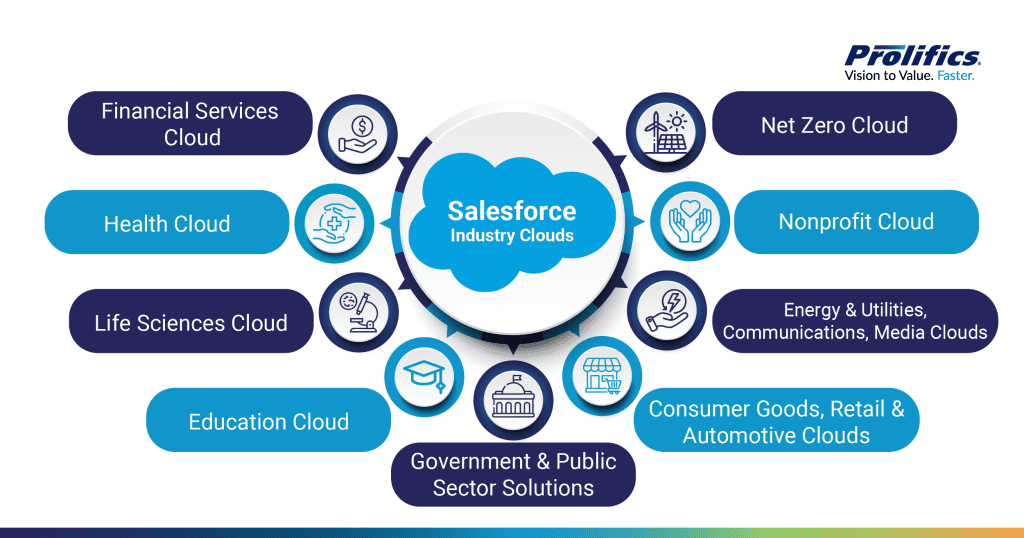
Salesforce has developed dedicated clouds for more than a dozen industries such as:
Financial Services Cloud – Tailored for banking, insurance, and wealth management to drive personalized client experiences and ensure regulatory compliance.
Health Cloud – Designed for healthcare providers to manage patient relationships, care plans, and clinical data securely.
Life Sciences Cloud – Offers capabilities for complex research, patient support, and clinical operations.
Education Cloud – Helps educational institutions manage student journeys from admissions through alumni engagement.
Government and Public Sector Solutions – Optimizes service delivery, constituent engagement, and compliance in public agencies.
Consumer Goods, Retail & Automotive Clouds – Support field execution, inventory management, and dealer networks with industry-specific tools.
Energy & Utilities, Communications, Media Clouds – Align industry workflows with Salesforce’s CRM foundation.
Nonprofit Cloud – Empowers nonprofits with fundraising, volunteer management, and impact reporting.
Net Zero Cloud – Supports organizations in tracking and reducing carbon emissions to hit sustainability goals.
Each of these industry clouds brings pre-configured data schemas, automation, and compliance support, meaning faster time to value and deeper alignment with regulatory and market requirements.
Why Salesforce Cloud Is the Right Choice for Your Business
Adopting Salesforce Cloud is more than implementing new software, it’s about transforming how your organization connects with customers, partners, and internal teams. Here’s what sets Salesforce apart:
✔ Unified Data and Seamless Integration – All clouds share a single data foundation, eliminating silos and enabling cross-department collaboration. ✔ Scalable for Any Business – From startups to global enterprises, Salesforce Cloud grows with you. ✔ AI-Driven Insights – AI and analytics embedded across the platform help teams make smarter decisions faster. ✔ Industry-Tailored Solutions – Specialized and industry clouds accelerate transformation with pre-built best practices. ✔ Mobile-Ready Experience – Your teams can access data and tools anywhere, on any device.
Prolifics’ End-to-End Salesforce Transformation Story
Prolifics delivered a comprehensive Salesforce transformation across Salesforce Sales Cloud, Salesforce Service Cloud, Field Service Lightning, and Salesforce Marketing Cloud, enabling enterprises to eliminate manual processes and unify fragmented data.
By integrating automation, governance, and AI-powered CRM solutions, Prolifics helped organizations move from siloed operations to insight-driven workflows powered by Salesforce Cloud.
Transformation Highlights and Business Impact:
Service Cloud: Automated end-to-end, SLA-driven case management for industrial manufacturers, delivering unified case views, real-time dashboards, standardized service processes, and structured change management to ensure strong user adoption.
Sales Cloud: Deployed LLM-powered, agentic SDR automation for a digital marketing provider—automating the entire outreach lifecycle with AI-generated emails and videos, real-time Salesforce integrations, and enterprise-grade orchestration to scale personalized prospect engagement.
Field Service Lightning: Modernized field service operations with a mobile-first Salesforce FSL implementation, enabling offline access, automated workflows, unified service history, and improved technician visibility across global service teams.
Pardot (Account Engagement): Unified fragmented marketing operations by implementing standardized lead scoring, automation, and distributor workflows, fully aligning marketing execution with enterprise Salesforce strategy.
Marketing Cloud: Successfully migrated marketing operations from HubSpot to Salesforce Marketing Cloud, delivering reusable campaign blueprints, scalable automation, and best practices that empowered teams to own and grow future campaigns.
The Prolifics Advantage:
Connected Salesforce clouds into a single, intelligent ecosystem
Embedded AI and automation to eliminate manual effort
Ensured adoption through structured rollout and governance
Delivered measurable improvements in productivity, customer experience, and operational scale
Ready to transform your business with Salesforce Cloud?
Partner with Salesforce today and tap into expertise that drives real results. Our certified Salesforce professionals will help you assess your needs, choose the right cloud strategy, and implement solutions tailored to your unique goals.
Manufacturing is entering one of its most significant shifts since the introduction of automation. AI-powered manufacturing is no longer experimental or confined to innovation labs. Artificial intelligence is actively reshaping how factories operate, how products are designed, and how decisions are made across the value chain.
Driven by Industry 4.0, the artificial intelligence in the manufacturing industry is accelerating as manufacturers combine AI with IoT, cloud platforms, advanced analytics, robotics, and intelligent manufacturing systems. This AI manufacturing transformation is enabling smarter, more responsive production environments that improve efficiency, reduce waste, enhance quality, and strengthen competitiveness in a rapidly changing global market.
At the center of smart manufacturing powered by AI is data. AI does not operate in isolation. Its success depends on a strong data foundation that allows models to learn, adapt, and deliver reliable outcomes.
Current Challenges Holding Manufacturers Back
Despite rapid technological progress, many manufacturers still face operational challenges that slow AI adoption in manufacturing.
Legacy processes remain slow, expensive, and inefficient. Equipment failures lead to unplanned downtime. Quality issues are often detected too late, resulting in scrap, rework, or recalls. Supply chains lack visibility and resilience. Workforce shortages and aging labor pools continue to widen skill gaps on the factory floor.
Data fragmentation is another major barrier. Information is scattered across machines, enterprise systems, suppliers, and partners. Without integration, manufacturers cannot unlock AI-driven manufacturing solutions or gain real-time insights.
These challenges show why modernization requires more than automation alone. It requires intelligence embedded across operations through AI-driven transformation in the manufacturing industry.
The AI-Powered Factory
The AI-powered factory uses advanced analytics, machine learning, automation, and predictive analytics in manufacturing to continuously optimize performance. Instead of reacting to problems after they occur, AI systems predict issues, adapt processes, and improve outcomes in real time.
This shift clearly demonstrates how AI-powered manufacturing improves productivity across the value chain.
Predictive Maintenance
Predictive maintenance is one of the most established examples of AI-powered manufacturing use cases. By analyzing sensor data from machines, AI models detect patterns that signal wear, fatigue, or potential failure.
This allows maintenance teams to act before breakdowns occur. The result is reduced downtime and longer asset life. These outcomes highlight how AI-powered manufacturing improves productivity while lowering operational costs.
Digital Twins
Digital twins are virtual replicas of physical assets, production lines, or entire facilities. Powered by real-time data and AI models, they allow manufacturers to simulate scenarios, test changes, and optimize operations without disrupting production.
Digital twins support capacity planning, energy optimization, and continuous process improvement. They are a core component of smart manufacturing powered by AI, enabling faster innovation with reduced risk.
Quality Inspection
AI-driven quality inspection combines computer vision and machine learning to identify defects that humans struggle to detect consistently.
High-resolution cameras paired with AI models inspect products in real time. This improves accuracy and speed, reduces scrap, ensures compliance, and protects brand reputation. These benefits reinforce the value of AI-driven manufacturing solutions.
Supply Chain Analytics
AI strengthens supply chain resilience by improving demand forecasting, inventory optimization, and supplier risk management.
By analyzing historical data, market signals, and real-time events, AI models deliver actionable insights. These insights help manufacturers anticipate disruptions and respond proactively. This visibility plays a critical role in the broader AI manufacturing transformation.
Computer Vision
Computer vision extends well beyond quality inspection. It enables safety monitoring, inventory tracking, and process optimization.
AI systems can identify unsafe behaviors, track material movement, and confirm that processes are executed correctly. These capabilities improve productivity, enhance worker safety, and support consistent operations across intelligent manufacturing systems.
Workforce Augmentation
AI does not replace workers, it augments them.
AI-powered assistants provide real-time guidance, predictive insights, and automated documentation. This supports less experienced workers, reduces errors, and helps close skills gaps. Collaborative robots and AI-enabled tools also improve ergonomics and safety, reinforcing responsible AI adoption in manufacturing.
Real Examples from Industry Leaders
Manufacturers across industries are already seeing measurable value from AI-powered manufacturing initiatives:
A global automotive manufacturer reduced unplanned downtime using AI-based predictive maintenance.
A consumer electronics company improved defect detection with AI-driven computer vision across production stages.
An aerospace manufacturer used digital twins to simulate complex assembly processes, improving throughput.
A food and beverage producer applied AI-driven demand forecasting to reduce waste and optimize inventory.
A chemical manufacturer used AI to monitor process conditions in real time, improving yield and energy efficiency.
These examples of AI-powered manufacturing use cases show that success depends on strong operational integration and a reliable data foundation.
The Data Foundation Behind Successful AI
Successful AI-driven transformation in the manufacturing industry begins with data engineering and governance. Without a strong data foundation, even advanced AI models fail to deliver trustworthy results.
Architecture for AI
Modern manufacturing architectures integrate data from machines, sensors, enterprise systems, and external sources into scalable platforms. Cloud and hybrid environments support high-volume and high-velocity data, while streaming pipelines enable real-time analytics and AI inference.
Data Engineering for AI
Data engineering ensures data accuracy, consistency, and accessibility. This includes building ingestion pipelines, transforming raw data into AI-ready formats, and supporting scalable compute for training and deployment.
Clean data leads to reliable outcomes. Poor data quality undermines AI-driven manufacturing solutions.
Governance and Trust
AI systems must be secure, transparent, and compliant. Data governance ensures lineage, quality controls, and access policies are enforced. Observability tools monitor performance over time, helping organizations maintain trust as conditions change.
How Manufacturers Can Get Started
Manufacturers do not need to transform everything at once. Effective AI adoption in manufacturing is incremental and focused.
Workshops: AI strategy workshops help identify high-impact opportunities aligned with business goals and operational readiness.
Assessments: Data and AI maturity assessments uncover gaps and provide a roadmap for scalable AI-powered manufacturing initiatives.
Pilot Projects: Pilot projects validate value quickly, demonstrating ROI and building confidence before scaling across operations.
Generative AI will accelerate design, documentation, and knowledge sharing. Digital workers will handle routine tasks. Autonomous factories will continuously optimize performance, balancing efficiency, sustainability, and resilience.
Human and AI collaboration will define the next era of manufacturing.
Key Takeaways
AI is no longer optional for manufacturers. The question is not whether to adopt AI, but how quickly and effectively it can be implemented.
Those who invest now in strong data foundations, targeted AI use cases and scalable architectures will gain a lasting competitive advantage. The technology is ready. The business value is proven. The time to act is now.
Prolifics helps manufacturers move from AI ambition to real-world execution by building the data engineering backbone, deploying practical AI solutions and scaling them across the enterprise. From assessments and workshops to pilot programs and full production rollouts, Prolifics partners with manufacturers at every stage of the AI journey to ensure AI delivers measurable, sustainable business impact.
Snowflake, the AI Data Cloud leader, has unveiled a new set of innovations to simplify how organizations ingest, govern, and activate data across its lifecycle. These updates strengthen the Snowflake enterprise lakehouse and create new opportunities for the Snowflake partner ecosystem to deliver advanced data and AI solutions.
At the center of these announcements are major advancements to Snowflake Horizon Catalog and Snowflake Openflow data ingestion, both now generally available. Together, they help enterprises connect data across systems and catalogs while making it securely accessible to AI agents without compromising governance within the Snowflake AI Data Cloud.
A Unified, AI-Ready Data Foundation
The Snowflake enterprise lakehouse now delivers a single, consistent data foundation built for AI. Snowflake Horizon Catalog introduces a universal governance and security layer that works across regions, cloud providers, and data formats.
It supports:
Native Snowflake data objects
Open table formats such as Apache Iceberg and Delta Lake
Relational databases including SQL Server and Postgres
These enhancements enable secure access for external engines while maintaining one governed source of truth. This approach supports AI-ready data governance and reinforces a unified lakehouse architecture that removes data silos and speeds up insights.
The result is a simpler environment where partners can build advanced AI solutions without duplicating or fragmenting enterprise data.
Enhanced Integration and Ingestion with Openflow
Snowflake Openflow enables automated, secure ingestion from virtually any source, ensuring that data remains fresh and centralized across the enterprise lakehouse. Snowflake has also expanded integration options through its partnership with Oracle, enabling near real-time change data capture that continuously streams updates into the Snowflake AI Data Cloud.
For partners, these ingestion and integration capabilities create new opportunities to modernize legacy pipelines, improve data reliability, and deliver optimized data solutions for industry-specific needs.
Interactivity, Speed, and Real-Time Intelligence
Snowflake Openflow data ingestion makes it easier to bring data into the platform from almost any source. It automates ingestion while keeping data fresh and centralized inside the Snowflake AI Data Cloud.
Snowflake has also expanded integration through its partnership with Oracle. This enables near real-time change data capture, allowing updates to stream continuously into the Snowflake AI Data Cloud without manual intervention.
These capabilities unlock Snowflake Openflow real-time data ingestion use cases, such as:
Modernizing legacy pipelines
Improving data accuracy
Supporting industry-specific analytics
Real-Time Performance and Interactive Analytics
To support modern analytics and AI workloads, Snowflake introduced Interactive Tables and Interactive Warehouses. These features deliver low latency and high concurrency for sub-second insights.
Near real-time streaming analytics now allows organizations to act on live operational data within seconds. This makes the Snowflake enterprise lakehouse ideal for both business intelligence and AI-driven decision-making.
These enhancements demonstrate how Snowflake enterprise lakehouse supports AI workloads that demand speed, scale, and reliability.
Snowflake Postgres and Open-Source Innovation
Following the acquisition of Crunchy Data, Snowflake launched Snowflake Postgres a fully managed Postgres service built directly into the Snowflake AI Data Cloud.
Snowflake also open-sourced pg_lake, a set of Postgres extensions that let developers query and write Apache Iceberg tables using standard SQL. This helps teams modernize Postgres environments, simplify migrations, and build lakehouse-ready applications without disrupting existing workflows.
Partner-Led Data Modernization
These innovations create new opportunities for enterprise data modernization with Snowflake, especially for partners delivering AI, analytics, and industry-specific solutions.
As a trusted Snowflake partner, Prolifics brings deep experience in data platforms, governance, and AI-ready architectures. Prolifics helps enterprises maximize the value of the Snowflake enterprise lakehouse by accelerating modernization, streamlining ingestion, and turning innovation into measurable business outcomes.