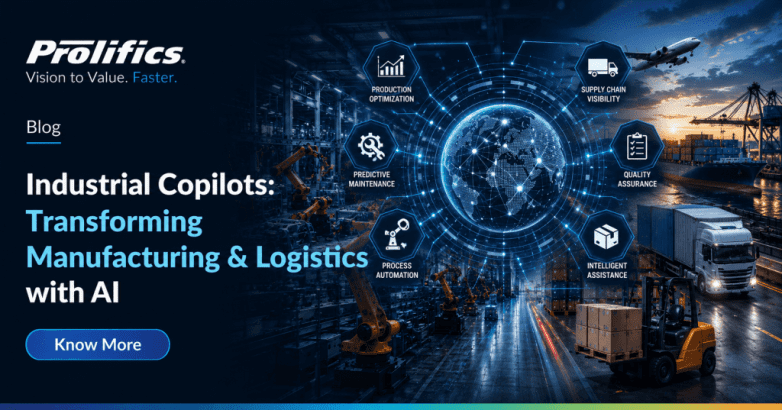
Artificial intelligence is no longer a futuristic concept for manufacturing and logistics organizations. It is rapidly becoming the operational backbone of modern enterprises. As factories face mounting pressure from labor shortages, supply chain volatility, and rising customer expectations, AI-powered industrial copilots are emerging as the single most impactful lever for achieving operational excellence.
Industrial copilots are redefining how manufacturing and logistics teams operate by combining generative AI, machine learning, automation, predictive analytics, and conversational interfaces into intelligent assistants that support employees across production environments.
As the manufacturing sector enters a new era of digital transformation, industrial copilots are becoming the bridge between human expertise and AI-driven decision-making, redefining what’s possible in smart factory environments.
What Are Industrial Copilots?
Industrial copilots are AI-powered assistants built for manufacturing, warehouse, and logistics environments. They analyze operational data in real time, predict failures, optimize workflows, and guide frontline workers going far beyond traditional automation by combining generative AI, NLP, machine learning, and IoT into a unified intelligent layer.
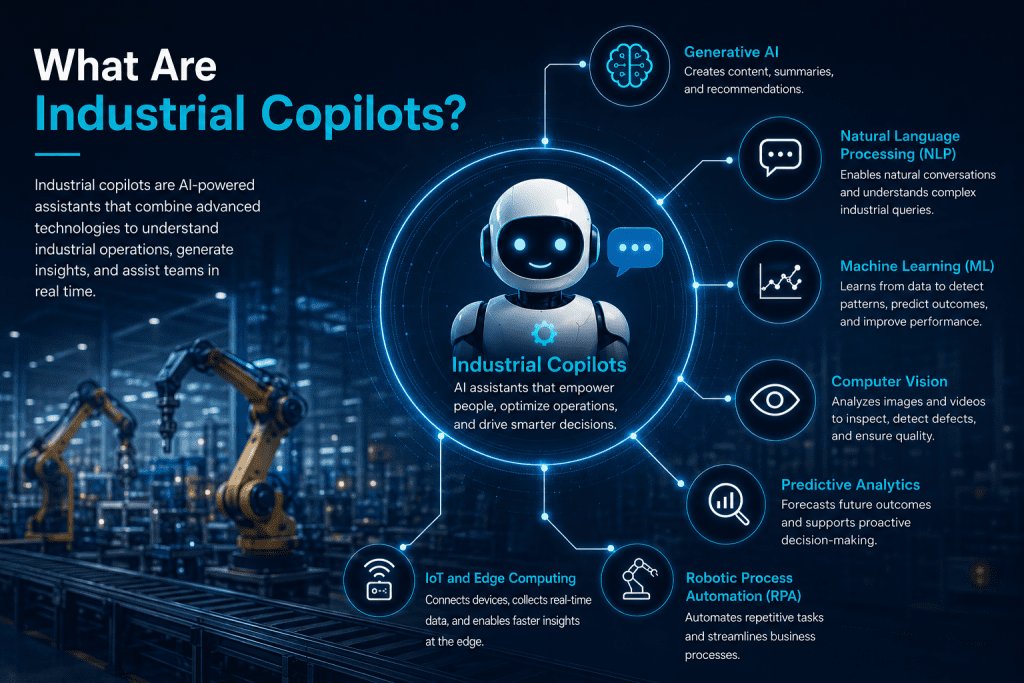
These copilots use technologies such as:
- Generative AI
- Natural Language Processing (NLP)
- Machine Learning (ML)
- Computer Vision
- Predictive Analytics
- IoT and Edge Computing
- Robotic Process Automation (RPA)
Industrial copilots interact with operators, engineers, supervisors, and logistics teams through conversational interfaces, dashboards, mobile devices, or integrated enterprise systems.
Why AI-Powered Industrial Copilots Are Surging in Manufacturing & Logistics
The manufacturing and logistics industries are under immense pressure to increase operational efficiency while managing labour shortages, supply chain disruptions, rising customer expectations, and sustainability goals.
Traditional operational models are struggling to keep pace with modern market demands. This has accelerated the adoption of AI-powered industrial copilots.
Today’s manufacturers generate massive amounts of data from:
- Industrial IoT sensors
- ERP Systems
- MES platforms
- Supply chain applications
- Warehouse management systems
- Robotics and automation equipment
- Quality control systems
However, much of this data remains underutilized.
Industrial copilots unlock the value hidden in this data by transforming raw information into actionable intelligence. Organizations that deploy them gain measurable advantages across every operational dimension:
By combining AI with industrial operations, businesses can:
- Improve production efficiency
- Reduce equipment downtime
- Enhance workforce productivity
- Accelerate decision-making
- Increase supply chain visibility
- Improve workplace safety
- Enable predictive maintenance
- Optimize logistics and inventory management
High-Impact Use Cases of Industrial Copilots in Manufacturing
1. Predictive Maintenance: Stopping Failures Before They Happen
Unexpected equipment failures can lead to costly downtime and production delays. Industrial copilots analyze real-time sensor data, maintenance history, and equipment performance patterns to predict failures before they occur.
AI-powered copilots can:
- Detect anomalies in machine behavior
- Predict maintenance requirements
- Recommend repair schedules
- Reduce unplanned downtime
- Extend equipment lifespan
This proactive approach minimizes operational disruptions while improving overall equipment effectiveness (OEE).
2. Intelligent Production Optimization
Manufacturers constantly seek ways to improve throughput, quality, and efficiency. Industrial copilots monitor production lines in real time and provide recommendations to optimize workflows.
AI assistants can help manufacturers:
- Identify production bottlenecks
- Optimize machine utilization
- Reduce energy consumption
- Improve production scheduling
- Enhance product quality
With AI-driven recommendations, production teams can make faster and more informed decisions.
3. Supply Chain and Logistics Optimization
Modern supply chains are highly complex and vulnerable to disruptions. Industrial copilots provide real-time visibility into logistics operations and supply chain performance.
AI-powered logistics copilots can:
- Forecast demand fluctuations
- Optimize transportation routes
- Improve warehouse operations
- Predict shipment delays
- Automate inventory replenishment
- Reduce transportation costs
This enables logistics teams to improve agility, responsiveness, and operational efficiency.
4. AI-Powered Quality Control at Scale
Maintaining consistent product quality is essential for manufacturing success. Industrial copilots use computer vision and AI analytics to identify product defects and quality issues in real time.
Quality control benefits:
- Faster, more accurate defect detection
- Reduced waste, rework, and scrap costs
- Improved regulatory compliance
- Enhanced product consistency across production runs
- Higher customer satisfaction and fewer returns
AI-powered quality inspection systems can analyze thousands of products faster and more accurately than manual inspections.
5. Workforce Assistance and Knowledge Management
As experienced workers retire, manufacturers face a critical knowledge-transfer challenge. Industrial copilots act as always-available digital mentors for frontline employees, reducing dependency on tribal knowledge and accelerating onboarding.
Frontline workers can use conversational AI to:
- Access operating procedures and SOPs instantly
- Troubleshoot equipment issues step-by-step
- Receive contextual training guidance
- Retrieve technical documentation hands-free
- Get real-time safety recommendations
How Industrial Copilots Measurably Improve Manufacturing Operations
Beyond individual use cases, industrial copilots deliver cumulative operational improvements across the entire enterprise:
Faster Decision-Making
Industrial copilots analyze massive operational data volumes in seconds, enabling managers and operators to act on data-driven insights before opportunities are lost.
Enhanced Operational Efficiency
AI assistants automate repetitive tasks, optimize workflows, and eliminate manual effort freeing workers to focus on higher-value activities.
Improved Workplace Safety
Copilots monitor hazardous environments continuously, identify safety risks in real time, and alert employees before incidents occur.
Reduced Operational Costs
By improving efficiency, cutting downtime, and minimizing waste, organizations achieve significant and measurable reductions in operational expenditure.
Increased Business Agility
Industrial copilots help manufacturers respond faster to market changes, supply disruptions, and shifting production demands.
Microsoft Copilots and Agentic AI: Reshaping Industrial Operations
Microsoft Copilots and agentic AI are playing a transformative role in industrial environments. “Agentic AI” refers to intelligent systems capable of autonomously performing complex tasks, making decisions, and collaborating with human teams a significant step beyond basic automation.
In manufacturing environments, Microsoft Copilots integrate natively with:
- Microsoft Dynamics 365 (ERP and supply chain)
- Azure AI and Azure OpenAI Service
- Power Platform (low-code automation)
- Microsoft Fabric (unified data analytics)
- IoT platforms and edge computing
- ERP and MES systems
Key Microsoft Copilot applications in manufacturing include:
- AI-generated production performance insights
- Automated supply chain risk analysis
- Conversational maintenance and troubleshooting support
- Intelligent procurement and vendor recommendations
- Real-time operational dashboards and KPI monitoring
Critical Challenges When Implementing Industrial Copilots
While industrial copilots deliver clear value, successful implementation requires addressing several common obstacles:
1. Data Quality & Integration
Manufacturing environments often contain fragmented systems and inconsistent data sources. Organizations must establish strong data governance frameworks and integration strategies before deploying AI.
2. Cybersecurity Risks
As industrial systems become increasingly connected, cybersecurity becomes mission-critical. Businesses must implement secure AI frameworks and robust cybersecurity controls to protect operational technology (OT) environments.
3. Change Management & Workforce Adoption
Employees may initially resist AI adoption. Successful implementation requires workforce training, transparent communication, and structured change management programs to build trust in AI systems.
4. Scalability
Organizations need scalable AI architectures capable of supporting enterprise-wide industrial operations — not just isolated pilot programs. Cloud-native and hybrid deployment models are essential.
The Future of Industrial Copilots: From Task Assistance to Autonomous Orchestration
Industrial copilots are on a rapid evolution path. As AI technologies mature, they will move far beyond task assistance transitioning toward autonomous industrial orchestration where AI systems self-coordinate across entire production ecosystems.
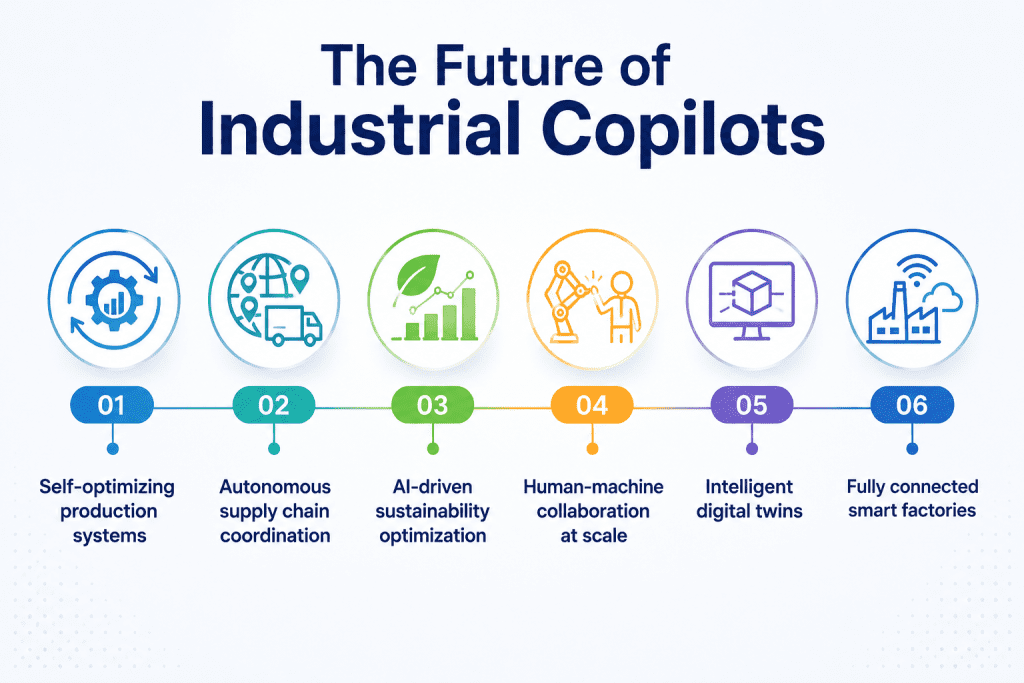
Near-future capabilities will include:
- Self-optimizing production systems that adjust autonomously
- Autonomous supply chain coordination across global networks
- AI-driven sustainability and carbon-reduction optimization
- Human-machine collaboration at unprecedented scale
- Intelligent digital twins for factory-wide simulation
- Fully connected, self-healing smart factories
Industrial copilots will sit at the center of Industry 5.0 initiatives where humans and intelligent machines collaborate to create more resilient, efficient, and sustainable industrial ecosystems.
Key Takeaways: Industrial Copilots in Manufacturing
- Industrial copilots in manufacturing are AI-powered assistants that combine generative AI, machine learning, NLP, IoT, and predictive analytics to optimize operations in real time.
- Top use cases include predictive maintenance, production optimization, supply chain management, AI quality control, and workforce knowledge management.
- Organizations that deploy industrial copilots gain measurable gains in efficiency, safety, cost reduction, and decision-making speed.
- Microsoft Copilots integrated with Dynamics 365, Azure AI, and the Power Platform are leading enterprise-grade industrial AI deployments.
- Key implementation challenges data quality, cybersecurity, change management, and scalability must be addressed with a structured strategy.
- Industrial copilots are the foundation of Industry 5.0, where human expertise and autonomous AI work together seamlessly.
- Partnering with an experienced AI transformation provider like Prolifics ensures successful, secure, and scalable deployment.
How Prolifics Helps Manufacturers Embrace Industrial AI
Successfully deploying industrial copilots requires both deep AI expertise and proven industrial domain knowledge. Prolifics partners with manufacturers and logistics providers to accelerate AI-driven digital transformation from strategy through implementation and ongoing optimization.
Prolifics’ industrial AI capabilities include:
- Generative AI development and AI copilot implementation
- Intelligent automation and RPA
- Data engineering and advanced analytics solutions
- Cloud modernization and Azure AI integration
- Industrial system integration (ERP, MES, IoT)
- Predictive analytics and ML model development
- Supply chain optimization and digital transformation
- AI governance, security, and responsible AI frameworks
By combining deep industry expertise with advanced AI technologies, Prolifics enables organizations to build scalable, secure, and intelligent industrial ecosystems.
Conclusion
Industrial copilots are transforming manufacturing and logistics by enabling smarter operations, faster decision-making, and enhanced workforce productivity. From predictive maintenance and intelligent production optimization to AI-powered logistics and supply chain management, industrial copilots are helping organizations unlock new levels of efficiency and innovation.
As manufacturers accelerate their digital transformation journeys, AI copilots will play an increasingly critical role in shaping the next generation of smart factories and connected supply chains.
Organizations that embrace industrial AI today will be better positioned to drive operational excellence, improve customer experiences, and remain competitive in an increasingly intelligent industrial landscape. The era of industrial copilots has arrived and the future of manufacturing is smarter, faster, and more connected than ever before.
FAQs
What are industrial copilots in manufacturing?
Industrial copilots are AI-powered assistants designed for manufacturing and logistics environments. They use generative AI, machine learning, predictive analytics, and IoT to automate workflows, improve workforce productivity, reduce equipment downtime, and enable real-time data-driven decision-making across industrial operations.
How do industrial copilots improve manufacturing efficiency?
Industrial copilots improve manufacturing efficiency by analyzing operational data in real time, identifying production bottlenecks, predicting equipment failures before they occur, optimizing workflows, and automating repetitive tasks reducing downtime, improving resource utilization, and accelerating production processes end-to-end.
What are the key use cases of AI copilots in logistics?
AI copilots in logistics optimize supply chain operations through demand forecasting, transportation route optimization, warehouse management automation, predictive shipment tracking, and inventory replenishment. These capabilities improve supply chain visibility, reduce operational costs, and enhance delivery performance across global networks.
What challenges do organizations face when implementing industrial copilots?
Key implementation challenges include fragmented data systems, industrial cybersecurity risks, workforce resistance to AI adoption, and the need for enterprise-scale AI architectures. Successful deployment requires strong data governance, secure AI frameworks, structured change management programs, and scalable cloud or hybrid infrastructure.
How does agentic AI differ from traditional industrial automation?
Traditional industrial automation executes predefined, rule-based tasks. Agentic AI the foundation of next-generation industrial copilots can autonomously perceive context, make decisions, take actions, and adapt in real time. This allows agentic AI to handle complex, dynamic industrial environments that fixed automation cannot address.