

Data readiness for AI determines whether enterprise AI initiatives deliver measurable business value – or stall before they scale. As CIOs and CTOs race to deploy generative AI, intelligent automation, and advanced analytics, the most common obstacle is not the technology. It is the data foundation underneath it. Organizations investing in enterprise AI often discover too late that fragmented data, poor governance, legacy systems, and inconsistent data quality prevent AI models from producing reliable outcomes.
AI strategies fail when businesses prioritize models before modernizing their data foundation. Successful AI adoption requires governed, integrated, accessible, and high-quality enterprise data across cloud platforms, applications, and business units. Without data readiness, even advanced AI tools generate inaccurate insights, increase operational risk, and slow digital transformation initiatives.
What Is Data Readiness for AI?
Data readiness is the foundation of a successful AI strategy. Enterprises cannot scale AI initiatives if their data is siloed, inconsistent, poorly governed, or inaccessible across systems. Organizations that prioritize data modernization, cloud integration, governance, and real-time analytics are more likely to achieve measurable ROI from AI, automation, and digital transformation investments.
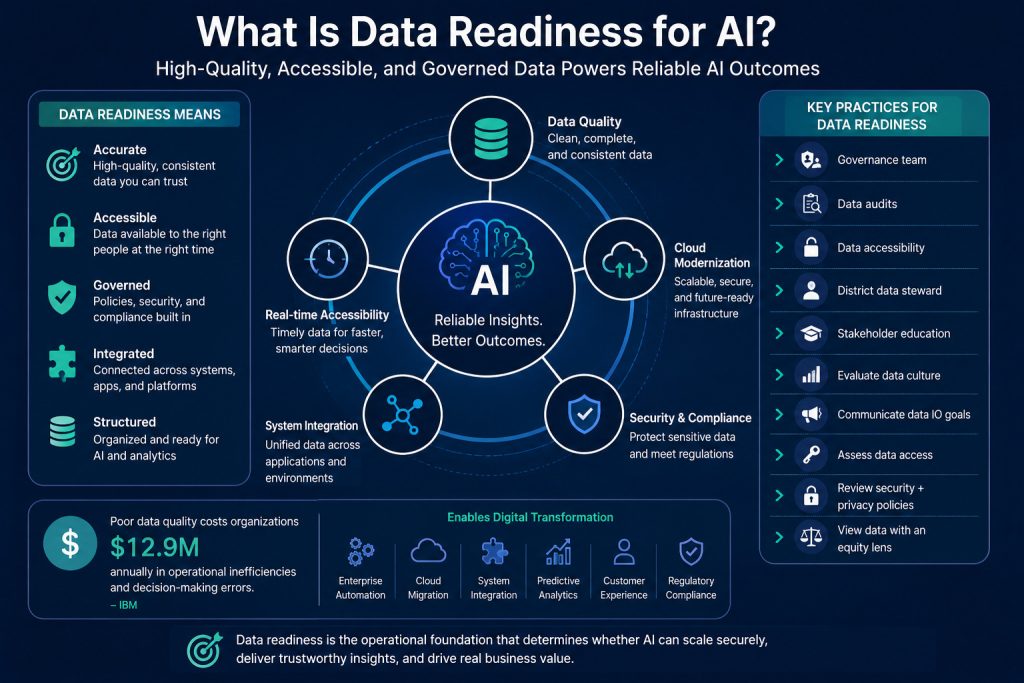
Data readiness for AI is the process of ensuring enterprise data is accurate, accessible, governed, integrated, and structured for AI and analytics use cases.
It includes data quality management, cloud data modernization, metadata governance, integration across systems, security compliance, and real-time accessibility. AI models depend entirely on the quality and consistency of the data they consume. If enterprise data is fragmented across legacy applications, disconnected business units, and outdated infrastructure, AI systems produce unreliable outputs.
According to IBM, poor data quality costs organizations an average of $12.9 million annually due to operational inefficiencies and decision-making errors.
Data readiness also supports broader digital transformation initiatives such as:
- Enterprise automation
- Cloud migration
- System integration
- Predictive analytics
- Customer experience modernization
- Regulatory compliance
For CTOs and IT leaders, data readiness is not a technical side project. It is the operational layer that determines whether AI can scale securely and effectively across the enterprise. Organizations in healthcare, banking, insurance, and retail face additional complexity because sensitive customer and operational data often exists across hybrid environments, legacy platforms, and third-party systems.
Why Do AI Strategies Fail Without Data Readiness?
Most AI strategies fail because enterprises underestimate the complexity of preparing enterprise data for AI workloads.
A 2024 report from Gartner found that poor data quality remains one of the primary barriers to successful AI adoption across enterprises. AI initiatives often stall after pilot phases because models cannot access trusted, real-time business data consistently across environments.
Common failure points include:
- Data silos between departments
- Legacy infrastructure limiting integration
- Inconsistent governance policies
- Duplicate or incomplete records
- Limited cloud interoperability
- Lack of metadata management
- Security and compliance gaps
For example, a retail organization deploying AI-driven demand forecasting may aggregate inventory, e-commerce, and supply chain data from multiple systems. If those systems use inconsistent product identifiers or delayed updates, the AI model generates inaccurate forecasts that directly impact revenue and customer experience.
Similarly, healthcare organizations implementing AI-powered patient engagement platforms require secure integration across EHR systems, insurance databases, scheduling platforms, and clinical applications. Without data standardization and governance, AI recommendations become unreliable and create compliance risks. AI accuracy is not primarily a model problem. In enterprise environments, it is usually a data architecture problem.
How Does Poor Data Quality Impact Enterprise AI Outcomes?
Poor data quality directly reduces AI accuracy, increases operational risk, and weakens business trust in AI systems.
AI models learn patterns from enterprise data. When datasets contain duplication, missing values, outdated information, or inconsistent formatting, models inherit those problems. The result is unreliable analytics, flawed predictions, and automation failures.
According to Forrester, organizations with mature data governance and integration capabilities are significantly more likely to achieve scalable AI outcomes compared to businesses with fragmented data ecosystems.
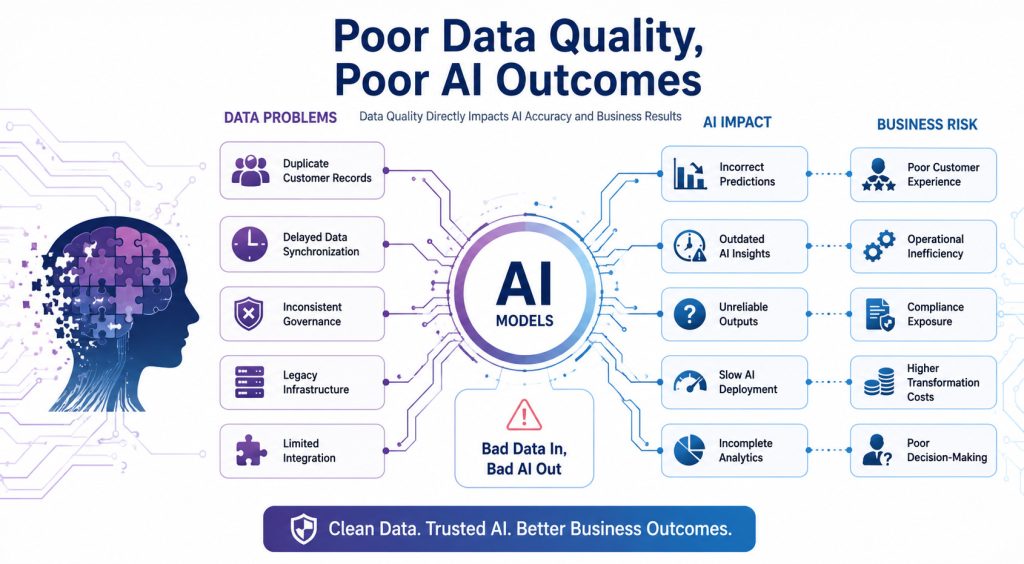
Key business impacts:
| Data Problem | AI Impact | Business Risk |
| Duplicate customer records | Incorrect predictions | Poor customer experience |
| Delayed data synchronization | Outdated AI insights | Operational inefficiency |
| Inconsistent governance | Unreliable outputs | Compliance exposure |
| Legacy infrastructure | Slow AI deployment | Higher transformation costs |
| Limited integration | Incomplete analytics | Poor decision-making |
Financial services organizations illustrate this challenge clearly. Fraud detection systems rely on real-time transaction data from multiple channels. If transaction streams are delayed or inconsistent across platforms, AI systems may fail to identify fraudulent activity accurately.
The same challenge affects insurance underwriting, healthcare analytics, and retail personalization initiatives. AI systems only perform effectively when enterprise data pipelines are reliable, integrated, and continuously governed.
How Can Enterprises Assess AI Data Readiness?
Enterprises should evaluate AI data readiness across governance, infrastructure, integration, quality, accessibility, and scalability.
Many organizations mistakenly focus only on selecting AI platforms or large language models. The more important question is whether existing enterprise systems can support AI-driven operations consistently across business functions.
A structured AI data readiness assessment typically includes the following areas:
- Data Quality Assessment — Evaluate accuracy, completeness, consistency, and duplication across enterprise datasets.
- Integration Readiness — Identify disconnected systems, legacy applications, and integration bottlenecks preventing unified data access.
- Cloud and Infrastructure Readiness — Assess whether existing infrastructure supports scalable analytics, AI workloads, and real-time processing.
- Governance and Compliance — Review security policies, metadata management, lineage tracking, and regulatory compliance frameworks.
- Accessibility and Democratization — Ensure business teams can securely access trusted data for analytics and AI use cases.
- Operational Scalability — Determine whether data pipelines support continuous AI deployment and enterprise automation initiatives.
Organizations that complete these assessments early avoid expensive AI rework later in transformation programs.
What Steps Improve Data Readiness for AI?
Enterprises improve AI data readiness by modernizing data architecture, standardizing governance, integrating systems, and improving data quality management.
The following framework helps organizations prepare for scalable AI adoption:
Step-by-Step AI Data Readiness Checklist
- Audit enterprise data sources — Identify structured and unstructured data across cloud, on-premise, and hybrid environments.
- Eliminate data silos — Integrate disconnected systems using APIs, middleware, and enterprise integration platforms.
- Improve data quality processes — Standardize validation, cleansing, deduplication, and enrichment practices.
- Implement governance frameworks — Establish policies for access control, lineage, metadata, and compliance monitoring.
- Modernize cloud data infrastructure — Enable scalable analytics using cloud-native platforms and modern data architectures.
- Enable real-time data accessibility — Support AI-driven automation and analytics with low-latency data pipelines.
- Align AI use cases with business outcomes — Prioritize initiatives tied to measurable KPIs such as operational efficiency, fraud reduction, or customer experience.
- Continuously monitor AI data performance — Track quality metrics, governance compliance, and model reliability over time.
This process creates a stable operational foundation for AI, analytics, and enterprise automation initiatives.
Which Industries Are Most Affected by AI Data Readiness Challenges?
Healthcare, finance, insurance, retail, and public sector organizations face the highest data readiness complexity because they manage large volumes of sensitive, fragmented, and regulated data.
Healthcare
Healthcare providers often operate across disconnected clinical systems, patient portals, insurance databases, and EHR platforms. AI-powered diagnostics and patient engagement require interoperable, secure, and standardized data ecosystems.
Financial Services
Banks and financial institutions rely on real-time transaction processing, fraud detection, and risk analytics. Legacy systems and siloed data environments often slow AI modernization efforts.
Insurance
Insurance providers require integrated customer, claims, underwriting, and policy data to support AI-driven automation and predictive analytics.
Retail
Retailers use AI for personalization, inventory forecasting, and supply chain optimization. Data fragmentation across e-commerce, ERP, POS, and logistics systems can significantly reduce AI effectiveness.
Public Sector
Government agencies face modernization challenges due to aging infrastructure, compliance requirements, and disconnected citizen service platforms.
These industries increasingly invest in cloud migration, enterprise integration, and data governance to support long-term AI transformation strategies.
How Does Modern Data Architecture Support AI Success?
Modern data architecture enables AI scalability by improving integration, governance, accessibility, and real-time processing.
Traditional enterprise architectures were not designed for generative AI, predictive analytics, or intelligent automation workloads. Many organizations still depend on batch processing systems and isolated databases that limit operational agility.
Modern AI-ready architectures typically include:
| Legacy Environment | Modern AI-Ready Environment |
| Siloed applications | Unified enterprise platforms |
| Batch data processing | Real-time data pipelines |
| On-premise-only infrastructure | Hybrid and cloud-native systems |
| Manual governance | Automated governance frameworks |
| Limited analytics accessibility | Self-service analytics and AI enablement |
| Point-to-point integrations | API-led system integration |
According to IBM, enterprises adopting hybrid cloud and AI-ready architectures improve operational agility while reducing integration complexity.
Modernization also improves:
- AI deployment speed
- Regulatory compliance
- Data observability
- Enterprise automation scalability
- Cross-functional decision-making
AI transformation is ultimately a data transformation initiative supported by modern architecture and governance practices.
What Does a Real-World AI Data Readiness Scenario Look Like?
Consider a regional healthcare provider implementing AI-powered patient scheduling and predictive care management.
The organization operates across multiple hospitals and outpatient facilities using separate EHR systems, billing platforms, and scheduling tools. Initial AI pilots produced inconsistent recommendations because patient data was duplicated across systems and updated at different intervals.
The provider launched a data modernization initiative that included:
- Cloud migration of analytics workloads
- Enterprise integration across clinical systems
- Data governance implementation
- Real-time patient data synchronization
- API-led interoperability frameworks
Once the data environment was standardized, the organization improved scheduling accuracy, reduced administrative delays, and enabled more reliable predictive analytics.
This example reflects a common enterprise pattern: AI value increases only after organizations resolve underlying data integration and governance challenges.
These are the types of enterprise modernization initiatives where Prolifics supports organizations through cloud transformation, system integration, AI enablement, and enterprise data modernization strategies.
Key Takeaways
- Data readiness for AI is the most critical – and most overlooked – factor in enterprise AI success.
- Poor data quality costs organizations an average of $12.9 million annually (IBM) and directly degrades AI accuracy and reliability.
- AI strategy failures are usually data architecture problems, not model problems.
- Healthcare, finance, insurance, retail, and the public sector face the highest data readiness complexity.
- A structured data readiness assessment across quality, governance, integration, cloud infrastructure, and scalability reduces AI rework costs.
- Modern AI-ready architectures replace siloed batch systems with real-time, cloud-native, API-led data platforms.
Enterprises that modernize data infrastructure before deploying AI scale faster and achieve measurable ROI sooner.
Frequently Asked Questions
What is data readiness in AI?
Data readiness in AI refers to the process of preparing enterprise data so it can be reliably used for AI, analytics, and automation initiatives. It includes data quality, governance, integration, accessibility, security, and cloud infrastructure modernization to ensure AI systems produce accurate and scalable business outcomes.
Why do enterprise AI projects fail?
Enterprise AI projects often fail because organizations lack integrated, high-quality, and governed data environments. Common issues include legacy infrastructure, disconnected systems, inconsistent governance, and poor data quality, all of which reduce AI reliability and operational scalability.
How do you assess AI data readiness?
Organizations assess AI data readiness by evaluating data quality, governance maturity, infrastructure scalability, system integration, compliance frameworks, and real-time accessibility. Effective assessments identify operational gaps that may limit AI deployment and long-term digital transformation goals.
What industries need AI data readiness the most?
Healthcare, finance, insurance, retail, and public sector organizations face the highest AI data readiness requirements because they manage large volumes of sensitive, regulated, and fragmented enterprise data across multiple systems and environments.
How does cloud modernization improve AI adoption?
Cloud modernization improves AI adoption by enabling scalable storage, real-time processing, system integration, and analytics accessibility. Modern cloud-native architectures also support enterprise automation, governance, and AI deployment across hybrid and distributed business environments.


