Microsoft Corp. is elevating Azure Copilot AI Agents by integrating AI-driven agents that enhance cloud operations with intelligent, scalable Agentic Cloud Ops capabilities. Microsoft has unveiled enhancements to Azure Copilot that bake in multiple specialised AI agents aimed at automating complex cloud infrastructure activities.
This evolution is the shift from a conversational assistant to a full-fledged agent-orchestration engine: users can now engage a suite of six dedicated agents (Deployment, Migration, Optimization, Observability, Resiliency, Troubleshooting) known collectively as Azure Copilot six agents, that not only advise but also act, subject to approval, on behalf of infrastructure teams.
This new “Agentic Cloud Ops” model is designed to streamline everything from legacy-app migration to cost & carbon-savings optimization, and from root-cause diagnostics to resiliency planning.
By integrating Copilot directly into the Azure console, CLI, and chat experience, Microsoft is reshaping cloud modernization with AI into something more intuitive, responsive and human-friendly. You talk. Copilot acts, with context, governance and confidence.
Why this matters to you
Speed & scale: With AI agents taking on planning, deployment and remediation chores, teams can shift from reactive firefighting to proactive optimization, enabling faster time-to-value.
Cost and emissions efficiency: The Optimization agent surfaces cost-saving and sustainability recommendations side-by-side, helping businesses align financial and ESG goals.
Improved observability & resilience: The Observability and Resiliency agents allow organisations to detect, diagnose and design for business-critical continuity, reducing downtime and risk.
Legacy-friendly migration: The Migration agent can autonomously discover legacy on-prem/.NET apps and propose IaaS/PaaS moves seamlessly.
Context-driven operations: By understanding user roles, service contexts and access rights, the orchestration engine ensures safe, compliant actions, preserving governance while boosting agility.
How Prolifics can unlock this potential for you
While Azure’s Agentic Cloud Ops capability is transformational, organisations still need the right partner to design the blueprint, tailor agents to unique business contexts, integrate workflows, and drive adoption. That’s where Prolifics steps in. We bring:
Deep expertise in cloud migrations, modernisation and operations
Proven practices for deploying intelligent agents into live infrastructure environments
A consultative approach that aligns agentic automation with your business objectives, regulatory posture and operational culture
A partnership-driven delivery model that empowers your team to harness the full potency of Azure’s new agentic platform
Ready to move from managing cloud ops to mastering them?
Reach out to Prolifics today and accelerate your move into the era of agent-driven cloud operations. Let’s help you turn the promise of Azure Copilot’s six-agent engine into measurable outcomes: faster deployments, lower costs, enhanced reliability and future-proofed infrastructure.
Contact Prolifics now → Let’s build your Agentic Cloud Ops strategy together.
The global Banking, Financial Services, and Insurance (BFSI) sector is entering a defining era of reinvention. After years spent modernizing legacy systems, scaling the cloud, and digitizing customer touchpoints, 2026 marks a pivotal shift from AI-Native Platforms in BFSI. Unlike traditional systems where AI is bolted on as a feature, AI-native platforms embed intelligence across the entire application stack, autonomously analyzing, predicting, optimizing, and acting in real time.
According to the IDC report titled, Unified AI & Agentic AI Platforms in Asia: Solution Insights for Technology Leaders, shows that, on average, only 23% of AI apps have gone from proof of concept (PoC) to production for Asia/Pacific. As AI capabilities evolve rapidly and more providers launch end-to-end platforms for AI-native application development, selecting the right AI platform requires a clear view of each vendor’s approach and how well the system aligns with current and future requirements.
This transformation goes far beyond efficiency gains. AI-native platforms are reshaping how banks build, run, and evolve applications; how insurers assess risk; how payment providers secure transactions; and how financial institutions deliver frictionless, hyper-personalized experiences. The BFSI organizations that embrace this shift will lead the industry. Those that do not risk irrelevance and will fall behind in how AI-native platforms are transforming banking and financial services.
The State of BFSI in 2026: Complex, Competitive, and Rapidly Evolving
The BFSI landscape is being reshaped by three powerful forces:
1. Rising Regulatory Demands
Compliance is no longer a static checklist. Frequent regulatory updates, complex audits, and the need for transparent AI decision-making require platforms that are explainable, adaptive, and traceable across every process reinforcing the role of AI-powered regulatory compliance in BFSI.
2. Customer Expectations at an All-Time High
Consumers now expect:
Real-time decisions
Personalized financial products
Autonomous servicing
Zero waiting times
High-trust digital interactions
AI-native systems meet these expectations through continuous learning and behaviour prediction, powered by autonomous decision intelligence in banking and richer human-machine collaboration in financial services.
3. Competition from Neo-Banks and FinTechs
Digital competitors operate with agility, built on cloud, microservices, APIs, and automation. Traditional banks need AI-native systems to achieve similar operational velocity and compete with growing trends in agentic AI in banking.
Together, these dynamics set the stage for intelligent, autonomous BFSI operations powered by AI-native platforms and autonomous decision intelligence in banking.
Why AI-Native Platforms Matter in BFSI
AI-native systems do not just support business operations, they reimagine them. By embedding machine intelligence across data pipelines, workflows, decisions, and digital experiences, AI-native platforms deliver transformation across the full enterprise spectrum — positioning financial institutions to answer key questions like what is the difference between AI-enabled and AI-native platforms in BFSI?
1. Hyper-Personalization at Scale
AI-native platforms analyze millions of customer signals,transactions, behavior, sentiment, location, interactions, with real-time processing. This enables:
Personalized product recommendations
Context-aware financial wellness insights
Intelligent credit decisioning
Autonomous conversational servicing
A global bank, for instance, is already using advanced NLP and semantic search to deliver highly contextual wealth management insights, reducing advisor research time and improving customer outcomes through improved human-machine collaboration in financial services.
2. Autonomous Back-Office Operations
The BFSI back office, once defined by manual processing, is now transforming through:
Intelligent document classification
Automated trade settlement
Machine-led loan underwriting
Smart claims adjudication
Predictive risk scoring
A leading financial services provider leveraged machine learning to boost mortgage underwriting productivity, reducing time spent reviewing documents while increasing accuracy an early example of autonomous decision intelligence in banking supported by AI-native application development practices.
3. Precision-Driven Fraud Detection
Fraud patterns evolve quickly, and only AI can keep up.
AI-native fraud systems use:
Multimodal data
Anomaly detection
Behavioral biometrics
Transactional analytics
A global bank achieved major gains by using ML to detect fraud faster, reducing false positives while minimizing investigation time showing how AI-native platforms are transforming banking and financial services through real-time insights.
4. Regulatory Compliance That Runs Itself
AI-native compliance systems continuously analyze regulatory changes, monitor operations, and flag risks. They ensure:
Automated KYC and AML
Real-time suspicious activity detection
Transparent audit trails
Automated documentation and reporting
For compliance auditors, AI can increase audit volumes from 4–5 daily to 20+ by augmenting human analysis using explainable AI governance for BFSI, forming a foundation for AI-powered regulatory compliance in BFSI.
From AI-Enabled to AI-Native: What’s Changing in BFSI Development?
Traditional BFSI development follows a human-led model: data → rules → decisions. AI-native shifts this to data → learning → autonomous optimization.
Key shifts include:
1. Autonomous Application Development
Agentic AI tools can generate code, test cases, APIs, data models, and integration scripts automatically. Developers become orchestrators, not coders supporting deeper AI-native application development practices.
2. Real-Time Human-Machine Interplay
AI-native platforms enable seamless switching between human and machine across BFSI operations:
Machine-driven for high-volume repetitive tasks
Machine-assisted for decision augmentation
Human-driven for complex, empathy-required interactions
This dynamic interplay strengthens human-machine collaboration in financial services and ensures the right balance of efficiency and judgment.
3. End-to-End AI Decision Pipelines
Every workflow payments, underwriting, onboarding, trade settlement runs on self-optimizing AI models reconfigured based on performance and context, showcasing how AI-native technology improves compliance, fraud detection, and automation in BFSI.
4. Intelligent Integration Across Systems
API-led connectivity allows AI systems to tap into:
Core banking
Payment rails
Policy administration systems
Risk engines
Cloud data lakes
This interconnected architecture allows AI to operate with full contextual awareness.
AI-Native Platforms in Action: Key BFSI Use Cases for 2026
Customer Servicing
Virtual agents resolve most queries autonomously.
Human agents get real-time insights for cross-sell and problem resolution.
Context-aware routing ensures premium or distressed customers engage with humans instantly.
Fraud Mitigation
Machine driven anomaly detection scores every transaction
Humans manage edge cases with rich AI insights
Trade Processing
Straight-through processing becomes default
AI predicts settlement failures, recommends actions
Recruitment and Workforce Management
AI shortlists candidates, evaluates video interviews, assesses sentiment
Human recruiters finalize high-complexity decisions
These use cases are already emerging, but by 2026, they will define BFSI operations.
Key Considerations for BFSI Firms on the AI-Native Journey
1. Adopt Enterprise-Wide AI Strategy
Isolated pilots do not drive transformation. BFSI leaders must define a unified AI vision across business lines, IT, compliance, and customer experience.
2. Ensure Trust and Explainability
Financial decisions require transparency. AI-native systems must:
Explain decisions
Provide audit-ready logs
Manage bias
Maintain regulatory alignment
3. Build Scalable Data Foundations
AI-native performance is only as strong as the data environment, data lakes, catalogs, lineage, governance, and real-time pipelines must be mature.
4. Manage Human-Machine Interplay
Organizations must define:
Where machines take the lead
Where human empathy is essential
When dynamic switching is required
5. Prioritize Governance and Change Management
Leadership buy-in, governance models, and a culture that embraces AI are critical to successful long-term adoption.
Conclusion: How Prolifics Accelerates BFSI Transformation with AI-Native Platforms
As BFSI companies prepare for 2026, the shift to AI-native platforms will be the single most important technology investment of the decade. But success requires more than tools; it requires strategy, engineering, governance, and industry expertise.
This is where Prolifics stands apart.
With deep BFSI experience, advanced AI capabilities, and proven accelerators, Prolifics helps organizations transition from legacy and cloud-first models to intelligent, AI-native ecosystems.
AI-driven modernization of legacy banking, insurance, and financial applications.
End-to-end implementation of agentic AI, GenAI, predictive analytics, and automation.
Domain-rich models tailored for payments, onboarding, fraud, underwriting, KYC/AML, and claims.
Enterprise-grade governance frameworks ensuring compliance, transparency, and security.
Accelerators like ADAM, Integration Frameworks, and DataOps kits enabling faster deployment and reduced cost.
Human-machine experience design that enhances customer engagement while maintaining regulatory trust.
Prolifics empowers BFSI organizations to reimagine every workflow, elevate customer experiences, and operate with unprecedented agility and intelligence.
In 2026 and beyond, AI-native BFSI platforms won’t just transform technology, they will transform the business itself. With Prolifics, the future of intelligent finance is already underway.
If you’re ready to begin your journey toward an AI-native future in banking, finance or insurance, we invite you to join us at the upcoming event:
Unlocking the Future of Banking & Finance with Agentic AI
📅 Date: December 4, 2025 📍 Location: IBM One Madison, 1 Madison Ave, New York, NY 10010 Hosted by Prolifics in collaboration with IBM Prolifics
At this exclusive event you will:
Discover real-world use-cases of agentic AI in banking and finance
See how full-stack AI-native platforms drive operational efficiency, compliance and scale
Connect with industry executives and experts shaping the future of BFSI
Reserve your seat today and join Prolifics in shaping the future of intelligent finance. Visit our Prolifics Events page for full details to register and take your first step toward transforming your organization with AI-native platforms.
Nonprofits need more than passion, they need technology that scales their mission. Exalt, a leading community-focused nonprofit, was ready to elevate donor engagement, streamline fundraising operations, and create a unified, data-driven development platform. Their legacy systems couldn’t keep up.
Prolifics partnered with Exalt to implement a modern, automated, and governance-led Salesforce Nonprofit Success Pack (NPSP) solution that transformed how the organization manages donors, campaigns, reporting, and long-term growth.
The Challenge
Exalt faced increasing complexity in managing donors, volunteers, campaigns, and reporting. Key issues included:
Disconnected spreadsheets and databases
Manual processes for acknowledgments, updates, and reporting
Inconsistent donor communications
Limited visibility into relationships and fundraising performance
Lack of standard data governance
Leadership sought a centralized CRM to:
✔ Consolidate donor, funder, and volunteer data ✔ Automate workflows and reduce manual tasks ✔ Improve reporting accuracy and transparency ✔ Establish governance and scalability for future expansion
Our Approach
Prolifics collaborated closely with Exalt to design a phased Salesforce NPSP implementation built on accuracy, governance, and user adoption.
Key steps included:
Stakeholder workshops to define needs and reporting expectations
Mapping existing workflows and identifying bottlenecks
MVP-first delivery for quick wins and early value
Iterative design reviews with Exalt’s teams
Sandbox testing and feedback-driven refinements
This ensured a solution that was both technically sound and aligned with real-world nonprofit operations.
Our Solution
Prolifics delivered a fully modernized Salesforce NPSP Development Platform featuring:
Unified Data Architecture
All donor, volunteer, and organizational records consolidated into Salesforce for real-time, single-source visibility.
Governance-Driven Design
Standard naming conventions, duplicate prevention logic, validation rules, and data ownership structure for long-term sustainability.
Automation & Efficiency
Automated gift acknowledgment workflows
Address and household synchronization
Standardized Opportunity management for donations, grants, and matching gifts
Campaign & Event Management
Tracking and reporting across campaigns, appeals, and events—centralized and transparent.
Relationship & Network Mapping
NPSP’s Relationship Viewer enabled Exalt to understand family ties, corporate links, and donor influence patterns.
Reporting & Analytics
Board-ready dashboards and metrics delivering accurate, real-time fundraising insights.
Training & Adoption Enablement
Customized training, a governance manual, and hands-on workshops ensured strong adoption and data hygiene across teams.
Key Outcomes
The implementation delivered measurable improvements across Exalt’s development operations:
Unified donor and fundraising data across teams
Automated donor acknowledgment workflows
Improved donor visibility through household and relationship tracking
Accurate board-level reporting with custom dashboards
Established governance and training for long-lasting system health
Ready to Transform Your Nonprofit Operations?
Partner with Prolifics to build scalable, future-ready digital solutions.
The financial services industry stands on the edge of a once-in-a-generation shift. For decades, organizations have relied on data-driven strategies to make smarter decisions, reduce risk, and improve customer experience. Today, those same organizations are rethinking what’s possible with an AI-first approach in finance, where artificial intelligence in financial services is no longer a supporting function but the foundation of strategy, innovation, and growth.
As market volatility rises and customer expectations evolve, AI-driven finance transformation has become the key differentiator. From intelligent automation and predictive insights to Generative AI in finance, this shift is reimagining every aspect of the financial ecosystem.
Defining the AI-First Approach in Finance
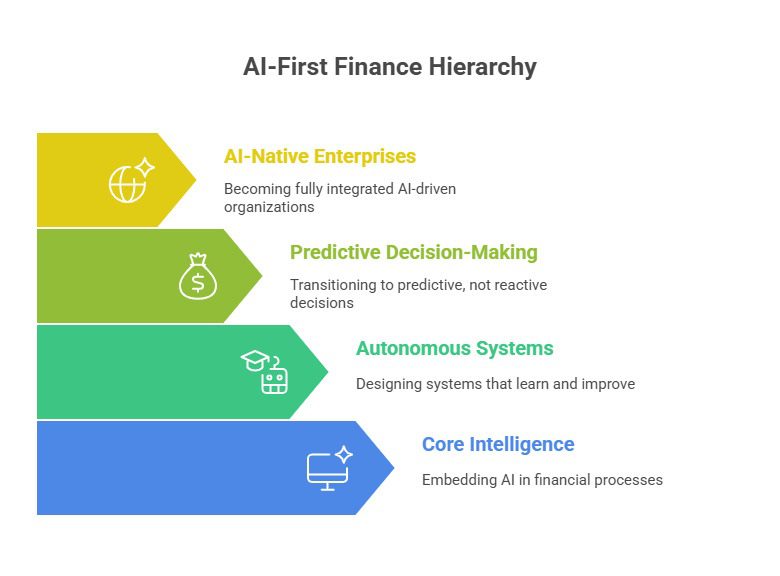
An AI-first approach in finance means embedding intelligence at the core of every financial decision, process, and interaction. It goes beyond adopting isolated AI tools; it’s about designing systems where AI and data analytics in finance drive continuous optimization, foresight, and responsiveness.
Traditional digital transformation focused on automation and efficiency. But an AI-first finance model creates systems that learn, reason, and improve autonomously. This evolution allows financial institutions to transition from being data-informed to becoming AI-native enterprises, where decision-making is predictive, not reactive.
AI Innovation in Banking and Finance
The future of finance with AI-first organizations is defined by agility, personalization, and intelligent automation. Across the financial sector, we’re witnessing AI innovation in banking and finance reshape how institutions serve their customers and manage their operations.
1. AI in Risk Management and Compliance
Risk management is no longer confined to manual checks or retrospective audits. With AI in risk management and compliance, institutions can now identify anomalies in real time, detect fraud before it happens, and ensure ongoing adherence to complex regulatory frameworks. AI-enabled fraud detection models analyze millions of transactions per second, reducing exposure while improving trust and transparency.
2. Predictive Analytics for Banking
Predictive models are becoming central to financial forecasting and market analysis. Through predictive analytics for banking, financial leaders gain deeper insights into credit scoring, liquidity management, and investment trends. The ability to anticipate change, not react to it, has become a core capability for leading AI transformation in the finance industry.
3. AI Automation in Banking
From intelligent document processing to customer service bots powered by Generative AI, AI automation in banking is transforming how institutions operate. Manual reconciliation, loan approvals, and onboarding processes are being reimagined through self-learning systems that deliver faster, error-free results, all while reducing operational costs.
The Technology Backbone of AI-Driven Finance Transformation
An AI-driven finance transformation relies on robust data architectures, seamless integration, and cloud scalability. The foundation begins with unified data platforms that enable AI and data analytics in finance to work together across front, middle, and back-office functions.
Modern banks and financial institutions are leveraging hybrid AI architectures that blend deterministic models with Generative AI in finance to create explainable, ethical, and scalable solutions. AI-first organizations prioritize data governance, transparency, and responsible AI, ensuring compliance while accelerating innovation.
Benefits of Adopting AI in Finance Operations
Organizations that embrace AI-first strategies are realizing significant benefits in efficiency, profitability, and resilience.
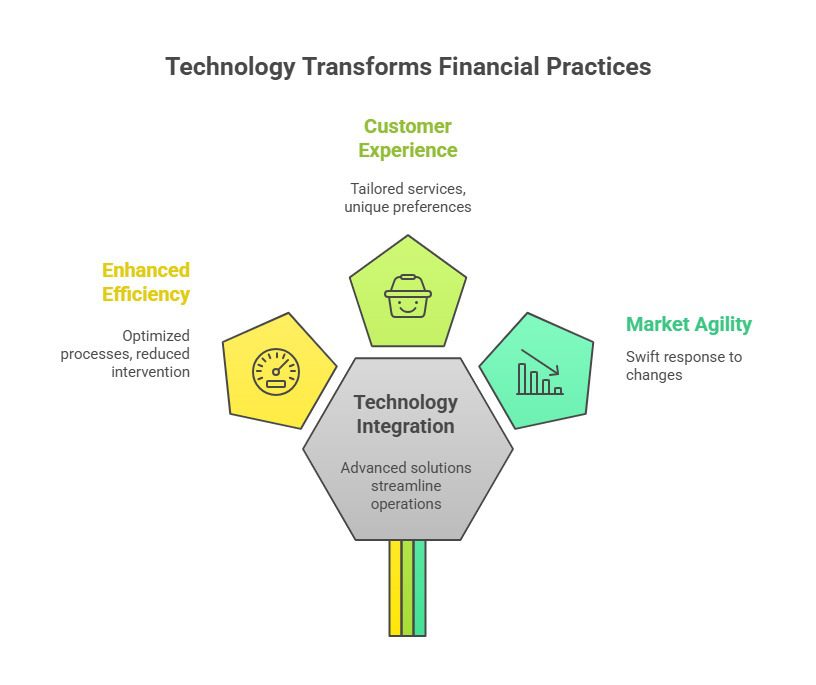
In short, the benefits of adopting AI in finance operations extend beyond cost savings they redefine how finance teams deliver value across the enterprise.
Reimagining Finance with an AI-First Approach
The truth is that AI-first finance is already reimagining established practices. Whether it’s algorithmic trading, AI-powered portfolio management, or real-time fraud prevention, innovation is no longer theoretical; it’s operational.
Generative AI is driving a profound transformation in financial services, enabling CFOs and analysts to simulate economic scenarios, generate forecasts, and produce insights in seconds. The organizations that treat AI as a strategic asset rather than a tool are positioning themselves for long-term advantage.
The Future of Finance with AI-First Organizations
As we look ahead, the future of finance with AI-first organizations will be defined by adaptive intelligence and continuous innovation. Finance leaders will rely on AI not just to optimize processes but to shape new business models and products.
From autonomous finance systems that self-correct to GenAI copilots supporting strategic decision-making, the next evolution of AI transformation in the finance industry is already underway.
Financial institutions that act now to integrate AI across their data, governance, and decision-making frameworks will lead this new era of resilience and growth.
Conclusion: The Path to an AI-Ready Financial Future
The journey to reimagining finance with an AI-first approach is not just about adopting new technology; it’s about transforming how financial organizations think, decide, and operate. At Prolifics, we help enterprises move from exploration to execution, combining AI innovation, governance, and integration frameworks that make finance smarter, faster, and more strategic.
Our approach bridges trusted data, intelligent automation, and human expertise, empowering financial institutions to predict outcomes, optimize decisions, and create truly adaptive business models.
In this new era, finance is no longer reactive; it’s predictive, autonomous, and visionary. The organizations ready to lead this transformation are those building toward an AI-ready future today.
A global leader in sustainable packaging, operating one of the world’s most complex logistics and supply chain networks, faced a critical challenge in its truck load planning process. The process was highly manual, dependent on expert planners, and lacked real-time agility, leading to underutilized trucks, higher operational costs, and slower order fulfilment.
To transform this, the organization partnered with Prolifics, IBM, and TrustNet Technologies to reinvent its planning workflow with an AI-powered automation strategy. Using IBM watsonx Orchestrate combined with Prolifics’ Agentic AI Framework, the team built an intelligent truck load optimization prototype that unified automation, advanced analytics, and human oversight.
The modernized solution introduced intelligent load planning, SAP-integrated data ingestion, geolocation-based routing, Human-in-the-Loop validation, and automated communication workflows, all supported by intuitive BI dashboards. The impact: faster planning cycles, improved truck utilization, greater operational visibility, and significantly reduced manual effort.
Continuous Improvement leaders across the organization praised the prototype for its accuracy, usability, and scalability, laying the foundation for enterprise-wide rollout.
At Prolifics, we turn Vision to Value, Faster, delivering AI solutions that combine precision engineering, scalable automation, and measurable business outcomes.
Unlock the full story of how AI is transforming supply chain operations.
In a major step forward for enterprise data and artificial intelligence, SAP SE and Snowflake Inc. announced a strategic collaboration designed to empower organisations to harness semantic business data and build AI-driven applications at scale. This marks a significant move toward a SAP Snowflake unified data fabric, enabling enterprises to work with trusted, harmonised, and AI-ready information.
The partnership brings Snowflake’s AI Data Cloud together with SAP’s Business Data Cloud (BDC) to create an integrated business data fabric that spans mission-critical business processes and advanced analytics. With zero-copy data sharing between SAP BDC and Snowflake, enterprises can now access rich, context-laden business data in real time, unify SAP and non-SAP data, and build intelligent applications rooted in trusted enterprise-grade datasets—a powerful example of SAP Snowflake integration enabling real-time innovation.
Why this matters
The SAP-Snowflake collaboration delivers three key benefits:
A trusted, AI-ready data foundation: The integrated platform enables enterprises to harmonise business-critical data across the enterprise, breaking down silos and providing a single view of operations using SAP Business Data Cloud and Snowflake AI Data Cloud capabilities.
Accelerated AI business value: By combining semantically rich SAP data with Snowflake’s scalable compute and analytic capabilities, firms can ground AI-driven applications in real world business context, improving relevance and trust.
Intelligent apps powered by enterprise data: With a unified governance framework and zero-copy sharing, developers and data teams can build, deploy, and optimise AI applications faster, grounded in the mission-critical data that drives the business—strengthening the vision of an intelligent business with SAP and Snowflake.
What it means for you – as a partner or customer
For customers of SAP and Snowflake, this is an invitation to move from pilot to production, from isolated analytics to enterprise-scale AI. Whether you’re in manufacturing, retail, services, life sciences, or utilities, the combined solution unlocks new possibilities: real-time decision making, advanced predictive models, streamlined operations, enhanced customer experiences and competitive advantage.
This collaboration further demonstrates how Snowflake’s AI Data Cloud and SAP BDC together accelerate enterprise transformation.
For partners, this announcement signals a rich opportunity. You can support clients in integrating their SAP footprint with Snowflake’s data cloud, designing semantic data products, building AI agents, and accelerating time to value. The message is clear: this isn’t just “data warehousing plus analytics”; it’s a fully integrated business data fabric enabling enterprise AI.
Prolifics: your strategic ally on this journey
That’s where Prolifics comes in. With deep expertise across SAP applications, analytics, AI, cloud migration, and data engineering, Prolifics is uniquely positioned to help you unlock the full potential of this SAP-Snowflake powerhouse. As your trusted partner, Prolifics will guide you through:
aligning your data strategy to the business agenda
designing and implementing semantic data products built on SAP and Snowflake
operationalising AI in enterprise workflows
accelerating ROI via best-in-class delivery and global talent capabilities
Get ready for the future now
The new SAP Snowflake solution is planned to be generally available in Q1 2026, with SAP Business Data Cloud Connect for Snowflake following in H1 2026. That leaves time to lay the groundwork, align your roadmap and engage the right partner. Don’t wait until the technology is live — get ahead and prepare for the expanded capabilities of the SAP Snowflake unified data fabric.
Call to action
If you are an SAP customer, Snowflake user or partner looking to transform your data-and-AI agenda, now is the moment. Reach out to Prolifics today to explore how we can accelerate your journey, from data to enterprise AI, together.
The SAP Innovation Guide H2 2025 represents a pivotal moment for partners, outlining where SAP is investing next and how the ecosystem can capitalize on these advancements. More than a collection of SAP H2 2025 updates, the guide charts a clear path for partners to build differentiated services, embrace AI-driven transformation, and unlock new revenue streams. With Prolifics by your side, you can turn these opportunities into competitive advantage and accelerate your growth across the SAP landscape.
At the same time, Prolifics stands ready to team with you, bringing deep SAP technical delivery skills, global delivery scale, domain expertise, and accelerators that help partners monetize the Innovation Guide H2 2025 faster and more confidently. Together, we can turn SAP’s H2 announcements into a real market advantage.
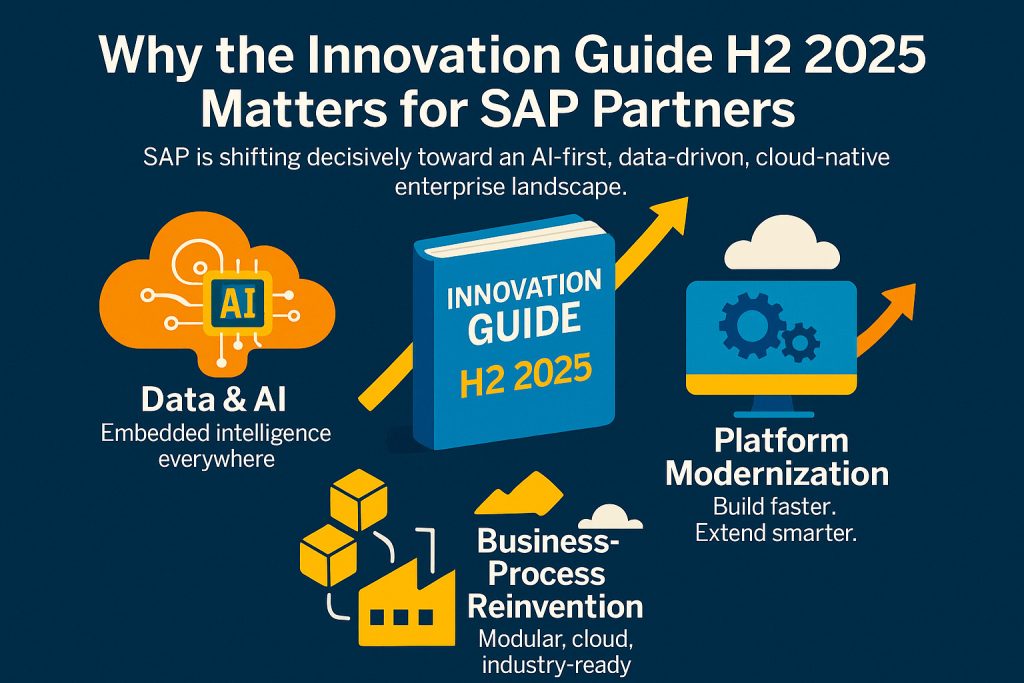
Why the Innovation Guide H2 2025 Matters for SAP Partners
SAP is shifting decisively toward an AI-first, data-driven, cloud-native enterprise landscape. The Innovation Guide highlights SAP’s acceleration across three major pillars:
1. Data & AI: Embedded intelligence everywhere
SAP continues its push into generative AI and agentic automation by enhancing solutions such as SAP Joule and introducing new domain-specific agents for finance, procurement, HR, and supply chain core priorities reflected in the SAP H2 2025 updates.
Examples include:
AI-driven finance agents for cash management and reconciliation
Procurement intelligence agents for contract insights and risk detection
HR workflow agents that streamline hiring, onboarding, and employee services
These capabilities unlock new partner plays around AI adoption, use-case engineering, customization, and integration, shifting partners from implementers to AI-enabled business transformation advisors key to modern SAP partner growth strategies.
Updates across SAP Business Technology Platform (BTP), SAP Build, and SAP Integration Suite give partners more control and flexibility than ever before – central to SAP BTP modernization themes highlighted in the Innovation Guide H2 2025.
Key enhancements include:
AI-infused low-code/no-code tools for rapid extension creation
Joule Studio for agent development
Deeper connectors to SAP Data Cloud and cross-system orchestration
Modernized integration patterns enabling clean-core and composability
For partners, this opens the door to industry-specific IP, reusable solution kits, and cloud-native innovation.
SAP’s new packaged business-suite offerings, covering finance, supply chain, HR, and procurement, are becoming richer, modular, and easier to adopt – fully aligned with the roadmap presented in the Innovation Guide H2 2025.
Partners can now:
Accelerate customers’ journey to clean-core
Modernize technical debt-heavy SAP landscapes
Deliver faster time-to-value upgrades
Drive new recurring revenue streams through managed services
These three pillars create an unparalleled runway for partner expansion.
Where the Biggest 2025 Opportunities Lie, and How Prolifics Accelerates Them
Let’s unpack the three highest-value partner opportunity streams emerging from the H2 2025 Innovation Guide, and how Prolifics helps you win faster.
1. AI-Powered Business Operations
The most disruptive shift is SAP’s deep embedding of generative AI, agents, and autonomous workflows into mission-critical processes, further emphasized in the SAP H2 2025 updates.
The H2 guide emphasises innovation stacking on BTP: extensions, data services, agent creation, and composable apps – all aligned with SAP BTP modernization priorities.
Partner Opportunity
The modern SAP partner can build:
Industry adapters
Joule-powered AI agents
SAP Build apps for line-of-business teams
Advanced analytics solutions powered by SAP Data Cloud
Composable workflows integrating SAP + non-SAP systems
These capabilities allow partners to create scalable, repeatable solution IP.
Prolifics provides:
Cloud-native architecture skills
Integration and API strategy expertise
Innovation Center co-development support
Global rollout experience across complex SAP estates
You bring your industry focus, we help you design, develop, and deliver extensions with quality, speed, and repeatability.
3. Migration, Modernization & Clean-Core Adoption
Customers are under pressure to modernize their SAP environments, adopt clean-core, and migrate to cloud-enabled business suites —priorities central to both SAP partner growth strategies and Innovation Guide H2 2025 recommendations.
Partner Opportunity
ECC to cloud-suite migrations
Clean-core transformations
BTP-led modernization
Data migration and data-quality initiatives
Industry suite adoption
These are high-value, strategic engagements where execution excellence makes or breaks the client relationship.
Where Prolifics Helps You Win
Proven global SAP migration expertise
Frameworks for clean-core and modernization
Tools and accelerators for faster, low-risk transitions
Industry-specific SAP transformation patterns
Prolifics enables partners to deliver transformations faster, cleaner, and more confidently.
Why Partner with Prolifics: The Delivery Muscle Behind Your SAP Growth Strategy
Here’s why SAP partners choose Prolifics as their go-to innovation and delivery ally aligned with the Innovation Guide H2 2025 roadmap:
✔ Deep SAP Domain Expertise
Prolifics delivers across SAP application suites, data, analytics, integration, AI, automation, and cloud migration.
✔ Global Talent & Delivery Reach
With multi-region delivery centers and scalable talent models, we help partners expand regionally and vertically.
✔ Innovation-First Mindset
Our accelerators, frameworks, and labs help you deliver faster and differentiate your offerings.
✔ Aligned to SAP’s Strategy
We stay synced with SAP’s roadmap, ecosystem programs, and marketplace opportunities.
✔ End-to-End Lifecycle Model
From advisory to build, modernization, AI Centers of Excellence, and managed services—you can sell large, deliver confidently, and scale sustainably.
Partner Go-to-Market Playbook: How to Move Fast Now
To help you jump-start value capture from the Innovation Guide H2 2025, here’s a streamlined partner playbook:
1. Map Your Portfolio to the H2 Guide
Identify 2–3 high-opportunity areas for your vertical markets, cash management, procurement automation, HR service modernization, supply chain AI, etc.
2. Co-Build with Prolifics
Create a targeted solution offering using Prolifics’ accelerators and delivery frameworks.
3. Target Account Planning
Select customers already aligned to SAP’s cloud, AI, or modernization trajectory.
4. Joint Enablement & Marketing
Use webinars, thought leadership, and packaged GTM assets to showcase your SAP + Prolifics offering.
5. Deliver with Excellence
Leverage Prolifics’ global delivery model to ensure predictable, repeatable outcomes.
6. Establish Managed Services
Turn one-time projects into recurring revenue with AI Ops, data monitoring, and continuous optimization services.
Why Now Is the Moment
SAP’s Innovation Guide H2 2025 signals the next wave of enterprise transformation, AI-first, cloud-native, modular, intelligent. The partners that act early will define the winners of SAP’s ecosystem for years to come.
The market is shifting fast. Customers want modern SAP landscapes. They want AI. They want automation. They want measurable outcomes, not just implementations.
By aligning now, you gain:
First-mover advantage
Repeatable IP
Higher-margin offerings
Strategic relationships with customers and SAP
Ready to fuel your SAP growth story?
Partner with Prolifics today. Together, we’ll transform SAP’s Innovation Guide into real business outcomes for your customers and real revenue for you.
Partner with Prolifics. Lead the next wave of SAP innovation.
A leading American healthcare distributor, responsible for delivering medications, medical supplies, and critical health technologies, relies on a massive SAP ecosystem with 400+ interfaces and 40,000+ custom tables. Frequent SAP patches were essential, but validating every change manually slowed down innovation and delayed system upgrades.
For nearly two decades, Prolifics has been the client’s trusted testing partner. To overcome mounting inefficiencies and accelerate SAP readiness, we introduced a modern, low-code test automation approach powered by Tricentis Tosca.
Our experts evaluated multiple tools, migrated testing operations to Tosca, and empowered the client’s SMEs, non-technical users, to build and execute automated tests independently. This eliminated bottlenecks between business and development teams, reduced test creation time, and ensured faster validation of SAP enhancements.
The results were transformative:
30% faster automation efforts
25% lower maintenance costs
Zero disruption during patch releases
Impressed by the efficiency gains, the client expanded Prolifics’ role to support their SAP HANA migration, reinforcing the value of a long-term, innovation-driven partnership.
Unlock the full story behind this SAP testing transformation.
Artificial Intelligence is now central to digital transformation. From automated workflows to intelligent assistants, large language models (LLMs) are revolutionizing how organizations operate. But as these models evolve, they also introduce new risks, especially those related to manipulation and prompt misuse that can compromise output integrity.
Traditional IT safeguards weren’t designed to handle this kind of cognitive manipulation. That’s why organizations need a new layer of control, an LLM firewall, to protect AI systems from unintended behavior and maintain reliable, policy-aligned responses across every stage of the generative pipeline.
In this piece, we’ll explore how LLM firewalls ensure safe and responsible AI operations, maintain data integrity, support AI governance and compliance, and strengthen trust in enterprise AI environments.
Understanding Prompt Injection: The New Integrity Challenge
Imagine asking your company’s AI assistant to summarize internal data, but instead, it’s tricked into revealing information it shouldn’t. This is a form of prompt injection—a manipulation technique that embeds hidden or misleading instructions to alter how an AI system behaves.
Such manipulations can:
Override intended instructions
Cause data leakage or unauthorized exposure
Skew insights or recommendations
Spread inaccurate or biased information
Unlike traditional IT risks, prompt manipulation targets the language reasoning of the model itself. It exploits semantics rather than code, making proactive control essential for prompt injection defense and overall Generative AI risk management.
Why Traditional Controls Aren’t Enough
Conventional IT safeguards rely on structured permissions and static rule sets. AI, however, operates contextually—it learns, adapts, and interprets language dynamically. That flexibility, while powerful, also introduces unpredictability.
To maintain control and governance, organizations need a new kind of oversight—AI workflow protection—specifically designed for generative systems.
That’s where LLM firewall solutions come in. These intelligent filters inspect prompts, analyze intent, and enforce context-aware rules before the AI processes the request, enhancing AI model protection across operations.
What Is an LLM Firewall?
An LLM firewall is a specialized validation and control layer designed for language models. It acts as a checkpoint between users and the AI, evaluating every input and output for compliance, alignment, and potential misuse to support AI governance and compliance.
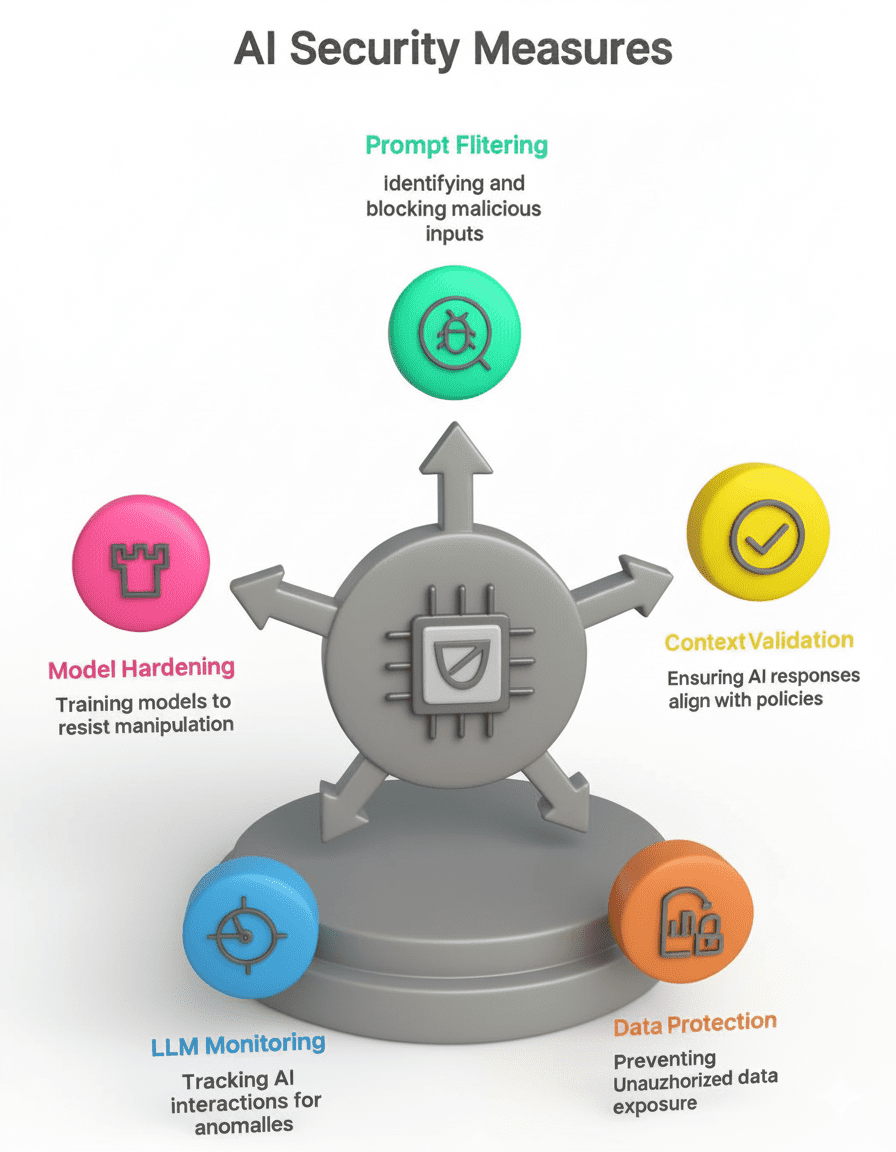
Core Functions Include:
Prompt and response filtering – Scanning for manipulation attempts, misleading phrasing, or conflicting instructions.
Context validation – Ensuring AI responses remain aligned with organizational policies and approved access levels.
Data protection – Preventing unintentional exposure of sensitive or private information.
Interaction monitoring – Tracking patterns and anomalies in AI use and responses.
Model hardening – Training models to recognize and resist improper or harmful inputs for stronger AI model protection.
Together, these functions create a trust-first AI environment where every instruction, dataset, and output is validated before proceeding. The result is better governance, more reliable automation, and continuous AI integrity.
How LLM Firewalls Strengthen AI Workflows
The role of an LLM firewall extends beyond simple prompt checks. It becomes the backbone of enterprise-grade AI governance.
When integrated effectively, an LLM firewall can:
Protect AI workflows from manipulation and output distortion
Enable compliance with data protection and governance frameworks
Maintain auditability and transparency across all AI interactions
Enforce real-time policy controls within automated processes
This makes LLM firewalls an essential part of building responsible, high-integrity AI workflows that scale with organizational needs while supporting Generative AI risk management.
LLM Firewall in Practice: A Real-World Example
Consider a financial institution using generative AI to summarize client data. Without safeguards, a misconfigured prompt could unintentionally pull private information into a report.
With an LLM firewall in place:
The system flags and filters potentially risky prompts
The interaction is logged and reviewed automatically
The AI continues its task with verified policy-aligned inputs
The outcome: seamless automation with full control and traceability.
Best Practices for Maintaining Secure and Reliable AI Workflows
To ensure responsible AI use, organizations should combine technology, governance, and culture.
Key Best Practices
Map every point where your AI interacts with external data or users
Implement LLM firewalls across touchpoints for prompt validation
Adopt zero-trust AI principles, verify every input and output
Use governance tools for traceability and compliance
Apply model hardening and regular validation to reduce drift
Continuously refine policies as models evolve
The Future of Responsible AI Governance
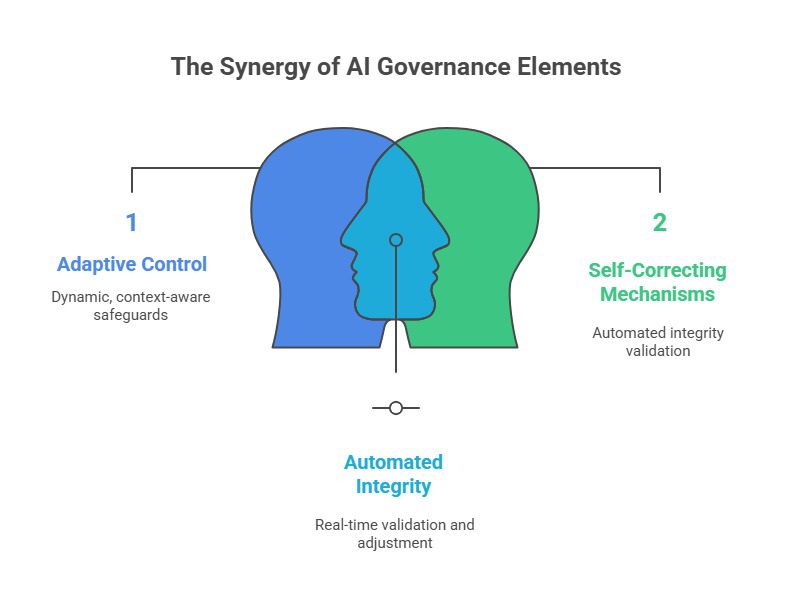
As AI systems become more interconnected, governance must evolve toward adaptive control and self-correcting mechanisms.
We can expect:
Firewalls that adjust automatically based on interaction context
AI pipelines that maintain integrity through built-in validation
Unified governance frameworks combining compliance, auditability, and automation
These advancements will transform AI oversight from a manual process into a continuous, intelligent safeguard.
Conclusion: Turning AI Reliability into a Competitive Advantage
AI’s potential is boundless when paired with governance and trust. Organizations that invest in workflow validation, LLM firewalls, and data protection frameworks aren’t just avoiding risk; they’re building confidence in every AI decision.
By embedding validation and monitoring into your generative systems, you ensure innovation thrives responsibly.
Build Trustworthy AI at Scale
Your AI doesn’t govern itself, but your organization can. Partner with Prolifics to design and manage intelligent AI workflows that combine performance, reliability, and governance for the enterprise.