Behavioral health providers face growing pressure to integrate care, streamline operations, and deliver measurable outcomes. For a leading digital behavioral health company, Prolifics transformed outdated, manual survey tools into a modern, cloud-ready behavioral-medical integration platform. Built with scalability, security, and compliance at its core, the solution enabled faster patient assessments, real-time analytics, and seamless data exchange between payers and providers, all while maintaining strict HIPAA standards.
Through a seven-year strategic partnership, Prolifics delivered not just technology, but business transformation. Our experts co-created a modular architecture that supported configurable workflows for screening, intake, care planning, and outcomes tracking. With automated testing, blue-green deployment, and observability practices, we ensured continuous improvement and zero downtime, empowering clinicians with better insights and freeing them to focus on what matters most: patient care.
The result was a scalable platform adopted by enterprise clients, including Kaiser Permanente, which drove measurable improvements in outcomes and efficiency. Prolifics’ approach positioned the client for long-term success and ultimately led to an acquisition by New Directions Behavioural Health.
Ready to accelerate your digital transformation?Talk to our experts today.
For decades, IT teams have been trapped in a cycle of inefficiency, endless ticket queues, repetitive forms, and long waits for resolution. The result? Employees lose over 350 hours a year to common IT issues, costing businesses billions. But now, Salesforce has reimagined IT service delivery with Agentforce IT Service, a groundbreaking, conversational-first solution that shifts IT support from reactive to proactive.
Built on the trusted Salesforce Platform, Agentforce IT Service empowers IT teams to automate incident management, streamline service requests, and deliver instant, AI-powered support directly in Slack, Teams, and employee portals. And with Prolifics as your trusted partner, your organization can implement, integrate, and maximize this innovation to achieve true digital transformation.
From Tickets to Talk: Conversational AI That Works for You
Agentforce IT Service replaces outdated, ticket-based systems with autonomous AI agents that instantly detect, resolve, and escalate IT issues, all through simple, natural conversations. Imagine employees reporting a VPN problem in Slack and having it fixed in seconds, no portal, no ticket, no delay.
This is more than automation; it’s empowerment. IT teams gain freedom to focus on strategic, high-value work, while employees enjoy personalized, real-time resolutions that keep business operations running smoothly. And thanks to Agentforce’s Agentic Configuration Management Database (CMDB), IT leaders gain a 360° view of systems and dependencies, reducing downtime and boosting operational resilience.
Trusted by Industry Leaders Worldwide
From UNESCO to Piedmont Healthcare, organizations across industries are already realizing tangible value from Agentforce IT Service. They’re improving margins, cutting operational costs, and freeing IT teams from mundane, repetitive tasks. Whether in government, healthcare, or manufacturing, Agentforce delivers seamless, intelligent, and scalable IT service management that transforms everyday IT operations into a competitive advantage.
Prolifics + Salesforce: Powering Your Intelligent IT Future
As a Salesforce implementation partner, Prolifics bridges innovation and execution. Our experts help enterprises integrate Agentforce IT Service with existing workflows, leveraging 100+ prebuilt connectors to platforms like Google, IBM, Microsoft, Oracle NetSuite, Workday, and Zoom. We enable rapid deployment, custom automations, and data unification across systems, ensuring your IT transformation delivers measurable ROI from day one.
With Prolifics’ expertise in AI-driven automation, data integration, and enterprise IT modernization, we help you unlock the full potential of Salesforce’s agentic ecosystem. Together, we’ll build intelligent IT service experiences that reduce operational costs, elevate employee satisfaction, and accelerate business growth.
Your Next Step: Transform IT into a Strategic Advantage
The age of legacy ITSM is over. The future belongs to agile, conversational, and AI-empowered IT support that evolves with your business. Partner with Prolifics today to implement Salesforce’s Agentforce IT Service and reimagine what your IT team can achieve when freed from manual tasks.
A unified, modern IT service desk helps companies automate incidents and service requests and augment IT teams. Let’s help your business spend less time managing tickets and more time driving innovation.
Digital Triplets and Agentic AI are redefining the future of intelligent automation. For years, the evolution of digital twin technology has helped organizations simulate operations, test scenarios, and predict outcomes using real-time data.
From smart factories to energy grids, digital twins have become the backbone of operational intelligence. But as enterprises seek more autonomy, transparency, and speed, a new era is taking shape, one that adds a layer of intelligence on top of the twin.
This next step introduces digital triplet agents, which combine physical systems, virtual replicas, and cognitive intelligence into a cohesive ecosystem. The shift is powered by Agentic AI in digital triplets, creating automation that is not only efficient but also responsible, explainable, and human-aligned. Digital triplets represent the next phase in the digital twin evolution, bridging insight with autonomous, explainable, and ethical AI.
What Is a Digital Triplet?
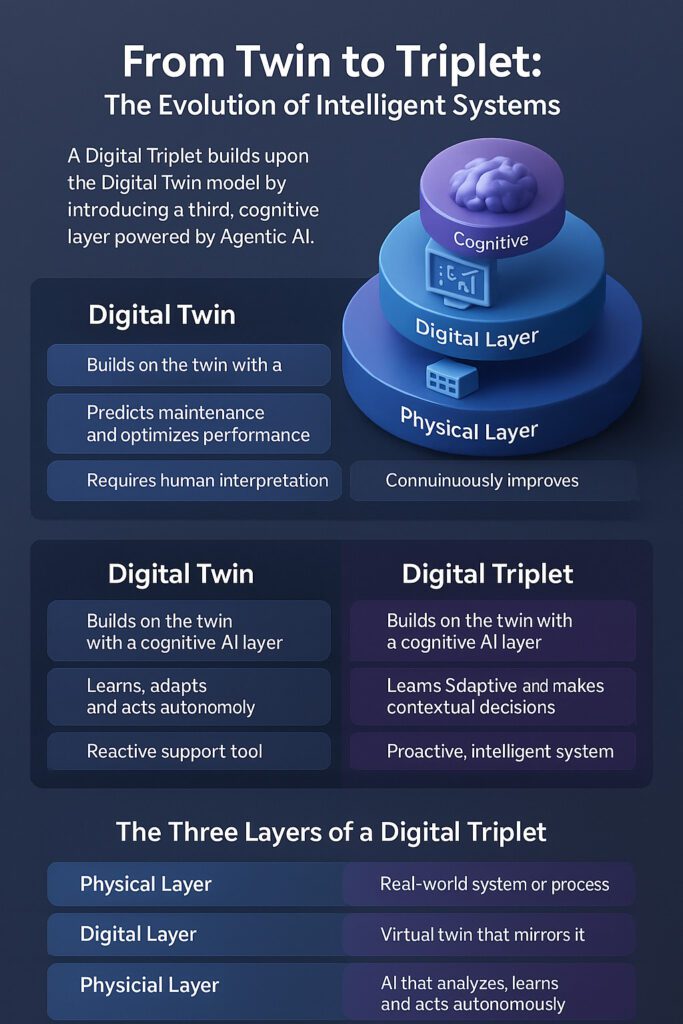
The concept of a digital triplet represents the next stage in digital transformation. While a digital twin mirrors real-world assets and processes to help organizations predict maintenance and optimize performance, it still relies heavily on human interpretation and intervention.
A digital triplet changes that. It adds a third cognitive layer—powered by Agentic AI—that learns, adapts, and acts autonomously. Instead of simply reflecting what’s happening, a digital triplet understands why it’s happening and what to do next.
In short: Digital triplets move organizations from reactive insights to proactive intelligence—bridging the gap between observation and autonomous action.
The infographic below illustrates how a Digital Triplet builds upon the Digital Twin model, adding a cognitive AI layer that enables learning, reasoning, and autonomous action.
Understanding Digital Triplets and Agentic AI
Agentic AI is an advanced form of artificial intelligence that plans, reasons, and makes decisions with limited human input, continuously learning and improving over time.
When integrated with digital triplets, it enables systems that act intelligently and proactively within their environments, strengthening autonomy and efficiency.
Trust remains central to this evolution — Responsible AI automation ensures every decision is transparent, traceable, and compliant with governance standards.
How Digital Triplets Work
Here’s a simplified breakdown of how digital triplets operate:
Monitor: Sensors feed real-time data from physical systems into the digital layer.
Simulate: The digital model evaluates potential outcomes and identifies trends.
Act: The cognitive layer predicts future states and recommends or executes optimized actions.
This creates a continuous feedback loop where each layer enhances the other. The result: a network of autonomous digital triplet agents capable of optimizing performance while ensuring accountability.
Building a Network of Responsible AI Agents
Imagine a generative AI (GenAI) system designed to deliver personalized health recommendations based on user data. Within this ecosystem, a network of specialized AI agents works together to ensure reliability, security, and privacy while managing user requests, authentication, and data access.
These “responsible use” agents operate alongside data retrieval, analysis, and content generation agents to make sure every output follows compliance and Responsible AI principles, creating a GenAI experience that is transparent, secure, and trustworthy.
Orchestration Agent – Coordinates communication between humans and AI agents, managing tasks, execution, and resources for smooth operation.
Retriever Agent – Gathers accurate and relevant information from verified sources to support reliable AI outputs.
Data Preparation Agent – Processes and analyzes data to deliver timely, precise insights for decision-making.
Quality Agent – Monitors data inputs and outputs, correcting or flagging inconsistencies to maintain data integrity.
Bias Detection Agent – Reviews system outputs to detect and mitigate unfairness or bias, ensuring objective results.
Privacy Compliance Agent – Applies privacy techniques such as anonymization and federated learning, enforcing data protection and regulatory compliance.
Security Monitoring Agent – Detects vulnerabilities, manages authentication, and protects against internal and external threats.
Generation Agent – Produces coherent, context-aware text or images, enhancing the user experience through reliable generative content.
Together, these agents create a collaborative network that builds transparency, fairness, and safety directly into AI operations, demonstrating how responsible automation drives both innovation and trust.
Benefits of Agentic AI in Digital Triplets
The integration of agentic AI into digital triplet models delivers tangible advantages for organizations focused on responsible, autonomous, and scalable AI systems.
1. Enhanced Efficiency and Effectiveness
By autonomously applying Responsible AI principles, agentic AI within digital triplets improves both the efficiency and effectiveness of AI operations. These systems can identify and resolve issues faster, minimizing manual oversight and accelerating reliable decisions.
2. Improved Trust and Adoption
Automating responsible AI principles ensures fairness and transparency, strengthening stakeholder confidence and driving broader adoption across the enterprise.
3. Scalability and Adaptability
Digital triplets enable organizations to deploy AI systems flexibly across various domains and environments. Their predictive and prescriptive capabilities allow teams to start small, validate outcomes, and confidently scale for increased value and performance.
4. Preparing for the Future of Agentic AI
Agentic AI in digital triplets represents a significant step forward in embedding Responsible AI directly into intelligent systems. By combining predictive and prescriptive models with physical and digital environments, enterprises can proactively manage ethical, legal, and operational challenges.
To sustain these benefits, organizations must continue investing in AI governance, ethical frameworks, and responsible innovation to ensure trustworthy, long-term success.
How Do Digital Triplets Extend Digital Twins to Improve Decision-Making?
Digital triplets bridge the gap between insight and execution. While traditional digital twins deliver analytics and predictions that require human action, digital triplets go further, using cognitive intelligence to analyze data and act autonomously.
Key improvements include:
Faster responses: Decisions happen instantly within the system.
Proactive control: Systems predict and prevent issues before they occur.
Smarter insights: Machine reasoning leads to higher precision.
Continuous learning: The system adapts with each new data cycle.
This evolution enables enterprises to move from “monitor and react” to “anticipate and act,” enhancing agility and accuracy at scale.
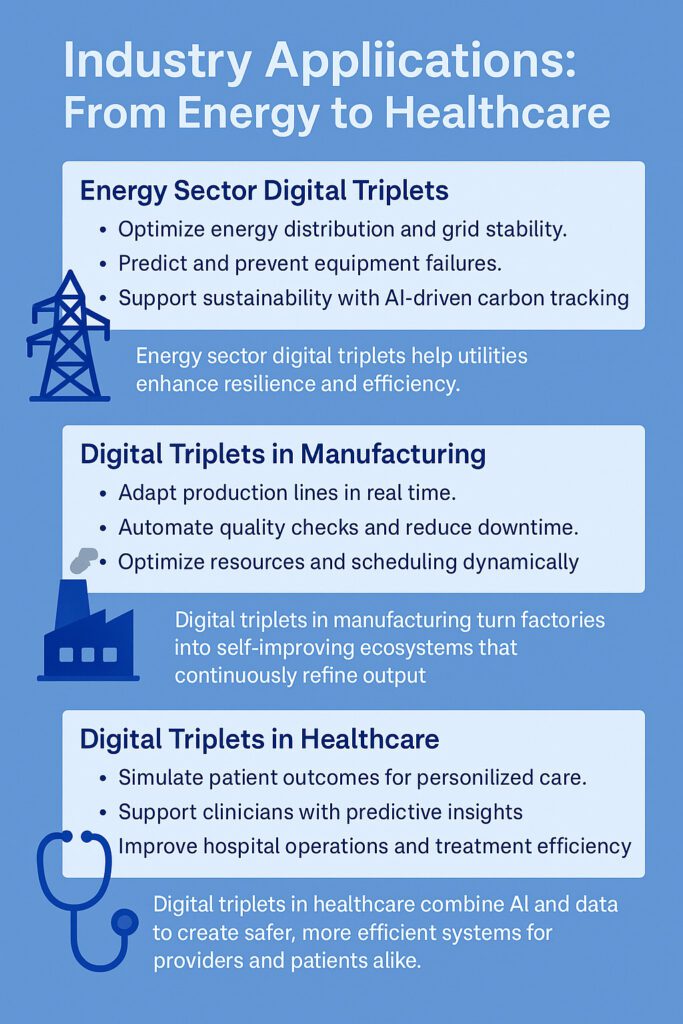
Energy Sector Digital Triplets
Digital triplets are transforming how energy utilities maintain stability, reliability, and sustainability. Acting as smart command centers, they analyze real-time operational data to fine-tune grid performance, predict failures before they occur, and support sustainable energy distribution, boosting resilience, efficiency, and environmental impact.
Digital Triplets in Manufacturing
Digital triplets are driving manufacturing beyond automation to intelligence. They enable production lines to sense, learn, and adapt in real time, using AI to detect quality issues, minimize downtime, and coordinate resources for a self-optimizing, high-performance ecosystem.
Digital Triplets in Healthcare
Digital triplets are redefining healthcare with precision-driven intelligence. By combining patient data, operations metrics, and AI reasoning, they help clinicians predict needs, optimize resources, and personalize treatment, transforming care from reactive to proactive.
The infographic below highlights how digital triplets are already transforming industries, from energy and manufacturing to healthcare, by enhancing intelligence, reliability, and performance.
Human-AI Collaboration: Designing the Future Together
The Human-AI collaboration future depends on partnership, not replacement. In digital triplet systems, humans define objectives and validate AI decisions while AI executes and optimizes.
This synergy ensures that human judgment and empathy guide machine precision. Organizations embracing this model will:
Operate faster and with more confidence.
Empower teams with real-time intelligence.
Build trust with customers and regulators.
Human-AI collaboration is what turns intelligent systems into responsible allies.
The Ethical Imperative
As automation scales, the importance of ethical AI grows. Ethical design ensures fairness, transparency, and safety in every AI-driven process.
In digital triplets, ethical frameworks define how cognitive systems make and justify decisions. This safeguards users, customers, and the business itself, strengthening the link between innovation and responsibility, a critical factor for long-term success.
The Future of Agentic AI in Digital Triplets
The coming years will redefine how organizations use AI. Agentic AI in digital triplets marks a leap toward self-learning, accountable ecosystems that operate responsibly at scale.
Imagine a world where:
Energy grids self-correct during outages.
Manufacturing systems optimize themselves in real time.
Hospitals predict and prevent medical complications.
These are not distant possibilities. They are becoming reality through autonomous agents that act intelligently, learn continuously, and collaborate ethically, each reasoning transparently while maintaining human oversight.
This is the foundation of the future: intelligent systems that evolve responsibly.
Key Takeaways
Digital triplets integrate physical, digital, and cognitive layers for proactive intelligence.
Agentic AI ensures decisions are transparent, responsible, and explainable.
Human-AI collaboration builds trust and drives sustainable innovation.
The goal is not to replace humans—but to empower them with smarter, more responsible AI systems.
Transform the way your organization connects, engages, and grows, just like CMC Energy Services did with Prolifics and Enable Consulting. Facing costly, outdated systems, CMC needed a scalable, user-friendly CRM to drive digital engagement and self-service transformation. Our experts designed a Salesforce Proof of Concept (POC) that validated Salesforce’s ability to deliver end-to-end business value, enhancing agility, customer relationships, and operational efficiency.
Through deep collaboration, Enable Consulting re-energized CMC’s digital ecosystem, aligning IT and business leaders behind a unified Salesforce vision. The result? A modern CRM platform that empowers teams, streamlines workflows, and accelerates decision-making, fueling growth in the evolving clean energy landscape.
At Prolifics, we turn vision into value faster. With over 45 years of digital engineering and consulting excellence, we combine strategy, design, and technology to help enterprises innovate and scale across industries, including energy, healthcare, finance, and government.
Ready to accelerate your transformation journey? Download the full case study and discover how Prolifics can help your organization achieve Salesforce success.
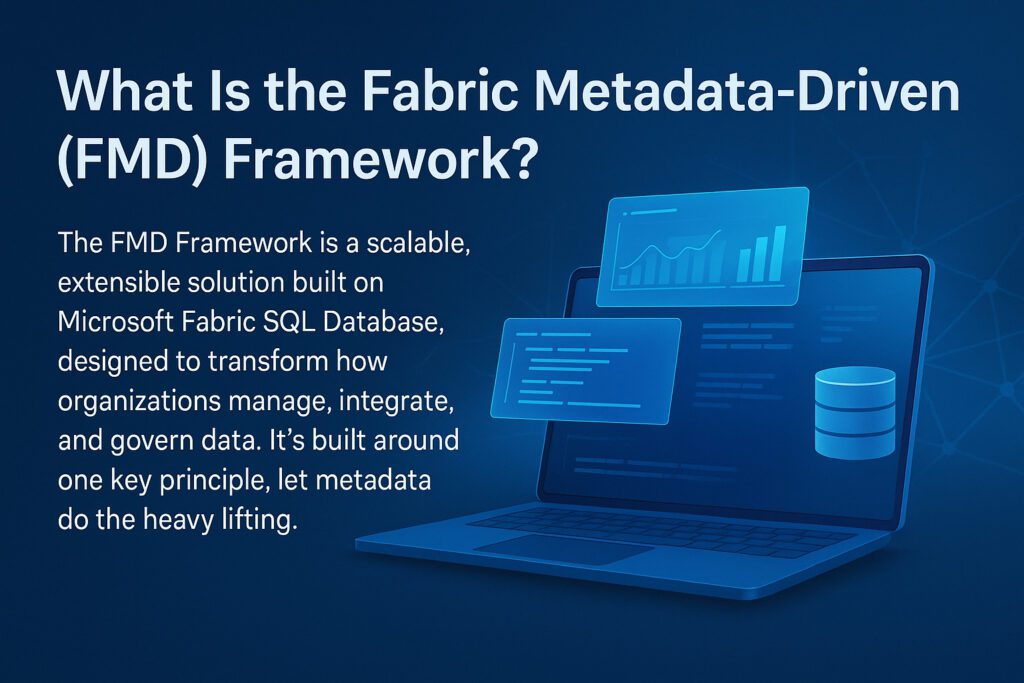
What Is the Fabric Metadata-Driven (FMD) Framework?
The FMD Framework is a scalable, extensible solution built on Microsoft Fabric SQL Database, designed to transform how organizations manage, integrate, and govern data. It’s built around one key principle, let metadata do the heavy lifting.
Instead of hardcoding every connection, transformation, and rule, the FMD Framework dynamically drives data pipelines, configurations, and workflows from metadata tables. The result? Faster deployments, consistent logic, and a framework that evolves effortlessly as business needs change.
Key Highlights:
Comprehensive Governance: Centralize metadata for better quality, consistency, and compliance.
Scalability and Flexibility: Adapt easily to new sources, schemas, and scaling needs.
Streamlined Integration: Connect diverse systems, from SQL to flat files, without rebuilding pipelines.
Cost Efficiency: Eliminate redundancy and optimize compute costs with metadata-driven automation.
Inside the Architecture: Simplicity Meets Power
At its core, the FMD Framework follows a modular architecture that separates data, code, and orchestration. This not only improves manageability but also enhances security and traceability.
Workspace Architecture
Workspace Type
Purpose
Examples
Data Workspaces
Manage and store data
Data Landing Zone, Bronze, Silver
Code Workspaces
Develop pipelines and notebooks
Data Pipelines, Spark, Scripts
Gold Workspaces
Host business-ready datasets
Gold Layer, Semantic Models
Reporting Workspaces
Create business intelligence
Power BI Reports
Orchestration & Logging
Manage operations and audits
Fabric SQL Database, Audit Tables
This structure ensures clear separation of responsibility, smoother collaboration, and cleaner governance, exactly what enterprises struggle to achieve in fragmented data environments.
How Microsoft Fabric Powers Metadata-Driven Pipelines
Fabric’s OneLake and Lakehouse medallion architecture, the Bronze-Silver-Gold layering, fit perfectly with a metadata-driven strategy.
Here’s how it all comes together:
Define Metadata Tables: Store all ingestion rules, parameters, and configurations dynamically.
Lookup Metadata at Runtime: Pipelines fetch instructions from the metadata layer, no code changes required.
Trigger Data Movement: Based on metadata, data flows from raw (Bronze) to refined (Silver) to business-ready (Gold).
Monitor & Audit: Logs track every step, ensuring complete transparency and traceability.
With this, onboarding a new data source becomes as simple as updating a few metadata records, no new code, no redeployment, no drama.
Why Traditional Data Engineering Falls Short
Let’s be honest, most data workflows today are a tangled mess. Pipelines break when schemas change, naming conventions vary wildly, and governance feels like an afterthought.
In mergers, acquisitions, or modernization projects, onboarding new sources can drag on for weeks. Every team brings its own standards, and manual mapping only adds more room for errors.
Even though Microsoft Fabric provides cutting-edge tools like lakehouses, warehouses, and notebooks, without a standardized, metadata-driven framework, teams often find themselves reinventing the wheel.
Metadata changes that. It brings structure, repeatability, and control. With clearly defined metadata schemas, transformations can be applied consistently, audits become effortless, and pipelines gain resilience. It’s not just about automation, it’s about regaining control of your data ecosystem.
Building a Modular, Future-Ready Solution
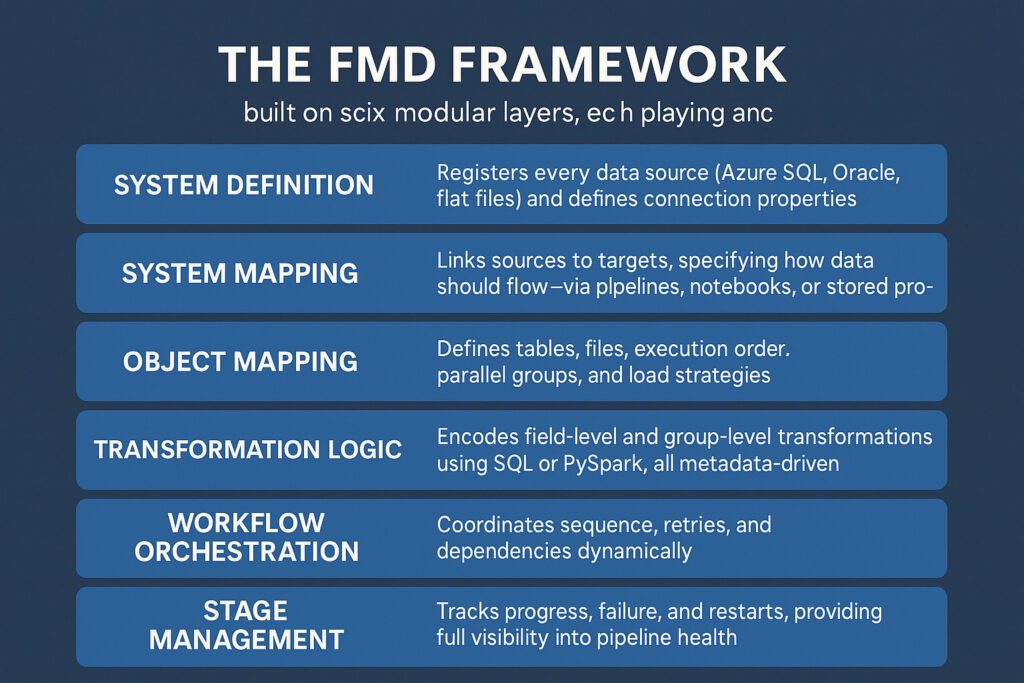
The FMD Framework is built on six modular layers, each playing a crucial role:
System Definition: Registers every data source (Azure SQL, Oracle, flat files) and defines connection properties.
System Mapping: Links sources to targets, specifying how data should flow—via pipelines, notebooks, or stored procedures.
Transformation Logic: Encodes field-level and group-level transformations using SQL or PySpark, all metadata-driven.
Workflow Orchestration: Coordinates sequence, retries, and dependencies dynamically.
Stage Management: Tracks progress, failure, and restarts, providing full visibility into pipeline health.
Every stage is parameterized and restartable, allowing seamless promotion from dev to prod with minimal DevOps dependency. Workflows are JSON-driven, so configurations can evolve without changing the underlying code.
The Heart of Automation: Configuration Tables
At the core of this automation lie meticulously designed configuration tables:
System & Mapping Tables: Define data sources and relationships.
Object Mapping: Details ingestion logic, parallelism, and sequence.
Transformation Configuration: Specifies transformation scripts and rules.
Workflow & Stage Management: Controls orchestration and monitoring.
Audit Tables: Capture complete lineage and execution logs.
Adding a new source? Just duplicate a row, tweak the parameters, and the framework does the rest. From connection setup to data transformation, Fabric pipelines self-configure based on metadata instructions.
It’s like teaching your data system to think for itself.
Breaking Barriers: Real-World Success Stories
Designing the metadata schema wasn’t easy. Too abstract, and people got lost; too rigid, and it couldn’t scale. The breakthrough came from balancing simplicity with flexibility, creating metadata definitions that both developers and analysts could grasp quickly.
A memorable success story came during a major migration from on-prem SQL Server to Microsoft Fabric. Instead of rewriting dozens of pipelines, we defined ingestion and transformation logic in metadata. Fabric’s SQL and notebooks took care of orchestration, enabling a clean, traceable migration, faster, cheaper, and far less error-prone.
Another big win? Reducing onboarding time for new data sources from three weeks to just a few days. Developers no longer duplicated logic; governance teams gained full audit visibility; project managers could finally predict timelines accurately.
The framework didn’t just automate workflows, it created confidence across the data lifecycle.
Why This Matters for Your Business
In an era where data drives every decision, agility is everything. But agility doesn’t come from writing faster code, it comes from building smarter systems.
The FMD Framework empowers organizations to:
Accelerate cloud migrations to Microsoft Fabric with minimal rework.
Standardize data pipelines for multi-source integrations.
Achieve operational excellence with traceable, reusable logic.
Reduce costs and risk by eliminating manual inefficiencies.
If your organization handles complex data flows or frequently onboards new sources, this approach can redefine your productivity curve.
Conclusion: A New Mindset for Modern Data Engineering
The Fabric Metadata-Driven Framework is more than just a technical architecture, it’s a mindset shift. It replaces chaos with clarity, repetition with automation, and uncertainty with transparency.
For data engineers, it means less firefighting. For architects, it means reliable scalability. For business leaders, it means faster time-to-value and measurable ROI.
If you’re exploring Microsoft Fabric for cloud migration or seeking a resilient, metadata-first approach to analytics, this framework could be your game-changer.
Let’s connect, collaborate, and reimagine what enterprise data can achieve, one metadata table at a time.
Location: IBM One Madison, 1 Madison Ave, New York, NY 10010
Speakers:
Gunjan Goel, Banking and Finance Services Leader, Prolifics.
Martin Fleming, Ph. D., Research Scientist, MIT FutureTech
Join IBM and Prolificsfor an exclusive educational session that explores the transformative potential of Agentic AI in modern financial ecosystems. Discover how Prolifics and IBM are utilizing intelligent agents to reshape operational efficiency, customer experience, and regulatory compliance – while enabling scalable automation across hybrid environments.
This session will showcase real-world use cases, introduce IBM’s latest agentic capabilities, and provide actionable insights into how financial institutions can harness AI to drive innovation and resilience. You’ll also have the opportunity to connect with fellow banking professionals and gain valuable insights from their real-world experiences and lessons learned.
Agenda
Time
Session
Duration
11:30 AM
Welcome and introductions
10 min
11:40 AM
Client Introductions
40 min
12:20 PM
Break
15 min
12:35 PM
BFSI Industry Observations & Use Case
25 min
1:00 PM
FA and HR Agent Overview and Demo
30 min
1:30 PM
INNOVATION CENTER TOUR
60 min
2:30 PM
Client Round Table
60 min
3:30 PM
What do I need to go from vision to reality? IBM’s Agentic AI Solutions
In a significant leap forward for enterprise AI, IBM has formally unveiled watsonx Orchestrate, a platform designed to unify, deploy, manage, and govern AI agents across business domains. The announcement arrives at a moment when organizations increasingly seek not only point solutions for automation, but scalable, interoperable orchestration of agentic intelligence.
At its core, watsonx Orchestrate offers a multi-agent orchestration framework that allows diverse AI assistants and agents to work together in coordinated processes. Rather than siloing individual assistants (e.g. for HR, procurement, customer service), the platform enables workflows in which multiple agents collaborate, invoke each other, or pass tasks in sequence. IBM positions this as “turning complexity into clarity.”
Key Capabilities & Technical Pillars
1. Open, interoperable architecture watsonx Orchestrate is engineered to plug into existing workflows, automations, legacy systems, and external tools, without forcing wholesale replacement of existing infrastructure or vendor lock-in. This openness greatly reduces adoption friction in enterprises with heterogeneous technology stacks.
2. No-code and pro-code agent building The platform supports both no-code and pro-code approaches for constructing AI agents. Business users can compose agents with drag-and-drop logic, while developers can extend or customize behaviors with code and integrate domain logic.
3. Rich catalog of agents & tools One of the standout features is IBM’s curated library of over 100 domain-specific agents and 400+ prebuilt tools. This catalog accelerates deployment, letting organizations adopt vertical capabilities (HR, procurement, finance, customer support) more quickly.
4. Governance, observability & compliance As AI agents proliferate in business environments, oversight becomes critical. watsonx Orchestrate includes centralized governance, embedded guardrails, policy enforcement, and observability modules to track agent decisions, audit trails, and compliance.
Use Cases & Early Deployments
IBM highlights several use cases in which orchestration can deliver value:
Employee productivity: by letting business teams offload repetitive, cross-system tasks (HR requests, procurement, finance workflows) via agent automation.
Customer experience: AI agents can autonomously resolve complex service requests that span multiple backend systems, leaving humans to step in only when high judgement is needed.
Procurement & risk analysis: For example, Dun & Bradstreet reported reducing procurement task time by up to 20% via supplier risk evaluation powered by AI orchestration.
Event & insight generation: UFC uses IBM’s solutions across live events to streamline content generation and insight extraction.
These examples indicate that watsonx Orchestrate is not just conceptual, IBM is already leveraging it in high-stakes, real-time environments.
Technical Challenges & Considerations
To succeed, orchestration must contend with several challenges:
Inter-agent communication and coordination logic: Defining how agents pass responsibilities, resolve conflicts, or negotiate tasks is nontrivial.
Data integration and latency: Many orchestration decisions require real-time data across disparate systems. Ensuring consistent, low-latency integration is critical.
Governance at scale: As the number of agents rises, oversight mechanisms must scale accordingly, without becoming bottlenecks.
Security and access control: Agents often require access to sensitive systems (HR databases, financial platforms). Ensuring least-privilege and secure credential handling is essential.
watsonx Orchestrate embeds governance and compliance tools to mitigate these risks.
Business Impact & Strategic Imperative
For enterprises invested in AI, watsonx Orchestrate aims to raise the ceiling on what AI can achieve, shifting from fragmented automation to coordinated, autonomous business operations. Because the platform supports existing systems and avoids vendor lock-in, it offers a low-friction path to modern AI adoption.
From an ROI standpoint, the ability to deploy agents rapidly via the prebuilt catalog and subsequently scale orchestration across domains promises accelerated time to value.
Call to Action — Partner with Prolifics to Unlock watsonx Orchestrate’s Potential
While watsonx Orchestrate provides the technological foundation, realizing its benefits fully requires domain expertise, integration know-how, and orchestrated deployment across systems. That’s where Prolifics enters the picture.
Partner with Prolifics to accelerate your journey:
Leverage Prolifics’ experience in systems integration, AI adoption, and enterprise transformation
Ensure seamless integration of watsonx Orchestrate into your existing infrastructure
Benefit from domain-specific accelerators, best practices, and governance frameworks
Realize faster ROI and scalable impact
Don’t let AI agents operate in silos, partner with Prolifics and orchestrate your way to a smarter, more efficient enterprise.
Data-Driven Supply Chains are revolutionizing the retail and CPG industry in 2026. Globalization, rising customer expectations, e-commerce acceleration, and unpredictable market conditions have made traditional supply chain management outdated. According to Gartner, over 70% of retail leaders say their organizations lack real-time supply chain visibility, creating delays, cost overruns, and poor customer experiences.
This is where the data-driven supply chain is reshaping the future of supply chain operations. By combining AI in supply chain processes, advanced analytics, and automation, organizations are moving from reactive problem-solving to proactive, predictive planning.
At Prolifics, we enable clients to implement a data-driven retail strategy by modernizing supply chain systems, unlocking supply chain analytics and retail insights, and creating pathways for demand forecasting, retail, and inventory optimization.
What Is a Data-Driven Supply Chain?
A data-driven supply chain is an intelligent, digitally connected ecosystem that uses analytics and automation to drive decisions across sourcing, warehousing, logistics, and delivery. Unlike traditional supply chains, which often rely on spreadsheets and delayed reporting, data-driven models harness real-time insights to continuously optimize operations.
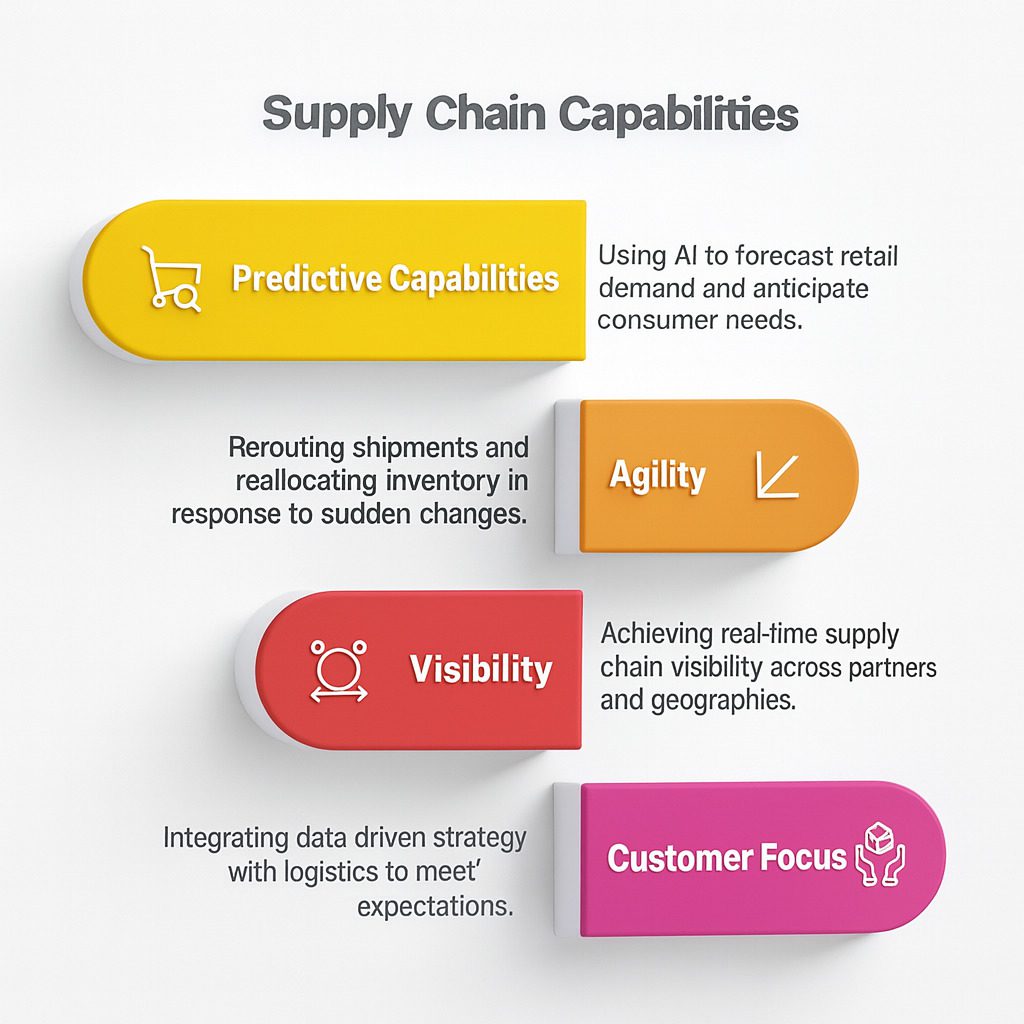
Key traits include:
Predictive capabilities: Instead of relying only on historical data, companies now use retail demand forecasting with AI to anticipate consumer needs with remarkable accuracy. These models analyze patterns from sales, promotions, weather, and even social media to predict demand shifts days or weeks in advance. This foresight helps retailers avoid both costly overstocking and frustrating stockouts.
Agility: A truly data-driven supply chain thrives on adaptability. By combining predictive insights with automation, businesses can reroute shipments or reallocate inventory in near real time to respond to sudden changes, whether that’s a supply shortage, a surge in e-commerce orders, or unexpected disruptions in transportation. This agility reduces downtime, lowers costs, and keeps customers satisfied.
Visibility: One of the biggest challenges in supply chain management has been the lack of end-to-end transparency. With modern analytics, businesses achieve real-time supply chain visibility across partners, suppliers, warehouses, and distributors. This allows leaders to spot bottlenecks instantly, track products from origin to shelf, and proactively address risks before they impact operations.
Customer focus: Today’s shoppers expect fast, accurate, and personalized delivery experiences. By aligning operations with a data-driven retail strategy, organizations can synchronize last-mile logistics with customer expectations, offering flexible delivery windows, real-time updates, and even personalized promotions tied to fulfillment data. This not only enhances customer satisfaction but also builds long-term loyalty in an increasingly competitive market.
By shifting to this model, companies are not only modernizing operations but also aligning supply chain performance with business growth and customer loyalty.
Why Retail, CPG & Logistics Leaders Are Moving to Analytics in 2026
1. Real-Time Visibility and Forecasting
Retail leaders increasingly recognize that seeing problems too late leads to lost sales, wasted resources, and reputational damage. By adopting real-time supply chain visibility, companies can:
Monitor shipments across multiple carriers in real time.
Adjust production and distribution dynamically based on demand.
Use predictive analytics for demand forecasting in retail, factoring in seasonal peaks, economic conditions, and even social trends.
Real-world value: According to McKinsey, retailers using advanced demand forecasting reduced errors by up to 50% and lowered inventory carrying costs by 10–15%.
Keyword integration: how retailers use data to improve supply chains and demand forecasting in retail.
2. Cost Efficiency and Waste Reduction
In an industry where margins are razor-thin, efficiency is everything. With supply chain analytics, retail companies can:
Identify excess stock and reallocate it to where it’s most needed.
Predict slow-moving SKUs and take corrective actions (discounting, redistribution, bundling).
Improve inventory optimization in retail by balancing safety stock with demand accuracy.
Real-world value: A global apparel retailer used analytics to reduce stockouts by 30% and cut holding costs by 20%, proving the benefits of supply chain analytics for retail.
3. Customer-Centric Logistics
The modern shopper expects fast, accurate, and sustainable delivery options. A data-driven retail strategy empowers businesses to:
Offer precise delivery windows that match actual capability.
Use customer data to personalize shipping offers and loyalty perks.
Dynamically reroute shipments to ensure on-time delivery.
In fact, Deloitte reports that over 60% of consumers are willing to switch brands after two poor delivery experiences, making analytics a direct driver of loyalty and revenue.
4. Risk & Compliance Management
Supply chains are not only complex, but they are also highly regulated. From sustainability to trade compliance, businesses must ensure accountability at every stage. By applying analytics, companies can:
Track carbon emissions and optimize for greener logistics.
Ensure compliance with import/export regulations in multiple regions.
Detect anomalies that may signal fraud or inefficiency.
This is a prime example of overcoming supply chain challenges with data, using visibility not only to improve efficiency but also to safeguard brand trust.
Challenges of Becoming Data-Driven
Adopting a data-driven approach is powerful but requires overcoming systemic barriers:
Legacy IT systems: Many retailers still run on outdated ERP systems that can’t process real-time data.
Data silos: Information is fragmented across suppliers, distributors, and logistics providers.
Talent gaps: The shortage of analytics experts makes it difficult to scale advanced capabilities.
Cultural adoption: Teams accustomed to manual decision-making may resist trusting AI-driven insights.
For many companies, the real challenge isn’t access to data, it’s knowing how to implement a data-driven supply chain strategy at scale while ensuring adoption across the business.
How Prolifics Helps Enable Data-Driven Supply Chains
Prolifics bridges this gap by offering solutions that help businesses build the foundations of a data-driven supply chain:
Cloud Migration for Supply Chain Systems: Moving outdated platforms to scalable, modern environments that support real-time analytics and enable Cloud-Powered Logistics.
AI & Automation for Predictive Insights: Embedding AI in supply chain processes for forecasting, inventory optimization, and intelligent routing.
Integration of ERP + Analytics Tools: Creating unified data ecosystems that eliminate silos and enable seamless decision-making.
Proof of Technology Labs: Safe, small-scale environments where companies can test innovations before full rollout.
CTA:Talk to our Retail Innovation Experts today and see how Prolifics can help.
Real-World Example
A global retail brand worked with Prolifics to integrate predictive analytics into its supply chain. Within the first year, the company reduced delivery delays by 20%, cut waste by optimizing inventory allocation, and significantly improved customer satisfaction. By leveraging retail demand forecasting with AI, the retailer could align stock levels with purchasing trends, reducing both overstock and stockouts.
Outlook – The Supply Chain of 2030
The future of the supply chain will look radically different by 2030. What’s emerging now as best practice will soon become the industry standard:
Digital Twins: Full-scale simulations of supply networks, enabling retailers to test scenarios such as supplier disruptions or demand spikes before they happen.
Autonomous Operations: AI systems making day-to-day supply chain decisions with minimal human intervention.
Sustainable Logistics: Analytics embedded to track emissions, optimize transportation routes, and achieve net-zero goals.
LLM-enabled operations: AI assistants helping managers analyze reports, simulate strategies, and recommend actions in plain language.
Retailers who adopt data-driven supply chain strategies in 2026 will be positioned to lead this transformation, not play catch-up.
Key Takeaway
The supply chains of the future will be data-driven, customer-focused, and resilient. By embracing analytics, AI, and automation in 2026, retail and CPG leaders can unlock smarter forecasting, achieve cost efficiency, and gain the real-time supply chain visibility needed to stay competitive.
Book a Supply Chain Modernization Assessment with Prolifics and take the first step toward your intelligent, future-ready supply chain.
Get ready, Panther 5.60 is almost here, and it’s set to redefine how developers build, secure, and deploy enterprise-grade applications. This major release brings together power, flexibility, and performance, enabling organizations to innovate faster and smarter than ever before.
A Smarter, More Secure Future
With Panther 5.60, security and agility take center stage. The introduction of Multi-Factor Authentication (MFA) ensures users enjoy a higher level of protection without compromising experience. Whether accessing internal enterprise applications or external portals, Panther’s new MFA capability helps businesses safeguard their systems from unauthorized access and evolving cybersecurity threats.
Security is not just a feature, it’s a foundation. Panther 5.60 reinforces this commitment, giving IT teams the confidence to operate in a digital-first world where data integrity and access control are paramount.
Python Integration: Expanding the Developer’s Power
For developers, Python Integration is a game-changer. Panther 5.60 enables advanced scripting and automation capabilities by embedding Python directly into the platform. This integration empowers teams to execute complex logic, automate workflows, and perform data analysis seamlessly within their Panther applications.
By combining the simplicity of Panther’s low-code environment with the versatility of Python, developers can now build smarter, more adaptive applications that drive real business outcomes. It’s the perfect bridge between modern scripting flexibility and enterprise-grade performance.
Enhanced Usability and Performance
Panther 5.60 introduces the ability to drop files directly into Panther applications, making user interactions faster and more intuitive. This enhancement simplifies document handling, accelerates workflows, and enhances productivity, especially in data-heavy or document-driven processes.
Under the hood, Panther now supports updated database drivers for Oracle 19 and Oracle 23, ensuring compatibility with the latest database technologies. Organizations can expect smoother integrations, improved query performance, and long-term reliability when managing mission-critical data environments.
Beautiful New Interfaces, Faster Development
This release also showcases a suite of new screen templates designed to help developers build modern, visually rich interfaces with ease.
Calendar with multiple themes for flexible, dynamic scheduling experiences.
Grid Filter screen to streamline data filtering and navigation.
Login sample screen that demonstrates secure, user-friendly authentication.
Grid Striping sample screen offering enhanced readability for data-heavy displays.
Each template is crafted to accelerate UI development while maintaining consistency, accessibility, and visual appeal.
Ready to See Panther 5.60 in Action?
Panther 5.60 is more than an upgrade, it’s a leap forward in performance, productivity, and user experience. It’s designed for developers who demand agility and for organizations that prioritize scalability and security.
Get a preview of what’s coming in this powerful release, watch the video now:
The future of application development is about to get faster, smarter, and more secure.
Generative AI is racing from pilots to production, but scaling inference reliably, cost-effectively, and anywhere has been the blocker. That changes now.
At Red Hat Summit (May 20, 2025), Red Hat unveiled the Red Hat AI Inference Server, a high-performance, open solution designed to run any GenAI model on any accelerator across any hybrid cloud. Built on the fast-moving vLLM project and enhanced with Neural Magic optimizations, it delivers dramatically faster, more efficient inference, without locking you into a single vendor stack.
What’s in it for your business
Model freedom: Run leaders like Llama, Mistral, Gemma, DeepSeek, Phi, and more, validated and model-agnostic. No more boxed-in roadmaps.
Hardware choice: Optimize NVIDIA and AMD GPUs, Intel Gaudi, Google TPUs, and CPUs, on-prem, public cloud, or edge. Your workloads go where they make the most sense (and the best economics).
Hybrid cloud portability: Deploy as a standalone product or as part of Red Hat OpenShift AI and RHEL AI for consistent operations at scale.
Performance & cost wins: Memory-smart scheduling and continuous batching from Vllm, plus Neural Magic accelerations, translate to higher throughput and lower TCO for production GenAI.
Straightforward buying: Available with per-accelerator pricing and support for third-party Linux, so you can fit it into your existing estate without re-platforming.
Why Prolifics + Red Hat
As a Red Hat partner, Prolifics turns this technology into a business impact fast. We bring reference architectures, landing zones, and accelerators to help you:
Pick the right models & hardware for your use cases and budget
Stand up OpenShift AI / RHEL AI with enterprise-grade MLOps, observability, and security controls
Control spend with right-sizing, spot/committed capacity strategies, and accelerator utilization tuning
Govern responsibly with policy, lineage, and risk controls aligned to your compliance needs
Bottom line: Red Hat just removed the “it depends” from GenAI infrastructure. Prolifics makes sure you capitalize, safely, scalably, and with measurable ROI.
Ready to unlock GenAI, any model, any accelerator, any cloud?
Talk to Prolifics about a rapid readiness assessment and a 30-day path to production with Red Hat AI Inference Server.