Amazon Web Services (AWS) has introduced a new generation of artificial intelligence workers known as Frontier Agents, now recognised as part of the broader AWS Frontier Agents ecosystem. These intelligent, autonomous AI agents mark one of the most transformative moments in enterprise automation.
They are designed to work much like real teammates, taking on long-running tasks, managing complex software projects, and adapting to the pace of modern development teams without constant human direction clearly showing how AWS Frontier Agents transform engineering teams in real-world scenarios.
The first wave includes three specialised agents:
Kiro: an autonomous development agent
The AWS Security Agent: a proactive virtual security engineer
AWS DevOps Agent: an always-on operations expert designed to prevent incidents before they occur.
Together, they represent AWS’s bold vision of a future where autonomous digital teammates work alongside human engineers to deliver high-value outcomes, especially in environments requiring autonomous AI agents for DevOps and security.
A New Model of AI Work
AWS developed Frontier Agents after observing trends within its own engineering teams. AI proved most valuable when given high-level goals, allowed to operate independently, and run at scale. These insights shaped the three pillars of the Frontier Agent model:
Autonomous: Agents plan and execute tasks end-to-end without continuous human oversight.
Scalable: They can run multiple tasks in parallel or coordinate among several agents.
Independent: Context is maintained across hours, or even days, of uninterrupted work.
This approach enables organisations to shift from micro-managing AI prompts to simply assigning outcomes, especially as AWS Frontier Agents evolve into a core part of intelligent cloud operations.
Kiro: The Autonomous Developer
Kiro stands out as a virtual developer capable of maintaining deep context across repositories, tickets, and communications. Unlike traditional code assistants, Kiro eliminates the “human thread,” the need for engineers to coordinate tools, track context, or manage cross-repository changes.
This makes Kiro a strong example of an autonomous developer agent contributing to AI-powered reliability engineering with AWS workflows.
Connected to Jira, GitHub, and Slack, Kiro learns from pull requests and team feedback, gradually adapting to an organisation’s coding standards. Developers can assign tasks directly in GitHub, from bug triage to refactoring, and Kiro executes the work autonomously while submitting final pull requests for human review.
AWS Security Agent: Security Built In, Not Bolted On
The AWS Security Agent transforms cybersecurity from a reactive burden into a proactive, integrated capability. It reviews designs, checks code against custom organisational standards, and automates penetration testing, a process that traditionally requires days of manual effort. Early adopters have reported impressive gains.
The agent completes full penetration tests within hours and uncovers hidden business logic flaws that traditional tools often miss. By contextualising application behaviour, it raises security assurance to a new level of precision.
AWS DevOps Agent: A New Standard for Reliability
The DevOps Agent is designed to reduce operational firefighting and functions as a tireless operations specialist. During incidents, it conducts autonomous root cause analysis using telemetry from CloudWatch, Datadog, New Relic, and other tools. It correlates signals across infrastructure, code, and pipelines to quickly identify failures.
With Frontier Agents, AWS is positioning AI not just as a productivity enhancer but as a true digital workforce capable of delivering end-to-end outcomes across development, security, and operations. As organisations adopt more autonomous systems, Frontier Agents may redefine the structure and capabilities of modern engineering teams.
SAP Databricks integration seamlessly embeds the Databricks Data Intelligence Platform within SAP Business Data Cloud, giving enterprises a unified foundation for advanced analytics and AI built on trusted business data. That’s where SAP Databricks integration steps in as a powerful new offering that brings the best of both worlds, enterprise-grade business data from SAP Business Data Cloud (BDC), together with the advanced data engineering, analytics, and AI/ML with SAP data capabilities of Databricks.
This native integration connects SAP’s semantically rich, business-ready datasets with external sources, enabling holistic insights, smarter decision-making, and accelerated AI and machine learning workloads built on a unified data intelligence platform.
For organisations that run SAP for enterprises adopting hybrid data architectures, SAP Databricks integration offers a game-changing opportunity to transform raw data into intelligent, actionable insights at enterprise scale, all within a unified data intelligence platform.
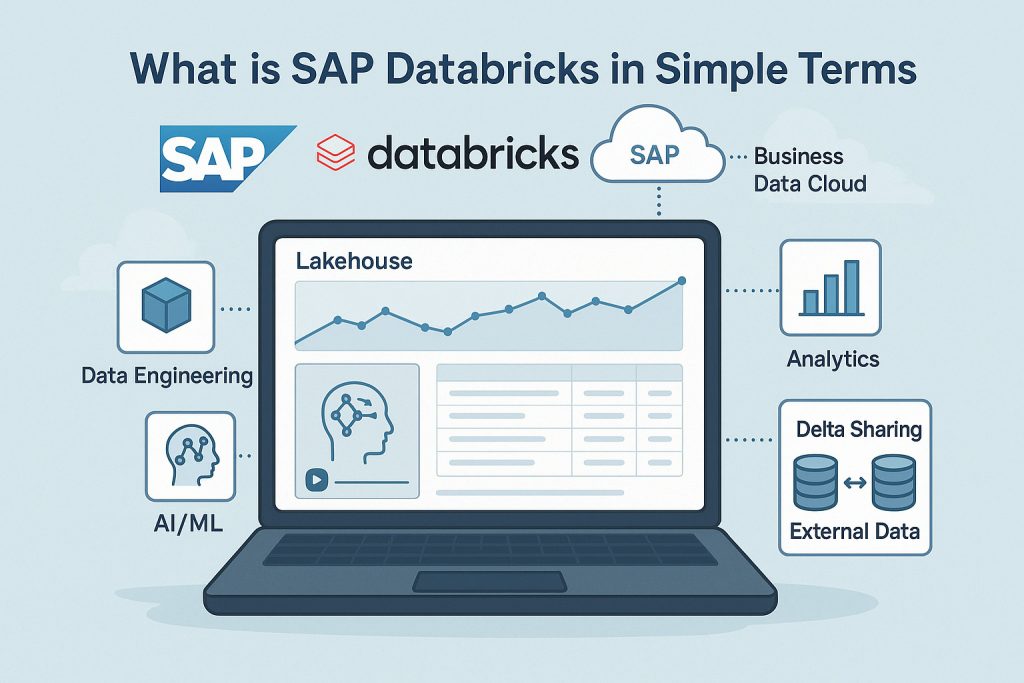
What is SAP Databricks in Simple Terms
At its core, SAP Databricks is the native embedding of the Databricks Data Intelligence Platform inside SAP Business Data Cloud.
It unifies data engineering, advanced analytics, AI/ML with SAP data, and data science under one roof, while preserving the semantic richness of SAP business data.
It offers Databricks lakehouse for SAP, data engineering tools, serverless computing, pro-code environments, and full support for machine learning, analytics, and data science workflows, without the traditional hassles of complex ETL, data duplication, or siloed data movement.
Crucially, with zero-copy data sharing via Delta Sharing SAP, SAP data products (from SAP applications) and third-party or external data sources can be blended seamlessly for enriched analytics and AI.
In short, SAP Databricks gives enterprises one unified, governed, powerful platform where business data, external data, analytics, and AI converge, enabling actionable intelligence built on trusted data.
Why This Matters: The Business Impact
Break Down Data Silos and Simplify Complexity
Many organisations struggle with fragmented data: SAP modules, legacy systems, external sources, spreadsheets, and third-party tools, often isolated and inconsistent. SAP Databricks collapses these silos by bringing business-ready SAP data and external data into a unified lakehouse via zero-copy sharing with Delta Sharing SAP.
No more fragile ETL pipelines, data duplication problems, or semantic mismatches, supporting more robust enterprise data governance.
Rapid AI and Analytics at Scale
With SAP Databricks, you don’t just store data, you derive insight. From exploratory analytics to full-fledged SAP Databricks machine learning workflows, from predictive modeling to real-time analytics and generative AI, the platform enables advanced use cases at enterprise scale.
Whether you need demand forecasting, supply-chain optimization, financial analytics, customer behavior analysis, or predictive maintenance, it is all possible through a scalable Databricks lakehouse for SAP. These capabilities highlight the benefits of integrating SAP with Databricks for business impact.
Trusted, Governed Data and Compliance Built-In
Because SAP Databricks lives inside SAP Business Data Cloud, data governance, lineage, access control, and compliance come as part of the package. The platform ensures that structured and unstructured data, ML models, notebooks, and dashboards remain governed under a unified catalog another example of strong enterprise data governance.
This strengthens IT, compliance, and data-governance oversight while empowering business and data-science teams to move quickly and confidently through SAP analytics modernization.
Faster Time-to-Value, Lower TCO
No more spending months building complex data pipelines, reconciling data across systems, or wrestling with infrastructure. With SAP Databricks’ serverless architecture and managed setup, enterprises can get started quickly and scale as needed.
Whether you are a greenfield implementation (new deployment), brownfield (existing Databricks estate), or hybrid setup, integration is smooth and frictionless, enhanced by the flexibility of the Databricks lakehouse for SAP.
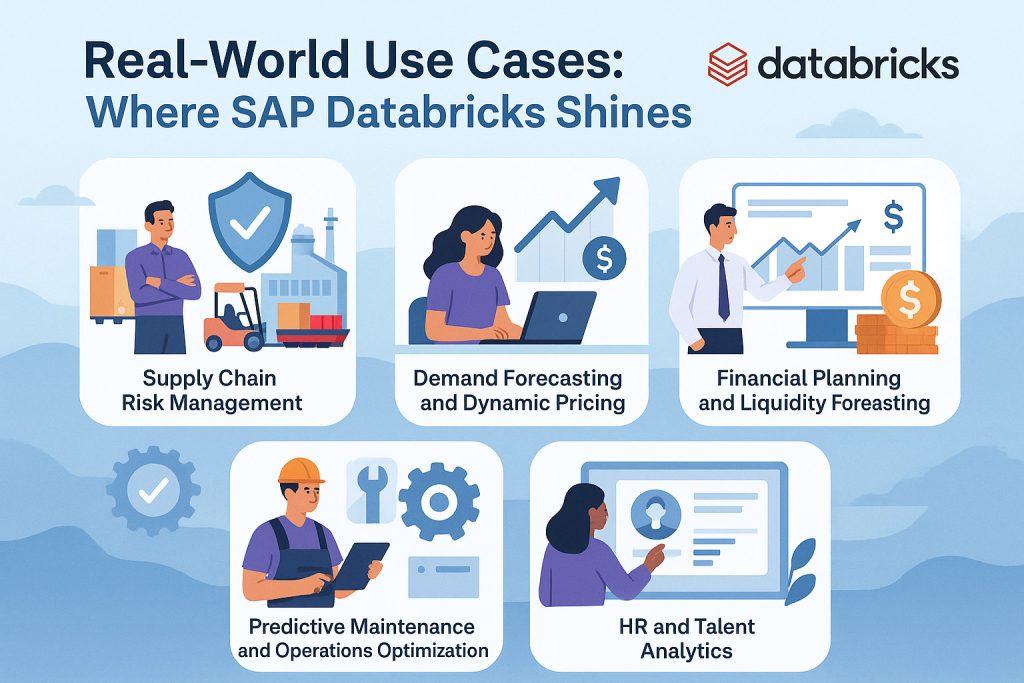
Real-World Use Cases: Where SAP Databricks Shines
Here are some ways savvy enterprises are leveraging SAP Databricks, and where you could too supported by Enterprise AI with SAP data in Databricks capabilities:
Supply Chain Risk Management: Combining SAP procurement and supplier data with external sources like weather forecasts, logistics data, and market volatility to predict disruptions, optimise sourcing, and proactively manage risk.
Demand Forecasting and Dynamic Pricing: Using historical sales, market analytics, and external demand signals to forecast demand accurately and adjust pricing dynamically with AI/ML with SAP data pipelines.
Financial Planning and Liquidity Forecasting: Merging SAP finance data (payables, receivables, cash flow) with market and economic data to forecast liquidity, simulate scenarios, and optimise working capital—powered by modern SAP analytics modernization approaches.
Predictive Maintenance and Operations Optimisation: Combining IoT sensor data, maintenance logs from SAP, equipment metadata, and environmental data to anticipate failures and schedule preventive maintenance, reducing downtime and cost.
HR and Talent Analytics: Blending SAP HR data (including SuccessFactors) with market trends, performance metrics, retention data, and training insights to enable data-driven talent management and workforce planning.
These use cases show that SAP Databricks does not just modernise data, it transforms how enterprises operate, anticipate, and adapt, reinforced by the Databricks lakehouse for SAP framework.
Why Partner with Prolifics to Unlock SAP Databricks Value
This is where the real impact begins. Having a powerful platform is only half the story. What really matters is whether you have the expertise, the vision, and the execution capability to turn that platform into real business value.
As a long-time partner with deep expertise in SAP, data engineering, AI/ML, cloud migration, and enterprise data modernization, Prolifics is uniquely positioned to help you:
Accelerate onboarding and deployment of SAP Databricks in your landscape.
Integrate your SAP data (ERP, finance, HR, supply chain) with external data sources while maintaining governance, security, and semantic consistency.
Rapidly develop use cases such as forecasting, analytics, and SAP Databricks machine learning workflows, from proof-of-concept to production, with best practices in data modeling, MLOps, and governance.
Optimize total cost of ownership and manage infrastructure, compliance, scaling, and ongoing operations, freeing your team to focus on insights, innovation, and outcomes.
With Prolifics, you don’t just get a vendor, you get a strategic partner who understands enterprise challenges across global clients and can tailor SAP Databricks solutions to your industry, your data maturity, and your long-term digital transformation goals, strengthened through SAP Databricks integration and the benefits of integrating SAP with Databricks.
Your Next Step: Don’t Wait for the Future, Build It
If your organisation is still struggling with fragmented data, slow analytics, disconnected applications, or delayed insights, the time to act is now.
SAP is evolving, and so should your data strategy. With SAP Databricks, you can unify, modernize, and future-proof your data and AI ambitions through Enterprise AI with SAP data in Databricks and SAP analytics modernization.
At Prolifics, we are ready to help you navigate this transformation and ensure you not only deploy the right technology but also derive real business value, faster.
Let’s connect and explore how SAP Databricks can turn your enterprise data into your most strategic asset powered by a future-ready, AI-ready SAP architecture.
Reach out to us today and take the first step toward intelligent, data-driven growth.
According to the recent study by IDC highlighted that organisations that combine SAP Business Technology Platform (SAP BTP) with core SAP Business Suite applications (like SAP S/4HANA, SAP SuccessFactors, and SAP Ariba) are realising substantial improvements in productivity, agility, innovation, integration, and financial returns. These clear SAP BTP benefits are becoming even more important as enterprises accelerate transformation.
Organizations that embed SAP BTP as the underlying platform for their SAP Business Suite environments (e.g., ERP, HR, procurement) achieve far more than just software adoption – they unlock a “transformation engine” that brings applications, data and AI into a unified, efficient, and extensible ecosystem. This unified approach strengthens SAP BTP integration, enabling enterprise data harmonization and reducing technical friction across systems.
This unified approach tackles the classic enterprise dilemma: fragmented systems, data silos, redundant processes, and isolated automation/AI efforts that stall real transformation.
Quantified Business & IT Gains
The IDC study surveyed 15 SAP customers using BTP alongside key SAP applications (e.g. SAP S/4HANA, SAP SuccessFactors, SAP Ariba / Intelligent Spend). The results highlight substantial gains across multiple dimensions.
Annual financial benefit per organisation – On average, customers reported benefits worth US $13.88 million/year (equivalent to roughly $259,400 per 1,000 employees).
Application development & automation – Use of SAP BTP’s low-code/no-code and automation tools (e.g. SAP Build) resulted in a 164% increase in SAP application extensions, delivered 41% faster. Developer productivity reportedly increased by 46%.
Integration & process efficiency – With the unified integration layer provided by SAP Integration Suite, companies experienced strong SAP Integration Suite benefits, including 29% efficiency gains in business-process management and 43% faster resolution of process errors.
Platform reliability & innovation throughput – Organisations reported a 90% reduction in unplanned downtime on average; they completed 187% more innovative projects and delivered them 44% faster.
Long-term ROI – Over three years, the average net-present-value benefits reached US $32.68 million, against a total investment of about US $5.31 million, equating to a 516% ROI. Payback, on average, occurred within eight months.
What Makes SAP BTP Effective
The strength of SAP BTP lies in its role as a platform backbone for enterprise IT and operations – enabling:
Unified data, application, and AI integration: SAP BTP brings together disparate SAP and non-SAP systems, harmonizing data and enabling cross-system workflows and analytics.
Flexibility via low-code/no-code development: Tools like SAP Build allow business units – not just traditional developers – to build custom apps, automate processes (onboarding, compliance, spend management) and respond quickly to changing business needs.
AI-powered automation and insights: Through BTP, companies can deploy AI agents in SAP BTP, adopt SAP BTP intelligent automation, automate complex workflows, and surface real-time insights – enabling smarter decision-making and timely responses across finance, procurement, HR, and supply chain.
Cost and resource efficiency: By standardising on a cloud-based, integrated platform, firms reduce infrastructure overhead, minimise manual errors, speed project timelines, and consolidate vendor ecosystems – lowering total cost of ownership while helping increase business agility with SAP BTP.
Why This Matters – Especially Now
In a business landscape defined by rapid change, supply-chain disruptions, workforce shifts, and increasingly dynamic markets, enterprises need agility, resilience, and speed. A fragmented or rigid IT stack can block timely adaptation. SAP BTP’s unified platform model offers a way out – turning legacy SAP deployments into a foundation for continuous innovation.
For organizations already invested in SAP Business Suite applications, adopting BTP isn’t just an incremental upgrade – it can transform IT from a “back-office cost center” into a strategic enabler of growth, delivering measurable business outcomes.
The breadth of improvements – from developer productivity to process automation to AI-driven insights – suggests that BTP can help bridge the long-standing gap between “software deployment” and “digital value realization.”
SAP BTP as the “Value Multiplier” for SAP Ecosystems
The new IDC data makes a compelling case: by embedding SAP BTP at the core of SAP Business Suite deployments, companies can unlock substantial, quantifiable benefits across productivity, agility, innovation, cost-efficiency, and long-term return on investment.
For CIOs and technology leaders evaluating digital transformation strategies, SAP BTP emerges not as a “nice-to-have” add-on, but as a powerful “value multiplier” – one that turns existing ERP/HR/Procurement investments into a dynamic, AI-enabled, business-centric platform.
Given the compelling ROI and broad operational benefits documented, the case for BTP adoption appears stronger than ever – especially for enterprises seeking to transform rather than just migrate.
Enterprise AI has shifted from a nice-to-have idea to an urgent business priority. Companies want better insights, faster decisions, and smarter automation, but most are still struggling to get there. Data is scattered. Governance is inconsistent. Infrastructure is complex. AI projects stall before they ever reach production.
Databricks is closing this gap. The latest generation of Databricks Brickbuilder Accelerators brings a fresh approach to building enterprise-ready AI. These accelerators combine proven architectures, industry templates, reference implementations, and go-to-market alignment so organizations can move from interest to impact quickly and confidently.
Enterprises across industries, financial services, healthcare, retail, manufacturing, public sector, and more, are rapidly shifting from AI “exploration” to AI “execution.” Enterprise AI adoption with Databricks accelerators is now accelerating this transformation. Databricks’ Data Intelligence Platform unifies data, governance, analytics, and AI into a single foundation that eliminates silos and accelerates innovation.
The platform’s core capabilities, including Unity Catalog implementation, Mosaic AI enterprise applications, DB SQL, Lakeflow, Lakebase, AI/BI, Marketplace, and Apps, create a future-proof ecosystem for building, tuning, governing, and deploying enterprise-grade AI.
Prolifics: Your End-to-End Databricks Partner for Acceleration
As Databricks evolves its GTM priorities, from Unity Catalog adoption to GenAI, MLOps, agent frameworks, data intelligence, and industry-aligned solutions, the need for specialized partners becomes critical. According to the Brickbuilder Program, Databricks recognizes and rewards partners who bring:
Proven industry solutions
Product-aligned accelerators
Deep certifications and specializations
Demonstrated customer success
Innovation on the Data Intelligence Platform
Accelerators That Shorten Your Time-to-Value
Prolifics leverages Databricks Brickbuilder Accelerators to speed up AI deployment and reduce implementation risk. The program, highlighted, outlines a powerful method to:
Build faster on Databricks
Align to Databricks’ product roadmap
Gain access to prescriptive architectures
Deliver validated solutions with proven customer outcomes
We help you activate these accelerators across:
1. Unity Catalog Adoption
Accelerate governance across ALL your data and AI assets, tables, models, dashboards, vector indices, unstructured content, and centralize access controls, discovery, lineage, and secure sharing.
Unity Catalog is clearly positioned as the foundation layer of Databricks. Prolifics helps you deploy it seamlessly, ensuring compliance, security, and enterprise-scale governance.
2. GenAI and Mosaic AI Solutions
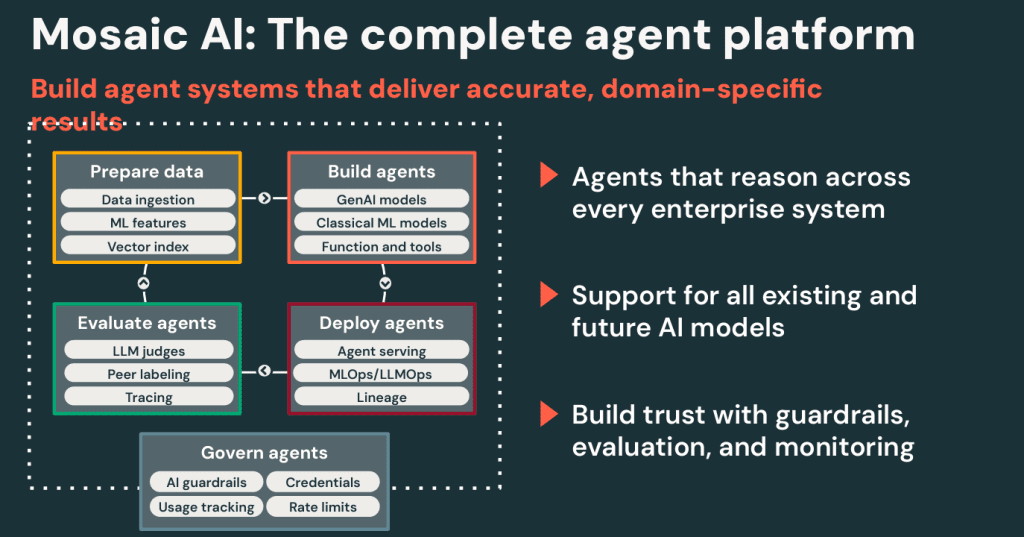
GenAI solutions with Databricks and Mosaic AI enterprise applications introduce the complete enterprise agent platform, enabling:
Model fine-tuning
Guardrails + LLM judges
Vector search
Agent serving
Evaluation + tracing
Full MLOps/LLMOps
Prolifics builds GenAI apps, AI copilots, customer-facing bots, internal automation tools, LLM-driven knowledge systems, and domain-specific AI pipelines with these capabilities.
3. Agent Bricks Integration
Databricks Agent Bricks automates the building of data-optimized agents at scale Prolifics leverages these components to create robust enterprise agents that safely reason across internal systems and deliver accurate, domain-specific outcomes.
4. Lakeflow Pipelines + Designer
Lakeflow accelerates ingestion, ETL, and orchestration with intelligent optimizations and AI-powered design. Prolifics helps you:
Modernize ETL
Automate orchestration
Remove bottlenecks
Build scalable pipelines
Reduce operational overhead
5. Data Warehouse Modernization with Lakebridge
Lakebridge data warehouse modernization simplifies DW-to-lakehouse migrations with:
Deep scanner analysis
LLM-driven code conversion
Lakeflow-powered data migration
Automated reconciliation
Prolifics enhances this process with our proprietary methodology, ensuring full validation, performance tuning, and enterprise-grade governance. This supports data warehouse to lakehouse migration with Databricks effectively.
Industry Solutions That Drive Real Business Outcomes
Databricks outlines 15 sub-verticals and six major industry categories where accelerators and specializations deliver the biggest impact. Prolifics builds and deploys solutions tailored to your industry’s needs, including:
Public Sector: citizen services, utilities insights, security analytics
With Prolifics + Databricks, you don’t get generic templates; you get industry-engineered, enterprise-ready solutions that deliver measurable results.
Why Prolifics? The Partnership That Delivers
Your data landscape is evolving, and the stakes are too high for trial-and-error innovation. Prolifics combines:
✔ Deep Databricks Expertise
We align directly to Databricks GTM priorities across Unity Catalog implementation, Mosaic AI enterprise applications, Lakeflow, DB SQL, and migrations.
✔ Certified Talent + Technical Excellence
The Brickbuilder program requires partners to maintain high levels of certifications and specialized skills. Prolifics meets and exceeds these expectations with a rapidly growing Databricks-certified practice.
✔ Proven Accelerators + IP
We build product-aligned IP and deliver accelerators that reduce cost, risk, and time-to-value, perfectly aligned with Brickbuilder benefits like GTM alignment, brand differentiation, and customer success.
✔ Industry Experience + Customer Evidence
As outlined in the partner eligibility requirements, demonstrating customer success is essential. Prolifics brings decades of sector-specific delivery excellence.
✔ A Complete Data + AI Transformation Partner
We don’t just deploy technology; we operationalize it for impact.
The Bottom Line: AI Winners Are Being Built Right Now
The companies that will lead the next decade are the ones modernizing their data infrastructure and activating AI today, not tomorrow. How Databricks accelerators speed up AI deployment ensures enterprises achieve measurable outcomes.
Databricks provides the world’s most powerful Data Intelligence Platform. Prolifics ensures you extract maximum value from it, faster than your competitors.
If you want to:
Modernize data pipelines
Accelerate GenAI adoption
Empower teams with governed data
Deploy AI agents safely
Build intelligent applications
Lower data warehouse costs
Create a scalable data foundation
Partnering with Prolifics is the fastest, safest, and smartest path forward.
AI Gets Easier in 2026
The Brickbuilder Accelerators Program represents one of Databricks’ boldest steps toward simplifying enterprise AI. It brings together governance, automation, industry depth, and platform innovation in a way that helps organizations move faster with confidence. With unified data, trustworthy AI foundations, and ready-to-deploy accelerators, teams can finally build AI on those scales.
Whether you are a business leader focused on outcomes or a technical team managing rising demand, one thing is clear. AI does not have to be complicated. With Brickbuilder, the path to intelligent, production-ready solutions is clearer than ever.
Prolifics is here to help you take that next step. Our Databricks specialists guide you from strategy to implementation, using Databricks Brickbuilder Accelerators, GenAI solutions with Databricks, and proven accelerators to turn AI ambition into real business value.
IBM has announced its new quantum processor, dubbed Nighthawk, designed to achieve quantum advantage as early as next year. This marks a pivotal moment in quantum technology, with implications spanning industries from finance and supply chain to materials science and cryptography.
Architectural Highlights & Technical Innovation
120-Qubit Square Lattice Architecture:
Nighthawk introduces a highly structured 120-qubit lattice, with each qubit connected to four nearest neighbours, boosting interaction density and accelerating complex circuit execution.
With a ~20% increase in connectivity over IBM’s Heron processor, Nighthawk supports deeper entanglement pathways and more reliable multi-qubit operations.
Rapidly Scaling Gate Capacity:
~5,000 two-qubit gates supported today
7,500 by end of 2026
10,000 by 2027
Up to 15,000-gate programs across 1,000+ connected qubits by 2028 This roadmap represents one of the most aggressive scalability trajectories in the industry.
Next-Gen Software Stack for Real Workloads:
A powerful C++ quantum programming interface designed for seamless integration with HPC environments
Expanding ML and optimisation libraries to unlock new scientific and commercial use cases
A Quantum Advantage Tracker, built with research partners, to rigorously validate emerging quantum benchmarks in real time
300 mm Quantum-Ready Fabrication Facility:
IBM’s new large-scale wafer facility adopts semiconductor-grade tooling to industrialise quantum hardware manufacturing—improving consistency, yields and delivery at scale.
Why It Matters for Enterprise & Industry
Quantum advantage means a quantum system solving a meaningful problem faster or more effectively than any classical counterpart. IBM’s roadmap projects this milestone as attainable before 2026. For enterprises, this opens prospects for tackling previously intractable problems, large-scale optimisation, molecular simulations, cryptographic legacy systems and AI model acceleration.
Yet the path remains nuanced: fault-tolerant quantum computing remains a significant challenge. IBM aims to deliver large-scale fault-tolerant systems by 2029. Technologies like error-correcting processors and long-range couplers are critical here.
Enterprises already adopting quantum-ready strategies will gain a strategic advantage: preparing algorithms, integrating quantum-software workflows, evaluating hybrid quantum-classical solutions and building a talent base today.
How Prolifics Can Guide You Through This Quantum Leap
As organisations across sectors prepare for quantum disruption, Prolifics stands at the forefront of enabling transformation. Whether you’re a global financial services firm looking to optimise trading or risk models, a manufacturer simulating novel materials, a supply-chain leader tackling complex routing, or a utility company modelling grids for renewable integration, Prolifics brings deep expertise in AI/ML, cloud, DevSecOps and now quantum-ready architectures.
We help you:
Assess your quantum readiness: identify high-value use-cases and hybrid quantum-classical trajectories.
Build quantum-friendly infrastructure and integration pathways into existing systems.
Train your teams on quantum software frameworks and programme design.
Design proof-of-concept quantum experiments aligned to your business goals.
Partner with Prolifics and begin your quantum strategy today. Reach out to discuss how your enterprise can leverage Nighthawk-era advances and position itself ahead of the quantum curve.
Contact Prolifics now to start the quantum journey.
Data privacy in healthcare is essential to safeguarding highly sensitive patient information. Ensuring compliance with regulations such as HIPAA and GDPR in Healthcare, and regional data protection laws is critical for maintaining patient trust, protecting confidentiality, and supporting responsible healthcare delivery.
For healthcare providers, insurers, technology partners, and software vendors, healthcare data privacy compliance goes far beyond ticking regulatory boxes. It’s about earning patient trust, protecting organizational reputation, and enabling innovation in a secure, compliant environment.
At Prolifics, we believe that comprehensive data privacy and governance should be viewed as foundational to delivering high-quality, future-ready healthcare services. This guide outlines key regulatory frameworks, best practices, and how Prolifics helps organizations turn compliance into a competitive advantage.
Types of Healthcare Data
Healthcare organizations manage a wide array of sensitive data, including:
Protected Health Information (PHI) – Personal identifiers, medical histories, lab results.
Electronic Health Records (EHRs) – Comprehensive patient care documentation.
Genomic and Research Data – Highly sensitive data requiring strict access control.
Wearable Device Data – Continuous monitoring information such as heart rate, glucose levels, and activity metrics.
Telehealth Communications – Video consultations, messages, and remote monitoring data.
Why Data Privacy Matters in Healthcare
Healthcare data is among the most sensitive categories of personal information, including physical or mental health conditions, treatments, insurance details, biometric data, and more. Mishandling such data can lead to identity theft, medical fraud, regulatory penalties, and irreversible reputational damage for providers.
Further, patients and regulators increasingly expect transparency, control, and accountability over how personal data is collected, stored, processed, and shared. Privacy isn’t just compliance, it’s ethics, patient trust, and business sustainability. Patient data privacy healthcare practices are becoming a top priority for modern healthcare organizations.
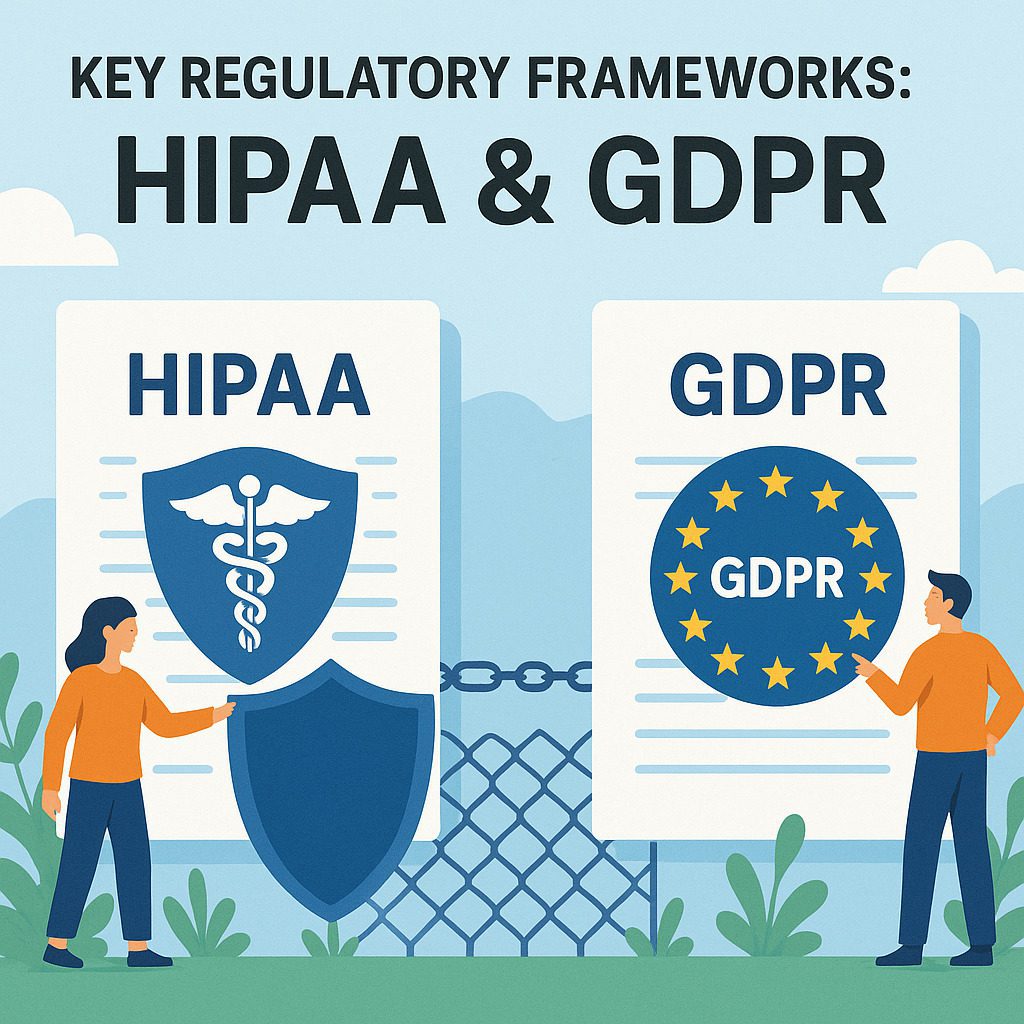
Key Regulatory Frameworks: HIPAA & GDPR
HIPAA
HIPAA defines standards for protecting Protected Health Information (PHI), whether electronic or otherwise. Covered entities – healthcare providers, insurers, and business associates, must implement robust administrative, technical, and physical safeguards to ensure confidentiality, integrity, and availability of PHI.
A robust data governance approach under HIPAA involves policies and procedures that manage data classification, access control, data lifecycle (retention/disposal), audit logging, breach detection/response, and ensure PHI is only accessible to authorized entities, this aligns with HIPAA compliance best practices.
GDPR
GDPR applies when health data of individuals covered under the regulation (e.g. EU citizens) is processed, regardless of where the organization is based. Under GDPR, “data concerning health” is classified as a “special category” requiring higher protection standards.
Key GDPR requirements: obtaining explicit, informed consent for processing; ensuring transparency and purpose limitation; enabling patient rights like data access, erasure (“right to be forgotten”), portability, and restriction of processing
Strict rules govern data transfer, especially cross-border transfers. Healthcare organizations need to ensure adequate safeguards during any data sharing or movement across jurisdictions. This is part of GDPR healthcare regulations.
HIPAA + GDPR: Working Together
Many organizations, especially global healthcare providers or vendors servicing international clients, need to comply with both HIPAA and GDPR in Healthcare. While both focus on protecting personal health data, their emphases differ: HIPAA centers on PHI security and breach prevention; GDPR centers on privacy rights and consent.
This overlap can be challenging – but also presents an opportunity: by aligning governance frameworks to meet both, organizations can build a stronger, future-proof privacy foundation.
Best Practices for Data Privacy & Governance in Healthcare
Building compliance is not a one-time effort, it requires a robust data governance program that permeates people, processes, and technology. Here are some widely accepted best practices:
1. Establish a Clear Data Governance Structure
Form a multidisciplinary data-governance committee composed of stakeholders from IT, clinical operations, compliance, legal, and data management teams. This committee defines policies, oversees compliance, and ensures accountability across the organization.
Define data ownership, stewardship, and decision rights clearly. Roles should include data custodians, privacy officers, and compliance stewards to manage PHI across systems responsibly. Implementing data governance strategies for healthcare providers ensures stronger compliance outcomes.
2. Classify & Inventory Data
Not all data is equal. Begin with comprehensive data classification and inventory, distinguish PHI, sensitive personal data, metadata, and general administrative data. This clarifies what must be strictly secured, who can access it, and under what conditions. Establish how long data is retained and define disposal/archival rules to avoid indefinite storage of sensitive data beyond its purpose.
3. Implement Strong Access Controls and Encryption
Enforce role-based access control (RBAC), multi-factor authentication (MFA), and least-privilege access for systems handling PHI. Ensure that data, both at rest and in transit, is encrypted using modern cryptography.
Ensure audit logging: track who accessed what data, when, and what actions were taken. This supports accountability, compliance audits, and forensic analysis in case of incidents.
4.Consent Management & Patient Rights (for GDPR compliance)
For patients under GDPR scope: implement mechanisms to capture explicit, informed consent; log consent versions with timestamps; provide options for patients to withdraw consent.
Facilitate patient requests for access, rectification, erasure, or portability of their data. Build workflows to respond within regulatory timeframes (e.g., typically one month under GDPR). Following how to comply with HIPAA and GDPR in healthcare ensures organizations meet regulatory requirements.
Deploy systems for continuous security monitoring and anomaly detection: monitor data access patterns, generate alerts for unauthorized access, and track unusual behavior.
Regularly conduct compliance audits, vulnerability assessments, and penetration testing. Also, maintain an incident response plan, with breach detection, containment, notification (to individuals and regulators), remediation, and post-mortem reviews.
6. Data Minimization, Masking & Pseudonymization
Adopt data minimization: collect and store only what is strictly required for stated purposes; avoid hoarding unnecessary data.
Use techniques like pseudonymization or anonymization wherever possible, especially for data used in research, analytics, or shared across third parties. This reduces risk without impairing usefulness for non-personal data insights.
7. Documentation, Policies & Training
Develop and maintain comprehensive documentation: data handling policies, access control policies, data retention/disposal policies, breach-response protocols, audit logs, consent logs, and data-sharing agreements.
Train staff, clinicians, IT teams, admin staff, on data privacy, security hygiene, consent handling, and compliance obligations. Privacy must be part of organizational culture, not just a compliance checkbox. Best practices for healthcare data privacy and security should be embedded in every workflow.
8.Use of Compliance-Oriented Tools & Automation
Given complexity of HIPAA and GDPR requirements, especially in organizations operating across geographies , compliance tools offer critical support. Key features to look for: data mapping, automated compliance reporting, real-time risk detection, secure storage, identity & access management, audit logs, and integration with existing IT/cloud infrastructure.
Automation not only reduces manual workload, but ensures consistency, reduces risk of human error, and helps prepare for audits or regulatory scrutiny.
Common Challenges — and How to Overcome Them
Complexity of overlapping regulations: Organizations operating globally may need to satisfy both HIPAA (U.S.) and GDPR (EU) standards. Without a unified governance strategy, compliance efforts can become fragmented or contradictory.
Scattered data across multiple systems: EHR systems, lab systems, billing, cloud storage, third-party vendors, patient data often resides in multiple silos, increasing risk and complicating management.
Evolving regulatory and technological landscape: As healthcare delivery becomes more digital and global, regulations may evolve; security threats grow more sophisticated. Compliance must therefore be proactive and adaptive, not static.
Balancing data utility and privacy: Healthcare organizations want to leverage data for analytics, research, and patient care improvements, but must do so without compromising privacy. That balance requires thoughtful governance, anonymization/pseudonymization, and proper consent management.
How Prolifics Helps – Our Approach
At Prolifics, we combine deep domain expertise in healthcare, strong data governance frameworks, and state-of-the-art security practices to deliver end-to-end data privacy solutions tailored to each organization’s needs. Here’s how we partner with you:
1. Comprehensive Privacy & Governance Assessment
We begin with a full audit of your data estate: where PHI resides, who accesses it, current security posture, compliance gaps (HIPAA, GDPR, cross-border requirements), and governance maturity.
2.Policy & Process Design
Based on audit findings, we help you define and implement robust privacy policies, data classification, access control, consent workflows, data retention/disposal, breach response, auditing and logging, and staff training programs.
3. Technology & Compliance Automation
Leveraging best-in-class compliance frameworks and tools, we implement identity & access management (RBAC, MFA), encryption, pseudonymization/anonymization strategies, and integrate compliance automation, making audit readiness continuous, not periodic.
4.Hybrid & Multi-Cloud Compliance Enablement
For organizations operating across geographies and cloud platforms, we build governance frameworks that span hybrid setups, cloud infrastructure, and on-premise systems, ensuring consistent compliance, no matter where data lives.
5. Data Governance for Analytics, AI & Innovation
We support proper anonymization/pseudonymization and consent-based data usage, enabling analytics, AI, and research to proceed without compromising compliance or privacy.
With ongoing security monitoring, user-behavior analytics, access logging, and incident response plans, we help you stay ahead of threats and meet regulatory requirements.
7.Training, Awareness & Culture Building
We run training programs for clinical, administrative, and IT teams, making privacy an integral part of your organizational culture, not just a checklist.
Partner with Prolifics for Data Privacy Excellence
At Prolifics, we don’t just help you meet regulatory requirements , we help you build a privacy-first culture that supports operational excellence, patient trust, and innovation.
Whether you are a healthcare provider, insurer, technology vendor, or a global enterprise offering digital health services, our tailored privacy and compliance solutions will:
assess and map your data estate,
design governance frameworks,
implement robust security controls,
enable compliance automation,
and support ongoing monitoring, auditing, and compliance readiness.
Digital excellence isn’t optional in today’s financial landscape, it’s the standard. When one of the largest U.S. financial institutions needed to modernize more than 110 mission-critical internal applications, they partnered with Prolifics to turn years of tech debt, fragmented workflows, and compliance challenges into a scalable, secure, and future-ready ecosystem.
The Client: A Top U.S. Financial Institution Ready for Change
This institution serves millions of customers through extensive retail, commercial, and investment banking operations. But behind the scenes, over 110 internal applications were built on outdated platforms, including:
Microsoft Access
Visual Basic (VB)
Excel VBA
ASP
Lotus Notes
These legacy systems had become:
Costly to maintain
Difficult to update
Misaligned with IT & security standards
Bottlenecks to compliance and release management
Barriers to innovation and business agility
The Challenge: Outdated Applications, Growing Operational Risk
The bank’s critical systems were creating:
Release management delays
Compliance inconsistencies
Integration issues with modern platforms
Rising maintenance costs
Increased operational risk
Limited scalability
Our Proven Approach to Modernization
1. Comprehensive Assessment – We evaluated 110+ applications across functionality, compliance, cost, and integration readiness.
2. Strategic Modernization Roadmap – Leveraged the DMAIC framework to define the right modernization path, modernize, consolidate, or retire.
In 2026, as enterprises accelerate deployments of generative AI (GenAI) models and large language models (LLMs), managing security, compliance, cost, and reliability becomes a paramount challenge. That is where Databricks AI Gateway stakes its claim, offering a unified, enterprise-grade control plane to govern, observe, and scale AI usage across the organization.
What is Databricks AI Gateway?
Databricks AI Gateway, also known as Mosaic AI Gateway, provides a central API-based entry point for all AI model interactions, whether they involve foundation models, open-source LLMs, custom models, or AI agents. With a single unified API for AI models, development teams no longer need to manage multiple endpoints or build bespoke integrations for each provider.
This unified access simplifies the adoption of new LLMs such as GPT-5 or the migration across providers. It enables model switchovers, experimentation, or fallback strategies without refactoring application logic.
Core Capabilities That Matter
1. Unified model access across providers: Whether the AI model is from OpenAI, Meta, an open-source ecosystem, or a custom internal build, AI Gateway routes all calls through a consistent interface, reducing integration complexity.
2. Governance, security, and compliance: Built-in guardrails allow organizations to enforce policies such as filtering PII, blocking unsafe content, applying role-based access, defining permissions, and setting rate limits, supporting enterprise AI governance at scale.
3. Observability and monitoring: Every request and response, along with metadata such as token usage, model version, and identity information, is logged into the lakehouse via inference tables. Teams can audit, debug, evaluate model quality, analyze cost, and produce compliance reports using native platform tools, strengthening GenAI observability and monitoring across applications.
4. Production-grade reliability and traffic management: AI Gateway supports load balancing, provider fallback logic, and dynamic AI model traffic management across multiple LLMs. Applications stay online even if a provider experiences downtime or rate limiting.
5. Cost and usage control: Centralized tracking of AI usage across all models, teams, and applications enables better financial discipline and simplifies budgeting and chargeback models.
Why It Matters for Partners and Customers
For enterprises and service providers aiming to embed GenAI at scale, AI Gateway addresses critical challenges such as fragmentation, risk management, governance, scalability, and cost unpredictability.
• Faster time to value: With a unified API, partners can integrate GenAI features into applications faster, without building custom connectors for each model.
• Safe and compliant AI adoption: Guardrails and audit trails support regulatory, privacy, and internal compliance needs especially important for industries that require strong enterprise AI governance.
• Scalable operations: Central monitoring and governance ensure policy consistency as AI usage expands across teams and geographies.
• Flexibility and future readiness: The ability to switch between proprietary models, open-source models, and custom-trained models ensures organizations avoid vendor lock-in.
Use Cases: Where AI Gateway Excels
• Enterprise-wide GenAI rollouts across marketing, analytics, R&D, operations, and customer support. • Embedding GenAI into commercial products such as chatbots, code assistants, and summarization tools. • Regulated industries that require strict governance, audit logs, and PII controls. • A/B testing and model optimization across multiple LLMs using dynamic routing and AI model traffic management.
Conclusion: AI Gateway as a Strategic Enabler
With Databricks AI Gateway, organizations finally have a secure, scalable, and resilient foundation for rolling out GenAI without integration challenges, compliance risks, or cost overruns.
For partners such as system integrators and consulting firms, including Prolifics, AI Gateway creates an opportunity to build enterprise-grade GenAI solutions backed by governance, observability, and operational excellence.
As GenAI adoption accelerates, integrating Databricks AI Gateway into your architecture becomes a strategic decision that ensures reliability, compliance, and scalability.
Partner with Prolifics to Maximize Your AI ROI
If you are considering GenAI at enterprise scale but are concerned about compliance, cost, governance, or operational overhead, the combination of Databricks AI Gateway and Prolifics provides the ideal foundation.
Partner with Prolifics and let our data and AI experts help you design, deploy, and manage a secure and scalable AI architecture on Databricks. From data strategy to Lakehouse modernization to end to end GenAI applications and agents, we deliver measurable results.
Let us help you build the next generation of AI powered enterprise solutions with governance, performance, and impact.