IBM AI Operating Model was the central focus of IBM’s bold new enterprise AI vision unveiled at its Think 2026 conference. The company introduced what it calls a “blueprint for the AI operating model,” a comprehensive framework designed to help organizations scale AI securely, intelligently, and efficiently across the enterprise.
The announcement comes at a time when enterprises worldwide are rapidly investing in AI technologies but struggling to generate measurable business value. According to IBM Chairman and CEO Arvind Krishna, the organizations gaining competitive advantage are not simply deploying more AI tools, they are fundamentally redesigning how their businesses operate.
At the center of IBM’s announcement is an integrated AI operating model built on four critical pillars:
• AI Agents and Orchestration for intelligent decision-making • Real-Time Data Integration to fuel AI-driven actions • Automation Across Workflows and Infrastructure • Hybrid Cloud and Governance for operational control and sovereignty
IBM introduced several new technologies supporting this vision, including the next generation of IBM watsonx Orchestrate, IBM Concert, IBM Confluent, and IBM Sovereign Core. These capabilities are designed to help enterprises deploy and govern thousands of AI agents across complex hybrid environments.
Industry analysts believe this shift marks the beginning of a new enterprise era where AI moves from isolated experimentation into core business operations.
Key Highlights from IBM Think 2026
• Multi-agent AI orchestration powered by IBM watsonx • AI-ready real-time data integration through IBM Confluent • Intelligent hybrid cloud operations with IBM Concert • Built-in governance, sovereignty, and compliance capabilities • Enterprise-scale AI deployment and management tools
The growing importance of AI operating models is also reflected in recent IBM research. A new IBM CEO study found that organizations with AI-centric leadership structures are scaling AI initiatives faster and achieving stronger operational outcomes.
For enterprises navigating this transformation, the challenge is no longer whether to adopt AI, but how to operationalize it effectively while ensuring governance, scalability, and measurable ROI.
This is where strategic implementation partners become critical.
Prolifics Helps Enterprises Turn AI Vision into Business Reality
As a trusted IBM partner, Prolifics helps organizations accelerate AI adoption through enterprise-grade integration, automation, cloud modernization, and AI transformation services. From deploying IBM watsonx solutions to modernizing data architectures and enabling intelligent automation, Prolifics empowers enterprises to operationalize AI securely and at scale.
Organizations looking to modernize their operating model and unlock the full value of AI can leverage Prolifics’ expertise in:
With deep IBM expertise and proven enterprise delivery capabilities, Prolifics helps businesses bridge the gap between AI innovation and real-world outcomes.
To learn how Prolifics can help your organization build an AI-ready enterprise, visit the Prolifics website today.
SAP digital transformation is becoming essential in today’s hyper-connected, rapidly evolving global economy, where organizations are facing an unprecedented convergence of challenges, including supply chain disruptions, regulatory complexities, sustainability demands, and the relentless push toward digital transformation. Businesses are no longer asking whether they should transform, but how quickly they can do so.
The recent IDC whitepaper, The Business Value of SAP HANA Cloud, provides significant business outcomes that directly impact both top-line growth and operational efficiency.
The numbers tell a compelling story:
$820,000 in average annual benefits per SAP HANA Cloud database
352% return on investment over three years, demonstrating strong financial justification
Payback achieved in just 10.3 months, accelerating time-to-value
35% reduction in total cost of ownership, enabling leaner operations
33% improvement in IT infrastructure efficiency, reducing operational complexity
Beyond financial gains, SAP is driving operational excellence across the enterprise:
35% reduction in help desk tickets, minimizing disruptions
71% reduction in unplanned downtime, ensuring business continuity
Productivity gains across teams further highlight SAP’s impact:
30% more efficient database administration teams
25% increase in analytics team productivity
30% boost in development team efficiency
154% increase in features and applications delivered annually
This is where SAP, combined with Prolifics’ deep industry expertise, becomes a powerful catalyst for transformation, helping enterprises not only survive disruption but lead through it.
The New Reality: Global Industry Challenges Are Reshaping Business
Increasing demand for real-time insights and predictive analytics
Rising operational costs and supply chain volatility
Regulatory pressures and ESG commitments
The need to deliver seamless, personalized customer experiences
Traditional systems simply cannot keep pace with this level of complexity. Organizations need an intelligent, integrated digital core that connects data, processes, and people in real time.
SAP has emerged as the backbone of this transformation, enabling enterprises to streamline operations, enhance visibility, and drive innovation across the value chain.
SAP as the Digital Core of Intelligent Enterprises
Unify data across systems for real-time decision-making
Automate processes to reduce manual effort and errors
Gain predictive insights using AI and analytics
Enhance customer experience through integrated platforms
Scale operations globally with cloud-enabled infrastructure
The Challenge: Transformation Without Disruption
Despite the promise of SAP, many organizations struggle with:
Complex migrations from legacy ERP systems
Custom code dependencies that slow innovation
Integration challenges across hybrid environments
Change management and user adoption barriers
A successful SAP transformation requires more than technology. It demands strategy, expertise, and execution excellence.
That is where Prolifics comes in.
Prolifics + SAP: A Partnership Built for Transformation
At Prolifics, we go beyond implementation. We partner with organizations to design, build, and optimize SAP-driven ecosystems that deliver measurable business outcomes.
We bring a business-first approach, ensuring that every SAP initiative aligns with strategic goals such as improving operational efficiency, accelerating time-to-market, and unlocking new revenue streams.
SAP Customer Story: Real Transformation, Real Results
To truly understand the impact of SAP, let’s look at how global organizations are leveraging it to overcome challenges and achieve tangible results.
A leading global enterprise undergoing digital transformation adopted RISE with SAP to modernize its operations and transition to the cloud. By leveraging SAP’s clean core strategy and Business Technology Platform, the organization significantly reduced reliance on legacy customizations and improved system agility.
The results were compelling:
25 percent reduction in financial close time
20 percent decrease in system maintenance efforts
Faster access to new functionalities and innovations
This transformation enabled the organization to focus on strategic growth initiatives rather than operational inefficiencies, demonstrating the true power of SAP when implemented effectively.
Across industries, similar success stories highlight how SAP helps businesses streamline processes, improve efficiency, and drive innovation at scale.
How Prolifics Amplifies SAP Success
While SAP provides the platform, Prolifics ensures that organizations extract maximum value from it.
1. Accelerated SAP Transformation
Our proven methodologies and accelerators reduce implementation timelines and minimize risk, enabling faster time-to-value.
2. Industry-Specific Expertise
From healthcare and finance to retail and manufacturing, we tailor SAP solutions to address unique industry challenges.
3. Seamless Integration
We connect SAP with enterprise ecosystems including cloud platforms, third-party applications, and legacy systems, ensuring a unified digital landscape.
4. AI and Data-Driven Innovation
By integrating SAP with advanced analytics and AI, we help organizations unlock actionable insights and predictive capabilities.
5. Continuous Optimization
Our managed services ensure that SAP environments evolve with business needs, delivering sustained performance and ROI.
Turning Challenges into Competitive Advantage
The organizations that thrive in today’s environment are those that embrace transformation as an opportunity, not a burden.
With SAP and Prolifics, businesses can:
Build resilient, agile supply chains
Achieve real-time visibility across operations
Enhance decision-making with data-driven insights
Deliver superior customer experiences
Drive sustainable growth and innovation
The Future: Intelligent, Autonomous Enterprises
As industries continue to evolve, the next frontier lies in AI-powered, autonomous enterprises where systems not only support decisions but actively drive them.
SAP is already leading this shift with embedded AI, machine learning, and automation capabilities. By combining Prolifics’ expertise in Gen AI, data, and cloud, organizations can move beyond traditional ERP to create truly intelligent enterprises.
Why Prolifics?
Choosing the right SAP partner can build your transformation journey.
Prolifics stands out with:
Deep SAP and cloud expertise
Proven track record of successful transformations
Global delivery capabilities
Strong focus on business outcomes, not just technology
We do not just implement SAP. We help you reimagine your business.
Ready to Navigate Global Challenges with Confidence?
The challenges facing today’s enterprises are complex, but they are not insurmountable.
With SAP as your digital core and Prolifics as your transformation partner, you can turn disruption into opportunity, complexity into clarity, and ambition into achievement.
Want to hear how global enterprises are turning disruption into opportunity with SAP?
Ready to transform your SAP journey? Connect with Prolifics to unlock intelligent, AI-powered business transformation with SAP.
▶️ Watch the full podcast:
FAQs
1. How does SAP help organizations navigate global industry challenges?
SAP provides a unified digital core that integrates data, processes, and systems in real time. It enables businesses to streamline operations, gain predictive insights, improve supply chain resilience, and respond quickly to regulatory and market changes.
2. What business value can organizations expect from SAP HANA Cloud?
According to IDC, SAP HANA Cloud delivers significant value, including a 352% ROI over three years, 35% reduction in total cost of ownership, faster deployment, improved performance, and enhanced productivity across IT, analytics, and development teams.
3. What are the key challenges in SAP transformation?
Organizations often face complexities such as migrating from legacy systems, managing custom code dependencies, integrating across hybrid environments, and ensuring smooth change management and user adoption during SAP transformations.
4. How does Prolifics enhance SAP transformation outcomes?
Prolifics combines deep SAP expertise with industry knowledge to accelerate transformation, enable seamless integrations, leverage AI and data insights, and provide managed services that ensure continuous optimization and long-term ROI.
5. Why should businesses choose Prolifics as their SAP partner?
Prolifics stands out for its business-first approach, proven track record, global delivery capabilities, and ability to align SAP initiatives with strategic goals helping organizations turn disruption into opportunity and achieve sustainable growth.
AI software factories for enterprise delivery combine 10x engineers, AI-driven development pipelines, and repeatable delivery frameworks to accelerate software outcomes. This model shifts enterprises from fragmented AI experimentation to scalable, production-ready delivery with measurable gains in speed, cost, and quality.
AI software factories for enterprise delivery are structured, AI-powered development models that combine highly skilled engineers with automated pipelines and reusable components. They enable faster software delivery, reduce costs by up to 40–60 percent, and improve quality by embedding AI across the full software lifecycle, from design to deployment.
What are AI software factories for enterprise delivery?
AI software factories for enterprise delivery are structured systems that combine people, processes, and AI tooling to deliver software at scale with repeatable outcomes. Instead of relying on individual teams and ad hoc workflows, enterprises use a factory model that standardizes development, embeds automation, and continuously improves delivery velocity.
AI software factories for enterprise delivery is a model where dedicated teams operate within an AI-enabled software development lifecycle, using shared tooling, automation, and reusable components to deliver consistent, high-quality outcomes at scale.
At the core of this model are three integrated layers:
10x engineers, who use AI tools across the entire development lifecycle
AI-powered delivery pipelines, which automate design, coding, testing, and deployment
Reusable frameworks and components, ensuring each project builds on previous success
This approach addresses a critical gap in enterprise AI adoption. According to the Prolifics Agentic Advantage white paper, many organisations are using AI tools in isolation without achieving measurable business outcomes.
Industry analysts reinforce this. Gartner reports that by 2026, over 75 percent of enterprises will adopt AI-augmented development tools, yet only a fraction will achieve scaled productivity gains due to a lack of structured implementation.
AI software factories solve this by moving from experimentation to industrialized delivery.
How Do 10x Engineers Enable AI Software Factories for Enterprise Delivery?
10x engineers enable AI-driven delivery by fundamentally changing how software is built, using AI as a collaborative partner at every stage rather than a standalone tool.
In the Prolifics model, 10x engineers:
Decompose complex requirements rapidly using AI
Generate production-quality code with AI assistance
Continuously improve output through AI feedback loops
These outcomes align with broader industry findings. Forrester Research shows AI-assisted development can reduce coding time by up to 30 percent while improving defect detection rates.
The real advantage is not just speed. It is consistency. AI ensures repeatable execution, while engineers focus on architecture, decision-making, and business alignment.
This creates a delivery model where both senior and junior engineers operate at higher productivity levels, making enterprise software development more scalable and predictable.
Why Are Enterprises Moving to AI Software Factories for Enterprise Delivery?
Enterprises are moving to AI software factories because traditional delivery models cannot keep pace with the complexity, cost pressures, and speed demands of modern digital transformation.
Legacy approaches rely on the following:
Siloed teams
Manual processes
Long development cycles
High dependency on individual expertise
These limitations lead to slow releases, high costs, and inconsistent outcomes.
AI software factories address these challenges by introducing the following:
Standardised delivery frameworks that eliminate variability
Automated pipelines that reduce manual effort
Reusable assets that accelerate future projects
Continuous improvement loops that increase velocity over time
According to IBM, organisations that adopt AI-driven automation in software delivery can reduce operational costs by up to 30 percent while accelerating time-to-market.
The Prolifics model extends this further by combining AI tooling with structured delivery teams and repeatable frameworks, ensuring that improvements compound across engagements rather than resetting with each project.
This shift is critical for industries like finance and healthcare, where regulatory pressure, system complexity, and customer expectations demand faster, more reliable software delivery.
What is the step-by-step process of an AI software factory?
AI software factories follow a structured, repeatable process that embeds AI into every stage of the software development lifecycle.
Step-by-step AI software factory workflow:
Requirement decomposition AI tools break down business requirements into structured specifications and identify dependencies early.
AI-assisted design Architecture and system models are generated and validated using AI insights.
Automated code generation AI generates production-ready code, reviewed and refined by engineers.
Continuous testing and validation Automated test generation ensures coverage and early defect detection.
AI-powered review and security scanning Code is analysed for vulnerabilities, performance issues, and compliance risks.
Automated deployment and documentation Release processes, documentation, and reporting are generated automatically.
Feedback and optimisation loop Performance data feeds back into the system, improving future delivery cycles.
This pipeline creates a repeatable, scalable delivery model where each iteration improves the next.
The Prolifics factory approach ensures that no project starts from scratch, enabling enterprises to build institutional knowledge into their delivery systems.
How do AI software factories compare to traditional development models?
Aspect
Traditional Development
AI Software Factory
Delivery speed
Months per release
Weeks or faster
Cost efficiency
High labour costs
40–60% lower costs
Code quality
Variable
Consistently higher
Scalability
Limited by team size
Scales with automation
Reusability
Low
High, reusable components
Risk
High due to manual processes
Lower with automation and validation
Time-to-market
Slow
Accelerated
Traditional models depend heavily on manual execution and individual expertise, which creates bottlenecks and inconsistency.
AI software factories shift delivery to a system-driven model, where outcomes are predictable, repeatable, and continuously improving.
What business value do AI software factories deliver in real industries?
AI software factories deliver measurable business value by accelerating digital transformation, reducing costs, and improving operational efficiency across industries.
Real-world example: Healthcare
A nationwide healthcare distributor working with Prolifics used AI-driven approaches to predict demand and optimise inventory. By embedding AI into their systems:
Inventory carry costs were reduced
Demand forecasting improved accuracy
Cash flow increased through reduced overstock
This reflects a broader trend. McKinsey estimates that AI-driven automation in operations can deliver up to $1 trillion annually in value across industries.
In finance and insurance, this translates to faster claims processing and fraud detection. In retail, it enables real-time inventory optimisation and personalised customer experiences.
AI software factories make these outcomes achievable at scale by turning AI from a tool into an integrated delivery system.
Which components make up a successful AI software factory?
A successful AI software factory consists of two core components: a structured delivery team and an AI-powered development toolkit.
1. Factory team
A cross-functional team organized around a defined software development lifecycle, including:
Product owners
Architects and tech leads
Developers and QA specialists
This team operates within a repeatable framework rather than a project-specific setup.
2. AI SDLC toolkit
A shared set of AI-driven tools and pipelines that support:
Code generation
Test automation
Security scanning
Deployment automation
Documentation
These components ensure that every project benefits from accumulated knowledge and tooling improvements.
The Prolifics model also includes specialised factory types:
Build factories for new applications
Modernisation factories for legacy systems
Migration factories for platform transitions
This layered approach allows enterprises to apply the same core model across different use cases, increasing efficiency and consistency.
Conclusion
AI software factories for enterprise delivery represent a shift from fragmented development to structured, scalable systems that deliver measurable business outcomes. By combining 10x engineers, AI-powered pipelines, and reusable frameworks, enterprises achieve faster delivery, lower costs, and higher quality.
This model is not theoretical. It is already being applied to modernise systems, improve operational efficiency, and drive real business value across industries.
Prolifics is helping organisations implement AI software factories to accelerate digital transformation and turn AI potential into measurable results.
FAQ
What is an AI software factory in simple terms?
An AI software factory is a structured development model that uses AI tools, automation, and repeatable processes to deliver software faster and more efficiently. It replaces manual workflows with AI-driven pipelines, improving speed, cost, and quality across the entire software lifecycle.
How do AI software factories reduce costs in enterprise IT?
AI software factories reduce costs by automating repetitive tasks, improving developer productivity, and reducing rework through early testing and validation. This can lower delivery costs by 40–60 percent while maintaining or improving output quality.
Are AI software factories suitable for legacy system modernisation?
Yes. AI software factories are particularly effective for legacy modernisation because they use automation and reusable frameworks to transform systems incrementally, reducing risk and accelerating time-to-value compared to traditional large-scale rewrites.
What industries benefit most from AI software factories?
Industries with complex systems and high operational demands benefit most, including healthcare, finance, retail, insurance, and the public sector. These sectors require faster delivery, better compliance, and scalable digital platforms.
How do AI software factories improve software quality?
AI software factories improve quality through automated testing, AI-driven code review, and continuous validation. These processes identify defects earlier, increase test coverage, and ensure consistent adherence to standards.
Agentic AI in software development is rapidly evolving from Waterfall to Agile and DevOps, improving speed and collaboration. However, many delivery processes still rely on manual workflows and human decision-making. Today, AI SDLC automation and agentic AI pipelines are transforming software development by automating requirements analysis, code generation, testing, and deployment decisions. This Agent-Driven SDLC enables faster delivery, improved quality, and more intelligent, adaptive software engineering workflows.
At Prolifics, we help enterprises modernize software delivery by combining AI-driven innovation with deep engineering expertise. Working across industries such as healthcare, financial services, retail, and manufacturing, we help organizations implement intelligent, scalable, and governed AI-first development practices. Our focus is not just on accelerating coding, but on building adaptive delivery systems where AI and human expertise work together to improve efficiency, reduce risk, and drive long-term business value.
What Are Agentic Pipelines?
An agentic pipeline is a coordinated network of AI agents that collaborate to execute software engineering tasks from end to end. Unlike traditional automation tools that follow rigid rules, agentic systems operate with context and reasoning. These systems are becoming a core part of modern AI SDLC automation strategies for enterprise engineering teams.
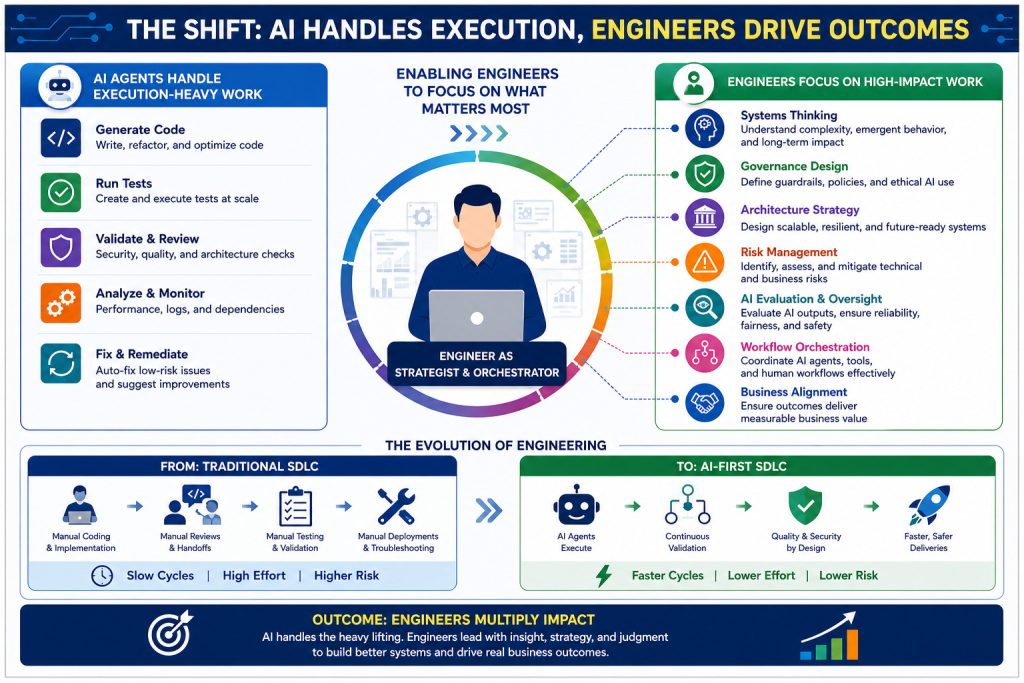
These agents can:
Interpret business needs into actionable development requirements.
Generate detailed technical specifications for faster project execution.
Create scalable architecture recommendations aligned with business objectives.
Write, optimize, and refactor code for improved performance.
Generate and execute automated tests for quality assurance.
Validate deployments to ensure stable and secure releases.
Monitor production systems for performance, stability, and reliability.
Trigger rollback or remediation actions during critical system failures.
The most important distinction is autonomy with oversight.
Agentic systems are not simply scripted bots. They analyze goals, break work into smaller tasks, evaluate outcomes, and adjust their behavior within defined governance boundaries. Instead of replacing developers, they reduce repetitive manual work and accelerate decision-making through autonomous coding agents and intelligent orchestration.
Organizations adopting AI-driven SDLC practices are already seeing measurable benefits:
Accelerate software delivery with intelligent AI-driven development workflows.
Increase test coverage through automated and continuous quality validation.
Improve code consistency across teams, platforms, and development environments.
Reduce deployment risk with predictive validation and monitoring systems.
Minimize technical debt through continuous refactoring and alignment checks.
Align business goals with accurate and scalable technical implementation.
Why Traditional SDLC Models Are Reaching Their Limits
Modern software systems are significantly more complex than those built even a decade ago. Applications span cloud platforms, APIs, microservices, data pipelines, AI services, mobile interfaces, and distributed infrastructure.
At the same time, stakeholder expectations continue to increase. Businesses expect faster releases, greater reliability, stronger security, and continuous innovation.
Traditional SDLC frameworks struggle under this pressure because they still rely heavily on sequential, human-driven workflows.
A common development cycle often looks like this:
Business stakeholders define requirements.
Product teams translate them into user stories.
Developers interpret and implement the functionality.
Slow incident diagnosis delaying issue resolution after production deployments.
Architectural drift creating gaps between planned and delivered systems.
Many organizations try to solve these challenges by adding more people, but increasing headcounts often produces diminishing returns. The issue is structural, not simply operational.
Agentic pipelines address this by embedding intelligence directly into the delivery workflow.
From Sequential Development to Autonomous Flows
Traditional SDLC models move work from one stage to another in sequence. AI-first SDLC environments operate differently.
In an agentic pipeline, stages communicate continuously rather than waiting for manual transitions. AI agents share context across the lifecycle, allowing feedback and refinement to happen in real time.
For example:
Requirements can automatically generate acceptance criteria.
Architecture recommendations can adapt based on system constraints.
Code generation agents can immediately trigger test generation agents.
Deployment agents can evaluate production risk before release.
Monitoring agents can identify anomalies and recommend remediation.
This creates a more adaptive and intelligent delivery system.
Instead of intelligence living solely within individuals, intelligence becomes embedded into the workflow itself.
The core principles of AI-first SDLC include:
Enable continuous context sharing across every software development lifecycle stage.
Improve efficiency through intelligent multi-agent collaboration and coordination.
Support autonomous decision-making within secure governance and operational guardrails.
Deliver real-time feedback loops for continuous improvement and optimization.
Maintain human governance and validation for responsible AI-driven development.
Organizations looking to implement agentic AI in DevOps pipeline environments are increasingly adopting these intelligent workflow models to improve agility and resilience.
AI-Driven Requirement Analysis and Design
One of the most expensive problems in software delivery is misunderstanding requirements. Business intent is often translated through multiple layers before reaching engineering teams. By the time implementation begins, gaps and ambiguities may already exist.
AI agents help reduce this problem significantly. Using natural language processing and contextual reasoning, agents can analyze business requirements, user stories, process documentation, and domain knowledge to create structured technical specifications.
These systems can:
Extract functional requirements from business and technical documentation automatically.
Generate clear acceptance criteria for accurate feature validation processes.
Identify missing dependencies before development and deployment activities begin.
Detect conflicting requirements across systems, teams, and project workflows.
Cross-reference existing architecture for compatibility and implementation alignment.
Recommend scalable design patterns based on system and business needs.
This dramatically reduces the amount of rework discovered later in development.
AI agents are also becoming increasingly capable of synthesizing architecture recommendations. Based on an organization’s standards, existing platforms, and infrastructure constraints, agents can generate:
System architecture suggestions
Component diagrams
API structures
Data flow models
UX flow recommendations
Compliance-aware design considerations
Rather than replacing architects, these tools provide faster starting points and reduce repetitive design work.
Autonomous Code Generation and Refactoring
AI coding assistants have already become common in many engineering teams, but agentic SDLC takes this further through coordinated multi-agent workflows powered by autonomous coding agents.
In advanced delivery pipelines, specialized agents perform different responsibilities simultaneously.
For example:
One AI agent generates code from approved technical specifications.
Another agent reviews code quality and development best practices.
Another agent validates security standards and compliance requirements automatically.
Another agent checks alignment with approved system architecture guidelines.
Another agent analyzes performance impact and optimization opportunities continuously.
This coordinated approach produces higher-quality outputs than standalone code completion tools.
Organizations implementing AI-driven coding workflows are reporting major productivity gains, particularly for well-defined engineering tasks such as:
Microservice scaffolding
API development
Legacy modernization
Automated refactoring
Documentation generation
Unit test creation
One particularly valuable capability is continuous design-code alignment.
In traditional environments, the implemented system often drifts away from the approved design over time. Agentic pipelines continuously validate the evolving codebase against architectural standards and intended system behavior.
When deviations appear, agents can:
Flag inconsistencies across code, design, and requirements.
Recommend corrections to improve accuracy and alignment.
Suggest refactoring opportunities for cleaner, stronger code.
Automatically remediate low-risk issues within approved guardrails.
This reduces technical debt accumulation and improves long-term maintainability.
AI-Driven Quality Engineering
Testing has historically been constrained by time, resources, and manual effort.
As release cycles accelerate, QA teams often struggle to maintain sufficient coverage. Agentic quality engineering changes this dynamic substantially.
AI agents can automatically:
Generate regression tests to validate existing functionality.
Create unit tests for individual code components.
Build integration tests across connected systems.
Identify edge-case scenarios before production release.
Prioritize testing based on risk and impact.
Validate acceptance criteria through automated workflows.
These agents use inputs such as:
Analyze code diffs to identify changes and testing requirements.
Learn from historical defect patterns to predict potential issues.
Use specifications to validate expected functionality and system behavior.
Monitor runtime behavior for stability, performance, and anomaly detection.
Evaluate system dependencies to reduce integration and deployment risks.
This allows organizations to expand their test coverage while reducing manual effort.
AI systems can also identify high-risk code areas before defects surface in production. By analyzing commit history, complexity metrics, and historical incident data, agents can predict where failures are most likely to occur.
Another emerging capability is self-healing code.
In controlled environments, AI agents can identify runtime failures, generate patches, validate fixes, and apply remediation within predefined safety boundaries.
While fully autonomous production remediation still requires careful governance, these capabilities already provide significant value in development and staging environments.
Intelligent Release and Deployment Management
Deployment remains one of the highest-risk stages of software delivery. Traditional CI/CD pipelines automate execution steps but still depend heavily on human judgment for release decisions. An AI-powered CI/CD pipeline introduces intelligence into release management and operational decision-making.
AI agents evaluate deployment readiness using signals such as:
Test results
Security scans
Infrastructure health
Dependency stability
Historical incidents
System performance metrics
Traffic patterns
Rather than producing a simple pass-or-fail outcome, agents generate contextual risk assessments and deployment recommendations. This allows teams to make release decisions with greater confidence.
Once deployments occur, monitoring agents continue evaluating production behavior in real time. If anomalies appear, the system can trigger alerts, recommend remediation, execute canary rollbacks, and automatically restore stable versions during critical failures.
This risk-aware automation improves reliability while reducing operational stress.
Measuring AI Developer Productivity ROI
As organizations invest more heavily in AI-driven engineering workflows, leadership teams are increasingly focused on measuring AI developer productivity ROI.
The value of AI SDLC automation extends beyond faster coding. Enterprises are evaluating outcomes such as:
Reduced software delivery timelines
Lower operational overhead
Faster incident remediation
Improved release quality
Increased engineering throughput
Reduced technical debt
Higher developer satisfaction
By combining autonomous coding agents, AI-powered testing, and intelligent deployment automation, organizations can shift engineering teams away from repetitive work and toward innovation, architecture, and strategic problem-solving.
For many enterprises, AI developer productivity ROI is becoming a critical metric for scaling digital transformation initiatives while maintaining governance and operational efficiency.
The Human Role in an Agentic SDLC
A common misconception is that agentic AI in software development eliminates the need for engineers. In reality, the role of humans becomes even more strategic.
As AI agents handle repetitive and execution-heavy tasks, engineers increasingly focus on:
Systems thinking
Governance design
Architecture strategy
Risk management
AI evaluation and oversight
Workflow orchestration
Business alignment
This changes what it means to be a software engineer. The most valuable skills in AI-first organizations are no longer limited to writing code manually. Instead, organizations need professionals who can guide intelligent systems effectively and evaluate their outputs critically.
New roles are already emerging, including:
AI pipeline engineers build scalable, intelligent, end-to-end delivery flows.
Agentic workflow architects design autonomous, goal-driven system orchestration.
AI governance specialists ensuring compliance, security, transparency, and ethical AI.
Autonomous systems reliability engineers maintain stability, resilience, and trust at scale.
The organizations succeeding in this transition are those that treat agentic AI as a transformation in delivery architecture, not simply as a productivity add-on.
Governance, Security, and Responsible AI Delivery
As AI agents gain more autonomy, governance becomes essential. Unlike traditional software systems, agentic systems behave probabilistically. Outputs may vary depending on context, prompts, and environmental factors.
This creates new governance requirements around:
Ensure explainability for transparent and understandable AI-driven decisions.
Maintain auditability across autonomous workflows and system activities.
Implement access controls to protect sensitive enterprise environments securely.
Strengthen risk management for responsible autonomous software delivery practices.
Monitor compliance continuously across evolving AI-powered development systems.
Detect operational drift impacting model accuracy and system reliability.
Maintain tamper-evident audit trails across all AI-generated activities.
Enforce role-based permissions for controlled access and accountability management.
Establish human approval checkpoints before high-risk production deployments occur.
Validate policies continuously across changing AI-driven engineering environments.
Monitor AI-generated code for vulnerabilities, compliance, and security risks.
Organizations in highly regulated industries such as healthcare and financial services must especially ensure that autonomous pipelines operate within clearly defined governance boundaries.
Agentic SDLC Platform Comparison Considerations
As enterprises evaluate next-generation engineering tools, many are conducting an agentic SDLC platform comparison to determine which solutions best align with their governance, scalability, and automation requirements.
Key evaluation criteria often include:
Multi-agent orchestration capabilities
Integration with existing DevOps ecosystems
AI-powered CI/CD pipeline compatibility
Security and compliance controls
Observability and auditability features
Support for autonomous coding agents
Scalability across hybrid and multi-cloud environments
Human-in-the-loop governance capabilities
Organizations should also assess how well platforms support long-term adaptability, operational transparency, and AI governance maturity.
The Future of Software Development
Agentic SDLC is still evolving, but the direction is clear. Over the next several years, advances in long-context models, multi-agent coordination, and multimodal AI systems will continue expanding what autonomous pipelines can accomplish.
We are moving toward environments where:
AI agents collaborate across the entire lifecycle.
Pipelines continuously improve themselves.
Delivery systems adapt dynamically to changing conditions.
Human-AI co-design becomes the default engineering model.
Organizations that invest now in governance, infrastructure, and workforce readiness will gain significant advantages in software delivery speed, quality, and scalability.
Conclusion
The shift from human-driven SDLC to agent-driven software delivery is reshaping how enterprises design, build, test, and deploy applications. Agentic AI pipelines use intelligent automation, autonomous code generation, AI-driven testing, and adaptive AI-powered CI/CD pipeline workflows to accelerate delivery, improve code quality, and reduce deployment risk across enterprise environments.
At Prolifics, we help organizations modernize software delivery through AI-powered SDLC transformation, platform engineering, DevOps automation, and intelligent quality engineering solutions. With expertise across healthcare, financial services, retail, and manufacturing, we enable scalable, governed, and AI-first engineering practices that drive innovation, operational efficiency, and long-term business value.
Organizations looking to implement agentic AI in DevOps pipeline strategies can leverage Prolifics’ expertise to accelerate adoption, improve governance, and maximize AI developer productivity ROI across the software delivery lifecycle.
Prolifics partnered with a major UK central government agency to design and deliver a cloud-native integration platform on Microsoft Azure, driving legacy integration modernization. By modernizing and migrating the agency’s legacy estate, we enabled greater agility, resilience, and scalability across their national services, while reducing annual IT costs from approximately $880k+ to $450k, a 50% cost reduction.
Annual costs were cut in half through the retirement of legacy software, hosting, and support, along with the creation of a repeatable blueprint for future government cloud integration programs.
Our Solution
Prolifics designed and delivered a fully cloud-native enterprise integration platform built entirely on Microsoft Azure. The platform accelerates delivery, improves reliability, and provides a reusable blueprint for future government modernization initiatives.
Outcome
Prolifics successfully delivered the agency’s first cloud-native integration platform after previous attempts by other suppliers had failed.
The new Azure platform is now the default home for all new integrations, enabling:
Greater agility
Improved scalability
Higher security and reliability
Significant cost efficiency
This delivery has created a repeatable blueprint for government modernization, demonstrating Prolifics’ capability and credibility in the public sector. By moving to Azure, the agency reduced annual IT costs from approximately $880k+ to $450k, cutting costs by 50%.
Salesforce has introduced Headless 360, a new platform suite designed to integrate third-party AI agents directly into its ecosystem. The launch marks a shift from traditional, user interface-driven software to an AI-first, agent-powered model that could redefine how businesses operate.
At its core, Headless 360 allows AI agents such as Microsoft Copilot, Google Gemini, and Anthropic’s Claude to access Salesforce data and execute workflows without relying on dashboards or manual inputs. Instead of employees navigating multiple screens, AI agents can now perform tasks through APIs, command-line tools, and Model Context Protocol integrations.
With Headless 360, businesses can increasingly adopt AI to streamline operations, Salesforce is positioning itself as the infrastructure powering these intelligent agents rather than competing with them.
Key Takeaways
Enables direct integration of third-party AI agents
Eliminates reliance on traditional dashboards and interfaces
Provides 60 plus MCP tools and prebuilt coding capabilities
Simplifies integration and reduces technical complexity
Accelerates automation across enterprise workflows
Supports a shift toward AI-first and agent-driven software systems
One of the standout aspects of Headless 360 is its extensive toolkit. The platform includes more than 60 MCP tools and over 30 prebuilt coding capabilities. This enables developers to connect AI agents seamlessly to business data, workflows, and internal logic. It also eliminates the need for complex custom integrations, which were previously time-consuming and technically demanding.
Salesforce has also introduced an experience layer that separates how tasks are executed from how results are displayed. This allows AI-driven actions to be delivered across multiple interfaces such as Slack, voice assistants, or other communication platforms without altering the underlying system.
The implications for businesses are significant. With Headless 360, organizations can automate sales processes, customer support, and internal operations at unprecedented speed. By reducing manual workloads and enabling real-time AI-driven decisions, companies can improve efficiency and unlock deeper insights from their data.
However, the shift also raises important questions about the future of traditional SaaS platforms. Salesforce’s approach suggests that software will no longer be defined by user interfaces but by programmable, AI-accessible systems. The platform is evolving into a headless backend that powers intelligent automation across industries.
As enterprises continue to explore AI-driven transformation, Headless 360 could serve as a blueprint for the next generation of digital operations where humans and AI agents collaborate seamlessly and workflows are executed autonomously.
Cloud modernization strategies are essential in today’s hyper-digital economy, where legacy applications are no longer just outdated. They are barriers to innovation, agility, and growth. Organizations that continue to rely on aging systems struggle with scalability, high maintenance costs, and limited integration capabilities, making modernizing legacy systems to cloud a critical priority.
Cloud modernization is the strategic answer. It’s not just about moving applications to the cloud. It is about reimagining them as agile, scalable, and future-ready digital assets that drive business transformation.
At Prolifics, we see cloud modernization as a powerful enabler that helps enterprises unlock innovation, reduce technical debt, and accelerate digital transformation journeys.
What is Cloud Modernization?
Cloud modernization refers to transforming legacy applications, infrastructure, and data ecosystems into cloud-native or cloud-optimized environments. Unlike simple migration, modernization involves re-architecting, refactoring, or rebuilding applications to fully leverage cloud capabilities.
It is important to understand cloud migration vs modernization, as modernization focuses on long-term scalability and innovation rather than just infrastructure relocation.
This transformation is designed to enhance: • Scalability • Performance • Cost efficiency • Business agility
Organizations that modernize effectively gain a competitive edge by enabling faster innovation cycles and improved user experiences.
Why Legacy Systems Are Holding You Back
Legacy systems were built for a different era that prioritized stability over speed. Today, that trade-off no longer works.
Key challenges include: • Limited scalability for growing workloads • High operational costs due to outdated infrastructure • Integration challenges with modern APIs and digital platforms • Slow time-to-market for new features
As industry insights highlight, outdated systems hinder agility and make it difficult to execute modern digital strategies effectively.
In a world where AI, real-time analytics, and digital experiences define success, legacy systems simply cannot keep up.
The Business Value of Cloud Modernization
Cloud modernization is not just a technical upgrade. It is a strategic investment in growth.
Enhanced Scalability and Flexibility Cloud-native architectures allow businesses to scale resources dynamically based on demand. This ensures optimal performance without over-provisioning.
Cost Optimization Modernization reduces infrastructure and maintenance costs while improving resource utilization. Organizations often achieve significant savings through automation and optimized cloud usage. (Hexaware Technologies)
Faster Innovation Modern platforms enable rapid development, testing, and deployment. This empowers teams to deliver new features faster.
Improved Resilience and Security Cloud environments offer built-in redundancy, disaster recovery, and advanced security capabilities.
Data-Driven Decision Making With modernized systems, businesses gain real-time insights and analytics capabilities. This enables smarter decisions.
Key Cloud Modernization Strategies
Transforming legacy applications requires a structured approach. Leading organizations adopt a mix of strategies based on application complexity, business value, and technical feasibility.
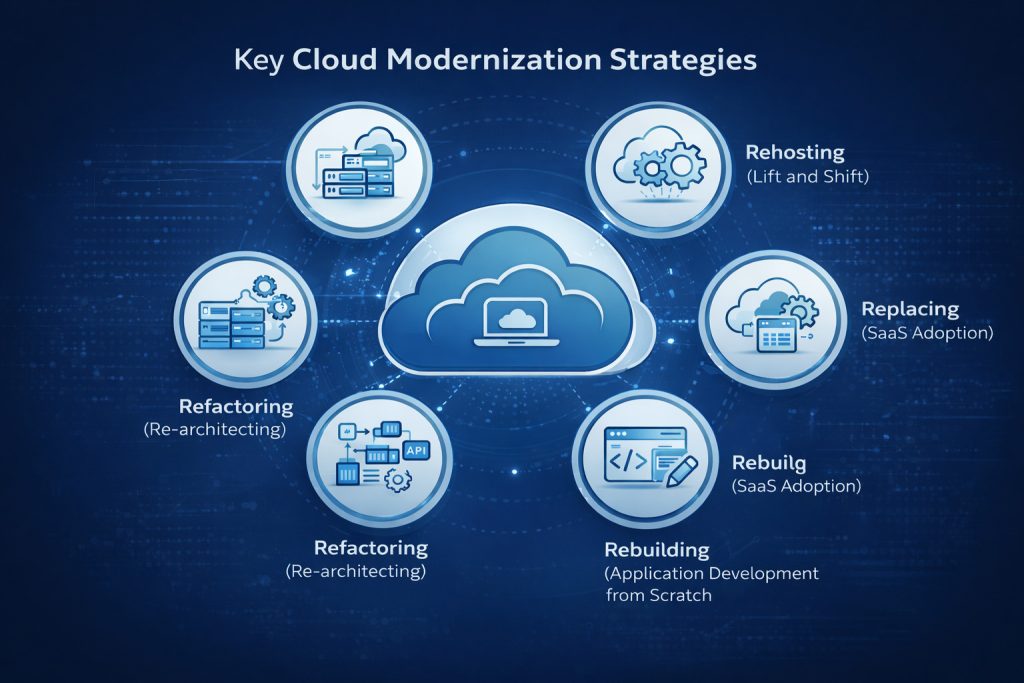
Rehosting (Lift and Shift) This involves moving applications to the cloud with minimal changes. It is a quick way to reduce infrastructure costs but may not fully leverage cloud benefits.
Replatforming Applications are optimized for the cloud without significant architectural changes. This improves performance and scalability while maintaining core functionality.
Refactoring (Re-architecting) Applications are redesigned using microservices, containers, and APIs. This approach unlocks maximum cloud potential and supports innovation.
Rebuilding Applications are rewritten from scratch using modern frameworks and technologies. This ensures long-term scalability and flexibility.
Replacing (SaaS Adoption) Legacy systems are replaced with cloud-based SaaS solutions. This reduces maintenance overhead and accelerates deployment.
Most enterprises adopt a hybrid approach, combining multiple strategies to achieve optimal results.
Overcoming Cloud Modernization Challenges
While the benefits are compelling, cloud modernization comes with challenges that require careful planning:
• Complex legacy architectures • Integration with existing systems • Data migration risks • Cost management issues • Security and compliance requirements
Without a well-defined strategy, organizations risk delays, cost overruns, and incomplete transformation.
How to Address These Challenges
• Conduct a comprehensive cloud readiness assessment • Prioritize applications based on business impact • Use automation tools to accelerate migration • Implement a Cloud Center of Excellence (CoE) • Ensure security is integrated from the start
The Prolifics Approach to Cloud Modernization
At Prolifics, we go beyond migration. We deliver end-to-end cloud transformation that aligns technology with business outcomes.
Strategic Assessment & Roadmap We evaluate your application portfolio to identify modernization opportunities and define a clear transformation roadmap.
Cloud-Native Architecture Design Our experts design scalable, resilient architectures using microservices, containers, and APIs.
Automation-Driven Transformation We leverage AI and automation to accelerate code transformation, testing, and deployment. This reduces time-to-market.
Seamless Integration We ensure smooth integration with existing systems, enabling hybrid and multi-cloud environments.
Continuous Optimization Post-migration, we optimize performance, cost, and security to maximize ROI.
Our expertise across AWS, Google Cloud, and Salesforce enables us to deliver tailored solutions that meet your unique business needs.
Real Transformation: From Legacy to Digital Powerhouse
Imagine a financial services organization struggling with a monolithic legacy system. Deployment cycles take months, and scaling is nearly impossible.
Through cloud modernization: • The application is decomposed into microservices • APIs enable seamless integration with digital channels • Automated pipelines accelerate deployment • Cloud infrastructure ensures scalability and resilience
The result? A future-ready digital platform that delivers faster services, improved customer experiences, and significant cost savings.
The Future is Cloud-Native
The rise of AI, data-driven decision-making, and digital ecosystems is reshaping enterprise IT. Organizations must move beyond legacy systems to remain competitive.
Industry trends show that cloud modernization is becoming essential and not optional for businesses aiming to scale and innovate in the AI-driven era. (TechRadar)
Those who modernize today will lead tomorrow.
Final Thoughts: Turn Your Legacy into a Competitive Advantage
Cloud modernization is not just a technology shift. It is a business transformation strategy. It empowers organizations to:
At Prolifics, we help you transform legacy applications into scalable digital powerhouses by unlocking the full potential of the cloud.
Ready to Modernize?
Your legacy systems don’t have to hold you back.
Partner with Prolifics to build a cloud-first, future-ready enterprise where innovation, agility, and scalability drive success.
Let’s transform your digital future today.
FAQS
What is cloud modernization?
Cloud modernization is the process of transforming legacy applications, infrastructure, and data systems to leverage cloud-native technologies. It includes rehosting, refactoring, replatforming, or rebuilding applications to improve scalability, agility, and performance.
Why is cloud modernization important for businesses?
Cloud modernization enables organizations to reduce operational costs, improve system reliability, enhance security, and accelerate innovation. It helps businesses stay competitive by enabling faster deployments and better customer experiences.
What are the key approaches to cloud modernization?
Common strategies include: Rehosting (Lift and Shift): Moving applications to the cloud with minimal changes Replatforming: Making minor optimizations for cloud efficiency Refactoring: Redesigning applications to be cloud-native Rebuilding/Replacement: Developing new applications or adopting SaaS solutions
What challenges are associated with cloud modernization?
Organizations often face challenges such as legacy system complexity, data migration risks, security and compliance concerns, skill gaps, and potential downtime during transition.
How can organizations ensure a successful cloud modernization strategy?
Success depends on a clear roadmap, application assessment, choosing the right cloud model (public, private, hybrid), leveraging automation tools, and partnering with experienced cloud service providers to minimize risk and maximize ROI.