Artificial Intelligence is reshaping how enterprises build, modernize, and manage software. Yet many organizations continue to face challenges with legacy systems, fragmented development environments, governance requirements, and increasing pressure to deliver innovation faster.
IBM Bob is an AI-first enterprise development platform designed to support the entire Software Development Lifecycle (SDLC), from planning and code generation to testing, deployment, modernization, and governance. When combined with Prolifics’ deep expertise in enterprise transformation, organizations gain a powerful framework to accelerate modernization initiatives while maintaining security, compliance, and operational excellence.
Why IBM Bob + Prolifics?
Accelerate legacy application modernization and cloud transformation
Improve developer productivity with AI-assisted SDLC automation
Strengthen governance, security, and compliance across development workflows
Integrate AI into DevSecOps, CI/CD, and enterprise engineering practices
Reduce technical debt and streamline software delivery
Scale AI adoption responsibly across hybrid and multi-cloud environments
Modernize mainframe, IBM i, COBOL, and legacy enterprise systems
Enable faster innovation with enterprise-ready AI solutions
Whether you’re modernizing mission-critical applications, optimizing software delivery, or building an AI-driven development strategy, Prolifics helps you unlock the full value of IBM Bob.
Discover how IBM Bob and Prolifics help enterprises move from experimentation to production-ready AI-powered software engineering.
When a senior developer retired after twenty-five years, critical business processes began slowing down because no one fully understood the rules embedded within legacy systems. What first looked like a technology issue quickly became a business continuity risk. This happens across enterprises every day, where valuable operational knowledge lives inside aging applications, undocumented workflows, spreadsheets, emails, and employee experience. As organizations move toward modernization, automation, and AI, uncovering hidden business logic becomes essential for reducing risk, preserving institutional knowledge, improving decisions, and building long-term competitive advantages with AI.
At Prolifics, we help organizations identify, extract, and transform hidden business logic into actionable intelligence that supports modernization, operational efficiency, and sustainable growth.
The Enterprise Blindspot: What Is Hidden Business Logic in Enterprise AI?
Hidden business logic in enterprise AI refers to the undocumented rules, decision trees, and operational knowledge embedded in legacy systems, employee expertise, and informal workflows. It is the invisible layer that drives real business outcomes and the missing context that causes AI models to underperform when left unaddressed.
Hidden business logic consists of the rules, decisions, workflows, and operational knowledge that drive business processes but remain undocumented or difficult to access. Over time, these business rules become deeply embedded within enterprise systems, employee expertise, and daily operations. As a result, organizations often struggle to fully understand, manage, or modernize the processes that keep their business running.
This challenge sits at the center of hidden business logic in enterprise AI. Without visibility into critical operational knowledge, businesses struggle to modernize systems, scale operations, reduce risk, and maintain consistency across teams.
The following challenges commonly prevent organizations from accessing and leveraging hidden business logic effectively:
Legacy Sprawl
The Cost of Friction
i. Legacy Sprawl: Why Critical Rules Sit Buried in Outdated Code and Employee Heads
Many enterprises operate hundreds of interconnected applications developed over decades. Business rules often exist inside custom code, obsolete systems, spreadsheets, and informal processes maintained by long-tenured employees. As systems evolve, documentation rarely keeps pace, creating significant knowledge gaps.
This fragmentation makes modernization initiatives increasingly difficult. Teams cannot confidently update systems when they do not fully understand the logic driving business outcomes. The result is increased risk, higher costs, slower innovation, and reduced readiness for AI adoption.
Common consequences of legacy sprawl include:
Critical business rules remain hidden inside aging applications.
Employee departures create significant knowledge retention and business continuity risks.
Documentation fails to reflect evolving business process requirements.
Legacy systems obscure dependencies across enterprise operations.
Teams struggle to identify the impact of changes across interconnected systems.
ii. The Cost of Friction: How Undocumented Logic Slows Down Software Migration and Onboarding
Organizations frequently invest millions in digital transformation and modernization initiatives. However, undocumented business logic often becomes a major obstacle during migration projects. Teams spend significant time reverse-engineering workflows before modernization efforts can begin.
New employees face similar challenges. Without clear documentation, onboarding requires extensive tribal knowledge transfer, reducing productivity and increasing dependency on experienced personnel.
The following challenges create operational friction across the enterprise:
Migration projects stall while teams decode undocumented workflows.
New employees require extended onboarding and process training.
Business decisions depend heavily on individual employee expertise.
Process inconsistencies increase operational costs and compliance risks.
Modernization timelines expand due to uncertainty around business rules.
Why Hidden Business Logic Matters More in the Age of AI
The rise of enterprise AI has increased the importance of understanding business logic. AI systems are only as effective as the knowledge and processes they are trained to support. When critical business rules remain hidden, organizations risk building AI solutions on incomplete or inaccurate information.
AI initiatives require a clear understanding of how decisions are made, how workflows operate, and how exceptions are handled. Without this foundation, automation efforts may introduce errors, compliance issues, and operational inefficiencies.
Organizations that successfully uncover hidden business logic gain several advantages:
Better decision-making through access to institutional knowledge.
Reduced dependency on individual employees.
How AI Helps Uncover Hidden Business Logic
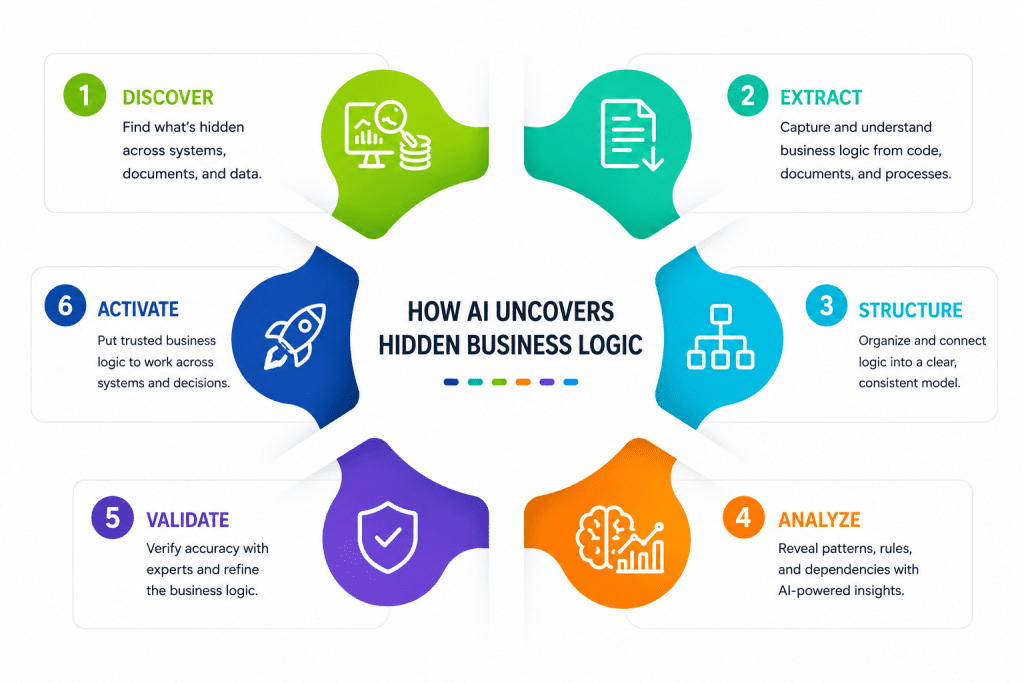
AI uncovers tacit knowledge in business processes by analyzing legacy source code, unstructured documents, emails, system logs, and expert interviews at scale. Unlike manual discovery, AI identifies patterns, decision rules, and workflow logic across thousands of data sources simultaneously, turning invisible institutional knowledge into structured, actionable intelligence.
Traditional approaches to documenting business processes often rely on interviews, manual reviews, and lengthy discovery projects. While valuable, these methods can be time-consuming and incomplete.
Modern AI technologies can accelerate discovery by analyzing large volumes of structured and unstructured data across the enterprise. AI can identify patterns, relationships, workflows, and decision rules that would otherwise remain hidden.
i. Analyzing Legacy Applications and Source Code
AI-powered tools can examine legacy applications, source code repositories, and system configurations to identify embedded business rules. This enables organizations to understand how systems operate without relying solely on historical documentation.
Benefits include:
Faster application assessment.
Improved migration planning.
Reduced modernization risk.
Better visibility into system dependencies.
ii. Mining Documentation, Emails, and Knowledge Repositories
Important business knowledge often exists outside formal systems. AI can analyze documents, emails, support tickets, process manuals, and collaboration platforms to uncover operational insights and decision-making patterns.
This helps organizations:
Capturing workflows that teams follow but rarely document clearly.
Preserving institutional knowledge before employees leave or roles change.
Identifying process variations that create confusion across business teams.
Improving knowledge access so teams find answers faster.
iii. Extracting Knowledge from Subject Matter Experts
Experienced employees often possess valuable operational knowledge that has never been formally documented. AI-assisted interviews, knowledge capture platforms, and conversational tools can help organizations preserve expertise before it is lost.
This approach helps organizations protect important expertise in practical ways:
Keeping critical knowledge available before experienced employees move on.
Helping new employees learn processes with less confusion.
Reducing business continuity risks tied to individual expertise.
Improving process documentation with clearer, more reliable details.
Transforming Hidden Business Logic into Actionable Intelligence
Discovering hidden business logic is only the first step. Organizations must also convert that knowledge into usable assets that support modernization and innovation.
Once extracted, business logic can be organized into centralized repositories, knowledge graphs, process maps, and governance frameworks that make information accessible across the enterprise.
Key outcomes include the following:
Creating consistent business rules teams can understand and apply.
Making processes easier to see, review, and improve.
Helping teams work together with shared operational contexts.
Connecting business priorities with technology decisions more clearly.
Building stronger foundations for future AI and automation initiatives.
Business Benefits of Uncovering Hidden Business Logic
Organizations that successfully identify and operationalize hidden business logic can realize significant business value.
i. Strengthening Business Continuity
When critical knowledge is documented and accessible, organizations become less dependent on individual employees. This reduces operational disruptions caused by retirements, turnover, or organizational changes.
ii. Accelerating Digital Transformation
Understanding existing business rules enables teams to modernize systems with greater confidence. Projects move faster because stakeholders have a clear view of current-state processes and dependencies.
iii. Improving Operational Efficiency
Documented workflows reduce duplication, eliminate unnecessary manual effort, and improve consistency across operations. Teams spend less time searching for information and more time delivering value.
iv. Enhancing Compliance and Risk Management
Clear visibility into business rules helps organizations demonstrate compliance, improve governance, and reduce operational risk. AI can also help identify inconsistencies and gaps that may create regulatory exposure.
v. Enabling Smarter AI Initiatives
Organizations with well-documented business logic provide AI systems with higher-quality context and decision frameworks. This improves the effectiveness of automation, analytics, and intelligent decision-making solutions.
Building a Competitive Advantage with AI
The organizations that gain the greatest value from AI are not necessarily those with the most advanced technology. They are the ones that understand their business processes, operational knowledge, and decision-making frameworks most effectively.
By uncovering hidden business logic, enterprises create a foundation for innovation that competitors may struggle to replicate. Institutional knowledge becomes a strategic asset rather than a hidden liability.
This creates a sustainable competitive advantage with AI through:
Helping teams move faster with clearer insights and decisions.
Reducing manual effort by making automation more accurate and useful.
Improving customer experiences through faster, more consistent service delivery.
Giving teams flexibility to respond quickly when priorities change.
Protecting business continuity by keeping important knowledge accessible.
How Prolifics Helps Organizations Unlock Hidden Business Logic
At Prolifics, we help organizations uncover, document, and operationalize hidden business logic across legacy systems, applications, workflows, and institutional knowledge sources.
Our approach combines AI-powered discovery, modernization expertise, process analysis, and enterprise architecture capabilities to help organizations:
Identify critical business rules embedded in legacy systems.
Preserve institutional knowledge before it is lost.
Accelerate software migration and modernization initiatives.
Improve operational efficiency and governance.
Build stronger foundations for enterprise AI and automation.
By transforming hidden business logic into actionable intelligence, organizations can reduce risk, improve agility, and unlock new opportunities for growth.
Conclusion
Hidden business logic represents one of the most significant yet overlooked assets within modern enterprises. Buried inside legacy systems, undocumented workflows, and employee expertise, this knowledge influences critical business decisions every day.
As organizations invest in digital transformation, automation, and enterprise AI, understanding and preserving this operational knowledge becomes increasingly important. AI provides powerful capabilities for discovering, documenting, and leveraging hidden business logic at scale.
Organizations that act now can strengthen business continuity, improve knowledge retention, accelerate modernization efforts, and create a lasting competitive advantage with AI. The ability to transform hidden knowledge into actionable intelligence will be a defining factor in future business success.
How does AI uncover tacit knowledge in business processes?
AI tools analyze legacy source code, documentation repositories, emails, support tickets, and structured interviews with subject matter experts. Machine learning models identify patterns, decision rules, and workflow logic that would otherwise require months of manual discovery making AI process intelligence faster and more accurate than traditional audits.
What are the hidden operational inefficiencies AI can detect?
AI can detect redundant manual steps, undocumented exception-handling rules, inconsistent data transformation logic, shadow IT processes, and informal approval chains. These inefficiencies often remain invisible until AI-powered analysis surfaces them from system logs, code repositories, and unstructured communications across the enterprise.
How does turning institutional knowledge into AI competitive advantage work?
When enterprises codify undocumented knowledge into structured process maps, knowledge graphs, and governance frameworks, they create AI training assets that competitors cannot easily replicate. This proprietary operational context improves model accuracy, accelerates automation, and builds a compound competitive advantage that deepens over time.
What AI strategy should enterprises use for codifying undocumented business rules?
Enterprises should start with a legacy system audit using AI code analysis tools, followed by unstructured data mining from documents and communications. Next, AI-assisted knowledge capture sessions with subject matter experts help fill gaps. The final step is operationalizing findings into centralized knowledge repositories that continuously feed enterprise AI and automation platforms.
As artificial intelligence adoption accelerates across industries, security leaders are facing a growing challenge: how to secure AI agents, machine identities, and automated workflows without slowing innovation. Amazon Web Services (AWS) is addressing this with new AWS AI security identity tools designed to close emerging security gaps in enterprise environments.
The latest AWS security enhancements focus on what experts increasingly call the “new attack surface,” non-human identities. AI agents, automated bots, APIs, and machine-driven workflows are rapidly proliferating across cloud ecosystems, creating new risks of unauthorized access, privilege escalation, and data exposure.
Industry reports indicate that many organizations remain overconfident in their AI security readiness despite lacking foundational identity governance controls. Security analysts warn that AI adoption is outpacing traditional identity management strategies, especially as enterprises scale autonomous systems.
To address these concerns, AWS has introduced advanced identity and access management capabilities that improve how AI agents authenticate, access systems, and interact with enterprise applications. Among the key innovations is AgentCore Identity, which provides enhanced access controls for AI agents and restricts interactions based on user permissions and organizational policies.
AWS is also integrating AI-driven automation into threat detection and security operations. New machine learning-powered security capabilities can automatically identify suspicious activity, detect multi-stage attacks, and correlate threats across cloud workloads in real time. These innovations aim to help organizations move from reactive security models to proactive, intelligent defense systems.
The importance of identity-centric security is becoming increasingly evident as enterprises embrace agentic AI architectures. AWS recently expanded its collaboration ecosystem around identity governance, with leading identity security providers such as SailPoint working closely with AWS to develop unified governance frameworks for both human and machine identities.
For enterprises, however, adopting these technologies is only part of the equation. Successfully implementing AI security requires a strategic partner capable of aligning cloud infrastructure, governance frameworks, compliance, and operational automation.
This is where Prolifics delivers value.
As a trusted digital transformation and cloud modernization partner, Prolifics helps organizations securely adopt AI-driven technologies while maintaining strong governance and operational resilience. From cloud-native identity management and zero-trust architectures to AI-enabled automation and security modernization, Prolifics enables enterprises to build scalable and secure AI ecosystems.
With deep expertise across AWS cloud services, AI integration, cybersecurity, and enterprise modernization, Prolifics helps organizations:
Modernize identity and access management frameworks
Secure AI agents and automated workflows
Implement cloud-native security architectures
Strengthen compliance and governance strategies
Accelerate AI adoption without compromising security
As AI becomes deeply embedded into enterprise operations, identity security will play a defining role in business resilience and digital trust. Organizations that proactively modernize their security posture today will be better positioned to innovate confidently tomorrow.
To learn how your organization can securely scale AI initiatives with AWS and advanced identity governance strategies, connect with Prolifics today.
Wildfires are no longer seasonal threats, they have become year-round disasters impacting utilities, governments, businesses, and communities worldwide. Climate volatility, aging utility infrastructure, extreme weather conditions, and expanding urban development near forests have significantly increased the frequency and intensity of wildfire incidents. For utility providers, especially energy and transmission companies, the stakes are higher than ever. A single ignition event can lead to catastrophic environmental destruction, regulatory penalties, financial liability, and public safety crises.
To address this growing challenge, Prolifics is pioneering an advanced wildfire risk prediction AI and Risk Mitigation AI Solution that combines Artificial Intelligence (AI), Machine Learning (ML), geospatial intelligence, weather analytics, and operational data into a unified decision-making platform. The solution empowers organizations to predict, prevent, and proactively respond to wildfire risks before they escalate into disasters.
The Growing Need for AI in Wildfire Management
Traditional wildfire mitigation approaches are reactive. Most organizations depend on static weather reports, fragmented operational systems, manual inspections, or historical observations to make critical decisions. However, wildfire conditions evolve rapidly and require real-time intelligence.
Several major challenges continue to delay wildfire management:
Escalating wildfire risks caused by climate volatility and prolonged droughts
Aging utility infrastructure vulnerable to ignition events
Fragmented datasets across GIS systems, weather platforms, operational tools, and vegetation monitoring systems
Inability to use historical trends effectively for predictive insights
Increasing regulatory scrutiny and liability exposure
Prolifics recognized that organizations needed more than isolated monitoring tools. They needed an intelligent platform capable of reasoning across multiple data sources, understanding wildfire patterns, and generating actionable insights to take quick decisions in real time.
Introducing the Prolifics Risk Mitigation AI Solution
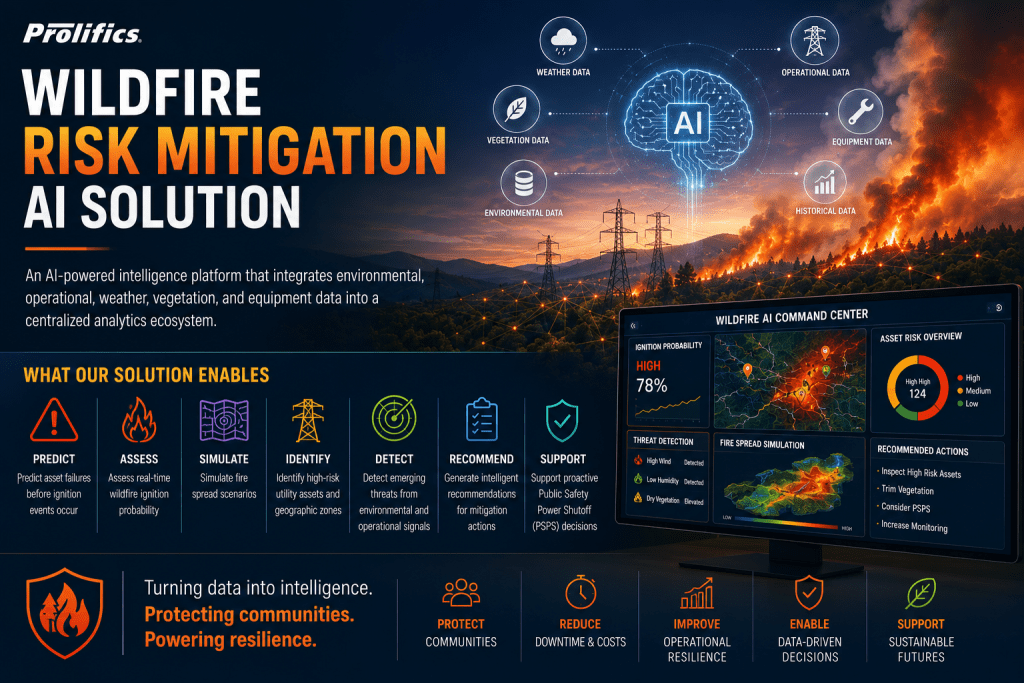
The Prolifics Risk Mitigation AI Solution is an AI-powered intelligence platform and predictive wildfire analytics platform that integrates environmental, operational, weather, vegetation, MET, and equipment data into a centralized analytics ecosystem.
The platform enables organizations to:
Predict outages caused by asset failures before ignition events occur
Assess real-time wildfire and wildfire spread probability
Identify high-risk utility assets and geographic zones
Detect emerging threats from environmental and operational signals
Generate intelligent recommendations for mitigation actions
Support proactive Public Safety Power Shutoff (PSPS) decisions
At its core, the solution leverages AI-driven reasoning engines that can process complex user queries in natural language. Business users no longer need deep technical expertise or database knowledge to access critical wildfire intelligence.
As discussed during solution planning sessions, the system was designed so that even newly onboarded personnel can ask straightforward questions based on user personas and pre-defined IAM privileges and receive intelligent answers without needing to understand underlying schemas or technical structures.
A Multi-Layered AI Prediction Framework
The Prolifics solution operates through a sophisticated three-layer wildfire prediction architecture.
Layer 1: Environmental and Weather Intelligence
The first layer focuses on weather conditions, atmospheric instability, fuel moisture, vegetation stress, and terrain analysis.
The system continuously evaluates critical wildfire indicators such as:
Relative humidity
Wind speed and wind gust behavior
Air temperature across multiple elevations
Vapor pressure deficit
Solar radiation
Soil moisture
Dead and live fuel moisture
Vegetation dryness indexes
Terrain ruggedness and slope
These variables are essential because wildfire ignition and spread are highly dependent on environmental conditions. For example:
Critically low vegetation moisture creates explosive fire conditions
The platform processes these parameters dynamically to assess fire susceptibility at granular geographic levels.
Layer 2: Fire Behavior and Equipment Risk Modeling
The second layer introduces advanced fire behavior simulations and utility asset risk analysis.
This layer evaluates:
Probability of catastrophic fire behavior
Fire spread rate
Predicted flame length
Potential fire footprint
Equipment failure probability
Vegetation-related ignition risks
Tree-strike probabilities
Infrastructure vulnerabilities
One of the most powerful capabilities is the Catastrophic Fire Probability (CFPt) scoring mechanism. The platform calculates risk scores using equipment conditions, vegetation exposure, and environmental variables as shared by MET to determine whether a specific asset or transmission section could trigger catastrophic wildfire conditions.
The system also evaluates induction risks, vegetation hazards, unresolved maintenance tags, and structural risks associated with utility poles and transmission infrastructure.
This comprehensive intelligence enables utility operators to prioritize high-risk assets before failures occur.
Layer 3: Intelligent PSPS Decision Support
Public Safety Power Shutoff (PSPS) programs are critical wildfire mitigation measures used by utility companies during extreme fire weather conditions. However, unnecessary power outages can significantly impact businesses, hospitals, schools, and communities.
The third layer of the Prolifics solution provides intelligent PSPS decision support by combining environmental risk scores, fire behavior analysis, asset intelligence, and operational thresholds.
The platform determines:
Whether minimum fire potential conditions are met
Which transmission lines require scoping
High Fire Risk Area classifications
Operational risk levels
Regulatory tier designations
Final scoping decisions for utility operations
This allows organizations to make faster, defensible decisions supported by AI-generated insights and predictive analytics.
AI-Powered Conversational Intelligence
One of the most innovative aspects of the solution is its conversational AI capability. The platform uses Large Language Models (LLMs) to translate business questions into intelligent SQL queries dynamically. Instead of relying on predefined dashboards alone, users can ask complex questions naturally, such as:
“Which transmission assets are at highest wildfire risk today?”
“Show assets within five miles of catastrophic fire zones.”
“Identify unresolved vegetation risks in high wind regions.”
The AI engine reasons through the query, generates multiple SQL queries if needed, retrieves the required data, and constructs an intelligent response for the user.
The architecture was further enhanced with:
Multi-query reasoning workflows
Distance calculation capabilities for nearby asset analysis
Contextual memory to retain previous interactions
Simplified UI experiences for business users
Collapsible technical outputs for developers and engineers
Asset history based on audit files
This creates a highly intuitive experience while still maintaining advanced technical depth behind the scenes.
Synthetic Data and Machine Learning Innovation
To improve predictive accuracy, the Prolifics team designed realistic synthetic wildfire scenarios categorized into:
Safe
Near-miss
Dangerous
Catastrophic
Each scenario includes realistic environmental and operational parameter ranges based on wildfire domain expertise.
The system generated over 5,000 synthetic records using weighted formulas that combined:
Weather conditions
Fuel moisture
Equipment failure probabilities
Vegetation risk factors
This approach improves AI model reliability while enabling scalable testing and simulation capabilities.
Business Impact and Executive Value
The Prolifics wildfire Risk Mitigation AI Solution delivers measurable business value across operations, compliance, and risk management.
Reduced Risk Exposure
Organizations can proactively identify wildfire-prone assets and geographic zones before incidents occur.
Wildfire management is entering a new era driven by predictive intelligence, automation, and AI-powered operational awareness. Organizations can no longer depend solely on manual monitoring or isolated systems to address increasingly complex wildfire threats.
The Prolifics Wildfire Risk Mitigation AI Solution represents a transformative shift toward intelligent wildfire prevention, where data, AI, and operational intelligence work together to protect communities, infrastructure, and the environment.
By combining machine learning, geospatial intelligence, conversational AI, and predictive analytics, Prolifics is helping organizations move from reactive firefighting to proactive wildfire prevention.
In a world where every second matters, AI-powered wildfire intelligence could mean the difference between containment and catastrophe.
About the Author: Swati Dora is an Associate Director at Prolifics specializing in AI-driven enterprise transformation, predictive analytics, and intelligent solutions for utility and industrial organizations.
Frequently Asked Questions (FAQs)
1. What is an AI-powered wildfire management solution?
An AI-powered wildfire Risk Mitigation AI Solution technologies such as machine learning, predictive analytics, weather intelligence, geospatial analytics, and real-time monitoring to identify wildfire risks before ignition occurs. These platforms help utilities and infrastructure providers predict equipment failures, assess fire spread probability, and optimize emergency response strategies.
2. How does Prolifics’ Risk Mitigation AI Solution help utility companies?
Prolifics’ Risk Mitigation AI Solution helps utility companies reduce wildfire risks by combining weather data, vegetation analysis, infrastructure monitoring, and AI-based predictive modeling into a unified platform. The solution enables utilities to proactively identify high-risk assets, improve PSPS decision-making, optimize maintenance activities, and reduce operational and regulatory exposure.
3. What types of data are used in wildfire prediction models?
Wildfire prediction models use multiple data sources, including: * Weather and atmospheric conditions * Wind speed and humidity * Fuel moisture levels * Vegetation density * Terrain and geospatial data * Infrastructure health metrics * Equipment failure probabilities * Sensor and operational data By analyzing these variables together, AI models can accurately predict wildfire ignition and spread risks.
4. Can AI improve Public Safety Power Shutoff (PSPS) decisions?
Yes. AI significantly improves PSPS decision-making by providing real-time risk assessments and predictive insights. Instead of implementing broad power outages, utilities can make targeted shutoff decisions based on wildfire probability, equipment risk, environmental conditions, and fire behavior simulations. This reduces unnecessary outages while improving public safety.
5. Why is predictive wildfire intelligence important for the future?
Predictive wildfire intelligence enables organizations to move from reactive firefighting to proactive wildfire prevention. As climate change increases the frequency and severity of wildfires, AI-driven systems provide faster decision-making, improved operational resilience, reduced liability exposure, and better protection for communities, infrastructure, and natural resources.