

As organisations accelerate AI adoption, agentic analytics is emerging as a defining new paradigm in enterprise intelligence. These systems operate autonomously, make real-time decisions, and continuously learn – but they also depend heavily on strong data governance to deliver reliable, scalable, and trustworthy outcomes.
The stakes are significant. According to Gartner, by 2027, organisations that fail to establish formal data governance for AI agents will experience 3x more AI project failures than those with structured governance frameworks in place. Forrester Research reinforces this finding, reporting that 73% of enterprise AI initiatives cite poor data quality and lack of governance as the primary barriers to scaling autonomous AI systems beyond the pilot stage. For CIOs and data leaders building agentic AI strategies in 2026, governance is not an afterthought – it is the foundation.
At Prolifics, we help enterprises put the right governance and data foundations in place so they can scale agentic analytics with confidence and control.
Rise of Agentic Analytics in Modern Enterprises
Agentic analytics refers to AI systems that act independently to analyse data, generate insights, and execute decisions with minimal human intervention. These systems are increasingly being deployed across enterprise environments to improve operational efficiency, customer experience, and strategic decision-making across industries including financial services, healthcare, retail, insurance, and the public sector.
However, the effectiveness of these systems is directly tied to the quality, consistency, and trustworthiness of the data they consume. This is where data governance for AI agents plays a pivotal role.
Without a well-defined governance framework, agentic systems risk operating on incomplete, inconsistent, or biased datasets which can lead to inaccurate outputs, regulatory exposure, and material business risk. IBM’s Data & AI Index found that enterprises without structured AI data governance experience 45% higher model error rates and 2.1x longer time-to-production for AI initiatives compared to governance-mature peers.
Why Data Governance is Critical for Agentic AI
Data governance for AI agents is essential because agentic systems rely on accurate, trusted data to make autonomous decisions at scale. Without proper oversight, poor agentic AI data quality leads to flawed outcomes and reduced system reliability.
Governance also ensures transparency and accountability, helping organizations understand, audit, and trust AI-driven actions. Finally, it enables secure, scalable deployment by maintaining consistency, compliance, and control across complex data ecosystems.
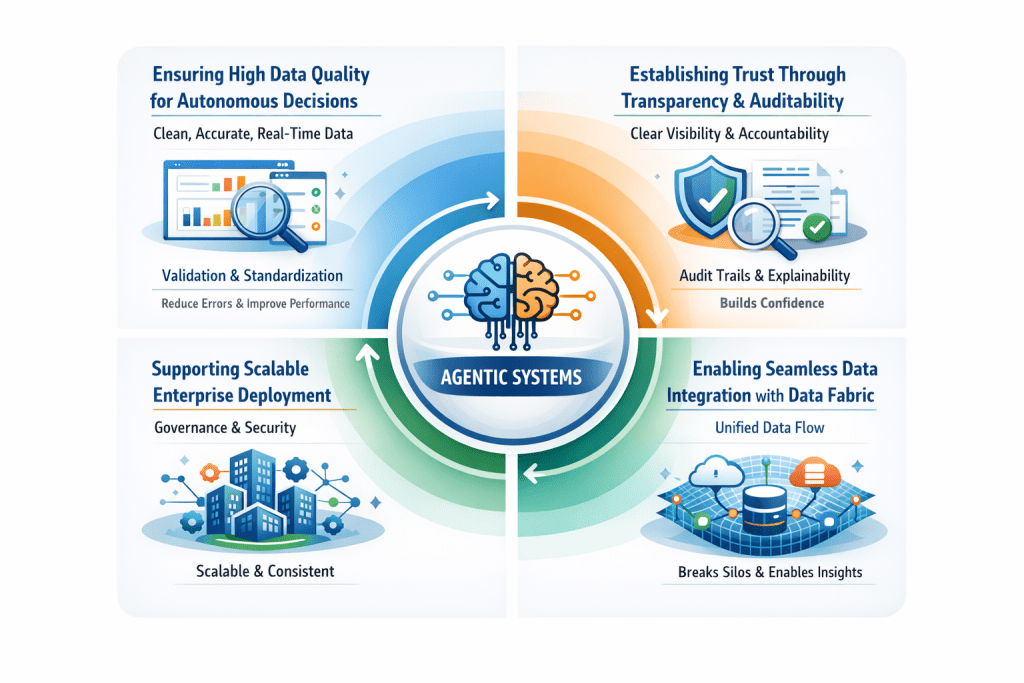
1. Ensuring High Agentic AI Data Quality for Autonomous Decisions
Agentic systems rely heavily on real-time data inputs. Poor data quality can directly impact decision accuracy and system performance with consequences that compound autonomously at machine speed. Implementing strong agentic AI data quality practices ensures that data is clean, validated, and standardized before it is consumed by AI agents.
This involves implementing key data quality practices such as:
- Data validation pipelines
- Schema enforcement
- Real-time anomaly detection
By maintaining high-quality datasets, organizations can significantly reduce the risk of erroneous insights and prevent autonomous systems from amplifying data errors into business-critical decisions.
2. Establishing Trust Through AI Data Lineage and Auditability
Trust is a fundamental requirement for enterprise AI adoption. Stakeholders including regulators, board members, and end users must understand how autonomous decisions are made, especially in regulated industries such as banking, insurance, and healthcare.
This is where AI data lineage and auditability become essential. A robust enterprise data governance framework provides full visibility into:
- Data origins and transformations
- Model inputs and outputs
- Decision-making workflows and agent actions
With clear lineage and audit trails, organizations can ensure regulatory compliance, improve accountability, and build trusted AI analytics systems that withstand internal and external scrutiny. Forrester notes that organizations with mature AI data lineage capabilities are 2.4x more likely to pass regulatory audits on first submission a critical advantage in financial services and healthcare environments.
3. Supporting Scalable Agentic AI Enterprise Deployment
Scaling agentic analytics across an enterprise requires consistency in data policies, access controls, and governance standards. A strong enterprise data governance strategy ensures that all AI systems operate within a unified framework regardless of business unit, geography, or cloud environment.
This enables:
- Secure data access across departments and platforms
- Standardised data definitions and metadata management
- Controlled data sharing across systems and partner ecosystems
Such consistency is critical for successful agentic AI enterprise deployment, especially in large, distributed organizations managing hundreds of concurrent AI agents across production environments.
4. Enabling Seamless Data Integration with Data Fabric for AI Analytics
Modern enterprises deal with highly fragmented data ecosystems spanning on-premises databases, cloud data warehouses, SaaS applications, and real-time streaming sources. To support agentic analytics, organizations must integrate data across these sources in real time without sacrificing governance or security.
A data fabric for AI analytics provides a unified architecture that connects disparate data systems, enabling seamless data access and orchestration for AI agents at scale.
When combined with governance, data fabric ensures:
- Consistent data policies across hybrid and multi-cloud environments
- Real-time data availability for AI agents making time-sensitive decisions
- Reduced data silos and improved interoperability across the enterprise
This creates a strong, resilient foundation for scalable and efficient agentic analytics workflows.
Real-World Use Case: Agentic Analytics Governance in Financial Services
A leading U.S. regional bank deploying agentic analytics across its credit risk, fraud detection, and customer personalisation functions partnered with Prolifics to implement a formal data governance for AI agents framework before scaling its autonomous AI programs.
Key outcomes delivered within 9 months:
- AI model error rates reduced by 41% – directly attributable to validated, schema-enforced data pipelines replacing ad hoc data feeds
- Regulatory audit preparation time cut by 58% – enabled by end-to-end AI data lineage covering 100% of agentic decision workflows
- Time-to-production for new AI agents reduced from 14 weeks to 5 weeks, achieved through standardised metadata management and reusable governance policies
- Data silo count reduced from 23 to 6 – through data fabric for AI analytics implementation connecting core banking, CRM, and real-time transaction systems
- Zero data compliance violations recorded in the 9 months following governance framework deployment versus 4 regulatory findings in the prior year
This deployment validated the direct relationship between enterprise data governance maturity and agentic AI enterprise deployment success in a high-stakes, regulated operating environment.
Core Elements of an Agentic Analytics Governance Framework
To fully support agentic systems, organizations should build governance around five foundational pillars:
- Data quality management frameworks – validation pipelines, schema enforcement, anomaly detection
- Metadata management and data cataloging – ensuring discoverability and consistency across AI data assets
- Role-based access control and data security – protecting sensitive data consumed by autonomous agents
- AI data lineage tracking and audit mechanisms – full visibility into agent decision pathways
- Compliance with regulatory standards and policies – GDPR, CCPA, HIPAA, and sector-specific AI regulations
Each of these components contributes to a resilient governance structure that enables reliable, trustworthy AI operations at enterprise scale.
The Business Impact of Strong Data Governance for Agentic AI
Organizations that invest in data governance for AI agents gain a measurable competitive advantage in deploying agentic analytics at scale. According to Gartner, governance-mature enterprises deploy AI initiatives 2.6x faster than peers and report significantly higher business stakeholder confidence in AI-driven recommendations.
The tangible business benefits include:
- Faster and more accurate autonomous decision-making
- Increased trust in trusted AI analytics systems across stakeholder groups
- Reduced operational and regulatory compliance risks
- Improved scalability of AI initiatives – from pilot to enterprise-wide deployment
Ultimately, strong governance transforms AI from an experimental capability into a strategic business asset one that compounds value as agentic systems learn and expand across the organization.
Conclusion: Data Governance Is the Backbone of Agentic Analytics
Agentic analytics represents the next evolution of enterprise AI offering unprecedented levels of autonomy, speed, and intelligence. However, its success depends entirely on the strength of the underlying data foundation.
By prioritizing agentic analytics data governance, organizations can ensure high agentic AI data quality, transparency, scalability, and trust. In doing so, they not only enable effective autonomous AI systems they position themselves for long-term competitive advantage in an increasingly data-driven world.
A well-defined enterprise data governance strategy is not just a support function. It is the backbone of reliable, scalable, and trusted AI analytics in the era of agentic intelligence. With Prolifics as your partner, that foundation is built right from day one.
Frequently Asked Questions
What is agentic analytics?
Agentic analytics refers to AI systems that autonomously analyse data, generate insights, and execute decisions with minimal human intervention across enterprise environments.
Why is data governance important for agentic AI?
Without data governance, agentic AI systems operate on incomplete or biased data – leading to flawed decisions, compliance risks, and unreliable business outcomes.
How does data quality impact agentic AI performance?
Poor data quality directly reduces decision accuracy in agentic systems. Validation pipelines, schema enforcement, and real-time anomaly detection are essential to maintain reliable AI outputs.
What is AI data lineage and why does it matter?
AI data lineage tracks the origin, transformation, and flow of data through AI systems – providing the auditability and transparency required for regulatory compliance and stakeholder trust.


