
Many organizations invest heavily in AI with the expectation that better models will automatically lead to better business outcomes. But in reality, even the most advanced AI systems can underperform when the data behind them lacks structure, consistency, and context.
That’s where integrated data semantics becomes critical.
AI models do not understand your business the way your teams do. They do not naturally know that “customer ID”, “client number”, and “account reference” may refer to the same thing across systems. They do not know whether one dataset uses “revenue” before discounts while another reports it after adjustments. Without semantic clarity, AI operates on fragmented interpretations of reality.
Integrated data semantics helps bridge that gap by aligning data across systems, departments, and platforms around shared business meaning. The result is not just cleaner data; it is more trustworthy AI, stronger model performance, and better ROI from every AI investment.
What is integrated data semantics?
Integrated data semantics is the practice of ensuring that data from different systems carries consistent meaning, relationships, and business context. It goes beyond traditional data integration. Instead of simply moving or combining data, semantic integration ensures that the data is also understood in the same way everywhere it is used.
For example:
- A “customer” in sales should mean the same thing in marketing, service, finance, and AI workflows.
- Product categories should follow the same logic across analytics and recommendation engines.
- Operational metrics should have a shared definition across dashboards, predictive models, and automation systems.
In simple terms, integrated data semantics helps organizations answer an essential question:
“Are all our systems, teams, and AI models speaking the same language?”
If the answer is no, AI performance usually suffers.
Why AI projects often fail to deliver expected ROI
A lot of AI underperformance is not caused by weak algorithms. It is caused by data inconsistency, disconnected systems, and poor contextual understanding.
Organizations often face issues such as:
- Duplicate or conflicting records create inconsistency across enterprise systems.
- Inconsistent business definitions lead to confusion and unreliable analytics.
- Missing metadata obscures context and weakens data relationships significantly.
- Data pipelines move records but often fail to preserve meaning.
- AI models learn from data that is correct, yet flawed.
This creates a hidden problem: models may appear functional, but they are learning from misaligned business truth. It leads to:
- Poor prediction quality leads to weaker business decisions and outcomes.
- Low trust in AI outputs slows adoption across teams.
- Slower deployment cycles delay value realization from AI investments.
- More time is spent cleaning and validating unreliable data.
- Reduced returns limit the impact of enterprise AI initiatives.
In other words, when semantics are weak, AI becomes expensive experimentation instead of measurable transformation.
How integrated data semantics improves AI model performance
Integrated semantics creates a stronger foundation for AI by helping models learn from data that is not only available, but also consistent, connected, and meaningful.
Here’s how that directly improves model performance:
1. It improves data quality at the source
AI models are only as good as the data they learn from.
When semantic integration is in place, organizations can standardize definitions, reconcile duplicates, and reduce ambiguity across datasets. This gives models cleaner and more reliable training data.
Why this matters:
If one system labels a customer as “active” after one purchase and another labels them “active” only after three purchases, your churn or retention model may learn the wrong behavior patterns.
Result:
- Better feature consistency ensures reliable inputs across all AI models.
- Less noise in training data improves accuracy and model learning.
- More stable model behavior delivers consistent and predictable outcomes.
This directly improves accuracy, precision, and confidence in outputs.
2. It gives AI business context, not just raw inputs
Most enterprise AI problems are not purely mathematical—they are contextual.
Integrated semantics helps models interpret data through the lens of real business relationships, such as:
- Which products belong to which category hierarchy?
- How customer interactions relate across channels?
- Which operational events influence service performance?
- How supply chain variables impact fulfillment outcomes?
This context allows AI to move beyond surface-level pattern recognition and become more aligned with actual business logic.
Result:
- Smarter recommendations help businesses deliver more personalized customer experiences.
- More relevant predictions improve planning, efficiency, and strategic outcomes.
- Better decision support enables faster, more confident business actions.
AI becomes more useful because it is grounded in how the business actually works.
3. It reduces feature engineering complexity
Feature engineering often becomes difficult when data from multiple systems is inconsistent or poorly documented.
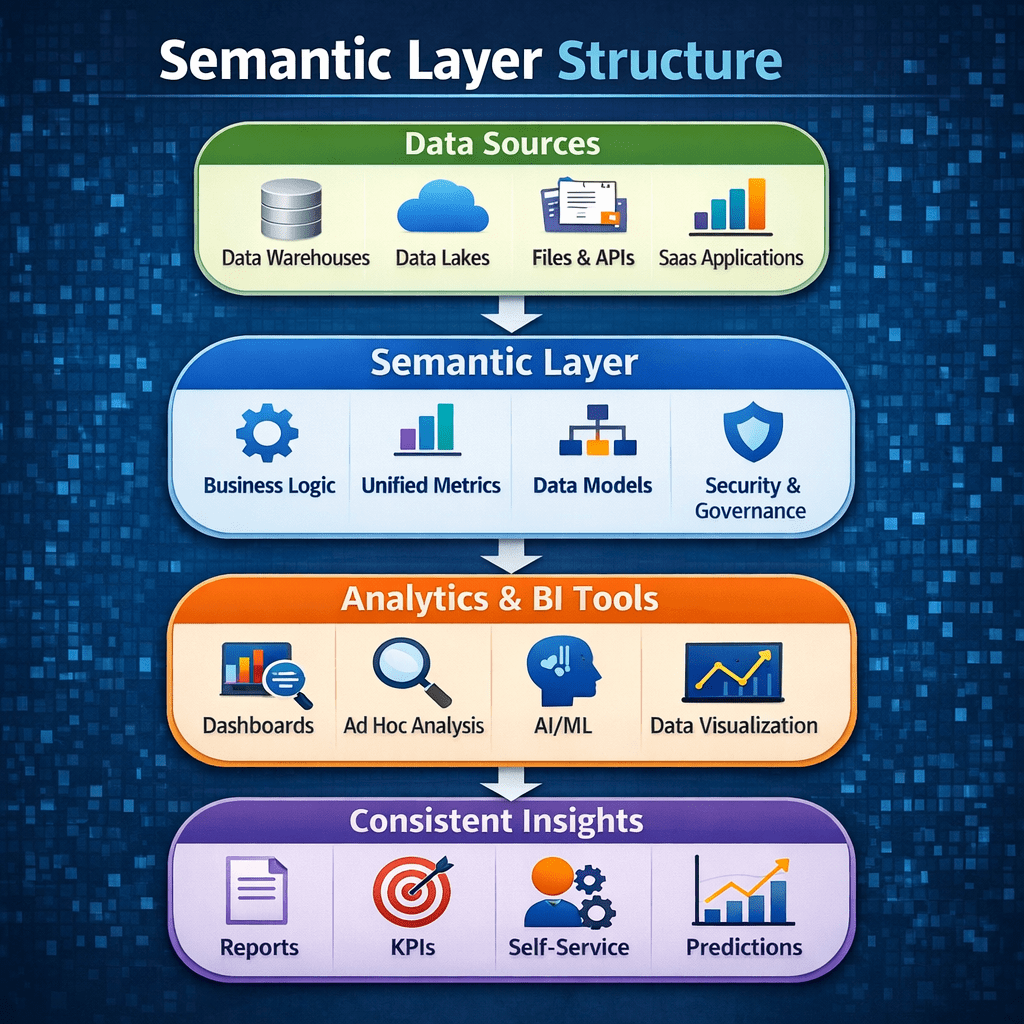
Semantic integration simplifies this by creating a common business layer across datasets. Instead of manually interpreting columns from every source system, data teams can work from clearly defined entities, relationships, and attributes.
Result:
- Faster model development accelerates AI initiatives and business value delivery.
- Less time spent preparing data improves overall productivity and efficiency.
- Easier collaboration strengthens alignment between business and technical teams.
This not only improves efficiency but also helps organizations scale AI faster across use cases.
4. It improves cross-system AI consistency
Many organizations deploy AI across multiple business functions—marketing, operations, customer service, finance, and supply chain.
But when each team uses differently defined data, the same customer, product, or KPI can be interpreted in conflicting ways. This creates inconsistent outputs across models and platforms.
Integrated data semantics ensures that AI systems are trained and deployed using a shared business understanding.
Result:
- More consistent outputs improve reliability across departments and business functions.
- Better alignment connects dashboards, analytics, and AI with clarity.
- Reduced confusion supports faster, smarter, and more confident decisions.
That consistency is essential for building trust in enterprise AI.
5. It supports explainability and governance
As AI adoption grows, organizations need to understand why a model made a decision, not just what the output was.
Semantic integration improves explainability by making the lineage, meaning, and relationships of data easier to trace.
For example, if a model predicts a drop in demand, semantic frameworks can help answer:
- Which business variables influenced the prediction?
- How were those metrics defined?
- Did the source data come from sales, supply chain, or market signals?
Result:
- Better AI transparency improves understanding of model-driven business decisions.
- Easier compliance and governance reduce risk across AI initiatives.
- Stronger stakeholder trust increases confidence in AI-led outcomes.
This becomes especially important in regulated industries or high-impact decision environments.
How Integrated Data Semantics Improves AI ROI
Better model performance is valuable—but businesses ultimately care about measurable returns. Integrated data semantics improves AI ROI by helping organizations generate value faster, with less rework, lower costs, and reduced operational friction across the AI lifecycle.
Here’s where the ROI becomes visible:
1. Faster Time to Value
When data is semantically aligned, AI teams spend less time fixing definitions, reconciling systems, and validating inconsistencies.
That allows teams to focus more on experimentation, deployment, and business impact. This leads to:
- Faster experimentation improves learning cycles and accelerates innovation.
- Faster model deployment shortens the path from concept to value.
- Faster business adoption increases enterprise-wide use of AI solutions.
- Organizations can move from pilot to production more efficiently and with fewer delays.
2. Lower Operational Costs
Poor data semantics often creates expensive downstream work that slows teams and reduces efficiency. Teams frequently spend time and resources on avoidable tasks such as:
- Manual data cleanup consumes time and increases operational inefficiency.
- Rebuilding features repeatedly slows development and wastes technical effort.
- Rechecking reports delays insights and reduces confidence in analytics.
- Explaining inconsistent AI outputs creates confusion across business teams.
- Retraining models repeatedly increases cost and reduces AI scalability.
- Integrated semantics helps reduce this hidden cost by improving data reliability and reuse.
ROI impact:
- Less engineering rework improves efficiency and speeds AI delivery.
- Lower maintenance overhead reduces long-term costs of AI operations.
- More scalable AI operations support sustainable enterprise-wide growth.
3. Better Adoption and Business Trust
A technically strong model still fails if business users do not trust the output. When AI outputs are based on consistent definitions and understandable business logic, teams are more likely to rely on them in daily decisions. That matters because AI only creates value when people actually use it.
ROI impact:
- Higher stakeholder confidence increases trust in AI-driven business outcomes.
- Better decision support enables faster, smarter, and informed actions.
- Greater enterprise-wide AI adoption expands impact across business functions.
4. More Reusable AI Assets
Many organizations build AI solutions that solve one problem but are difficult to reuse across departments or future initiatives. Integrated semantics creates a reusable foundation that supports multiple AI use cases without rebuilding from scratch.
This foundation can support use cases such as:
- Customer segmentation improves targeting and enhances personalized engagement strategies.
- Demand forecasting strengthens planning and reduces supply chain uncertainty.
- Predictive maintenance helps prevent downtime and improve asset reliability.
- Fraud detection identifies suspicious activity and reduces financial risk.
- Personalization improves customer experiences through more relevant interactions.
- Supply chain optimization increases efficiency and improves fulfillment performance.
ROI impact:
- More reuse across teams increases efficiency and reduces duplication.
- Lower cost per initiative improves long-term AI investment efficiency.
- Higher return from data investments strengthens overall business value.
Real-world example: why semantics matters in AI outcomes
Imagine a manufacturer using AI to predict equipment downtime across multiple plants.
At first glance, the organization appears to have all the right ingredients: machine data, maintenance logs, sensor readings, and historical performance records. But when that data is not semantically aligned, the AI model is forced to learn from fragmented operational meaning instead of a unified business reality.
Without semantic alignment:
- One facility logs machine status as “inactive.”
- Another records the same condition as “offline.”
- A third tracks maintenance interruptions in a separate system.
- Sensor and maintenance data lack shared definitions and relationships.
The model may still function, but the outputs are far less reliable. Instead of learning from consistent operational signals, the AI is exposed to disconnected interpretations of the same events.
As a result, predictions may become inconsistent, incomplete, or misleading.
Key components of a strong semantic foundation for AI
Organizations looking to improve AI ROI through data semantics should focus on a few foundational capabilities:
1. Common business definitions
Ensure that key entities like customers, products, orders, assets, and KPIs are defined consistently across systems.
2. Metadata and lineage
Track where data comes from, how it is transformed, and what it means.
3. Master data alignment
Reduce duplication and create trusted reference points for critical business entities.
4. Semantic modeling
Build relationships between datasets in a way that reflects real business operations.
5. Cross-functional governance
Bring business and technical teams together to define and maintain semantic consistency over time.
This is not just a data engineering exercise. It is a strategic capability for enterprise AI.
Why this matters even more in the era of generative AI
With the rise of generative AI, semantic integration has become even more important. Large language models and enterprise copilots are only as useful as the data and context they can access. If enterprise knowledge is fragmented, mislabeled, or inconsistently structured, even advanced generative AI tools can produce irrelevant or unreliable outputs.
Integrated semantics helps generative AI by enabling:
- More accurate enterprise search improves discovery across connected business knowledge.
- Better retrieval-augmented generation strengthens relevance and response quality significantly.
- More trustworthy AI assistants improve confidence in enterprise interactions.
- Stronger context-aware responses deliver more meaningful and useful outputs.
- Reduced hallucination risk improves reliability in business-critical AI use cases.
As AI becomes more embedded into enterprise workflows, semantic clarity will increasingly determine whether those systems create value or confusion.
Conclusion
Integrated data semantics ensures that AI systems operate on consistent, meaningful, and connected data rather than fragmented or conflicting inputs, allowing models to better understand business context and deliver more accurate outcomes. This alignment improves model performance, accelerates deployment timelines, and builds stronger trust among business users.
It also reduces operational inefficiencies by minimizing data rework and lowering the overall cost of AI initiatives. Ultimately, by creating a reliable and reusable data foundation, integrated semantics enables organizations to scale AI effectively across use cases, turning AI from isolated experimentation into a true driver of measurable business value.
Frequently Asked Questions
1. What is integrated data semantics in AI?
Integrated data semantics ensures that data across systems has consistent meaning, relationships, and business context, allowing AI models to interpret and use data accurately.
2. Why do AI projects fail to deliver expected ROI?
Many AI initiatives fail due to inconsistent data definitions, lack of context, and disconnected systems, which lead to unreliable insights and low business trust.
3. How does Prolifics help improve AI ROI through data semantics?
Prolifics helps organizations align data definitions, implement semantic modeling, and establish governance frameworks to ensure AI systems operate on accurate, business-aligned data.
4. How can businesses get started with semantic data integration?
Prolifics recommends starting with defining common business entities, improving metadata and lineage tracking, and aligning master data across systems to create a strong foundation for AI.
5. How does integrated data semantics support generative AI use cases?
It enhances enterprise search, improves retrieval-augmented generation, and reduces hallucinations by ensuring AI systems access consistent and well-structured business knowledge.


