Orlando, United States – February 4, 2026 – Prolifics has been named a 2025 Liferay Rising Star of the Year, recognizing emerging partners who have demonstrated rapid growth, strong collaboration, and outstanding customer delivery within the Liferay ecosystem. The award was presented on February 3, 2026, during Liferay’s Sales Kickoff in Vienna, Austria.
The Rising Star of the Year Award honors partners who joined the Liferay ecosystem in recent years and quickly distinguished themselves through exceptional sales performance, marketing execution, and customer success.
“This recognition reflects our team’s relentless focus on delivering meaningful digital experiences that drive real business outcomes for our clients,” said Satya Bolli, Chairman & MD, Prolifics. “Our partnership with Liferay has enabled us to accelerate innovation, deepen customer engagement, and scale impactful solutions across industries. We’re honored to be recognized as a Rising Star and look forward to continued collaboration.”
Award recipients were selected through a rigorous evaluation process that assessed their positive impact on business results, market expansion, and demonstrated commitment to marketing and sales initiatives for Liferay solutions.
“At Liferay, partners are woven into the fabric of our core operations, representing more than just a route to market,” said Fernando Areias, Chief Operating Officer at Liferay. “These awards are a testament to the remarkable results our partners have delivered and their unwavering commitment to our shared future. Partners continue to remain our focus as we evolve into an Integrated Model that removes organizational barriers, embeds partner success into every business function and drives us toward 100% partner involvement in all customer engagements.”
Liferay’s partner ecosystem plays a critical role in helping organizations deliver modern digital experiences at scale. Through close collaboration with its partners, Liferay continues to support customer success across industries and regions worldwide.
About Prolifics
Prolifics is a global digital transformation company delivering innovative technology solutions that help organizations modernize, integrate, and optimize their digital ecosystems. With deep expertise across digital experience platforms, cloud, data, automation, and AI, Prolifics partners with enterprises to accelerate growth, enhance customer engagement, and achieve measurable business outcomes.
About Liferay
Liferay helps organizations build for the future by enabling them to create, manage, and scale powerful solutions on the world’s most-flexible Digital Experience Platform (DXP). Trusted globally by over a thousand companies spanning multiple industries, Liferay’s open-source DXP facilitates the development of marketing and commerce websites, customer portals, intranets, and more. Learn how we can use technology to change the world together at liferay.
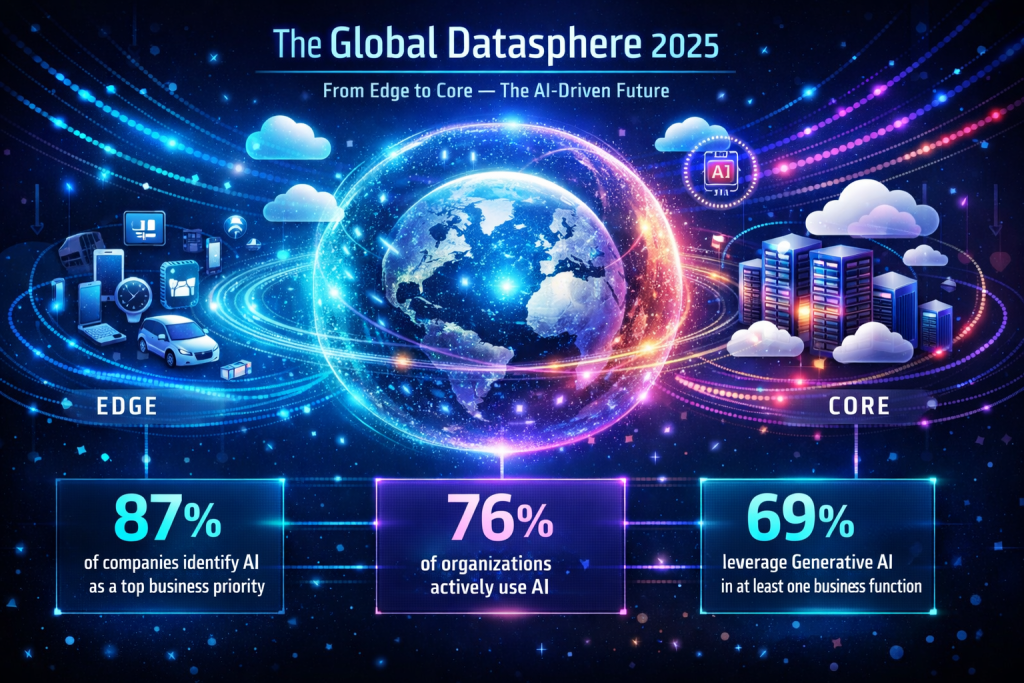
AI transformation is now a top priority for IT MNCs because it boosts productivity, strengthens customer experience, and improves business decision-making. Enterprises are applying AI in real operations such as support automation, predictive maintenance, intelligent analytics, software delivery, and cybersecurity.
As AI scales across departments, clouds, and applications, security becomes a critical requirement. Integrated AI security helps protect sensitive data, APIs, and automated workflows. It reduces fragmented controls, improves governance and compliance, and enables trusted enterprise AI adoption. For organizations pursuing secure AI transformation, security integration is no longer optional.
What Is Integrated AI Security?
Integrated AI security is a unified security approach that covers the entire AI and digital estate, ensuring AI systems are protected with consistent governance, monitoring, and enforcement mechanisms. This approach forms the foundation of enterprise AI security, aligning protection with business scale.
It combines security controls across:
Identity and access management.
Data classification, loss prevention, and encryption.
Cloud workload protection and configuration governance.
Endpoint security and threat intelligence.
Centralized detection, investigation, and response workflows.
In simple terms, Integrated AI security ensures that AI systems are protected under the same strategic security umbrella as the rest of the enterprise, instead of being treated like an isolated innovation layer.
Why AI Transformation Changes Security Requirements?
AI transformation is different from traditional modernization initiatives. While cloud adoption or DevOps mainly focused on infrastructure and delivery pipelines, AI introduces new technical risks because the system behavior can be dynamic and data driven.
In enterprise environments, AI workloads depend on:
Continuous ingestion of business data (structured and unstructured)
This makes AI a prime target for threat actors and significantly raises the operational and financial risk of failures related to AI risk management. These realities explain why integrated security is critical for AI transformation at scale.
Below the chart demonstrates why integrated security is critical to successful AI transformation:
The Shifts Every IT Leader Must Address
AI adoption introduces security challenges that go beyond traditional infrastructure protection. IT leaders must understand these major shifts:
AI expands the attack surface beyond systems and networks into data pipelines, model behavior, and automated decision-making workflows.
AI pipelines create new risk points, including training datasets, prompt inputs, and inference outputs, which may expose sensitive information.
Many AI services operate in multi-cloud and hybrid environments, increasing governance effort and the chance of configuration gaps.
AI initiatives move at high speed, where rapid experimentation can bypass standard security reviews if controls are not embedded early.
These realities make it essential to build an enterprise-wide AI security framework that is integrated, consistent, and scalable, rather than relying on disconnected security control.
Security Challenges in AI Transformation Initiatives
Even mature enterprises face challenges when AI initiatives move from pilots to production-scale adoption. As AI becomes embedded into core systems and daily operations, security risks and governance gaps often surface quickly. These are common security challenges in AI transformation initiatives.
Where AI Transformation Introduces New Security Risk?
Tool sprawl and fragmented controls: Teams adopt different platforms across cloud and security, leading to duplicated policies and inconsistent enforcement.
Expanded identity risk: AI services often rely on automated accounts, APIs, and service principals that require strict access to governance.
Data exposure risk: AI workflows can unintentionally expose sensitive data through model training, prompts, outputs, or logs.
Cloud governance complexity: Multi-subscription and multi-cloud environments create configuration drift and inconsistent enforcement.
These issues highlight a major truth: AI risk management must be integrated into enterprise security design through strong AI governance and security, not handled separately.
How Integrated Security Enables Enterprise AI Adoption?
A common concern in IT MNCs is whether security will slow AI projects. In reality, how integrated security enables enterprise AI adoption is by reducing friction, improving governance clarity, and supporting continuous control across systems.
Business benefits of integrated security for AI transformation
Reduced transformation risk by establishing a consistent AI security baseline
Faster scaling of AI pilots into production workloads due to clear governance guardrails
Improved trust among customers and stakeholders because AI usage becomes auditable and compliant
Lower operational cost by reducing duplicate tools and manual processes
Simpler SOC operations through unified incident visibility and response
Organizations that achieve Integrated AI security can scale enterprise AI more confidently because security becomes a growth enabler, not a blocker.
Building an AI Security Framework for Enterprise Environments
An effective AI security framework must secure AI end-to-end, starting from access to data and continuing through deployment, monitoring, and governance.
A practical enterprise-ready framework includes:
1) Identity-first security (Zero Trust)
Multi-factor authentication and conditional access enforcement
Least privilege access policies for AI resources and service accounts
Role-based governance for AI project teams and operators
2) Data governance integrated into AI workflows
Data classification, labeling, and access control for training datasets
DLP enforcement to reduce sensitive data leakage
Encryption and secure data pipelines across AI workloads
3) Secure AI infrastructure and cloud configuration
Cloud security posture management to prevent misconfiguration
Workload protection for containers, VMs, and managed AI services
Continuous vulnerability monitoring for AI infrastructure
4) SOC-level integration for end-to-end AI security
Centralized telemetry for identity, endpoint, cloud, and data security
Automated incident correlation and prioritization
Faster triage and reduced mean time to resolution
5) Continuous governance and responsible AI security
AI governance policies aligned with enterprise risk goals
Monitoring for model misuse patterns and abnormal AI activity
Strong reporting for compliance and audit purposes
This integrated framework strengthens Responsible AI security, while enabling rapid adoption without compromising control.
Conclusion
AI transformation is reshaping how IT MNCs operate, innovate, and compete. However, AI adoption introduces new security challenges across identity, data, cloud infrastructure, and automated workflows. That is why integrated security is no longer optional. It is the foundation for sustainable enterprise AI adoption.
Integrated AI security provides unified visibility, consistent governance, and faster incident response across the full AI lifecycle. It also supports enterprise compliance readiness and builds stakeholder trust through auditable AI practices.
Organizations that adopt an end-to-end AI security approach can scale AI initiatives confidently while reducing operational complexity and security risk. Ultimately, integrated security enables secure AI transformation by turning protection, governance, and risk management into strategic enablers of innovation.
Salesforce has taken a major step forward in helping enterprises tame the rapidly expanding world of AI agents with new enhancements to its MuleSoft Agent Fabric platform. As organizations accelerate AI adoption, autonomous agents are being deployed across clouds, business units, and development teams at an unprecedented pace making Salesforce AI agent governance and enterprise AI agent visibility critical priorities.
Tackling Agent Sprawl With Automated Discovery
To address this complexity, Salesforce has introduced automated agent discovery, supported by new Agent Scanners built directly into MuleSoft Agent Fabric. These scanners dramatically simplify how enterprises find, catalog, and govern AI agents, delivering a single, unified control plane that strengthens MuleSoft AI agent management while providing end-to-end visibility across the entire agent ecosystem.
Rather than relying on fragmented inventories or manual processes, organizations can now gain an always-on view of their AI landscape, regardless of where agents are deployed demonstrating how Salesforce governs AI agents across clouds.
The Rise of Distributed AI, and the Risks It Brings
Modern enterprises increasingly rely on distributed AI capabilities, including:
Internal forecasting and analytics agents running on Google Cloud Vertex AI
Customer service assistants built with Salesforce Agentforce
Custom, domain-specific agents deployed in private or hybrid environments
While this distributed approach accelerates innovation, it also creates blind spots for security, compliance, and AI operations teams. Without a centralized system of record, organizations struggle to track what agents exist, what data they access, and how they interact with core systems.
Automated Agent Discovery eliminates these gaps by transforming a fragmented agent environment into a cohesive, governed agent network, without the overhead of manual detection and inventory management.
As agents are detected, the scanners automatically:
Identify active AI agents and tools
Extract deep operational and technical metadata
Register agents in the centralized MuleSoft Agent Registry
The Agent Registry becomes the authoritative catalog of all AI assets, enabling real-time tracking of agent capabilities, data permissions, ownership, and deployment context.
From Spreadsheets to Strategic Visibility
With MuleSoft Agent Fabric, IT and AI operations teams no longer depend on spreadsheets or ad-hoc tracking methods. Instead, they gain immediate insight into:
Which agents are running and where
What each agent is designed to do
How agents connect to workflows and enterprise systems
By normalizing metadata through standard protocols, MuleSoft also ensures that agents built on different platforms can interoperate more easily making governance simpler and more consistent across the enterprise.
Visualizing the Enterprise AI Footprint
Beyond discovery, MuleSoft’s Agent Visualizer provides a visual map of an organization’s AI ecosystem. Advanced filtering and search capabilities allow teams to segment agents by platform, function, or location, enabling side-by-side comparisons, such as agents running on Amazon Bedrock versus Vertex AI.
This visibility supports not only governance, but also cost optimization, architecture planning, and workload consolidation.
Industry Momentum and Market Impact
Early adopters report improved cross-team collaboration, reduced redundancy, and stronger operational control. With enterprises projected to deploy over one billion AI agents globally by 2029, Salesforce’s enhancements arrive at a critical moment.
As AI workflows become core enterprise infrastructure, MuleSoft Agent Fabric is emerging as the backbone for trusted, scalable, and governed AI operations, positioning Salesforce at the center of the agentic enterprise and reinforcing long-term MuleSoft AI agent management strategies.
Artificial intelligence is now a pivotal force driving innovation, efficiency, and competitive advantage across industries. Yet for many organizations, realizing the full power of AI as a Service (AIaaS) remains a challenge. High infrastructure costs, talent gaps, and lengthy development cycles can all slow progress. That’s where AI as a Service solutions come in, a game-changing paradigm that democratizes access to AI and unlocks transformation at scale.
And when it comes to harnessing AIaaS for enterprises for real business value, Prolifics stands out as a trusted, strategic partner with the expertise and global delivery capability to turn AI potential into measurable ROI.
What is AI as a Service (AIaaS)?
At its core, AI as a Service (AIaaS) offers cloud-based access to powerful AI tools and capabilities, including machine learning, natural language processing, predictive analytics, and more, without the need for organizations to build, host, maintain, or invest in their own AI infrastructure.
Think of AIaaS as the AI equivalent of SaaS (Software as a Service), a subscription or consumption-based model where companies can tap into advanced AI models and cloud AI services via cloud platforms. This delivers immense agility, scalability, and cost-efficiency, enabling organizations of all sizes to innovate faster and smarter.
Rather than shouldering massive upfront investments in servers, GPUs, data scientists, and development cycles, businesses can begin experimenting with AI quickly, accelerating time-to-value and minimizing risk one of the key benefits of AI as a Service for businesses.
Why AIaaS Is a Business Game Changer
AIaaS transforms how organisations approach digital transformation by lowering adoption barriers and enabling AI innovation across business functions. Here’s how:
1. Rapid Deployment and Time-to-Value
With pre-built AI models and APIs readily available through enterprise AI solutions, teams can launch AI-enabled solutions in weeks, not months or years. This accelerates experimentation, adoption, and delivery of business outcomes.
2. Scalable, Cost-Effective Access
AIaaS eliminates the need to invest heavily in infrastructure upfront. Instead, companies pay based on usage or subscription, giving them the flexibility to scale services up or down as needs evolve using scalable AI infrastructure.
3. Democratized AI for All
By simplifying complexity and handling computationally intensive tasks behind the scenes, AI as a Service solutions enable organisations, large and small, to leverage advanced AI capabilities without requiring deep in-house expertise.
4. Agility Across Use Cases
From customer service chatbots and workflow automation to predictive analytics and intelligent insights, cloud AI services support a wide range of use cases that boost productivity, drive innovation, and enhance user experiences showcasing how AIaaS accelerates digital transformation.
AIaaS Real-World Impact: Examples Across Industries
AIaaS has proven its value across sectors by leveraging machine learning cloud platforms:
Retail & eCommerce: Personalization engines use AIaaS to tailor offers and recommendations, driving higher conversion rates.
Healthcare: Predictive analytics processed via AIaaS for enterprises help identify disease risk patterns and improve patient care.
Financial Services: Fraud detection models leverage AI-powered insights delivered via cloud APIs to protect customers and assets.
Manufacturing: Computer vision services monitor product quality and reduce defects in real time.
These AI-driven capabilities are unlocking measurable value, reducing operational costs, streamlining processes, and reshaping customer engagement.
Prolifics + AIaaS: A Partnership Built for Your Success
While AI as a Service (AIaaS) opens the door to limitless possibilities, realizing its full potential requires the right expertise, strategy, and execution. Enter Prolifics, a global digital transformation leader with deep AI and AI consulting services experience.
Prolifics empowers organizations with end-to-end enterprise AI solutions that extend and elevate AIaaS adoption, helping businesses not only leverage AI tools but also integrate them into their operations for sustained competitive advantage as an AI as a Service implementation partner.
Strategic AI & Digital Transformation Consulting
Prolifics begins with understanding your unique business goals and challenges. Through comprehensive assessments and tailored AI roadmaps, our AI consulting services help prioritize what matters most, aligning AI initiatives with measurable value.
Fast, Iterative Innovation with Measurable Value
Using a proven phased delivery model, Prolifics helps organizations move rapidly from idea to impact maximizing the value of AIaaS for enterprises without long-drawn pilot cycles.
Custom AI Solutions Built for Your Needs
Prolifics combines the flexibility of AI as a Service solutions with tailored AI models and automation to deliver business-specific outcomes across industries.
The Outcome: AI That Works for You
By pairing the flexibility of AI as a Service (AIaaS) with Prolifics’ strategic guidance and delivery excellence, organizations achieve:
Faster time-to-insight and operational efficiency
Lower costs with scalable AI solutions
Enhanced customer experiences powered by intelligent automation
AI built on a foundation of solid data and strategic intent
Conclusion
A New Era of AI Accessibility and Impact
AI as a Service (AIaaS) is rewriting the rules of innovation. By making advanced AI accessible and affordable, AIaaS empowers organizations to innovate at scale, transform operations, and deliver richer experiences for customers and employees alike.
However, realizing AI’s full potential, and ensuring those solutions align with business objectives requires more than technology alone. It requires a partner with strategic vision, deep expertise, and proven delivery capabilities.
That partner is Prolifics.
Whether you’re exploring AIaaS for the first time or accelerating AI initiatives across the enterprise, Prolifics guides you every step of the way, turning AI ambition into tangible success.
Ready to unlock AI’s full potential? Let’s start the journey together.
Artificial intelligence in healthcare is no longer experimental. From intake automation to revenue cycle workflows, AI is already embedded across healthcare systems. The real question leaders are asking now is not whether AI can help, but how safe AI is in healthcare when it begins to act autonomously.
Autonomous AI in healthcare introduces a new level of responsibility. When systems move beyond recommendations and begin taking action, safety, compliance, and governance become non-negotiable. The good news is that autonomous AI can be deployed safely when it is applied to the right workflows, with the right guardrails, and under the right governance model.
What autonomous AI in healthcare really means
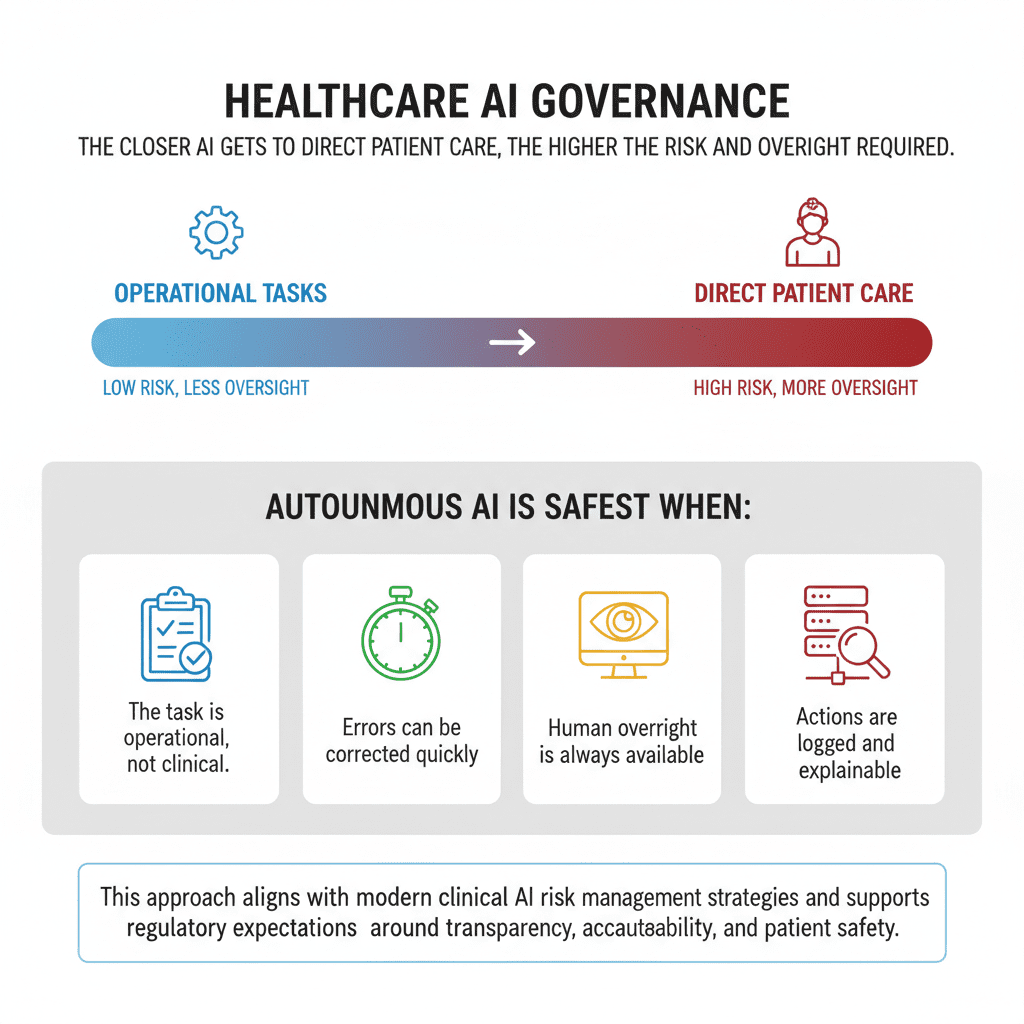
Autonomous AI in healthcare does not mean AI making clinical decisions independently. In safe and responsible deployments, autonomy is limited to operational execution, not medical judgement.
Autonomous AI healthcare operations typically involve systems that can:
Execute predefined operational tasks
Follow strict rules and thresholds
Escalate exceptions to humans
Maintain full auditability
This distinction is central to AI safety in healthcare. The safest use cases focus on workflows that are repetitive, low-risk, measurable, and reversible.
The safety principle: Operations first, clinical decisions last
In healthcare, the value of AI depends on how intentionally it is applied. Systems that influence clinical decisions require far greater governance than those supporting operational efficiency. That distinction is critical for maintaining trust, meeting regulatory expectations, and protecting patient outcomes.
Successful healthcare AI strategies start by placing autonomy where risk is lowest, then layering in oversight, traceability, and accountability as AI moves closer to clinical impact.
Autonomous AI delivers the greatest value and lowest risk when it is applied thoughtfully, with clear guardrails and continuous human oversight.
Where autonomous AI is safe in healthcare operations
These workflows are operational in nature, and mistakes are typically reversible, making them ideal for early autonomy.
2. Document intake and classification
Healthcare organisations process massive volumes of documents daily. Autonomous AI can safely:
Classify incoming documents
Extract structured data
Route documents to the correct work queues
Flag missing or inconsistent information
When combined with HIPAA-compliant AI systems, this reduces manual effort while maintaining compliance and traceability.
3. Prior authorisation preparation and tracking
Autonomous AI safety and compliance in healthcare are strongest when AI supports, rather than decides, prior authorisation workflows. Safe use cases include:
Assembling required documentation
Monitoring payer status updates
Flagging denials or missing data
Drafting appeal documentation for review
Decision authority remains with humans, while AI handles the operational workload.
4. Revenue cycle and billing operations
Autonomous AI healthcare operations can improve billing efficiency by:
Identifying claim errors before submission
Routing claims to correction workflows
Triggering follow-up tasks
Supporting patient billing inquiries
These workflows are governed by rules and metrics, making them strong candidates for controlled autonomy.
5. Call centre routing and non-clinical patient support
AI safety in healthcare is maintained when autonomous systems:
Identify call intent
Route patients to the correct department
Provide non-clinical responses
Escalate clinical questions immediately
This improves response times without introducing clinical risk.
6. Supply chain and non-clinical inventory management
Autonomous AI is safe for managing non-clinical supply chain workflows such as:
Inventory monitoring
Reorder threshold alerts
Logistics coordination
Exception detection
These actions are governed by clear parameters and do not impact patient care directly.
7. Compliance monitoring and audit support
Autonomous AI can support healthcare AI governance by:
Monitoring workflow adherence
Flagging documentation gaps
Creating audit-ready summaries
Tracking compliance milestones
This strengthens oversight without replacing accountability.
The role of human-in-the-loop AI
Even in the safest workflows, human-in-the-loop AI is essential. Humans must be able to:
Review and override decisions
Pause or stop automation
Investigate anomalies
Adjust rules and thresholds
Human oversight is not a limitation; it is the foundation of safe autonomous AI in healthcare.
Where autonomous AI should not operate independently
Despite rapid advancements, autonomous AI should not independently handle:
Diagnosis or treatment decisions
Medication changes
Clinical triage
Patient risk scoring without review
These areas require heightened clinical AI risk management and often fall under stricter regulatory oversight.
Building autonomous AI safety and compliance in healthcare
To deploy autonomous AI responsibly, healthcare organisations should focus on:
Clear healthcare AI governance models
Defined accountability and ownership
Continuous monitoring and validation
Lifecycle risk management
Secure, HIPAA compliant AI systems
Autonomy should expand only after performance, safety, and compliance have been proven over time.
Conclusion: Safe autonomy is earned, not assumed
So, how safe is AI in healthcare when it becomes autonomous? The answer depends on where and how it is applied.
The safe use of autonomous AI in healthcare workflows starts with operational processes, strong governance, and continuous human oversight. When healthcare organisations respect these boundaries, autonomous AI in healthcare operations can deliver real efficiency gains without compromising safety or trust.
Autonomous AI does not replace humans. It supports them when implemented thoughtfully, transparently, and responsibly.
Why modern enterprises are turning to Data Quality eXtended (DQX) frameworks, and how Prolifics helps make them real.
Databricks data quality framework is essential for today’s data-driven enterprises, where analytics and AI initiatives are only as strong as the data that powers them. Inconsistent, incomplete, or inaccurate data can derail dashboards, undermine machine learning models, and erode trust across the business. As organizations scale cloud data platforms like Databricks, the need for automated, repeatable, and extensible data quality controls becomes mission-critical.
Addressing this challenge head-on, Databricks introduced DQX (Data Quality eXtended), a modern data quality framework designed to embed quality checks directly into data pipelines. As highlighted in Hexaware’s recent blog, DQX provides a scalable and unified approach to managing data quality across batch and streaming workloads, aligning seamlessly with the Lakehouse architecture.
What Is Databricks DQX?
Databricks DQX is an extensible data quality framework that enables data teams to profile, validate, and monitor data continuously as it moves through the pipeline. Rather than treating data quality as a downstream or manual process, DQX integrates quality rules and controls directly into ingestion, transformation, and consumption layers.
This approach ensures that data issues are detected early, handled consistently, and governed transparently supporting both operational analytics and AI-ready datasets.
How the DQX Framework Works
DQX spans the full lifecycle of data pipelines, focusing on three core stages:
Data Profiling DQX helps teams understand their data by automatically analyzing distributions, patterns, null values, and anomalies. Profiling provides a baseline for defining meaningful data quality rules.
Data Validation Using rule-based checks, DQX enforces expectations such as schema conformity, range checks, uniqueness, and completeness. These rules can be applied consistently across batch and streaming pipelines.
Data Monitoring DQX continuously monitors data quality metrics over time, making it easier to detect drifts, recurring issues, or SLA breaches before they impact downstream consumers.
Key Capabilities of Databricks DQX
The DQX framework stands out for its flexibility and enterprise readiness:
Support for both batch and real-time streaming pipelines
Rule enforcement with configurable thresholds and expectations
Reaction strategies, such as quarantining bad records, logging failures, or stopping pipelines
Native alignment with Databricks Lakehouse, Delta tables, and Spark-based processing
Extensibility to meet domain-specific and regulatory data quality requirements
Business Value: From Data Trust to Better AI Outcomes
By embedding data quality into pipelines, organizations gain measurable business benefits:
Increased trust in analytics and dashboards
Reduced operational risk and rework caused by poor data
Faster root-cause analysis of data issues
Stronger foundations for AI, ML, and advanced analytics, where data quality directly impacts model accuracy
As one Prolifics data leader puts it:
“Data quality isn’t a checkpoint, it’s a capability. Frameworks like DQX allow our clients to operationalize trust at scale, not just detect problems after the fact.”
How Prolifics Enables DQX at Enterprise Scale
Prolifics helps organizations design, implement, and operationalize Databricks DQX as part of broader data modernization, analytics, and AI initiatives. From defining data quality strategies and governance models to embedding DQX into CI/CD-enabled pipelines, Prolifics ensures data quality becomes a sustainable capability, not a one-time fix.
By integrating DQX with enterprise data platforms, governance frameworks, and AI use cases, Prolifics enables clients to move confidently from raw data to trusted insights.
Unlocking Trusted Data for Analytics and AI
As enterprises invest heavily in analytics and AI, frameworks like Databricks DQX are becoming essential building blocks. With the right implementation partner, data quality transforms from a persistent challenge into a strategic advantage.
At Prolifics, we help clients unlock the full value of their data by ensuring it is trusted, governed, and ready for analytics and AI, at scale.
As hybrid and multi-cloud architectures become foundational to enterprise IT – enabling seamless integration between on-premises infrastructure and public and private clouds organisations increasingly rely on AIOps for IT operations to maintain control and resilience. While this architecture drives agility and scale, it also introduces operational complexity that traditional monitoring can no longer manage.
The scale of this challenge is significant. According to Gartner, by 2026, 40% of large enterprises will combine AIOps with observability practices to achieve autonomous IT operations up from less than 10% in 2023. Forrester Research further reports that organisations deploying enterprise-grade AIOps platforms reduce mean time to resolution (MTTR) by an average of 60% and cut alert noise by up to 85% within the first 12 months of deployment. For IT leaders managing increasingly distributed digital estates, these are not incremental gains – they are operational imperatives.
AIOps (Artificial Intelligence for IT Operations) addresses the complexity challenge by applying AI and machine learning to deliver intelligent observability, predictive insights, and automated remediation across complex environments. Integrated with DevOps AI tools, ArgoCD-driven CI/CD pipelines, log monitoring platforms, and frameworks such as MLOps, LLMOps, DataOps, FinOps, and SRE, an AIOps platform strengthens DevSecOps by embedding security into workflows enabling AI-powered IT operations that scale across modern digital ecosystems.
What Is AIOps and Why It Matters in 2026
AIOps for IT operations applies advanced analytics, machine learning (ML), and automation to operational data including logs, metrics, traces, events, and tickets. Instead of relying on siloed tools and manual investigation, AIOps leverages an enterprise-grade AIOps platform to ingest data across the IT estate and automatically correlate signals, detect anomalies, and surface actionable insights.
This shift is critical. Modern IT environments generate enormous operational noise thousands of alerts from disconnected monitoring tools, fragmented dashboards, and handoffs between siloed teams.
AI-powered IT operations supported by AIOps in DevOps pipelines cut through this noise by providing a centralised, intelligent operational view that accelerates incident response, reduces alert fatigue, and enables proactive prevention rather than reactive firefighting. According to IBM’s IT Automation Report, organisations still relying on manual IT operations spend an average of 70% of IT staff time on reactive incident management time that AIOps systematically reclaims for higher-value work.
How AIOps Works: From Data to Decision
AIOps platforms enhance traditional monitoring by layering intelligence and automation across the operational lifecycle:
1. Data Ingestion and Enrichment
Operational data from infrastructure, applications, networks, cloud platforms, and service desks is ingested into a unified AIOps platform. This data is cleaned, normalised, and enriched with contextual metadata including topology, service dependencies, ownership, and historical behaviour supporting predictive IT operations at scale.
2. Correlation and Advanced Analysis
Machine learning models analyse patterns across signals to correlate related alerts into meaningful incidents. This dramatically reduces alert volume while improving accuracy demonstrating how AIOps improves IT operations efficiency and allowing teams to focus on what truly matters.
3. Intelligent Decisioning and Automation
Based on confidence thresholds and predefined runbooks, AIOps platforms can automatically trigger remediation actions such as restarting services, scaling resources, or rolling back deployments or escalate enriched incidents to the right teams with full context already attached.
4. Predictive Insights
Using historical trends and anomaly detection, AIOps identifies early indicators of risk such as capacity saturation or performance degradation enabling teams to resolve issues before users are impacted.
By replacing manual correlation and repetitive tasks with intelligent pattern recognition and automated remediation, AIOps for IT operations fundamentally reshapes how IT leaders manage system health across hybrid and multi-cloud environments.
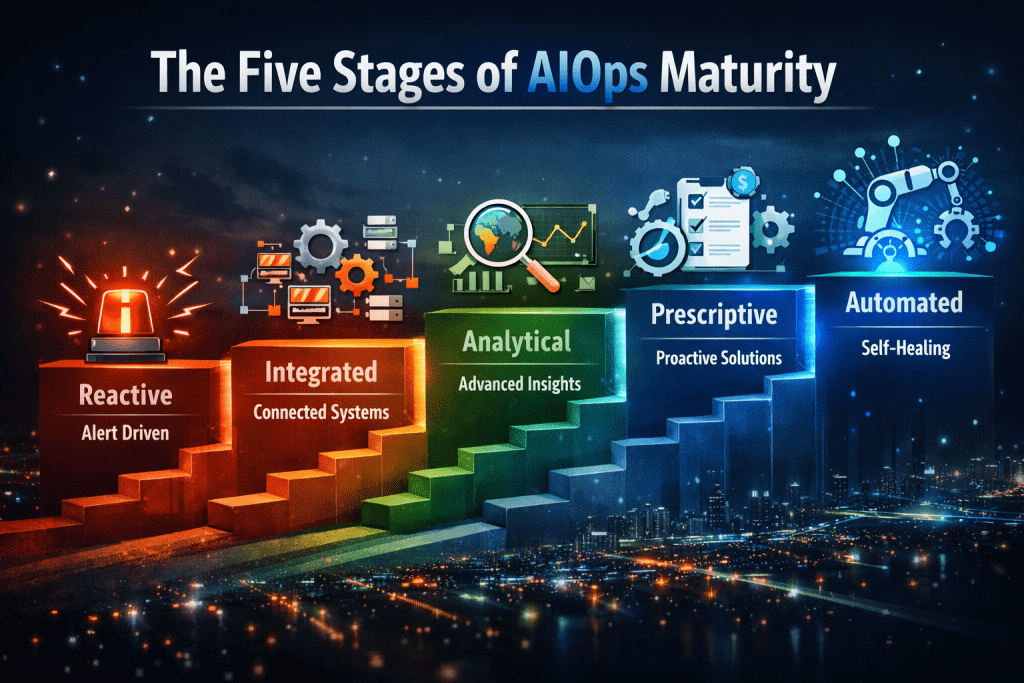
The Five Stages of AIOps Maturity
AIOps adoption is a journey. Most organisations progress through five maturity stages:
Reactive – Siloed tools and teams respond after incidents occur.
Integrated – Operational data sources feed into a shared platform, reducing silos.
Analytical – Shared insights and metrics support data-driven decisions.
Prescriptive – ML and automation recommend actions with measurable business impact.
Understanding this maturity curve helps organisations assess their current state, prioritise investments, and accelerate the transition to autonomous operations the ultimate goal of a mature AI-powered IT operations model.
Key Benefits of AIOps for the Enterprise
When implemented effectively, AIOps for IT operations delivers tangible value across IT and the wider business:
Faster Incident Resolution Automated correlation and root-cause analysis significantly reduce MTTR minimising downtime and operational disruption. Forrester benchmarks show leading AIOps deployments achieving MTTR reductions of 60% or greater within the first year.
Reduced Noise and Alert Fatigue AIOps suppresses redundant alerts and clusters related events enabling teams to focus on high-impact issues rather than false positives. Alert noise reductions of 80–85% are consistently reported across enterprise deployments.
Predictive Prevention By identifying emerging anomalies and risk patterns, AIOps enables proactive maintenance and outage prevention – shifting operations from reactive firefighting to intelligent foresight.
Lower Operational Costs Automation handles routine tasks, allowing organisations to manage complex environments without increasing headcount. IBM data indicates that mature AIOps implementations reduce operational overhead by 25–35% on average.
Improved Cloud and Hybrid Control AIOps provides consistent visibility across on-premises, cloud, and multi-cloud environments supporting cost optimisation and performance management at scale.
Enhanced User and Customer Experience Faster recovery times, predictable performance, and improved availability translate directly into better digital experiences and stronger customer satisfaction scores.
Real-World Use Case: AIOps in Financial Services
A top-10 U.S. insurance carrier managing over 2,400 business-critical applications across a hybrid cloud environment partnered with Prolifics to implement an enterprise AIOps platform – replacing 14 disconnected monitoring tools with a single, AI-driven operational intelligence layer.
Key outcomes achieved within 12 months:
MTTR reduced by 63% – from an average of 4.2 hours to 1.6 hours per critical incident
Alert volume reduced by 81% – from 47,000 daily alerts to 8,900 actionable signals, eliminating alert fatigue across NOC teams
Automated remediation handled 34% of all incidents without human intervention – freeing senior engineers for strategic work
Unplanned downtime reduced by 52% – directly improving policyholder digital experience and reducing SLA breach penalties
IT operational costs reduced by 29% within the first year – achieved by retiring legacy monitoring tools and reducing on-call staffing overhead
This deployment demonstrated the transformative potential of AI-powered IT operations in a regulated, high-availability environment where system reliability is directly tied to business performance and regulatory compliance.
Real-World AIOps Use Cases Across Industries
AIOps for IT operations delivers value across a wide range of operational scenarios:
Automated Anomaly Detection – Identifying unusual behaviour in metrics and logs that may signal impending failures
Root Cause Analysis – Rapidly isolating the underlying cause of incidents from complex, noisy data
Automated Remediation – Triggering workflows that resolve issues without human intervention
Cloud Cost Optimisation – Rightsizing resources based on real-time usage and demand patterns
Observability at Scale – Unifying insights across distributed applications and infrastructure
These use cases enable organisations to build resilient, intelligent observability frameworks that scale alongside digital growth – across finance, healthcare, retail, insurance, and the public sector.
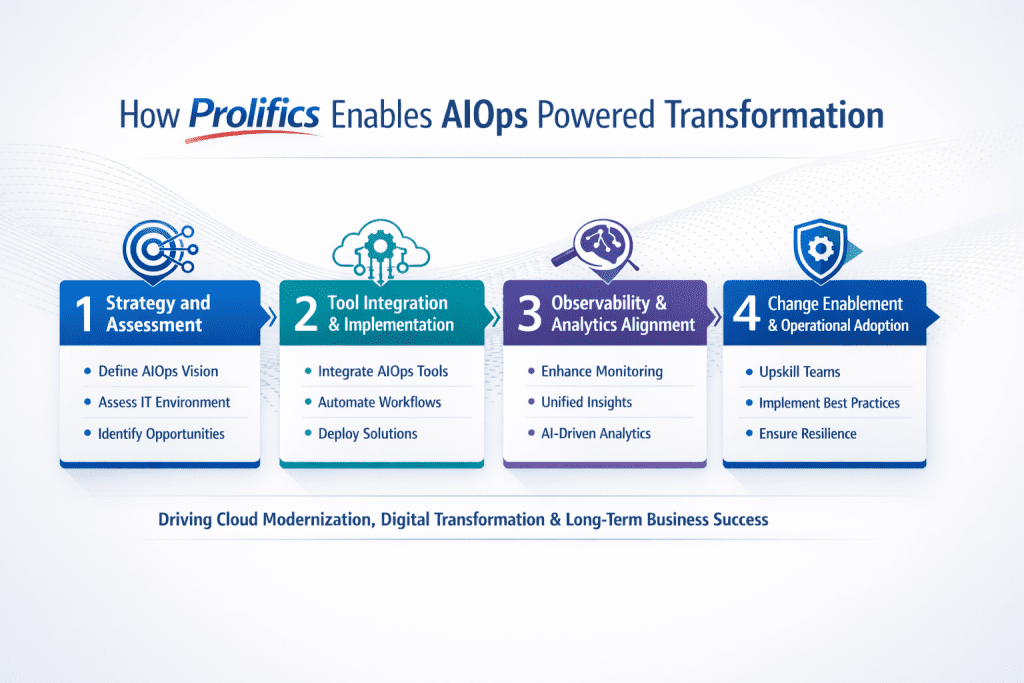
How Prolifics Enables AIOps-Powered Transformation
At Prolifics, we recognise that successful AIOps adoption requires more than tools. It demands the right strategy, deep integration expertise, and a people-centric approach to change. We help organisations realise AIOps value through four core capabilities:
Strategy and Assessment We assess your current operational landscape and define a pragmatic AIOps roadmap focusing on high-impact opportunities for intelligence and automation aligned to your business priorities.
Tool Integration and Implementation Whether deploying leading AIOps platforms or integrating custom solutions, our engineers ensure seamless implementation, robust data pipelines, and strong governance frameworks.
Observability and Analytics Alignment We integrate AIOps with broader intelligent observability practices transforming fragmented telemetry into unified, actionable insights across the full IT estate.
Change Enablement and Operational Adoption We support teams in moving from reactive operations to proactive, data-driven workflows underpinned by clear KPIs, runbooks, and automation guardrails that ensure sustainable adoption.
“With AIOps, we don’t just automate alerts we automate understanding. Prolifics helps organisations turn operational data into confidence and control.”
Our approach ensures AIOps becomes a sustainable capability that supports cloud modernisation, digital transformation, and long-term business outcomes.
Delivering Value Across the Enterprise
By partnering with Prolifics, organisations can leverage AIOps for IT operations to:
Reduce mean time to resolution (MTTR) by 60%+
Improve operational efficiency and service quality
Optimise cloud and hybrid environments with intelligent observability
Strengthen digital reliability and uptime
Free skilled teams to focus on innovation rather than incident response
This operational maturity enables Agile delivery, DevOps acceleration, and AI-driven innovation across the enterprise.
Conclusion: AIOps as a Strategic Imperative in 2026
As digital services become the backbone of business performance, AIOps for IT operations is no longer optional it is transformational. AIOps shifts IT operations from manual firefighting to intelligent automation and predictive IT operations management.
With Prolifics as your partner, AI-powered IT operations become a strategic enabler of resilience, agility, and business value. By unlocking actionable insights from operational data and automating decisions at scale, organisations can remain competitive, responsive, and ready for the future of intelligent digital operations.
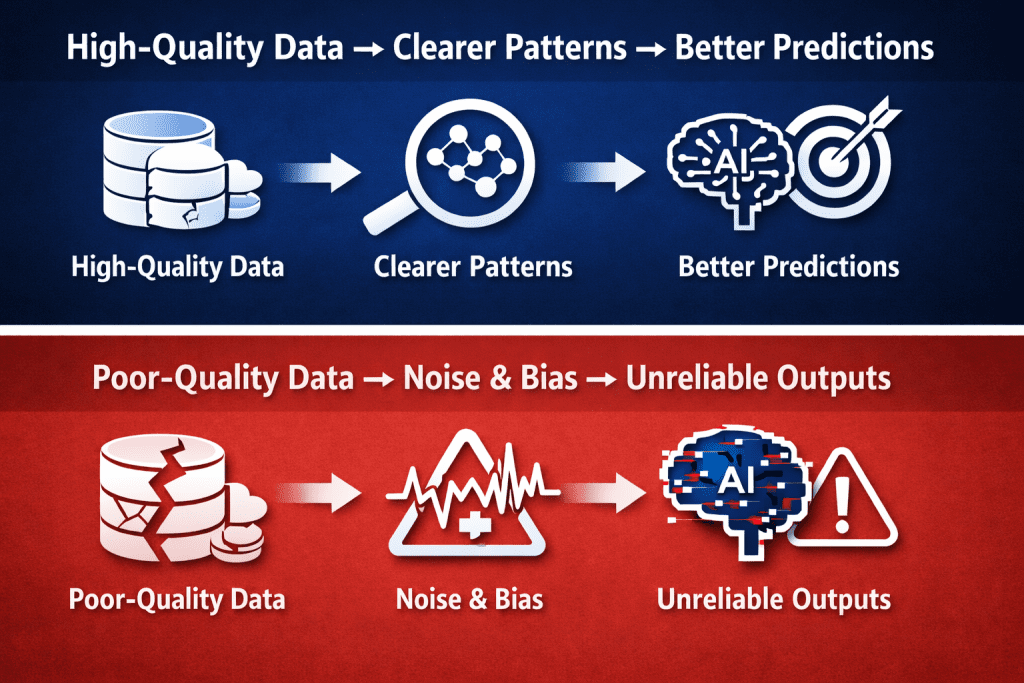
AI projects don’t fail because algorithms are weak. They fail because the data feeding those algorithms is unreliable. If your AI model is producing biased, inaccurate, or unpredictable results, the root cause is often hidden in your data. This is why quality data for AI is a non-negotiable requirement for long-term success.
Before chasing bigger models or newer frameworks, it’s time to look at the real foundation and quality data for AI.
Data Quality Shapes AI Intelligence
Organizations invest heavily in AI tools, cloud infrastructure, and talent. Yet many still struggle to move from pilot projects to real business impact. Why?
Because data quality in artificial intelligence is often treated as a cleanup task instead of a strategic priority, even though quality data for AI directly determines outcomes.
AI doesn’t understand intent, context, or business meaning. It learns patterns exactly as they exist in the data. If the data is incomplete, inconsistent, outdated, or biased, the AI will faithfully reproduce those flaws at scale. This is why the importance of data quality in AI cannot be overstated.
What “Quality Data for AI” Actually Means?
Quality data is not just clean data. For AI systems, it must be:
Accurate – Correct values, labels, and measurements
Complete – No critical gaps in features or records
Consistent – Same definitions across systems and time
Relevant – Aligned with the problem the AI is solving
Timely – Updated frequently enough to reflect reality
Together, these attributes protect machine learning data integrity, which directly impacts model performance and trust.
Relationship Between Data Quality and AI Accuracy
There is a straight line between AI model accuracy and data quality. The cleaner and more reliable the data, the better the model performs.
Even the most advanced model cannot compensate for flawed input. In fact, complex models often make data issues worse, making errors harder to detect and explain.
This is why teams focusing on training AI with high quality data consistently outperform those chasing algorithmic sophistication alone.
Poor Data Quality Impacts AI Models
Let us understand how poor data quality affects AI models helps justify early investment in data foundations.
The most common outcomes include:
Biased predictions due to unrepresentative data
Low generalization when models fail outside training scenarios
Unstable performance caused by inconsistent data sources
Erosion of trust among business users and stakeholders
In regulated industries, poor data quality can also lead to compliance risks and ethical concerns.
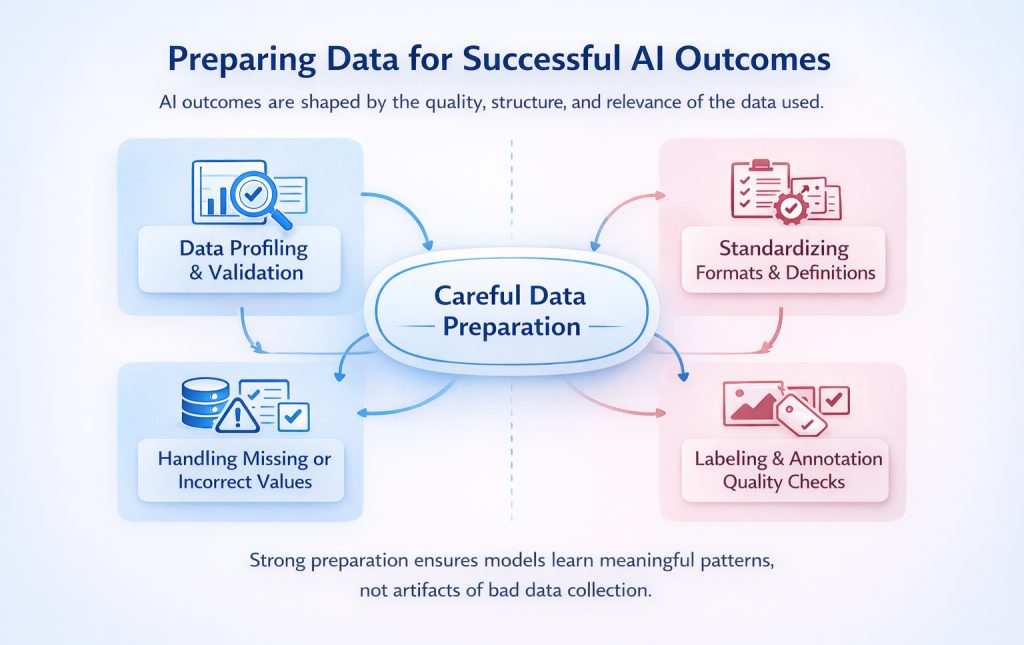
Strategic Importance of AI Data Preparation
AI outcomes are fundamentally shaped by the quality, structure, and relevance of the data used. Careful AI data preparation ensures that AI systems learn meaningful patterns rather than noise or bias. This phase includes data profiling and validation, handling missing values, standardizing formats and definitions, and performing labeling and annotation of quality checks.
Strong preparation ensures that models learn from reality, not from artifacts of bad data collection.
Data Quality Management for AI Is a Continuous Process
Sustained AI performance depends on continuous data validation and governance. Without ongoing data quality management, AI systems gradually lose reliability.
As data sources evolve, business rules change, and user behavior shifts; data quality can degrade silently. Continuous monitoring, automated checks, and clear ownership are essential to keep AI systems reliable over time.
Organizations that treat data quality as a living system; not a project; build more resilient AI capabilities.
Best Practices for Ensuring Data Quality in AI
If you are asking why quality data is critical for AI success, these best practices provide the answer,
Define data standards for early Agree on common definitions, formats, and quality thresholds before model development begins. This ensures consistency and prevents confusion across teams and data sources.
Embed quality checks into pipelines Validate data during ingestion, transformation, and model training stages. Early detection of issues reduces downstream errors and rework.
Track data lineage and ownership Maintain visibility into where data originates and how it moves across systems. Clear ownership improves accountability and data accuracy.
Monitor model feedback loops Analyze model outputs to identify unexpected patterns or performance drops. These signals often reveal hidden data quality problems.
Align data with business context Ensure data reflects real business scenarios and decision-making needs. Technical accuracy alone is insufficient without relevance to outcomes.
Following these steps strengthens data quality in artificial intelligence across the entire lifecycle.
Role of Data Quality in Gaining Competitive Advantage
AI models can be replicated, and algorithms can be reused across organizations. However, high-quality, well-governed data remains difficult to reproduce at scale.
Organizations that invest early in data quality develop AI systems that are more accurate, explainable, and scalable, creating sustainable advantages beyond model performance alone.
Conclusion
Quality data is the foundation of every successful AI system. It is not just a technical requirement, but a critical factor that determines whether AI delivers real business value. Without strong and reliable data, even the most advanced AI strategies struggle to produce accurate or trustworthy results.
When organizations prioritize quality data for AI, they improve model accuracy, build confidence among users, and enable better decision-making. Clean, consistent, and well-governed data allows AI systems to scale effectively and remain dependable over time. Ultimately, AI alone does not transform businesses reliably; high-quality data makes that transformation possible.
Microsoft has officially transitioned its Microsoft 365 app, formerly known by many as Office, into the Microsoft 365 Copilot app. This update reflects Microsoft’s growing focus on artificial intelligence and positions Copilot at the heart of everyday work and life tasks.
But what does this mean for you? Whether you’re a student, professional, or casual user, here’s a clear and engaging breakdown of what’s changing, and what stays the same.
What’s New: A Name and Feature Shift
New App Name and Look
The familiar Microsoft 365 app has been renamed to the “Microsoft 365 Copilot app.”
This change rolled out beginning January 15, 2025, with a new icon and updated interface that highlights AI-powered capabilities.
Despite the name change, it’s not a completely new program, it’s a continuation and evolution of the productivity hub many users already rely on.
Unified Across Devices
The Microsoft 365 Copilot app now appears consistently on:
Web (via m365.cloud.microsoft with automatic redirects from office.com and microsoft365.com)
Windows devices
iOS and Android mobile platforms
So whether you’re on your desktop or phone, the experience feels familiar but smarter.
What Copilot Brings to the Table
At its core, Copilot isn’t just a name, it’s an AI assistant built directly into your productivity workflow. Here’s how the Copilot mindset changes the app:
AI-Enhanced Productivity
Ask Copilot to draft or edit content.
Use it to summarize documents or generate ideas.
It helps with tasks like writing emails, preparing presentations, or analyzing data. These AI tools help users work smarter, not harder.
Seamless Search + Chat
Powered by advanced AI (including capabilities similar to large language models), Copilot:
Offers intelligent search across your files and emails.
Provides chat-style interactions that help you get answers, suggestions, or content ideas on the fly.
This makes the Copilot app more than a launcher for Word or Excel, it’s a smart companion for productivity.
Who Gets Copilot Features?
Microsoft distinguishes between two types of users:
Work or School Accounts
Copilot Chat is available with a Microsoft 365 subscription (at no extra cost) or with a Microsoft 365 Copilot license for enhanced features.
Personal Accounts
Personal, Family, and Premium Microsoft 365 subscribers will also get access to Copilot Chat as part of their plan.
Users without a subscription won’t see Copilot Chat, although the app name and icon remain the same for consistency.
Why This Matters
This evolution isn’t just cosmetic. It signals a larger shift in how Microsoft defines productivity, moving from traditional tools toward AI-assisted workflows that help users solve problems faster and collaborate more efficiently.
For many users, the transition will be seamless, just a new name and smarter features. But for those curious about the AI buzz, the Microsoft 365 Copilot app offers a glimpse into the future of work.
Modernizing Enterprise Resource Planning (ERP) systems is no longer a matter of choice, it is a strategic imperative for businesses striving to remain competitive in a digital-first economy. While traditional ERP platforms once formed the backbone of enterprise operations, many now struggle to support the speed, scale, and intelligence required by modern organizations.
The emergence of cloud ERP modernization initiatives and next-generation ERP platforms offers enterprises a powerful pathway to improve agility, streamline operations, and unlock innovation. Yet ERP modernization is more than a technology upgrade; it is a transformation journey that demands clarity, alignment, and the right execution partner.
ERP has evolved significantly over the years, expanding from basic inventory and financial management systems into platforms that support human resources, customer engagement, and complex supply chains. Despite this evolution, many legacy environments still require legacy ERP modernization to overcome fragmented architectures that operate in silos and limit visibility across the enterprise. These constraints make it increasingly difficult for organizations to gain real-time insights, adapt to change, and fully realize the value of ERP digital transformation.
Understanding Today’s Business Challenges
While ERP systems have been around for decades, many businesses still rely on outdated or fragmented technology stacks that create inefficiencies and limit growth, making ERP modernization a critical priority:
1. Data Silos and Fragmented Processes
Traditional ERP systems often operate in silos, which prevents finance, supply chain, HR, and customer teams from sharing real-time data. This fragmentation slows decision-making and increases operational risk, highlighting the need for cloud-based ERP solutions.
2. Lack of Scalability
As organisations grow, expanding into new markets, launching new products, or adding services, their legacy systems struggle to keep pace with changing requirements. This challenge accelerates the need for ERP migration to cloud platforms that scale effortlessly with business demands.
3. Rising Costs and Technical Debt
Maintaining older systems becomes expensive over time due to upgrades, specialized IT staffing, and patchwork integrations. Many companies invest more in maintenance than innovation, making legacy ERP modernization essential for cost optimization.
4. Limited Visibility and Decision Support
Without real-time insights and analytics, organizations lack the visibility needed to proactively respond to market shifts or internal inefficiencies. ERP digital transformation enables advanced analytics and intelligent decision-making.
5. Security and Compliance Pressures
With more data flowing across digital channels, securing sensitive information and meeting regulatory requirements has become increasingly complex, particularly for organizations that have delayed ERP modernization initiatives.
These challenges are preventing organizations from meeting customer expectations, slowing innovation, and increasing operational risk. Modern ERP strategies are no longer optional; they are essential for long-term success.
Why Modern ERP Matters
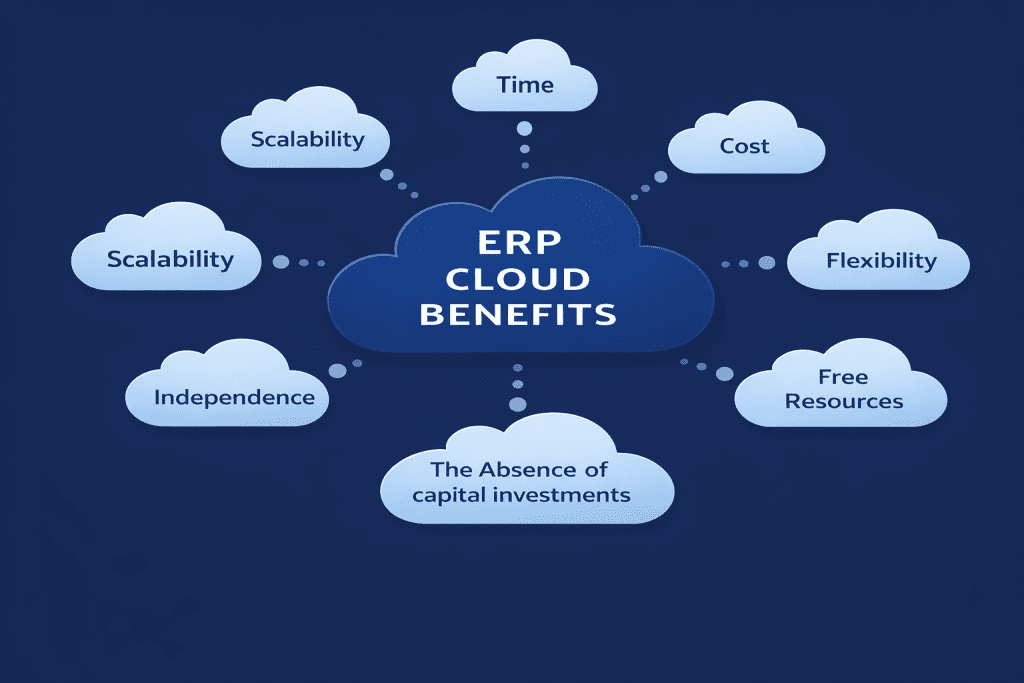
Modern ERP systems, especially those built on cloud ERP modernization principles, deliver advanced capabilities that transform business operations:
✔ Unified, Real-Time Data Cloud platforms centralize enterprise resource planning systems into a single source of truth, enabling real-time dashboards and analytics.
✔ Enhanced Scalability & Flexibility Cloud-native architectures support rapid growth without costly infrastructure upgrades, reinforcing the value of ERP migration to cloud.
✔ Lower Operational Costs Subscription-based cloud-based ERP solutions reduce upfront investments while providing continuous access to innovation.
✔ Integrated Business Functions Modern ERP platforms eliminate silos by integrating finance, operations, HR, supply chain, and CRM into one cohesive environment.
✔ Improved Security & Compliance Cloud providers invest heavily in security, compliance automation, and disaster recovery, reducing enterprise risk.
These benefits allow organizations to respond faster to market changes, increase efficiency, and unlock new growth opportunities through ERP digital transformation.
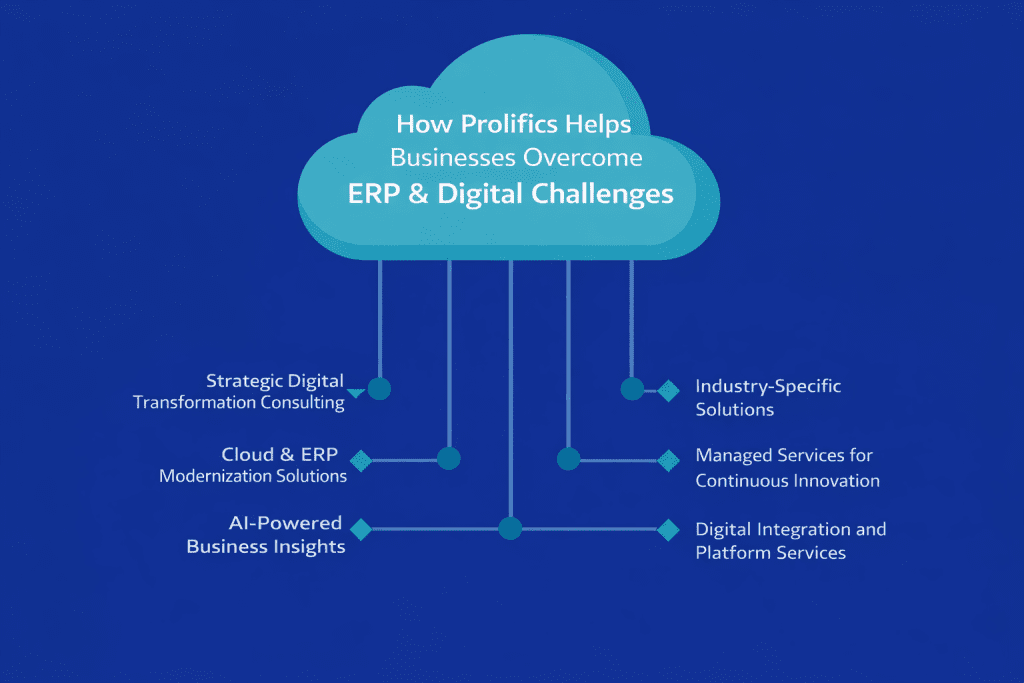
How Prolifics Helps Businesses Overcome ERP & Digital Challenges
Successfully adopting modern ERP and ERP digital transformation isn’t just about technology, it’s about strategy, execution, and alignment with business goals. Prolifics offers deep expertise in helping organizations navigate complex ERP modernization initiatives:
🔹 Strategic Digital Transformation Consulting Prolifics partners with organizations to build transformation roadmaps that align technology initiatives with business outcomes. From digital strategy to execution, Prolifics ensures transformation is purposeful, measurable, and aligned with long-term ERP modernization goals.
🔹 Cloud & ERP Modernization Solutions Whether you’re migrating from legacy systems or implementing cloud ERP modernization initiatives, Prolifics provides expert guidance and hands-on support to accelerate deployment, reduce risk, and maximize ROI from cloud-based ERP solutions.
🔹 AI-Powered Business Insights Prolifics integrates artificial intelligence and analytics into business systems to surface insights that drive smarter decisions, helping enterprises anticipate trends and respond proactively.
🔹 Industry-Specific Solutions From healthcare and banking to retail and manufacturing, Prolifics delivers tailored solutions that support legacy ERP modernization while addressing unique industry challenges and regulatory requirements.
🔹 Managed Services for Continuous Innovation Transformation shouldn’t stop after deployment. Prolifics’ managed services ensure continuous optimization, security, and performance across ERP migration to cloud environments, freeing internal teams to focus on strategic priorities.
🔹 Digital Integration and Platform Services Prolifics helps connect systems, APIs, and applications, enabling seamless data flow and integrated workflows that strengthen enterprise-wide ERP digital transformation efforts.
These offerings empower businesses to not just adopt modern ERP but thrive in a digital economy, achieving greater efficiency, resilience, and customer satisfaction.
Transformation in Action: What Success Looks Like
Imagine a middle-market enterprise struggling with disconnected finance systems, supply chain delays, and limited visibility. After adopting a structured ERP modernization strategy with Prolifics:
Real-time dashboards and analytics replace manual reporting,
Cloud ERP enables secure remote access and lowers infrastructure costs,
AI-driven predictive insights help optimize demand forecasting,
Integrated workflows enhance collaboration across departments.
Results in the improved responsiveness to customer demand, higher operational efficiency, and measurable growth in both revenue and customer satisfaction.
Partner with Prolifics for Digital Success
Modern ERP initiatives are complex, but with the right partner, they become transformational. Prolifics combines decades of experience, cross-disciplinary expertise, and a client-first approach to deliver successful ERP digital transformation outcomes. Whether modernizing systems, implementing cloud-based ERP solutions, or unlocking AI-powered insights, Prolifics helps organizations lead and innovate with confidence.
Conclusion
The transition to ERP modernization is no longer a future ambition; it is a current business imperative. Organizations that embrace cloud-native platforms, integrated systems, and strategic execution gain efficiency, resilience, and competitive advantage. With Prolifics as your trusted partner for cloud ERP modernization, AI integration, and ongoing support, enterprises can achieve measurable results and long-term success.
Partner with Prolifics to transform your business – Talk to our experts today.