Orlando, FL– March 20, 2026 – Cigna Healthcare® has selected Prolifics as a recipient of the 2025 Silver Level Healthy Workforce Designation for demonstrating a strong commitment to improving the health and vitality of its employees through a comprehensive workplace well-being program.
This marks the second consecutive year Prolifics has earned this recognition, underscoring its continued focus on fostering a culture where employee well-being is a strategic priority. Prolifics’ wellness initiatives are designed to support physical, mental, and emotional health through a combination of benefits, awareness programs, and engagement-driven activities. From promoting preventive care and mental health resources to encouraging work-life balance and inclusive wellness participation, Prolifics continues to invest in programs that empower employees to thrive.
“At Prolifics, workforce vitality is central to how we operate and grow as an organization,” said Satya Bolli, CMD & Chairman, Prolifics.
“We are honored to receive the Cigna Healthy Workforce Designation for the second year. This recognition reflects our belief that when employees are supported in their well-being, they are more engaged, innovative, and empowered to deliver meaningful outcomes for our clients.”
Vitality is defined as the ability to pursue life with health, strength, and energy. It is both a driver and an outcome of health and work-life engagement, and Cigna Healthcare believes it is not only essential to individuals but also a catalyst for business and community growth.
Research conducted as part of the Evernorth Vitality Index confirms that individuals with higher vitality experience better mental and physical health, along with higher levels of job satisfaction, performance, and stronger workplace relationships. With only one in five U.S. adults reporting high levels of vitality, organizations have a critical opportunity to strengthen workplace well-being programs and create environments where employees can succeed.
“Employers that prioritize workforce vitality by addressing workplace stress, promoting healthy behaviors, and fostering a sense of connection are driving both employee well-being and organizational success,” said Bryan Holgerson, president of Cigna Healthcare U.S. “We are proud to recognize Prolifics for its commitment to building a culture of well-being and advancing health outcomes across its workforce.”
The Cigna Healthy Workforce Designation evaluates organizations based on key components of their well-being programs, including workforce insights, strategy and culture, health equity, dimensions of vitality, and employee engagement. Organizations that receive this designation demonstrate measurable impact and leadership in advancing workforce health.
Cigna Healthcare’s recognition of Prolifics with the Silver Level designation reinforces the company’s continued progress in 2025 toward nurturing a healthy, engaged, and resilient workforce.
About Prolifics
Prolifics is a global technology solutions provider that helps organizations accelerate digital transformation through data, AI, cloud, integration, and automation services. With deep industry expertise and strategic partnerships, Prolifics enables clients to innovate faster, improve operational efficiency, and deliver exceptional customer experiences. The company is committed to fostering a people-first culture that prioritizes employee well-being, growth, and long-term success.
Why Business Intelligence Analytics Matters for Modern Enterprises
In a digital economy driven by data, organizations must convert raw information into meaningful insights that support strategic decisions. Business intelligence analytics enables companies to analyze operational data, understand patterns, and drive measurable outcomes across departments. However, traditional analytics models struggle to keep pace with the scale and speed of modern enterprise data.
Today, organizations require AI-driven business intelligence that combines automation, machine learning, and real-time analytics. This approach transforms enterprise data into actionable intelligence that leaders can trust.
Prolifics help organizations modernize their analytics ecosystem by implementing scalable enterprise BI analytics, integrating advanced business intelligence tools, and enabling AI powered insights across complex enterprise environments.
Business Intelligence and Analytics in the Age of AI
Organizations today operate in a data rich environment where insight speed directly impacts competitiveness. Traditional analytics systems were built for static reporting and periodic analysis. In contrast, modern organizations require data analytics for business that support predictive insights, automation, and intelligent decision making.
Artificial intelligence is redefining business intelligence analytics by enabling faster analysis, deeper pattern recognition, and automated insight generation.
AI accelerates enterprise data analysis with automated intelligence.
Machine learning enhances predictive insights from complex datasets.
Real-time analytics improves operational responsiveness across business units.
Natural language interfaces simplify enterprise data exploration.
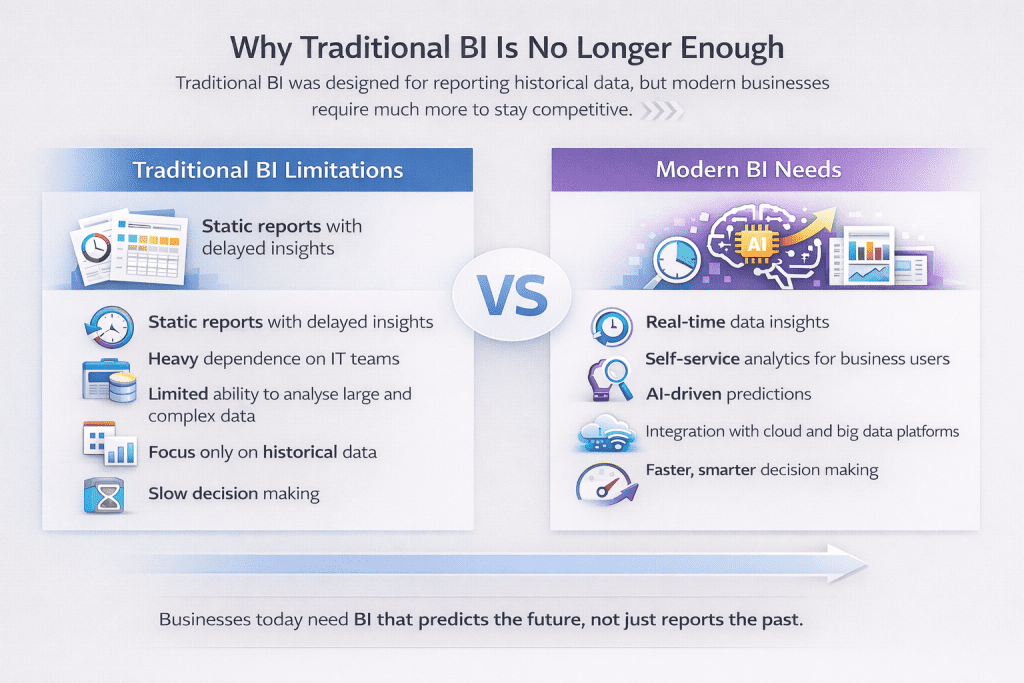
Why Traditional BI Is No Longer Enough
Legacy BI systems were designed primarily for reporting historical data. These platforms rely on manual data preparation, static dashboards, and complex query processes. As enterprise data grow exponentially, traditional systems create delays in insight generation.
Business leaders now require instant access to reliable data. Without modernization, legacy BI environments often create data silos, slow reporting cycles, and limited analytical capabilities.
Organizations are therefore transitioning toward AI driven business intelligence platforms that support real-time analytics and automated insight generation.
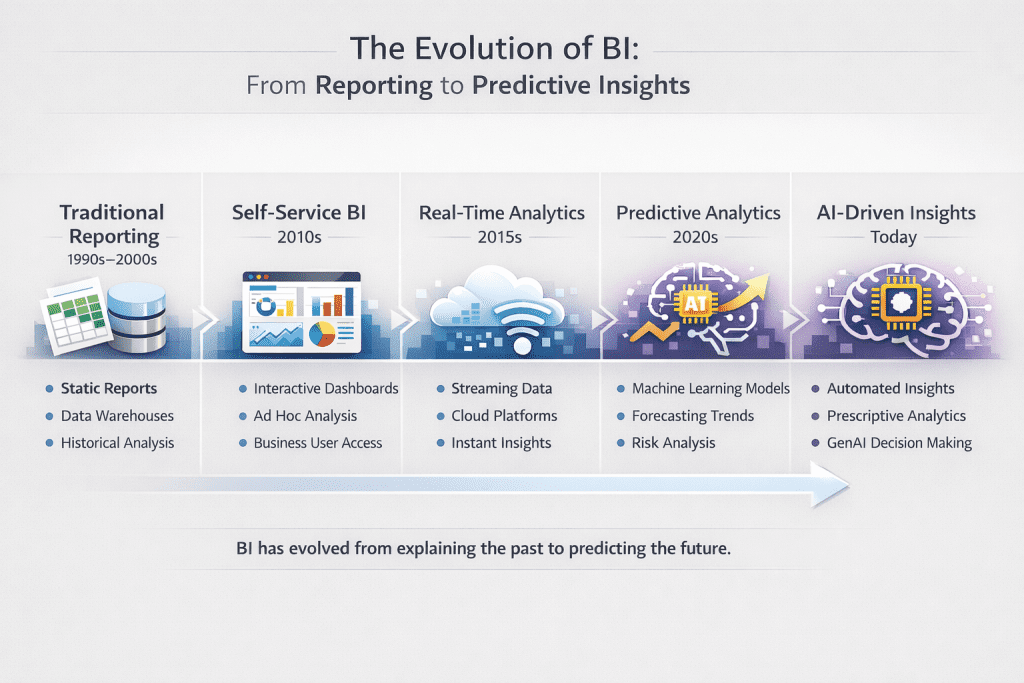
The Evolution of BI From Reporting to Predictive Insights
The modern business environment requires faster decision cycles and deeper data intelligence. Traditional BI platforms focused mainly on descriptive reporting, which explained what happened in the past. However, modern analytics solutions must also predict future outcomes and recommend actions.
The shift toward enterprise BI analytics enables organizations to combine machine learning models, predictive analytics, and automated data pipelines. These capabilities transform BI from a reporting function into a strategic intelligence platform.
Companies that adopt modern BI architectures gain the ability to detect trends early, forecast operational outcomes, and optimize business strategies with greater accuracy.
BI platforms now support predictive and prescriptive analytics.
AI models uncover hidden patterns across enterprise datasets.
Modern BI integrates machine learning with analytics workflows.
Predictive insights help businesses anticipate risks and opportunities.
Data driven strategies improve long-term organizational performance.
From Dashboards to Data Intelligence
Traditional BI environments focused heavily on dashboards and visual reports. While dashboards remain valuable, they represent only a small part of modern analytics capabilities. Today, organizations require systems that automatically analyze data, detect anomalies, and generate insights.
This transformation moves BI from static visualization to intelligent analytics powered by artificial intelligence and machine learning.
Modern AI business intelligence platforms combine automation, advanced analytics, and natural language interfaces to simplify enterprise data exploration.
Automated insights highlight trends without manual analyst intervention.
AI models continuously analyze enterprise operational data streams.
Natural language queries simplify access to complex data.
Intelligent systems generate contextual insights for business leaders.
How AI Is Transforming Business Intelligence
Artificial intelligence introduces a new level of intelligence into enterprise analytics. Instead of relying on manual queries and static reports, AI powered systems automatically analyze data, identify trends, and generate insights.
This shift significantly improves the efficiency and accuracy of enterprise analytics. Organizations can detect operational issues earlier, forecast business performance, and make more informed strategic decisions.
AI powered business intelligence tools now support automated insights, anomaly detection, and conversational analytics.
AI accelerates enterprise data processing and pattern recognition.
Natural Language Query for Data enables conversational analytics.
AI reduces manual reporting and data preparation workloads.
Turning Enterprise Data Into Real Business Intelligence
Enterprise organizations generate massive volumes of operational data across systems, applications, and cloud environments. However, data alone does not create value. The real advantage comes from transforming data into actionable insights.
Modern enterprise BI analytics platforms integrate data from multiple sources, apply advanced analytics, and generate real time intelligence that supports strategic decision making.
Organizations can then align data insights with business goals and operational priorities.
Integrated analytics platforms unify enterprise data sources.
AI generates actionable insights from complex datasets.
Data intelligence improves enterprise strategic decision making.
How Modern BI Platforms Are Redefining Data Analytics
Modern analytics platforms combine data engineering, artificial intelligence, and advanced visualization to create scalable intelligence systems. These platforms integrate structured and unstructured data while supporting automated insights and predictive analytics.
Solutions such as AI/BI Genie Integration and conversational analytics platforms allow users to interact with enterprise data using natural language queries. This capability democratizes analytics across the organization and reduces dependency on specialized data teams.
Organizations adopting modern business intelligence analytics platforms can reduce reporting delays, increase operational visibility, and improve decision accuracy.
Why AI Driven Analytics Defines the Future of BI
The next generation of Business Intelligence is being driven by Artificial Intelligence and advanced analytics. These technologies enable organisations to move from static reporting to intelligent, self-learning decision systems.
AI driven business intelligence will automate enterprise data insights.
Generative AI will reduce manual reporting and analysis workloads.
Natural language analytics will democratize enterprise data access.
Intelligent analytics platforms will continuously learn from enterprise data.
AI powered BI ecosystems will enable autonomous business decisions.
Prolifics is helping organisations move into the next era of Business Intelligence by bringing together AI, advanced analytics, and modern data platforms. With strong expertise in data engineering and enterprise analytics, we help businesses turn their data into smarter insights and more confident decisions.
Conclusion
The future of business intelligence analytics lies in the integration of artificial intelligence, advanced analytics, and scalable enterprise data platforms. Organizations that modernize their BI infrastructure gain the ability to transform raw data into strategic intelligence.
By adopting AI driven business intelligence, companies can reduce operational inefficiencies, accelerate insight generation, and improve decision accuracy across the enterprise.
Prolifics helps organizations modernize their analytics architecture through advanced AI business intelligence platforms, scalable business intelligence tools, and integrated enterprise BI analytics solutions.
Databricks has unveiled a new AI agent designed to transform how enterprises search and reason over internal data. The system, called KARL (Knowledge Agents via Reinforcement Learning), is built to address a major limitation of traditional retrieval augmented generation for enterprises pipelines that often fail when dealing with diverse enterprise information needs.
Most enterprise RAG systems are optimized for only one type of search behavior. For example, a model trained to summarize documents may struggle with constraint-based entity search or multi-step reasoning across fragmented internal records. These limitations often surface when enterprises attempt to apply agentic ai for enterprise data to complex knowledge tasks such as analyzing meeting notes, reconstructing account histories, or extracting insights from scattered operational data. These challenges are one reason organizations are exploring enterprise ai search systems and purpose-built AI agents.
To overcome this challenge, Databricks trained KARL across six distinct enterprise search behaviors simultaneously. This approach enables the agent to generalize across different types of knowledge queries rather than specializing in a single retrieval pattern.
The company reports that KARL can match the performance of advanced frontier models while significantly improving operational efficiency. According to internal benchmarks, the system delivers results with 33 percent lower cost per query and 47 percent lower latency compared to leading large language models such as Claude Opus 4.6.
One of the key innovations behind KARL is its reinforcement learning approach. The agent was trained using synthetic data generated by the system itself rather than relying on manually labeled datasets. This method allows the model to learn complex reasoning patterns across enterprise knowledge workflows without extensive human supervision.
Databricks also introduced a new reinforcement learning algorithm called Optimal Advantage based Policy Optimization with Lagged Inference (OAPL). This technique improves training efficiency by enabling distributed training while maintaining model stability. As a result, the full training process required only a few thousand GPU hours, making enterprise deployment more practical.
Another capability of the KARL agent is its ability to perform iterative reasoning over large knowledge bases. The system can conduct hundreds of vector database queries during a single task, refining search results and compressing contextual information dynamically to maintain accuracy. This type of enterprise vector database search capability plays an important role in modern enterprise ai search systems and advanced rag pipeline optimization strategies.
However, the system still faces challenges. The model sometimes struggles with ambiguous questions where multiple answers may be valid, and it currently focuses primarily on vector search tasks rather than SQL or code-based queries.
Despite these limitations, the development highlights a growing shift toward purpose-built enterprise AI agents rather than relying solely on general-purpose language models. Experts believe such systems could reshape how organizations extract insights from internal data repositories. The databricks karl rag agent explained in this announcement demonstrates how enterprises are moving toward specialized enterprise rag ai agent architectures designed to support complex business intelligence and agentic ai for enterprise knowledge management.
Key Takeaways
Organizations exploring AI-driven knowledge systems should consider several key factors.
Enterprise search complexity is increasing Modern enterprises manage vast volumes of structured and unstructured data that require advanced reasoning beyond simple document retrieval.
Multi-task training improves AI reliability Training agents across multiple retrieval behaviors enables more accurate responses across different business scenarios.
Purpose-built AI agents are emerging as the next step Instead of relying on generic models, enterprises are beginning to develop specialized AI agents optimized for their data environments.
How Prolifics Can Help Enterprises Leverage Agentic AI
Organizations looking to adopt advanced AI agents can benefit from structured implementation strategies.
Prolifics capabilities include:
Enterprise AI architecture design Building scalable AI and RAG pipelines across cloud platforms such as AWS and Google Cloud.
Data engineering and governance Preparing enterprise data environments to support reliable AI retrieval and reasoning.
Gen AI and intelligent automation solutions Implementing AI agents that integrate with enterprise applications and business workflows.
End-to-end AI modernization services Helping organizations transition from experimental AI pilots to production-ready intelligent systems.
As enterprise AI continues to evolve, innovations such as KARL highlight the growing importance of specialized AI agents capable of reasoning over complex organizational data at scale.
Cloud transformation services enable organizations to migrate, modernize, and manage their IT infrastructure and applications in the cloud, driving greater innovation, operational efficiency, and long-term business value. Enterprise cloud transformation services empower organizations to build scalable digital infrastructure that supports future innovation. Enterprises that embrace cloud transformation unlock unprecedented capabilities, including scalable infrastructure, enhanced security, faster innovation cycles, and the ability to harness data and AI in meaningful ways.
But while many organizations talk about moving to the cloud, true cloud transformation goes far beyond simply migrating workloads. It involves rethinking how technology supports your business strategy and adopting a cloud modernization strategy that aligns technology with business growth.
At Prolifics, we view cloud transformation as a strategic catalyst for sustainable growth, improved customer experiences, and operational excellence. Through Enterprise Cloud Transformation Services, we help organizations adopt AI-native cloud architecture and enable modern digital capabilities. In this blog, we explore what cloud transformation truly means, why it matters now more than ever, and how Prolifics partners with enterprises to unlock real business value.
What Is Cloud Transformation?
Cloud transformation is a holistic journey. It is not just about moving apps or data to the cloud. It involves rearchitecting, optimizing, and modernizing your entire technology landscape. The goal is to fully leverage cloud-native capabilities such as scalable infrastructure, automation, microservices, serverless computing, and cloud-native application development to accelerate innovation and business impact.
Organizations often ask how to transition from cloud migration to cloud transformation, especially as they scale their digital platforms and infrastructure.
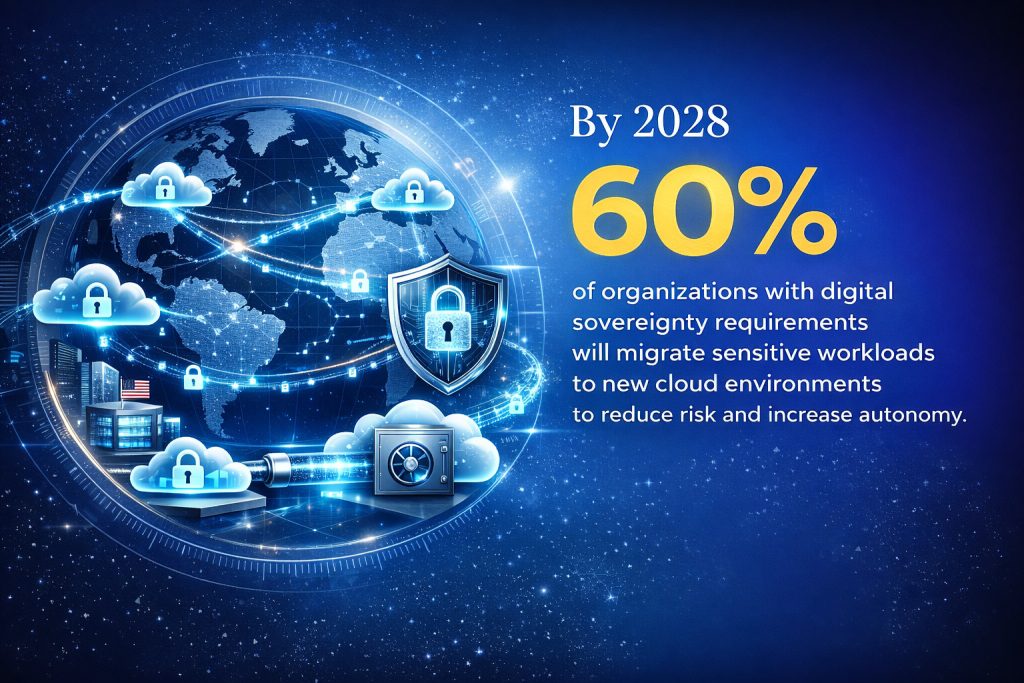
IDC FutureScape 2026 Predictions reveal that by 2028, due to geopolitical uncertainties, 60% of organizations with digital sovereignty requirements will migrate sensitive workloads to new cloud environments to reduce risk and increase autonomy.
While cloud migration focuses on relocating assets to cloud environments, cloud transformation encompasses a broader strategy including:
• Modernizing applications and architecture • Reimagining data and analytics for real-time insights • Implementing robust cloud governance and security • Embedding automation and DevOps practices • Operationalizing continuous innovation and Cloud Cost Optimization Services
This strategic shift empowers organizations not just to operate in the cloud but to operate better in the cloud through enterprise cloud transformation services.
Why Cloud Transformation Matters Now
Cloud transformation is not a future trend. It is a business imperative for enterprises striving to stay competitive. The pace of digital expectations is faster than ever. Customers demand seamless experiences, IT teams are expected to innovate continuously, and market competition never slows down. Here is why cloud transformation is mission-critical today:
1. Agility and Speed
Legacy systems can slow innovation, create silos, and limit your ability to respond quickly to customer needs. Cloud transformation builds agile and resilient architectures supported by AI-native cloud architecture, allowing teams to iterate faster, deploy updates seamlessly, and launch new offerings ahead of competitors.
2. Operational Efficiency and Cost Optimization
Cloud environments enable automation, rightsizing of resources, and self-service models that reduce the burden on IT teams. This results in significant cost savings and more predictable operational expenses. Many organizations achieve this through cloud cost optimization services and improved governance frameworks.
3. Real-Time Data and AI Enablement
Modern business thrives on data. With cloud transformation and cloud-native application development, enterprises gain the foundation needed to harness analytics and AI. This transforms raw data into actionable insights that power smarter decisions and improved customer experiences.
4. Enhanced Security and Compliance
Cloud platforms provide advanced security controls, automated policy enforcement, and the ability to scale protections globally. This supports strong operational resilience while enabling enterprises to meet industry and regulatory standards with confidence.
In short, cloud transformation helps organizations shift from reactive IT operations to proactive value creation. Technology becomes a driver of growth rather than just a support function.
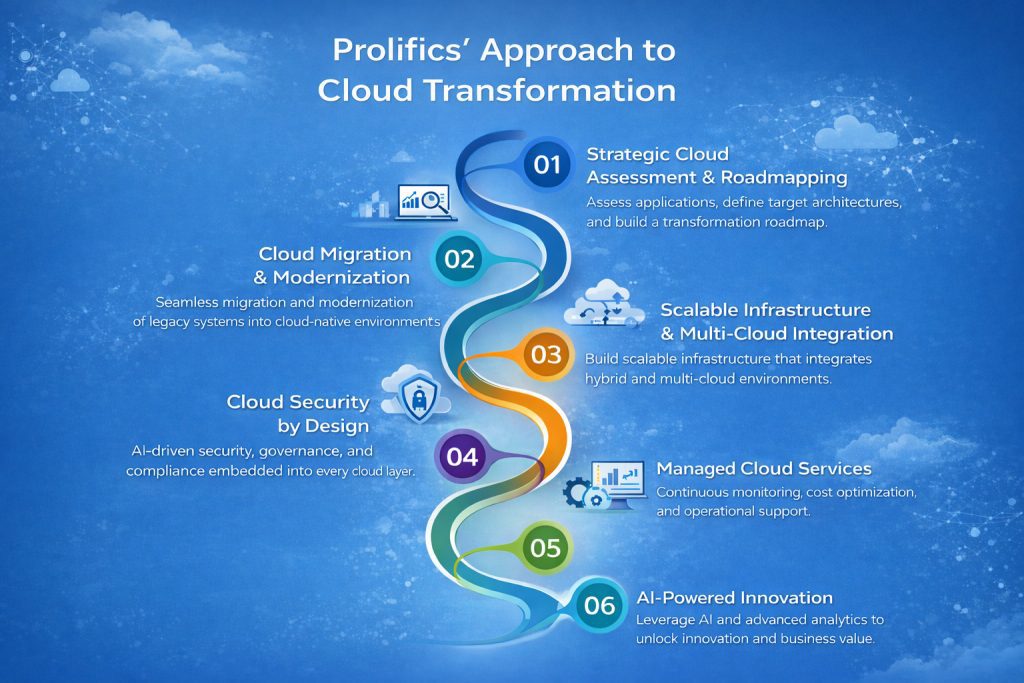
Prolifics’ Approach to Cloud Transformation
At Prolifics, we help enterprises not just move to the cloud but thrive in and through the cloud. Through Enterprise Cloud Transformation Services, we partner with organizations across industries to design, build, and operate cloud environments that are secure, scalable, resilient, and aligned with business goals.
Here is how Prolifics makes cloud transformation effective and impactful:
1. Strategic Cloud Assessment and Roadmapping
Every successful transformation begins with a deep understanding of your current landscape and business objectives. Prolifics conducts strategic cloud assessments for legacy application modernization to help organizations prepare for modernization and innovation.
These readiness assessments help organizations:
• Assess applications, infrastructure, and technical debt • Define target architectures and desired business outcomes • Build roadmaps with clear milestones and governance models
This structured approach ensures that cloud initiatives deliver measurable business value from the start and support a long-term cloud modernization strategy.
2. Cloud Migration and Modernization
Whether you are lifting and shifting workloads or rearchitecting for cloud-native efficiency, Prolifics provides seamless migration services that minimize risk and disruption. Our Enterprise Cloud Transformation Services help modernize legacy systems so they become drivers of innovation rather than bottlenecks.
3. Scalable Infrastructure and Multi-Cloud Integration
Prolifics designs scalable cloud infrastructures that adapt to business growth. Our hybrid cloud management solutions ensure that cloud services, legacy systems, and hybrid environments work together with high performance and secure data flow.
4. Cloud Security by Design
Security is a core pillar of every cloud strategy. Prolifics embeds advanced, AI-driven security controls and compliance frameworks into cloud environments, ensuring data integrity and supporting enterprise cloud governance for digital sovereignty compliance 2026 requirements.
5. Managed Cloud Services
Transformation does not stop after go-live. Prolifics offers ongoing cloud-managed services that proactively optimize performance, monitor costs, secure operations, and handle incidents. These services include advanced cloud cost optimization services and governance frameworks that help enterprises maximize ROI.
6. AI-Powered Innovation
Cloud and AI naturally complement each other. Prolifics helps clients leverage AI-native cloud architecture and modern cloud platforms to deploy analytics solutions, automate workflows, and deliver personalized experiences at scale.
Cloud Transformation in Action: Business Outcomes You Can Expect
When executed correctly, cloud transformation delivers measurable and strategic value, not just technology upgrades. Organizations partnering with Prolifics and leveraging Enterprise Cloud Transformation Services experience:
• Faster innovation cycles with agile delivery and CI/CD pipelines • Improved reliability and uptime through resilient cloud architectures • Reduced total cost of ownership through automated scaling and Cloud Cost Optimization Services • Stronger security and compliance posture across environments • Enhanced customer and employee experiences with scalable, secure digital platforms
These outcomes transform cloud initiatives from technical projects into strategic growth engines for the business.
At Prolifics, we are committed to guiding organizations through every phase of their cloud journey, from strategy and migration to modernization, management, and innovation. Our Enterprise Cloud Transformation Services help organizations build scalable digital infrastructure and realize the full potential of cloud by turning challenges into opportunities and aspirations into outcomes.
If you are ready to accelerate growth, unlock agility, and redefine what is possible for your business, start your cloud transformation journey today.
The Future Is Cloud-First. Are You Ready?
Talk to our cloud experts at Prolifics and unleash your cloud potential.
Regulatory oversight and compliance reporting demand precision, transparency, and timely insights. Yet many organizations still rely on complex legacy reporting environments that slow decision-making and increase IT dependency. Power BI self-service analytics is helping organizations modernize these environments by enabling faster insights and reducing reliance on IT teams.
In this case study, discover how a global legal and compliance organization partnered with Prolifics to modernize its reporting ecosystem and unlock faster, more secure analytics.
Facing a reporting landscape of over 450 SAP BusinessObjects reports, the organization struggled with complexity, limited usability, and heavy reliance on IT teams for report modifications. Compliance analysts lacked the agility needed to quickly respond to audits, regulatory requests, and emerging risk indicators.
Prolifics implemented a modern Power BI–driven analytics platform designed to simplify reporting, enable secure self-service analytics, and deliver real-time insights for legal and compliance teams. Through report rationalization, automated migration, and interactive dashboards, the organization transformed its reporting environment into a scalable and user-friendly analytics ecosystem.
The result was a streamlined reporting framework that reduced complexity, improved accessibility, and empowered compliance professionals to explore insights independently while maintaining strict data governance.
Download the full case study to learn how Prolifics helps organizations modernize legacy reporting platforms, enhance compliance visibility, and build scalable analytics foundations with Microsoft Power BI.
Artificial intelligence is rapidly reshaping how organizations operate, compete, and innovate. From predictive analytics and automation to generative AI and intelligent decision-making, AI is becoming a core driver of business transformation. However, the success of AI initiatives does not depend solely on algorithms or models. It depends on the infrastructure that powers them.
A well-designed AI infrastructure strategy is now emerging as a critical strategic asset for enterprises seeking to scale AI across their operations. It provides the computing power, data management capabilities, and operational frameworks required to develop, deploy, and manage AI systems effectively.
At Prolifics, we see organizations across industries recognizing that AI initiatives cannot succeed without a strong, scalable, and secure infrastructure foundation. Companies investing in modern enterprise AI infrastructure gain the ability to operationalize AI faster, support data-driven decision-making, and deliver measurable business value.
Organizations that implement scalable AI systems for business can accelerate innovation while ensuring that their AI capabilities remain flexible, secure, and aligned with evolving operational needs.
What Is AI Infrastructure
AI infrastructure refers to the integrated combination of hardware, software platforms, networking systems, and data environments required to support the full lifecycle of artificial intelligence applications.
Unlike traditional IT environments, AI workloads require significantly higher levels of computational power and data processing capabilities. These systems must support tasks such as model training, data ingestion, feature engineering, and real-time inference.
A well-designed AI environment includes high-performance computing resources, scalable storage environments, machine learning frameworks, and orchestration platforms that manage the deployment and monitoring of models.
Modern AI platform engineering practices play an essential role in enabling organizations to build reliable AI environments. These practices integrate infrastructure automation, data management platforms, and machine learning tooling to support scalable development and deployment.
Why AI Infrastructure Matters
The rapid growth of generative AI and advanced machine learning models has significantly increased infrastructure demands. Training modern AI models requires substantial computational resources and large volumes of data.
Many organizations find that traditional infrastructure environments are not designed to handle these workloads. As a result, companies are modernizing their environments to support distributed computing, scalable data platforms, and Hybrid Cloud AI architecture models.
Organizations that successfully modernize their infrastructure gain several advantages:
Faster model development and experimentation
Scalable deployment of AI across the enterprise
Improved operational efficiency through automation
More accurate insights from real-time data analysis
When implemented effectively, a strong AI infrastructure strategy also improves AI infrastructure ROI, allowing organizations to maximize the value of their AI investments while optimizing infrastructure costs.
Core Components of AI Infrastructure
Building effective AI infrastructure requires multiple components working together seamlessly.
High-Performance Compute
AI systems rely on high-performance computing resources such as GPUs and specialized accelerators capable of processing large datasets and complex neural networks.
Effective compute resource management ensures that these resources are allocated efficiently across AI workloads, enabling faster model training and supporting real-time AI applications.
Scalable Data Storage
AI models depend on large volumes of data. Scalable storage systems such as data lakes and distributed storage architectures allow organizations to manage structured and unstructured data efficiently while supporting continuous model training.
Proper Data Sovereignty & governance policies are also essential to ensure that sensitive data is managed securely and complies with regulatory requirements.
High-Speed Networking
Efficient networking ensures that data can move quickly between compute resources and storage systems. High bandwidth and low latency networks are essential for distributed AI workloads and real-time model inference.
AI Development Frameworks
Machine learning frameworks provide the tools required to develop and train AI models. These frameworks help data scientists build, test, and deploy models in scalable environments.
These platforms support the creation of scalable AI systems for business that can integrate with enterprise applications and operational workflows.
MLOps and Lifecycle Management
Operationalizing AI requires strong lifecycle management practices. MLOps platforms enable organizations to track experiments, automate model deployment, monitor performance, and manage version control.
These capabilities are also critical for organizations looking to understand how to build secure AI pipelines for enterprise environments where governance, security, and model transparency are essential.
Hybrid AI Infrastructure for Enterprise Scalability
Many enterprises are adopting hybrid infrastructure models that combine on-premises systems, public cloud environments, and edge computing platforms.
A modern Hybrid Cloud AI architecture provides flexibility and scalability for AI workloads while allowing organizations to maintain control over sensitive data and compliance requirements.
Prolifics works with clients to design hybrid AI architectures that integrate data platforms, cloud services, and AI development environments. This approach allows organizations to scale AI workloads while maintaining strong governance and security.
These architectures also play a key role in reducing technical debt in AI infrastructure systems, ensuring organizations can modernize legacy environments without disrupting ongoing AI initiatives.
Challenges in Building AI Infrastructure
While AI infrastructure offers significant benefits, organizations often face several challenges when implementing these systems.
Infrastructure complexity can make it difficult to coordinate compute resources, data environments, and operational workflows. High-performance computing environments can increase infrastructure costs. Many organizations also lack the specialized expertise required to build and manage enterprise AI infrastructure.
Security, governance, and regulatory compliance requirements further add to the complexity of large-scale AI deployments.
Building an AI-Ready Infrastructure Strategy
Enterprises looking to scale AI successfully must approach infrastructure strategically. This requires aligning infrastructure investments with business goals and ensuring that systems are designed for scalability, security, and operational efficiency.
A well-structured strategic roadmap for AI infrastructure 2026 should include the following principles:
Align infrastructure investments with measurable business outcomes
Design scalable AI systems for business that can support evolving workloads
Implement governance frameworks that ensure transparency and compliance
Use automation and orchestration to improve operational efficiency
Establish secure data pipelines and infrastructure monitoring systems
These strategies also help organizations optimize AI infrastructure ROI by ensuring AI initiatives deliver tangible operational and financial benefits.
The Future of AI Infrastructure
As AI adoption continues to accelerate, infrastructure technologies will continue to evolve. Advances in AI accelerators, distributed computing, and cloud platforms will make it easier for organizations to train and deploy large-scale AI models.
At the same time, organizations will increasingly focus on responsible AI governance, infrastructure resilience, and regulatory compliance. Strong Data Sovereignty & governance frameworks will become essential as AI applications expand across global data ecosystems.
Enterprises that invest in modern infrastructure today will be better positioned to take advantage of future AI innovations and maintain a competitive edge.
Conclusion
AI infrastructure is the foundation that allows organizations to turn AI from experimentation into measurable business outcomes.
At Prolifics, we help enterprises design and implement scalable, secure, and AI-ready environments through a comprehensive AI infrastructure strategy. Our expertise across data platforms, integration, automation, quality engineering, and modern application platforms enables organizations to build robust enterprise AI infrastructure environments that support the entire AI lifecycle.
From designing Hybrid Cloud AI architecture environments to implementing governance frameworks and operational AI platforms, Prolifics enables organizations to modernize infrastructure, scale AI responsibly, and maximize AI infrastructure ROI while transforming data into real business value.
In a strategic leap forward for enterprise connectivity and automation, Oracle NetSuite has launched the NetSuite Integration Platform, a low-code integration platform and AI-driven integration platform designed to remove complexity from cross-system connectivity and unlock enterprise-wide data flow like never before.
Recently described as the missing puzzle piece for NetSuite’s composable business suite, this release represents more than a product update. It signals a transformation opportunity for digital leaders ready to scale with agility and intelligence through modern NetSuite cloud integration capabilities.
Today’s enterprise ecosystems are data-rich but often integration-poor. Businesses juggle multiple systems, including CRM, commerce, HR, supply chain, and finance, and struggle to connect them efficiently. Traditional integration approaches burden IT teams with custom code, long delivery cycles, and costly maintenance.
Oracle’s new approach changes this dynamic by empowering both technical and business teams to build smart, scalable connections using low-code integration platform tools and AI assistance, enabling faster enterprise data integration across departments.
Three Industry Trends This Platform Represents
1. AI-Powered Collaboration Between Teams
With AI embedded into the integration workflow, business analysts and operations leaders can describe desired integrations in natural language. The platform researches APIs, suggests workflows, and assists with mapping fields without requiring users to memorize complex database structures.
This capability accelerates delivery timelines and reduces reliance on scarce developer resources while improving collaboration between business and IT teams. It also demonstrates how NetSuite integration platform connects enterprise systems, simplifying complex workflows through intelligent automation.
2. A Unified Integration Fabric for Modern Cloud Suites
Built on Oracle Cloud Infrastructure, the NetSuite Integration Platform acts as a centralized hub for connecting data sources, monitoring activity, applying policies, and ensuring compliance. This modern enterprise application integration platform helps organizations implement scalable cloud system integration solutions for their digital ecosystems.
It not only connects systems but also brings enterprise data into a unified context for reporting and decision-making. This reflects a broader industry movement where integration platforms have become foundational to future-ready architectures across ecosystems such as Salesforce, Workday, and ServiceNow, accelerating the need for advanced cloud automation and workflow integration.
3. Democratizing Digital Transformation
Value creation is no longer limited to IT departments. AI-assisted integration tools now give business stakeholders greater autonomy, accelerating initiatives that drive revenue growth, faster time-to-value, and improved customer satisfaction.
For Prolifics clients, this translates into faster digital roadmaps, reduced operational bottlenecks, and stronger returns on cloud investments supported by AI-driven NetSuite integration for cloud applications.
Why This Matters to Prolifics and Our Customers
At Prolifics, we believe integration is the backbone of enterprise transformation. The surge in cloud adoption, AI-first strategies, and composable architectures requires seamless connectivity without compromise.
Oracle’s new NetSuite Integration Platform validates this shift and empowers organizations to:
• Accelerate digital workflows with AI-guided automation • Connect ecosystems with minimal coding, reducing backlog and cost • Create enterprise-wide visibility for smarter insights and decisions • Govern integrations effectively to ensure compliance and risk control
Our expertise in platform modernization, integration engineering, cloud migration, and AI transformation positions us to help enterprises operationalize these capabilities faster and with measurable business outcomes. Organizations can also leverage this enterprise application integration platform as a low-code integration platform for enterprise cloud systems, enabling rapid innovation without increasing technical complexity.
What’s Next
Oracle’s NetSuite Integration Platform is now available in key global regions, and enterprise adoption is gaining momentum. As organizations demand smarter automation and connected digital experiences, Prolifics is ready to help clients maximize the full potential of their NetSuite ecosystem and broader cloud landscape through advanced NetSuite cloud integration strategies.
Connect with Prolifics to explore how AI-driven integration platform technologies and modern cloud system integration solutions can power your next phase of growth.
Artificial intelligence is rapidly transforming how organizations operate, interact with customers, and make decisions. By 2026, Salesforce AI is positioning itself at the center of this transformation with a vision of the agentic enterprise. In this model, AI-powered agents work alongside humans, autonomously executing tasks, analyzing data, and driving outcomes across business functions.
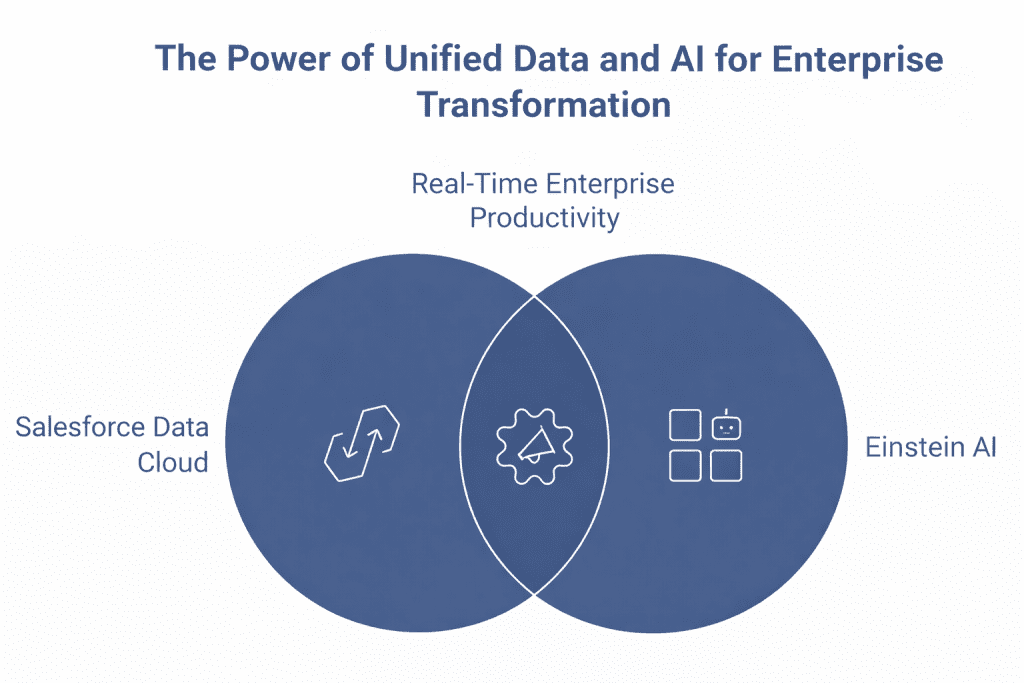
With Salesforce Data Cloud providing the unified data foundation and Einstein AI delivering intelligence and automation, companies can create systems that act, adapt, and optimize in real time. This shift is redefining enterprise productivity, customer engagement, and innovation through AI-powered CRM platforms.
The Rise of the Agentic Enterprise
The idea of an agentic enterprise marks a big shift in how businesses operate. Instead of relying only on people and manual processes, organizations are starting to use Salesforce AI agents that can assist teams and handle certain tasks on their own. These AI systems work alongside employees, helping businesses move faster and make smarter decisions.
AI agents can quickly analyze large amounts of data and highlight insights that would take humans much longer to find.
They help sales teams identify promising leads and suggest the next best action to move deals forward.
Marketing teams can automatically launch personalized campaigns based on real-time customer behavior using AI-powered CRM capabilities.
Customer service teams can resolve issues faster, sometimes even before the customer realizes there is a problem.
Understanding Salesforce AI in 2026
Salesforce has been steadily building its AI capabilities through Einstein AI Salesforce, bringing artificial intelligence directly into everyday Salesforce tools. What started as predictive insights and recommendations has now grown into a more advanced platform that includes generative AI, automation, and intelligent decision support. This evolution helps teams work smarter by embedding Salesforce AI into the applications they already use.
Generative AI helps teams draft emails, create content, and summarize customer interactions quickly.
Predictive AI analyzes trends to forecast sales performance and identify potential churn risks.
AI-powered insights recommend the next best action for sales, marketing, and service teams.
AI agents across the Salesforce ecosystem help organizations respond faster to changing customer needs and market conditions.
At Prolifics, we help businesses turn these Salesforce AI capabilities into real, practical solutions that fit their everyday workflows. Our team works closely with clients to connect Salesforce Data Cloud with their processes, helping them get real value from their Salesforce investments.
Data Cloud as the Foundation of AI
Salesforce Data Cloud brings all your customer data into one place, creating a unified and real-time view of your business. By connecting data from multiple systems, it helps teams understand customers more clearly and act on insights faster.
This strong data foundation allows AI tools like Einstein AI Salesforce to generate smarter predictions, recommendations, and automation. It also demonstrates how Salesforce Data Cloud and Einstein AI work together to power modern enterprise intelligence. With trusted and connected data, organizations can deliver more personalized experiences and strengthen AI-driven customer relationship management strategies.
Role of Einstein AI in Intelligent Automation
Einstein AI Salesforce acts as the intelligence engine within the Salesforce ecosystem, turning data into actionable insights. It helps teams work smarter by bringing predictive analytics, automation, and generative AI directly into everyday business workflows.
Delivers predictive insights that help sales, marketing, and service teams make smarter decisions.
Automates routine tasks such as lead scoring, case classification, and workflow recommendations.
Uses generative AI to draft emails, summaries, and customer responses quickly.
Provides real-time recommendations like the next best action for sales and customer engagement.
Continuously learn from business data to improve accuracy, insights, and operational efficiency.
These capabilities strengthen AI-powered CRM systems and enable smarter enterprise automation.
AI Agents and Autonomous Workflows
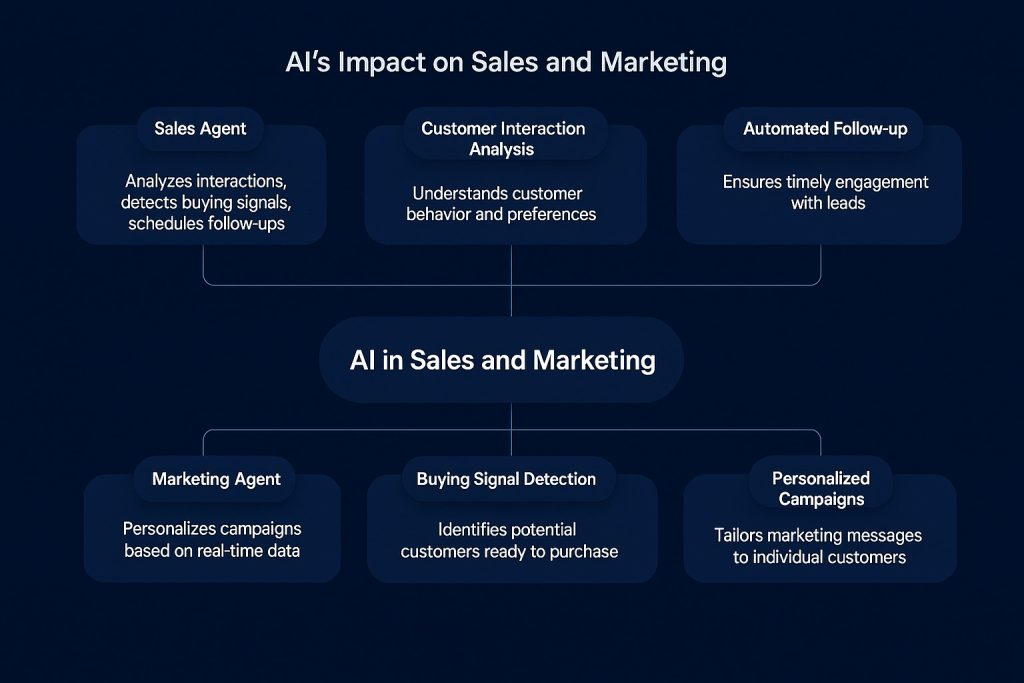
A key component of Salesforce’s AI strategy is the development of AI agents that execute business tasks autonomously. These agents can monitor workflows, analyze data, and take action without constant human supervision.
For example, an AI agent in a sales environment could analyze customer interactions, detect buying signals, and schedule follow up activities automatically. In marketing, agents could personalize campaigns based on real-time customer data.
These agents do not replace human employees but instead augment their capabilities. Human teams can supervise AI activities, refine strategies, and focus on complex decisions while AI handles operational tasks.
This collaboration between humans and AI agents creates a more agile and productive enterprise environment.
Responsible and Trusted AI
As AI adoption grows, organizations must ensure that their systems operate responsibly and transparently. Salesforce emphasizes trusted AI practices, including strong data governance and ethical AI guidelines.
Responsible AI involves maintaining data privacy, ensuring fairness in AI models, and providing transparency in automated decision-making. Organizations must also monitor AI systems to prevent bias and ensure compliance with regulatory requirements.
Salesforce provides tools that help businesses manage these responsibilities while maintaining control over their data and AI processes.
Business Impact of the Agentic Enterprise
The transition to an agentic enterprise delivers significant business benefits. Automation powered by AI can dramatically increase productivity by reducing manual tasks and accelerating workflows.
AI continuously analyzes real-time data, helping organizations make faster and more informed decisions.
Teams gain deeper insights into customer behavior, operational performance, and emerging market trends.
By automating routine work, AI gives employees more time to focus on innovation and strategic initiatives.
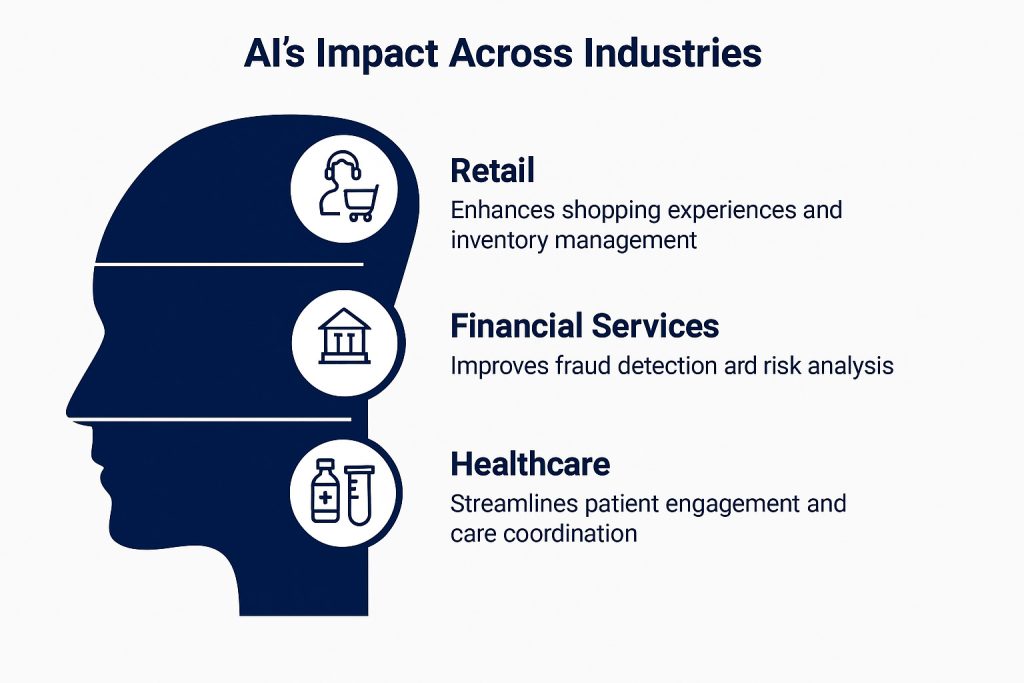
Use Cases Across Industries
The impact of Salesforce AI extends across multiple industries.
Retail: AI helps businesses analyze shopping patterns, personalize promotions, and optimize inventory management.
Financial services: AI supports fraud detection, risk analysis, and personalized financial recommendations.
Healthcare: AI can streamline patient engagement, improve data management, and enhance care coordination.
These industry-specific applications demonstrate how AI can deliver tangible business value while improving customer experience.
Preparing Your Organization for Salesforce AI
Organizations that want to adopt Salesforce AI should begin with a strong data strategy. Ensuring data quality, governance, and integration across systems is essential for successful AI implementation.
Businesses should also identify high-value use cases where AI can deliver immediate impact. Starting with targeted projects allows teams to build confidence and refine their AI strategies over time.
Training employees to work effectively with AI tools is equally important. When teams understand how to collaborate with AI systems, they can maximize the value of these technologies.
The Future of AI-Powered Enterprises
The future of enterprise technology will increasingly revolve around autonomous systems that combine data, intelligence, and automation. Salesforce’s vision of the agentic enterprise represents a step toward this future. Below are a few points that highlight how businesses are evolving to operate, collaborate, and create value:
AI agents will handle routine business processes, allowing teams to focus on strategic and creative work.
Unified data platforms will enable faster insights and smarter decision-making across the organization.
Businesses that adopt AI-driven systems early will be better positioned to innovate and stay competitive.
Conclusion
AI-powered platforms like Salesforce Data Cloud and Einstein AI are changing how businesses operate and make decisions. With unified data and intelligent automation, organizations can move faster and deliver better customer experiences.
The Agentic Enterprise model helps teams focus more on strategy while AI handles routine tasks. Businesses that build strong data foundations will be better prepared for this shift. At Prolifics, we help organizations adopt Salesforce AI in ways that drive real business value.
AI-ready data infrastructure is becoming the foundation for enterprises that want to scale artificial intelligence successfully. Artificial intelligence has moved far beyond experimentation. Enterprises are embedding AI into customer experiences, operations, and strategic decision-making. Yet despite massive investments in enterprise AI infrastructure and tools, many organizations still struggle to scale AI successfully.
The reason is simple. AI is only as powerful as the data behind it. Most enterprises have ample data, but very little of it is truly AI-ready. Data sits in silos, lacks governance, or is inconsistent across systems. Without a modern data infrastructure for AI, even the most advanced AI initiatives stall before reaching production.
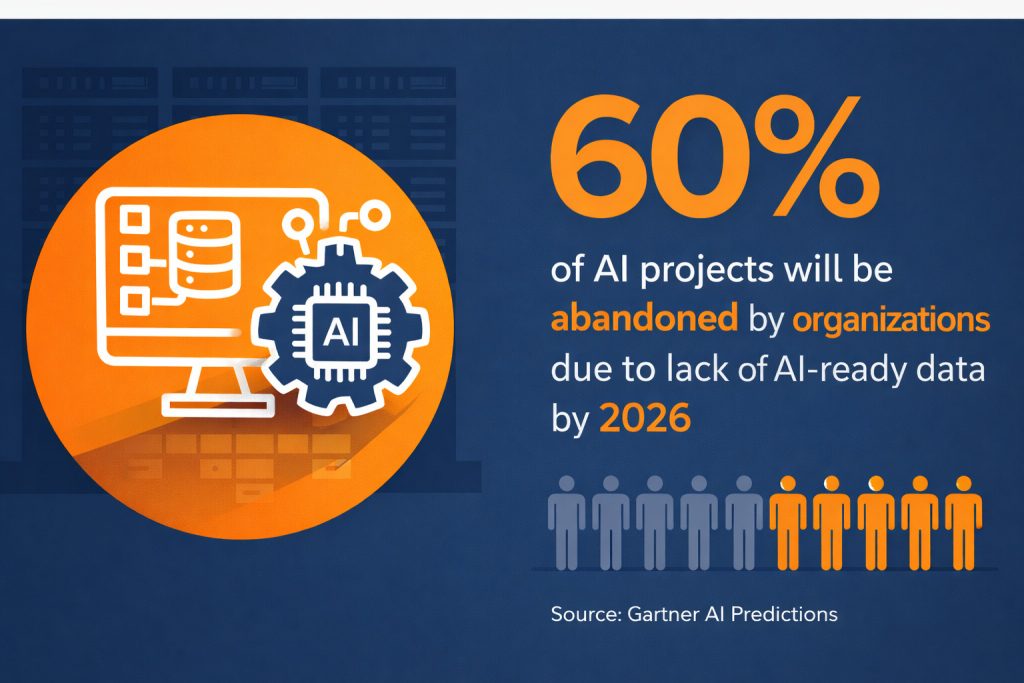
In fact, studies show that nearly 90% of AI initiatives fail to move beyond pilot stages because the underlying AI data infrastructure architecture isn’t prepared to support them.
To unlock real business value from AI, enterprises must rethink their data strategy and build AI-ready data infrastructure, a modern framework designed to manage, process, and operationalize data for intelligent systems.
What Is AI-Ready Data Infrastructure and Why Enterprises Need It
AI-ready data infrastructure refers to the systems, platforms, and governance frameworks that enable organizations to ingest, manage, process, and scale data for AI and machine learning workloads. This foundation often forms the data infrastructure for AI and machine learning that supports enterprise innovation.
Unlike traditional analytics infrastructure that is designed mainly for reporting, AI environments must support:
Massive volumes of structured and unstructured data
Real-time data pipelines
Continuous model training and inference
Automated governance and security
Scalable computing and storage
AI systems depend on accurate, contextualized, and scalable datasets that can feed machine learning models and enable intelligent automation within a strong enterprise data platform for AI.
For enterprises, this capability is more than a technical upgrade. It is a strategic differentiator. Organizations with integrated data ecosystems and strong enterprise AI infrastructure are far more likely to generate measurable business value from AI initiatives.
With the right enterprise AI infrastructure, organizations can:
Transform raw data into actionable insights
Accelerate AI innovation cycles
Deliver personalized customer experiences
Optimize operations with predictive intelligence
Enable autonomous decision-making
At Prolifics, we help enterprises modernize their data foundations by leveraging cloud, data engineering, and AI platforms to build scalable infrastructures aligned with AI data infrastructure architecture that turn data into real business outcomes.
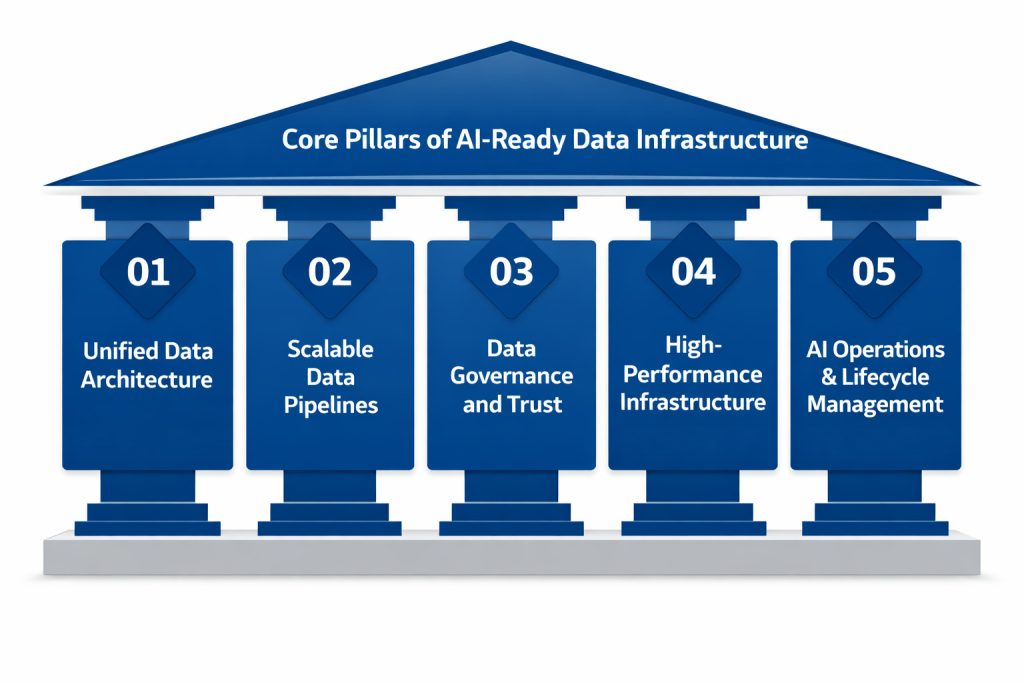
The Core Pillars of AI-Ready Data Infrastructure
Creating an AI-ready enterprise requires more than deploying AI models. It demands a holistic architecture built on several foundational pillars.
1. Unified Data Architecture
AI thrives on complete, connected data. Fragmented data silos prevent organizations from gaining a holistic view of operations.
Modern architectures such as data lakehouse architecture, data mesh frameworks, and unified data platforms enable seamless integration across enterprise systems.
These architectures allow organizations to:
Consolidate structured and unstructured data
Enable enterprise-wide data accessibility
Deliver consistent insights across business units
These capabilities support the best data architecture for scalable AI systems by ensuring unified access to enterprise data.
2. Scalable Data Pipelines
AI applications require continuous data ingestion and transformation pipelines.
Robust pipelines ensure data can be:
Collected from multiple sources
Cleansed and enriched
Delivered to AI models in real time
Without reliable pipelines, AI models quickly become outdated or inaccurate. Modern MLOps and AI data pipelines help organizations automate and manage these processes efficiently.
3. Data Governance and Trust
AI cannot function effectively without trusted and governed data.
Organizations must implement:
Data lineage tracking
Metadata management
Compliance and regulatory controls
Data quality monitoring
Strong governance ensures AI outputs remain transparent, ethical, and compliant while strengthening the data infrastructure for AI and machine learning.
4. High-Performance Infrastructure
AI workloads demand massive compute power and high-speed data processing capabilities.
Infrastructure must support:
GPU and AI accelerators
Distributed storage systems
High-speed networking
Hybrid and multi-cloud environments
These capabilities allow enterprises to scale AI from experimentation to production using a strong enterprise AI infrastructure and modern AI data infrastructure architecture.
5. AI Operations and Lifecycle Management
AI success requires operational frameworks such as MLOps, which manage the lifecycle of machine learning models from development to deployment and monitoring (Wikipedia).
MLOps ensures:
Continuous model improvement
Reliable deployment pipelines
Collaboration between data scientists and engineers
Together, these pillars form the backbone of AI-ready data infrastructure that enables enterprise-scale AI.
Challenges to Building AI-Ready Data Infrastructure
While the benefits are clear, building an AI-ready data infrastructure ecosystem is not without challenges.
Data Silos and Fragmentation
Many enterprises still operate with isolated data systems across departments, preventing unified insights and slowing AI development.
Poor Data Quality
AI models require accurate and unbiased datasets. Incomplete or outdated data leads to unreliable predictions.
Legacy Systems
Traditional architectures built for batch analytics cannot support real-time AI workloads or the massive data volumes required by modern data infrastructure for AI.
Governance and Compliance Risks
Without proper governance, organizations face challenges in:
Ensuring regulatory compliance
Tracking data lineage
Managing privacy and security
Infrastructure Complexity
AI systems require sophisticated environments that combine cloud platforms, data engineering pipelines, and machine learning frameworks.
For many organizations, managing this complexity internally becomes overwhelming.
This is where strategic technology partners like Prolifics play a critical role by helping enterprises design and implement modern AI data ecosystems.
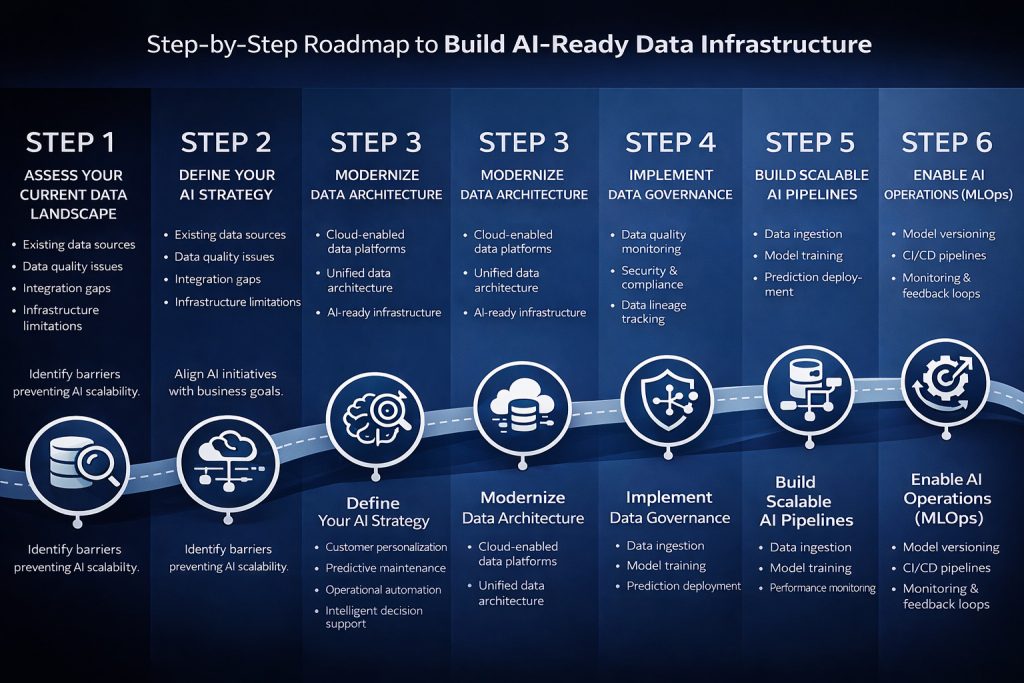
Step-by-Step Roadmap to Build AI-Ready Data Infrastructure
Transforming your enterprise data ecosystem requires a structured approach.
Step 1: Assess Your Current Data Landscape
Start by evaluating:
Existing data sources
Data quality issues
Integration gaps
Infrastructure limitations
This assessment identifies barriers preventing AI scalability.
Step 2: Define Your AI Strategy
AI initiatives should align with business goals such as:
Customer personalization
Predictive maintenance
Operational automation
Intelligent decision support
A clear strategy guides infrastructure investments.
Step 3: Modernize Data Architecture
Organizations must transition toward cloud-enabled data platforms and unified data architectures that support AI workloads.
This often includes:
Data lakehouses
Real-time streaming platforms
API-driven integrations
Step 4: Implement Data Governance
Establish policies and frameworks for:
Data quality monitoring
Security and compliance
Data lineage tracking
Strong governance builds trust in AI systems.
Step 5: Build Scalable AI Pipelines
Automated pipelines allow enterprises to continuously:
Ingest data
Train models
Deploy predictions
Monitor performance
These pipelines form the operational backbone of AI systems.
Step 6: Enable AI Operations (MLOps)
Operationalizing AI requires:
Model versioning
CI/CD pipelines
Monitoring and feedback loops
This ensures AI systems remain reliable and scalable over time.
Best Practices for Scaling AI Data Infrastructure Across Business Units
Once foundational infrastructure is in place, organizations must ensure AI can scale across the enterprise.
1. Adopt a Data-First Culture
Encourage data sharing and collaboration across teams.
AI innovation accelerates when data is treated as a strategic enterprise asset.
2. Implement Modular Architectures
Flexible architectures allow organizations to add new AI capabilities without disrupting existing systems.
3. Prioritize Real-Time Data Capabilities
Modern AI systems increasingly rely on real-time data streams for dynamic decision-making.
4. Invest in Data Observability
Monitoring tools ensure data pipelines remain healthy and reliable across environments.
5. Leverage Strategic Technology Partners
Building enterprise-grade AI infrastructure requires deep expertise across:
Data engineering
Cloud platforms
AI and machine learning
Integration and automation
Organizations benefit from working with experienced partners who can accelerate implementation and reduce risk.
Turning Data into Intelligence with Prolifics
The future of enterprise AI will be defined by who has the best data foundations. Organizations that invest in AI-ready data infrastructure today will lead tomorrow’s intelligent enterprises. Organizations that invest in AI-ready data infrastructure today will lead tomorrow’s intelligent enterprises.
At Prolifics, we help businesses transform fragmented data environments into scalable AI ecosystems through:
Data modernization and integration
Cloud and hybrid data platforms
AI and machine learning engineering
Automation and intelligent workflows
Governance-driven data strategies
With deep expertise across AWS, Google Cloud, Salesforce, and enterprise data platforms, Prolifics empowers organizations to unlock the full potential of AI.
Artificial intelligence has moved from experimentation to executive priority. Enterprises across industries are investing in machine learning, generative AI, and autonomous systems to improve efficiency, reduce costs, and unlock new growth opportunities.
For many organisations, building a successful Enterprise AI Implementation Strategy has become essential to turning innovation into measurable business outcomes.
Yet many organizations struggle to move beyond pilots. Proofs of concept demonstrate potential, but scaling AI securely, strategically, and profitably is where real transformation happens. Many enterprises still ask how to move AI from pilot to production while maintaining governance, integration, and business alignment.
The journey from idea to measurable ROI requires more than technology. It demands competency, structured execution, and enterprise-grade integration. A strong Enterprise AI Implementation Strategy combined with a proven AI ROI Framework helps organizations transition from experimentation to enterprise-scale impact.
Where Intelligence Meets Impact
AI success is not defined by the number of models deployed. It is defined by business impact, operational improvements, measurable savings, productivity gains, and scalable innovation.
A successful enterprise AI implementation strategy must be:
Integrated into existing workflows
Secure and governed with strong AI Governance and Security practices
Built on reliable data foundations
Designed for scalability
Aligned with clear business outcomes
This is where structured AI competency makes the difference and where organizations implement Scalable AI Solutions for Industry that drive measurable transformation.
The Enterprise AI Evolution
Enterprise AI maturity evolves across three strategic layers, forming the foundation of an effective Enterprise AI Implementation Strategy.
1. Classic Machine Learning – The Foundation
Traditional machine learning provides the analytical backbone of AI transformation. It enables:
Predictive analytics
Pattern recognition
Demand forecasting
Risk modelling
Workflow automation
This stage enables Operational Efficiency through Machine Learning, helping organizations make smarter decisions and optimize operational processes.
However, successful ML deployment requires more than model development. It demands strong data engineering, optimization frameworks, testing mechanisms, and seamless integration across enterprise systems.
Without this foundation, AI remains isolated and unsustainable.
2. Generative AI – The Creator
Generative AI introduces foundation models such as large language models (LLMs) and multimodal AI systems that create content, generate insights, and enhance productivity.
Organizations increasingly deploy Generative AI for Enterprise Workflows to enhance collaboration, automate documentation, and streamline knowledge discovery.
Enterprises are leveraging generative AI for:
Intelligent document processing
Automated reporting
Knowledge augmentation
Customer interaction enhancement
Context-aware decision support
This layer accelerates innovation, reduces manual effort, and enhances employee productivity. When deployed correctly within an Enterprise AI Implementation Strategy, Generative AI for Enterprise Workflows becomes a key driver of scalable business intelligence.
But to move from experimentation to enterprise value, governance, security, and workflow integration are critical.
3. Agentic AI – The Autonomous Future
The next frontier is agentic AI, intelligent agents that can plan, reason, and act autonomously to achieve business goals.
Modern Agentic AI Business Applications are redefining how enterprises orchestrate operations and decision-making.
Agentic systems move beyond task automation. They:
Orchestrate end-to-end workflows
Adapt dynamically to changing inputs
Coordinate across systems
Enable decision intelligence
These Agentic AI Business Applications transform AI from a supporting tool into a core operational capability within a scalable Enterprise AI Implementation Strategy.
This evolution transforms AI from a tool into an autonomous business capability.
Core AI Competencies That Enable Scale
Scaling AI requires more than algorithms. It requires structured frameworks and accelerators across the lifecycle.
Data & Analytics
Enterprise AI begins with trusted data. Key capabilities include:
Automated data migration
End-to-end data observability
AI-enabled data quality monitoring
Model testing and validation frameworks
These capabilities strengthen Data Foundations for Scalable AI, ensuring accuracy, reliability, and compliance across enterprise AI initiatives.
Strong data governance also reinforces AI Governance and Security, which is essential when scaling AI across departments and geographies.
These systems support Generative AI for Enterprise Workflows by embedding intelligent automation directly into daily operations.
Automation shifts from isolated scripts to coordinated, intelligent systems aligned with an organization’s Enterprise AI Implementation Strategy.
Integration & Platforms
AI must integrate seamlessly with existing ecosystems. This requires:
API-led architecture
Platform modernization
Secure deployment environments
Enterprise workflow connectivity
These integration frameworks help organizations deploy Scalable AI Solutions for Industry that can operate reliably across complex technology environments.
When AI integrates securely and intelligently, it enhances rather than disrupts business operations while maintaining strong AI Governance and Security controls.
Industry Impact: Applied Intelligence in Action
AI’s true value emerges when aligned to real-world industry challenges.
Across sectors, organizations are achieving measurable impact through Scalable AI Solutions for Industry, including:
Across sectors, organizations are achieving measurable impact through:
Predictive maintenance and digital twin modeling in manufacturing and energy
Supply chain optimization and forecasting in retail and distribution
Compliance automation and intelligent data pipelines in healthcare
Fraud analytics and document automation in finance
Smart infrastructure planning in public sector initiatives
These industry deployments demonstrate the growing importance of Agentic AI Business Applications and Generative AI for Enterprise Workflows in real-world enterprise environments.
AI is no longer experimental. It is operational, measurable, and transformative.
Measurable Business Outcomes
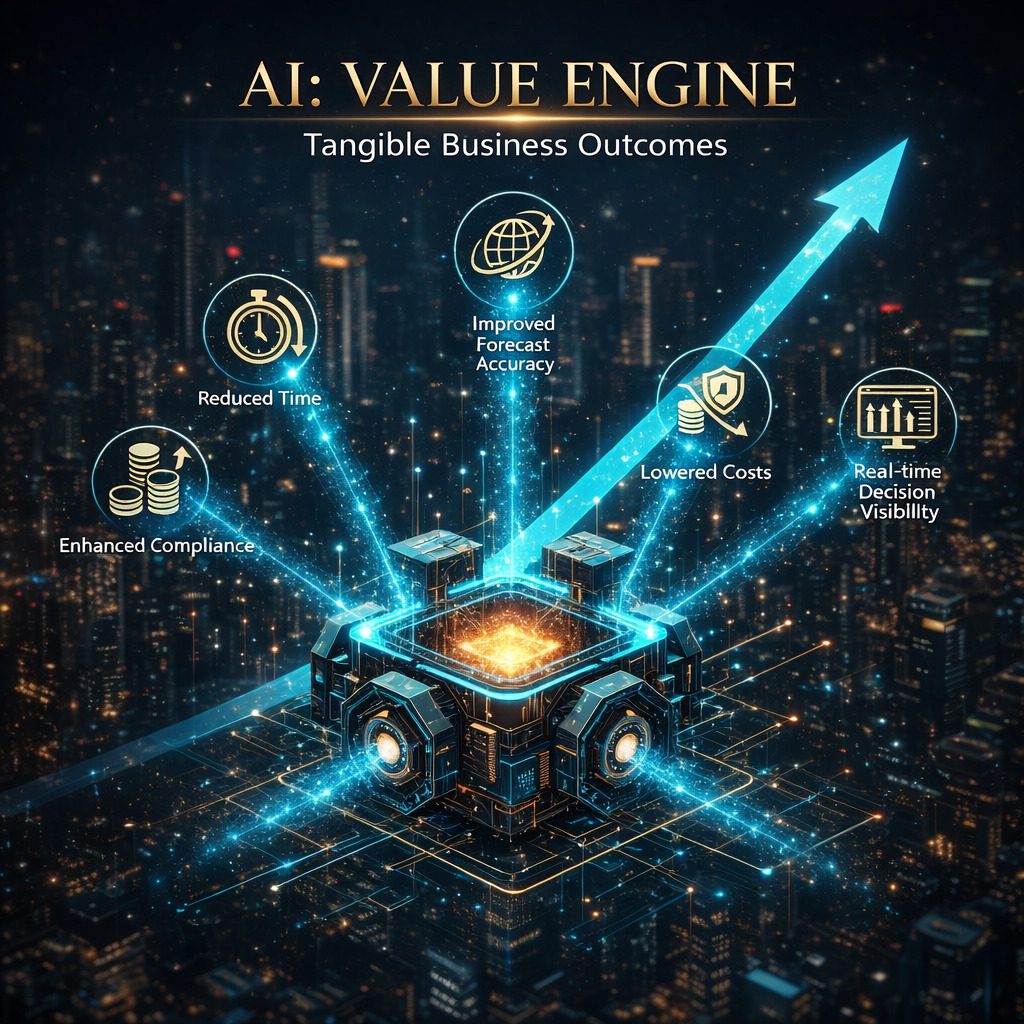
Enterprise AI initiatives are delivering tangible results, including:
AI creates tangible business value by transforming how organizations operate at scale. It simplifies complex workflows, improves planning confidence, and enables smarter allocation of resources across the enterprise. By minimizing inefficiencies and strengthening oversight, it supports more disciplined cost management and faster execution across strategic initiatives.
With intelligent insights embedded into everyday decision-making, organizations gain greater operational control and long-term performance stability. When deployed with clear structure and alignment, AI evolves from a technology initiative into a sustained driver of enterprise growth and measurable returns.
The Power of One: A Structured Path to ROI
AI transformation succeeds when innovation is paired with execution discipline.
The Power of One framework accelerates the journey:
Idea in One Day
Define opportunities, explore possibilities, and establish a clear solution hypothesis with a basic business case.
Prove in a Week
Develop a working prototype and refine the value proposition. Validate feasibility and investment viability.
Deliver in a Month
Launch a Minimum Viable Product (MVP) using a streamlined, scalable delivery model.
ROI in a Year
Scale across the enterprise with continuous enhancements, managed services, and measurable performance improvements.
This structured approach reduces risk, accelerates time-to-value, and ensures AI investments deliver sustainable returns.
From Experimentation to Enterprise Scale
AI transformation is not about deploying isolated tools. It is about building intelligent ecosystems that evolve with business needs.
Organizations that succeed:
Start with a clear strategy
Strengthen data foundations
Leverage accelerators for speed
Integrate securely with existing systems
Govern responsibly
Scale with measurable objectives
The journey from idea to ROI is intentional. It requires the right combination of expertise, frameworks, and execution rigor.
AI is no longer just a technology initiative. It is a strategic growth engine.
When intelligence meets impact, transformation becomes measurable, and ROI becomes inevitable.