Accessibility testing has historically been viewed as a regulatory obligation rather than a core quality practice. For many organizations, accessibility testing was introduced late in the software development lifecycle, often just before release, with the sole purpose of meeting minimum accessibility compliance testing thresholds.
This reactive approach to accessibility testing has created persistent challenges across enterprises, including:
Accessibility issues identified too late to resolve efficiently
Increased remediation costs and delayed release cycles
Inconsistent user experiences across devices and platforms
Elevated exposure to compliance, legal, and reputational risk
As digital platforms become critical to customer engagement, workforce productivity, and business operations, digital accessibility compliance has evolved beyond a checkbox exercise. Enterprises are now expected to deliver inclusive digital experiences while meeting expanding regulatory and legal expectations across global markets.
This shift is forcing organizations to rethink accessibility testing, moving it from a reactive compliance activity to an enterprise responsibility embedded within quality assurance, delivery, and governance models.
Accessibility Testing Is More Than a Compliance Activity
At its core, accessibility testing ensures that digital applications can be used effectively by individuals with diverse abilities. However, when accessibility is treated only as accessibility compliance testing, organizations fail to recognize its broader impact on usability, quality, and experience.
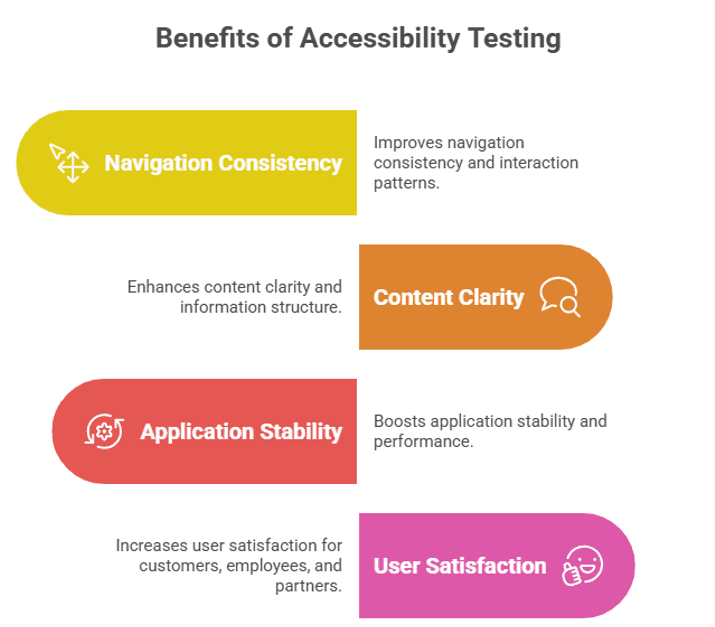
In practice, accessibility defects often reveal deeper quality issues. Poor keyboard navigation, unclear content hierarchy, or inconsistent interaction flows frequently affect all users, not only users with disabilities. Addressing accessibility early improves overall application quality and reduces downstream defects.
When accessibility is integrated into everyday testing practices, it strengthens usability, resilience, and trust across digital platforms.
The Growing Importance of Digital Accessibility Compliance
Regulatory scrutiny around digital accessibility compliance has increased significantly in recent years. The WCAG accessibility guidelines now serve as the global foundation for accessibility expectations, enforcement actions, and legal standards.
Enterprises must navigate multiple layers of compliance, including:
Web accessibility standards for public-facing websites and customer portals
Accessibility requirements for internal enterprise applications and tools
Region-specific regulations tied to accessibility obligations
For global enterprises, maintaining consistent digital accessibility compliance across regions adds complexity. Variations in regulatory interpretation, enforcement timelines, and documentation requirements demand a coordinated, enterprise-wide approach.
Non-compliance can result in legal action, financial penalties, delayed launches, and reputational damage. As a result, accessibility is no longer optional. It is a business risk factor that must be actively managed.
Why Enterprises Struggle to Move Beyond Accessibility Compliance
Despite increased awareness, many organizations struggle with how to move beyond accessibility compliance and embed accessibility into everyday delivery practices.
Common challenges include:
Accessibility testing introduced too late in the development lifecycle
Overreliance on automated tools without expert manual validation
Fragmented ownership across design, development, QA, and compliance teams
Absence of a unified enterprise accessibility strategy
These gaps lead to inconsistent results, repeated remediation cycles, and recurring compliance findings. Without governance, accountability, and integration into QA frameworks, accessibility efforts fail to scale effectively.
Rethinking Accessibility Testing for Enterprise Applications
Accessibility testing for enterprise applications requires a structured, continuous approach. Enterprise systems are complex, highly integrated, and frequently updated, making one-time validation ineffective.
A modern accessibility testing model includes:
Shift-Left Accessibility Testing
Accessibility considerations are introduced during design and development phases, reducing costly rework later in the lifecycle.
Continuous Accessibility Validation
Accessibility testing is embedded within agile and DevOps workflows, ensuring issues are identified as changes are introduced.
Balanced Testing Approach
Automated testing accelerates detection of common issues, while expert manual testing validates real-world usability and compliance against WCAG accessibility guidelines.
Risk-Based Reporting
Clear reporting mapped to compliance, usability, and enterprise risk metrics supports informed decision-making.
By shifting accessibility left and testing continuously, enterprises reduce remediation costs, improve release confidence, and maintain consistent user experiences.
Building an Enterprise Approach to Digital Accessibility Testing
An enterprise approach to digital accessibility testing treats accessibility as a core quality discipline rather than a standalone task.
Key components of a scalable enterprise model include:
Enterprise Accessibility Strategy
A defined strategy that aligns accessibility goals with business priorities, risk tolerance, and regulatory requirements.
Standardized Frameworks and Guidelines
Consistent application of web accessibility standards across all digital platforms and teams.
Governance and Accountability
Clear ownership models that define responsibilities across design, development, QA, and compliance functions.
Training and Enablement
Ongoing education that builds accessibility awareness and practical skills across delivery teams.
This structured approach enables enterprises to scale accessibility testing while maintaining consistency, quality, and compliance across complex digital ecosystems.
Accessibility Testing Services and Modern QA Practices
Modern accessibility testing services support enterprises by combining tools, expertise, and proven methodologies. Automated testing accelerates defect identification, while expert manual testing ensures usability, accuracy, and regulatory alignment.
When accessibility compliance testing is embedded into CI and QA pipelines, organizations benefit from:
Faster detection of accessibility defects
Reduced remediation effort and cost
Improved release predictability and confidence
Continuous compliance validation
Accessibility testing becomes part of continuous quality assurance rather than a last-minute gate.
The Business Value of Inclusive Digital Experiences
Beyond regulatory compliance, accessibility delivers measurable business value. Inclusive digital experiences expand audience reach, improve usability, and strengthen brand trust.
Enterprises that prioritize accessibility benefit from:
Higher customer and employee satisfaction
Reduced legal and regulatory exposure
Improved overall application quality
Stronger alignment with corporate responsibility and ESG goals
Accessibility becomes a strategic asset that supports growth, reputation, and long-term sustainability.
Key Takeaways
At Prolifics, we view accessibility testing as an essential component of enterprise quality assurance. It is not a one-time compliance exercise, but a continuous responsibility that supports both risk reduction and inclusive innovation.
Our approach focuses on:
Embedding accessibility into enterprise QA and testing strategies
Aligning digital accessibility compliance with usability and experience goals
Applying governance, reporting, and accountability models
Supporting enterprises across complex, regulated environments
Prolifics helps organizations move from reactive accessibility compliance to a proactive, scalable, and responsible accessibility testing practice.
Accessibility has evolved from a compliance requirement into an enterprise responsibility. As digital platforms continue to shape how organizations operate and engage, accessibility must be treated as a foundational element of quality.
Enterprises that rethink their approach can reduce risk, enhance user experience, and deliver digital solutions that are inclusive by design. With the right strategy, governance, and execution model, accessibility becomes a driver of trust, quality, and long-term success.
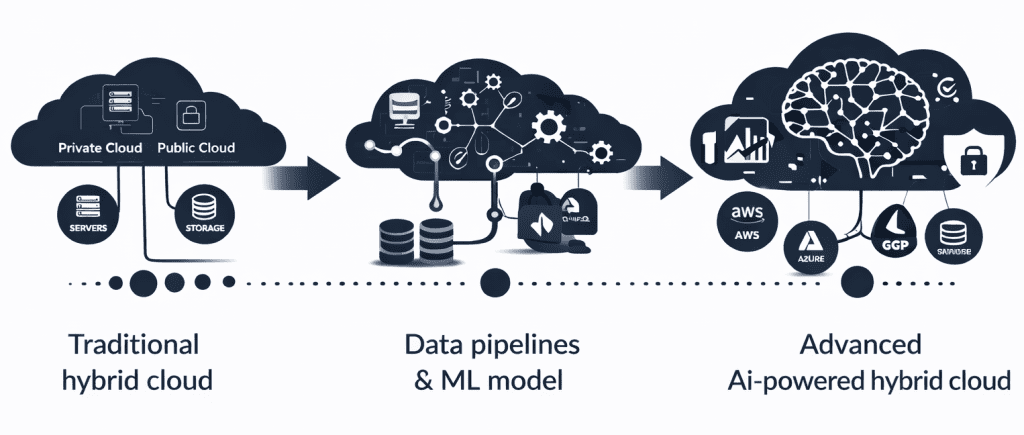
The evolution of hybrid cloud from traditional infrastructure to AI-powered environments is driven by data pipelines, machine learning models, and intelligent cloud integration. This transformation enables smarter workload management, faster decision-making, and better use of enterprise data.
It also allows organizations to build more scalable, secure, and intelligent hybrid cloud systems.
AI in Hybrid Cloud
AI in hybrid cloud is changing how modern enterprises manage data, applications, and workloads. By combining artificial intelligence with hybrid cloud models, organizations gain flexibility, intelligence, and control while keeping critical systems secure and highly available.
Understanding Hybrid Cloud and AI Together
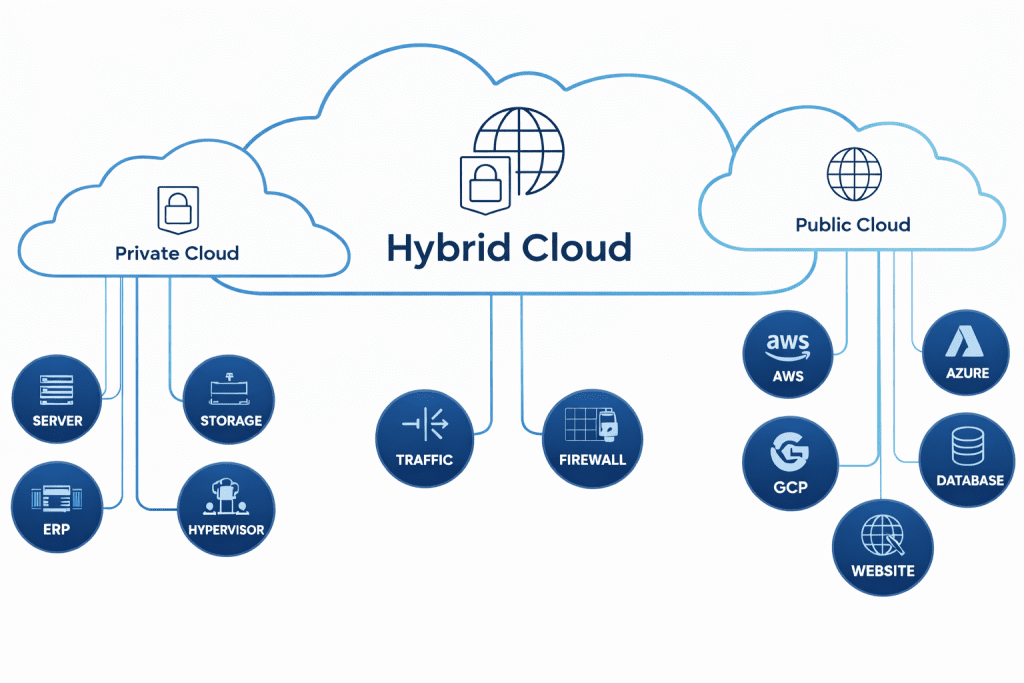
Hybrid cloud combines private cloud, public cloud, and on-premises infrastructure. It allows businesses to move workloads where it makes the most sense. AI adds intelligence to this setup by automating decisions, predicting issues, and optimizing performance.
Earlier, hybrid clouds were mainly about infrastructure. Now, it is about intelligence. AI helps analyze massive data, manage resources, and improve user experience. This shift is the real evolution.
Today, companies are not just using hybrid clouds. They are building enterprise AI hybrid cloud models where AI is deeply integrated into operations.
Why AI Became Essential in Hybrid Cloud
As data grew, manual management became slow and risky. Businesses needed faster insights and smarter systems. AI solved this problem.
AI helps organizations improve operational efficiency by allowing them to:
Predicting system failures
Managing workloads automatically
Improving security
Optimizing costs
This is why hybrid cloud AI solutions are now a core part of digital strategy.
AI Hybrid Cloud Architecture: How It Works
AI hybrid cloud architecture is designed to allow AI models to run across private and public clouds without disruption. The architecture includes key components that ensure smooth data flow, security, and intelligent automation:
Data pipelines across environments
AI models deployed close to data
Secure integration layers
Automated orchestration tools
The structure allows businesses to process sensitive data in private clouds while using public cloud power for heavy AI workloads. It gives both control and scale.
The Role of Hybrid Cloud Machine Learning
Hybrid cloud machine learning enables training and deploying models across different environments. For example, a bank may train models on private data but use public cloud GPUs for faster processing.
Organizations gain multiple advantages from this approach, such as,
Faster model training
Better data privacy
Lower infrastructure cost
Higher flexibility
Machine learning in hybrid cloud is not limited to IT teams. It is now used in marketing, finance, operations, and customer service.
AI Driven Hybrid Cloud Platforms Shaping the Future of Enterprise
Modern enterprises are adopting AI-driven hybrid cloud platforms that provide built-in AI capabilities. These platforms support smarter operations by enabling intelligent workload placement, automatic resource scaling, predictive maintenance, and real-time analytics to maintain stability, performance, and business continuity. This approach improves productivity and operational efficiency by adding intelligence to the hybrid cloud environment.
How AI Is Transforming Hybrid Cloud Environments
Let’s clearly understand how AI is transforming hybrid cloud environments into real life. It is not just a technical upgrade, but a practical change that improves daily operations, decision-making, and system performance. From automation to smarter resource management, AI is making hybrid clouds more efficient and reliable.
Intelligent Cloud Orchestration
AI automates workload movement between private and public clouds based on performance, cost, and demand. This is called intelligent cloud orchestration. It ensures that systems always run in the best environment.
Multi-Cloud AI Integration
Many enterprises use more than one cloud provider. Multi-cloud AI integration allows AI models and data to work smoothly across AWS, Azure, GCP, and private clouds.
Smarter Security
AI detects unusual behavior, identifies threats, and responds in real time. This improves security in complex hybrid environments.
Cost Optimization
AI predicts usage patterns and adjusts resources automatically. This avoids over-provisioning and reduces cloud bills.
Better Performance
AI monitors system health and fixes issues before users are affected. This improves uptime and user experience.
Benefits of AI in Hybrid Cloud Computing
AI brings real and visible improvements to hybrid cloud environments. It helps organizations work smarter, faster, and more efficiently in their daily operations.
The benefits of AI in hybrid cloud computing are clear and practical:
Operational efficiency: Less manual work and more automation across systems.
Scalability: Ability to handle business growth without infrastructure stress.
Data intelligence: Better insights generated from large and complex datasets.
Security: Proactive detection of threats and unusual activities.
Cost control: Smarter use of resources to avoid unnecessary spending.
Business agility: Faster response to changing market needs and customer demands.
These benefits make AI and hybrid cloud a strong combination for long-term success.
AI Use Cases in Hybrid Cloud for Enterprises
Enterprises across industries are actively adopting AI in hybrid cloud to improve performance, security, and decision-making. Here are real AI use cases in hybrid cloud for enterprises:
Predictive Maintenance
Manufacturing companies use AI to predict machine failures. Data stays on private cloud, while AI processing runs on public cloud.
Fraud Detection
Banks analyze transactions using AI models deployed across hybrid environments to ensure speed and data security.
Customer Support Automation
AI chatbots and virtual assistants run on hybrid platforms to deliver fast and personalized support.
Supply Chain Optimization
Retailers use AI to predict demand, manage inventory, and reduce delays using hybrid cloud data.
Healthcare Analytics
Hospitals analyze patient data securely while using AI for diagnosis and treatment recommendations.
Enterprise AI Hybrid Cloud Driving Business Transformation
An enterprise AI hybrid cloud approach gives organizations the right balance between control and innovation. It allows businesses to protect critical data while still using the power of AI at scale.
An enterprise AI hybrid cloud approach allows organizations to:
Keep sensitive data private
Use public cloud power for AI
Meet compliance needs
Scale without risk
This strategy is especially important in industries like finance, healthcare, and government.
Overcoming Challenges with AI Solutions
Hybrid cloud environments bring operational and management challenges. AI solutions help overcome these issues by simplifying processes and improving system control. Managing multiple environments is not easy. AI helps in simplifying operations, reducing human errors, automating monitoring, and improving visibility.
Without AI, hybrid clouds can become hard to control. With AI, it becomes a powerful business engine.
The Future of AI in Hybrid Cloud
The future of AI in hybrid cloud will focus on making systems more intelligent, autonomous, and responsive. Organizations will move beyond basic automation toward smarter and more adaptive cloud environments.
Deeper automation to reduce manual intervention and improve efficiency
Self-healing systems that detect and fix issues without human involvement
Real-time decision engines to support faster and more accurate actions
Advanced intelligent cloud orchestration to manage workloads across environments seamlessly
Hybrid clouds will no longer be limited to hosting applications. It will evolve into an intelligent environment that can think, learn, and adapt to business needs.
Conclusion
AI is no longer optional in hybrid cloud environments. It has become a critical part of the modern IT strategy. From hybrid cloud AI solutions to AI-driven hybrid cloud platforms, the shift is clear as AI makes hybrid clouds more intelligent, efficient, and reliable. For enterprises, adopting AI in hybrid cloud is more than a technology upgrade. It is a strategic step toward better performance, stronger innovation, and long-term business growth.
Modern enterprises generate vast volumes of structured and semi-structured data across cloud platforms, applications, IoT systems, and partner ecosystems. While cloud data platforms like Snowflake have solved scalability and performance challenges, many organizations still struggle to operationalize data at speed. The bottleneck is no longer storage or compute, it’s access. Traditional BI workflows rely heavily on centralized data teams, complex SQL queries, and static dashboards, slowing insight delivery and limiting business responsiveness.
Snowflake Intelligence changes this paradigm by embedding AI-driven, self-service analytics directly into the Snowflake Data Cloud. By combining governed semantic layers, natural language interfaces, and real-time data access, Snowflake Intelligence empowers business users to explore, analyze, and act on data independently, without compromising security, performance, or governance. This shift enables enterprises to move from reactive reporting to proactive, insight-led decision-making.
The Power of Self-Service Analytics in Snowflake
Self-service analytics empowers non-technical users, including product managers, finance teams, and operations leaders, to explore and analyze data without relying on SQL expertise or lengthy data engineering cycles. With Snowflake Intelligence, advanced large language models (LLMs), metadata-aware query engines, and secure data sharing work together to translate natural language business questions into optimized queries across the Snowflake platform.
This enables faster, more confident decision-making while maintaining enterprise-grade governance and security.
Enables business users to query data using intuitive, natural language interfaces
Eliminates dependency on data engineering teams for routine analytics requests
Leverages LLMs and metadata-aware engines for accurate, optimized query generation
Supports strategic questions such as margin performance, regional trends, and supply chain impact
Runs analytics directly on Snowflake’s single source of truth, ensuring data is current, consistent, and trustworthy
Accelerating Enterprise Agility
Enterprise agility depends on how quickly organizations can adapt to market changes, regulatory requirements, and customer expectations. Snowflake Intelligence accelerates agility in three keyways:
Faster Decision Cycles By eliminating dependency on centralized BI teams, organizations enable real-time decision-making at the edge of the business. Teams can experiment, validate hypotheses, and respond to trends without delays.
Consistent Governance at Scale Self-service does not mean loss of control. Snowflake’s native security, role-based access, and data governance ensure users only see what they are authorized to see, maintaining compliance while democratizing analytics.
Cross-Functional Collaboration With shared datasets, semantic models, and AI-assisted insights, teams across finance, operations, marketing, and IT work from the same data foundation, reducing silos and misalignment.
Unlocking Value in Various Use Cases
Organizations using Snowflake Intelligence for self-service analytics see immediate impact across forecasting, operational monitoring, customer analytics, and executive reporting. Whether enabling finance teams to model scenarios, supply chain leaders to identify disruptions, or executives to track KPIs in real time, Snowflake Intelligence turns data into a strategic asset, not a technical hurdle.
Why Prolifics?
Implementing self-service analytics successfully requires more than technology, it demands the right architecture, governance strategy, and change management. Prolifics helps enterprises design, implement, and scale Snowflake Intelligence solutions that deliver real business outcomes.
From Snowflake architecture optimization and semantic layer design to AI-driven analytics enablement and governance frameworks, Prolifics ensures your teams gain trusted, self-service access to insights, without sacrificing performance or control.
Ready to accelerate enterprise agility with Snowflake Intelligence? Partner with Prolifics to transform your data into decisions, faster, smarter, and at scale.
The AI technology trends of 2026 are no longer on the horizon they are live, operational, and reshaping competitive advantage right now. The global AI market has reached $434 billion in 2026, growing at a 41.95% CAGR toward $2.5 trillion by 2031 (Mordor Intelligence). Yet the most important statistic isn’t the market size it’s this: only 34% of organizations are truly reimagining their businesses around AI, while the remaining 66% are still optimizing legacy processes with AI layered on top (Deloitte State of AI in the Enterprise, 2026).
For executives, product leaders, and growth-focused organizations, understanding the emerging technology trends of 2026 is no longer a luxury it is a strategic imperative. The winners in the next wave of digital transformation will be those who move beyond experimentation, embed AI deeply into core operations, and convert market uncertainty into competitive advantage.
This guide breaks down the 8 most critical enterprise AI trends in 2026, the data behind each, and how your organization can act on them with a clear AI innovation roadmap that delivers measurable outcomes.
Quick Answer
The top AI technology trends for 2026 are: agentic AI moving into production workflows (Gartner’s #1 strategic priority, with 33% of enterprise software expected to include agentic capabilities by year-end), quantum computing crossing the enterprise threshold, AI efficiency replacing brute-force model scaling, end-to-end AI system orchestration, AI becoming a direct revenue engine, AI governance and sovereignty as competitive differentiators, domain-specific models outperforming general LLMs, and AI extending into physical operations through industrial IoT and robotics.
$434B Global AI market in 2026, growing to $2.5T by 2031 at 41.95% CAGR Mordor Intelligence
$114.9B Enterprise AI market in 2026, growing 18.91% annually Mordor Intelligence
34% of organizations truly reimagining around AI, the rest are optimizing legacy Deloitte, 2026
1. Agentic AI in Enterprise Moves from Hype to Production
Agentic AI in enterprise represents the most significant behavioral shift in how organizations use AI in 2026. Where earlier AI tools responded to instructions, agentic systems plan, act, self-correct, and complete multi-step tasks with minimal human supervision. Gartner predicts that 33% of enterprise software applications will include agentic AI capabilities by end of 2026.
IBM Distinguished Engineer Chris Hay describes the shift clearly: “In 2024, agents were small and specialized the email writer, the research helper. In 2026, agent control planes and multi-agent dashboards are becoming real. You kick off tasks from one place, and those agents operate across environments your browser, your editor, your inbox without managing a dozen separate tools.”
Automation at scale: End-to-end business workflows from procurement to customer onboarding executed autonomously with human-in-the-loop checkpoints only where required
Democratized innovation: Business users without deep technical expertise can now design and deploy agent-driven processes a shift Kevin Chung (Writer CSO) calls “the most exciting change of 2026”
Faster decision-making: Multi-agent coordination reduces approval friction, handoff delays, and context-switching across teams and systems
Governance reality check: 71% of organizations report they are not fully confident in autonomous AI agents for business-critical decisions (Neontri, 2026). Governance and human oversight frameworks are essential alongside deployment a point addressed in Trend 6 below.
For SAP-running organizations, agentic AI arrives through SAP Joule which in 2026 autonomously executes S/4HANA workflows including purchase order creation and financial reconciliation. For Salesforce environments, Agentforce is enabling autonomous agents across sales and service.
How Prolifics Helps
Prolifics enables enterprises to design and deploy agentic AI architectures embedding intelligence across operations, customer experiences, and decision frameworks aligned with an enterprise-wide AI innovation roadmap. From SAP Joule implementation to multi-agent orchestration, we help you move from pilot to production safely.
2. Quantum Computing Crosses the Enterprise Threshold
In 2026, quantum computing moves from research labs into selective enterprise production environments. IBM, Google, and a growing field of quantum-native startups are delivering systems capable of outperforming classical computers on specific high-value problems particularly in molecular simulation, financial portfolio optimization, and logistics route planning.
This is one of the most significant emerging technology trends of 2026 for industries with computationally intensive challenges: healthcare and life sciences, financial services, advanced manufacturing, and supply chain optimization.
Drug discovery: Problems that previously took months to solve computationally can now be addressed in days or hours
First-mover advantage: Early adopters in regulated industries gain optimization capabilities that classical compute simply cannot replicate at any cost
Hybrid architectures: Classical-quantum hybrid systems will define the enterprise infrastructure roadmap through 2027–2028
Prolifics helps enterprises assess quantum readiness, design hybrid classical-quantum architectures, and align quantum initiatives with business outcomes so organizations are positioned before the capability gap becomes a competitive gap.
3. AI Efficiency Becomes the New Scaling Strategy
The era of “bigger models at any cost” is definitively over. In 2026, efficiency has become the primary benchmark for AI innovation. With AI investments reaching $225.8 billion in 2025 representing 48% of all global venture capital the pressure to demonstrate ROI has intensified sharply.
Organizations pursuing an effective AI strategy for business growth are no longer asking “How large can we build this?” They are asking “How much value can we extract per dollar of compute?”
Hardware diversification: GPUs remain dominant (NVIDIA holds over 80% of AI accelerator market share), but ASICs and AMD’s Instinct MI325X outperforming NVIDIA’s H200 by 40% on key inference benchmarks are reshaping the competitive landscape
Edge-centric AI: Lightweight, optimized models running at the edge cut latency by up to 50% vs. cloud alternatives (Mordor Intelligence, 2026)
Cost-aware architecture: Large enterprises running on-premises AI report 20% lower operating costs versus equivalent cloud deployments at high utilization making efficiency a financial strategy, not just a technical one
Prolifics designs performance-optimized AI architectures, balancing cloud, hybrid, and edge environments to maximize ROI from every AI investment while minimizing operational complexity.
4. AI Systems Not Just Models Define Enterprise Leadership
In 2026, the competitive divide is not between organizations that have AI models and those that don’t. It is between those that have built end-to-end AI systems and those still running isolated AI experiments. According to McKinsey, only 34% of organizations have actually moved AI into production at scale the remaining 66% have not yet scaled enterprise-wide.
True enterprise AI value emerges when models are orchestrated with workflows, automation engines, data pipelines, and business applications. IBM’s Watson platform processed over 1 billion enterprise customer interactions in 2024 alone, a 40% year-over-year increase (IBM Annual Report 2024) illustrating the scale that system-level AI deployment achieves versus model-level experimentation.
Orchestration-first design: AI solutions built as integrated end-to-end systems, not standalone tools that require human handoffs
Multi-agent coordination: Intelligent agents that collaborate on complex, multi-step business problems autonomously
Enterprise interoperability: Seamless integration with existing data platforms, security frameworks, and ERP/CRM applications determines whether AI creates value or creates technical debt
Prolifics specializes in building enterprise-grade AI systems, orchestrating models, agentic AI agents, and workflows that operate as digital teams driving productivity, automation, and measurable business impact.
5. AI Becomes a Direct Revenue Engine, Not Just a Cost Tool
The strategic narrative around AI has decisively shifted. In 2026, AI is no longer being evaluated primarily through the lens of cost reduction. It is being measured against revenue generation, market expansion, and new business model creation.
Deloitte’s 2026 State of AI in the Enterprise report finds that worker access to AI rose 50% in 2025 and that twice as many business leaders as last year are now reporting transformative business impact not just efficiency gains. GenAI adoption grew from 6% in 2023 to 30% in 2025, a 5x jump in two years (Capgemini).
New revenue streams: AI-powered products, data monetization platforms, and AI-native services are creating revenue lines that did not exist 24 months ago
Hyper-personalization at scale: 73% of marketing executives in the US and Canada identify AI-powered personalization as the single most important trend shaping 2026 strategy (Statista)
Enterprise-wide transformation: AI is being embedded across supply chains, finance operations, field service, and marketing not just in digital-native functions
Prolifics aligns AI initiatives directly with business KPIs and revenue targets ensuring that AI investments translate into growth, agility, and sustainable long-term competitive value.
6. Trust, Security, and AI Sovereignty Become Strategic Differentiators
As agentic AI deepens its footprint inside enterprise operations, trust becomes the most important non-technical variable in the AI strategy for business growth. The EU AI Act is now in active enforcement in 2026. The US Executive Order on AI has driven federal contractors toward mandatory transparency frameworks.
AI sovereignty: Nations and enterprises alike are asserting control over their data, model weights, and deployment infrastructure. India, Japan, and the EU are investing billions in domestically governed AI capacity
Identity and access management for AI agents: Securing autonomous systems with access to enterprise APIs, financial systems, and customer data requires entirely new IAM architectures
Collaborative defense: Industry-wide approaches to combating deepfakes, AI-enabled fraud, and adversarial model attacks are becoming standard security practice, not advanced capability
Compliance timeline: The EU AI Act’s prohibited AI practices provisions have been enforceable since February 2025. High-risk AI system requirements take effect August 2026. Organizations without governance infrastructure are already exposed.
Prolifics embeds secure-by-design AI governance frameworks into every engagement ensuring compliance, auditability, and stakeholder trust across regulated, high-risk, and data-sensitive environments.
7. Open Source and Domain-Specific AI Create the Real Competitive Moat
In 2026, the generic large language model is a commodity. The real competitive advantage comes from domain-specific AI models trained on industry-specific data that outperform general-purpose alternatives on the problems that actually matter to your business.
Meta’s Llama family, Mistral, and a growing ecosystem of domain-tuned models have demonstrated that smaller, purpose-built models frequently outperform much larger general models on targeted tasks at a fraction of the compute cost.
Higher accuracy: A domain-specific model trained on healthcare claims data, legal contracts, or manufacturing sensor logs will consistently outperform a general GPT-class model on those specific tasks
Lower total cost of ownership: Smaller, efficient models reduce compute, maintenance, and inference costs SMEs can now access AI capabilities previously only available to large enterprises
Faster time to value: Industry-ready foundation models with domain pre-training reduce the data and fine-tuning required to reach production quality
This trend is particularly powerful in financial services the fastest-growing AI investment sector globally where domain-specific models enable faster credit decisions and measurable operational savings while maintaining the auditability required by regulators.
With deep industry expertise in healthcare, financial services, manufacturing, and the public sector, Prolifics builds custom domain-specific AI solutions where precision, compliance, and context are non-negotiable.
8. AI Moves into the Physical World Intelligent Operations at Scale
The final frontier of the AI innovation roadmap for 2026 is the extension of AI beyond software and screens into physical operations. Industrial IoT rollouts are now generating terabytes of sensor data daily, and AI-driven analytics is turning that data into real-time operational decisions. Smart manufacturing, autonomous logistics, and predictive field maintenance are moving from pilot to production across industries.
Smart manufacturing: Real-time AI-driven optimization of production quality, yield rates, and equipment uptime directly reducing scrap rates and improving throughput
Autonomous operations: AI-driven logistics planning, predictive maintenance, and autonomous service delivery are reducing operational costs and improving reliability
New digital-physical ecosystems: Connected infrastructure, smart buildings, and AI-managed utilities are creating entirely new operational models for enterprises with large physical footprints
Prolifics bridges digital intelligence with physical enterprise systems enabling end-to-end intelligent operations from the data layer through to physical automation and real-world outcomes.
Leading 2026: From AI Ambition to Enterprise-Scale Execution
The AI technology trends shaping 2026 are not future possibilities they are present realities that are actively determining which organizations will define the next decade of their industries and which will spend it catching up.
The data is unambiguous: the global AI market stands at $434 billion in 2026, enterprise AI investment is growing at 18.91% annually, and AI spending across hardware, software, and services is projected to exceed $2 trillion in 2026 alone (Gartner). Yet only 34% of organizations are truly reimagining their businesses the rest are still optimizing legacy processes.
Success in 2026 requires more than vision. It demands execution, governance, and measurable ROI. The organizations that will lead are those building AI systems not just deploying AI tools and aligning every AI investment with a clear business outcome.
What are the top AI technology trends for 2026?
The top AI technology trends for 2026 are: agentic AI moving into production enterprise workflows Gartner’s #1 priority, with 33% of enterprise software expected to include agentic capabilities by year-end quantum computing entering selective enterprise production environments, AI efficiency replacing brute-force model scaling, end-to-end AI system orchestration over isolated model deployment, AI shifting from cost optimization to revenue generation, AI governance and sovereignty as strategic differentiators, domain-specific AI outperforming general LLMs, and AI extending into physical operations via robotics and industrial IoT.
What are Gartner’s top strategic technology trends for 2026?
Gartner’s 2026 Strategic Technology Trends rank agentic AI as the #1 enterprise investment priority, alongside AI governance (TRiSM Trust, Risk, and Security Management), spatial computing, and polyfunctional robots. Gartner predicts that 33% of enterprise software applications will include agentic AI capabilities by end of 2026, making autonomous AI systems the defining technology investment of the year for CIOs planning their digital transformation budgets.
How is agentic AI different from generative AI?
Generative AI responds to prompts it produces content when asked. Agentic AI acts autonomously: it plans multi-step tasks, uses enterprise tools and APIs, self-corrects based on intermediate results, and completes entire workflows without human intervention at each step. In 2026, enterprise agentic AI systems manage end-to-end processes like procurement, customer onboarding, and financial reconciliation not just answering questions. The key distinction: generative AI is reactive; agentic AI is proactive.
What AI technologies should CIOs prioritize in their 2026 roadmap?
CIOs should prioritize four capabilities: (1) Agentic AI infrastructure the orchestration platforms and governance frameworks to deploy autonomous agents safely; (2) Data readiness clean, governed, accessible enterprise data is the prerequisite for every AI initiative; (3) Domain-specific model development industry-tuned models that outperform general LLMs on your specific use cases; (4) AI governance EU AI Act compliance and identity management for autonomous agents. The most successful 2026 roadmaps are co-built between technology and business stakeholders, not designed in isolation by IT.
How are AI trends affecting SAP and ERP transformation in 2026?
SAP Joule SAP’s embedded AI copilot now operates as an agentic AI system in 2026, autonomously executing S/4HANA workflows including purchase order creation, financial reconciliation, and HR approvals. Organizations planning S/4HANA implementation must maintain a Clean Core architecture to enable Joule’s full capabilities. SAP ECC end-of-mainstream-maintenance is 2027, making the migration timeline urgent for organizations who want access to 2026 AI capabilities within their ERP environment.
Managed testing services play a critical role as enterprise software now sits at the core of how modern businesses operate. From customer engagement and supply chain optimization to regulatory compliance and AI-driven decision making, software reliability directly affects performance and growth.
When software fails, the impact is immediate:
Revenue and operational efficiency take a hit
Customer trust and retention decline
Compliance risks increase
Digital transformation initiatives stall
Industry research shows that organizations facing frequent production issues experience higher downtime and customer churn than those that invest early in quality assurance. As systems grow more interconnected and release cycles accelerate, even small defects can create enterprise-wide disruption.
This is why leaders are rethinking how software testing services are delivered and governed. Managed testing services are no longer optional support functions. They are becoming a strategic necessity for enterprises navigating scale and complexity.
The Evolution of Software Testing in the Enterprise
Software testing has shifted from a final checkpoint to a continuous discipline embedded across the development lifecycle.
Historically, testing focused on:
Manual validation late in the release cycle
Isolated QA teams operating independently from development
Limited automation and fragmented tooling
Today, enterprise systems demand a very different approach.
Modern software testing services must support continuous integration, frequent releases, and real time feedback loops. This shift has led to the rise of enterprise testing solutions that emphasize automation, governance, and alignment with business outcomes.
Insight: Industry analysts consistently note that organizations practicing continuous testing detect defects earlier, reduce rework, and improve release confidence.
Why Traditional QA Models Are Under Pressure
As digital ecosystems grow more complex, traditional in-house QA models struggle to keep pace.
Enterprises face mounting pressure from:
Rapid adoption of cloud, SaaS, and microservices architectures
Increasing regulatory and security requirements
Growing reliance on data and AI driven applications
These pressures expose structural gaps in many QA organizations.
Key Challenges Enterprises Encounter
Difficulty hiring and retaining specialized QA talent
High costs associated with maintaining testing tools and environments
Inconsistent testing practices across teams and platforms
Limited visibility into quality metrics and risk exposure
These challenges explain the growing shift toward outsourced software testing and structured managed QA services that offer scalability and expertise.
What Managed Testing Services Deliver That Traditional Models Cannot
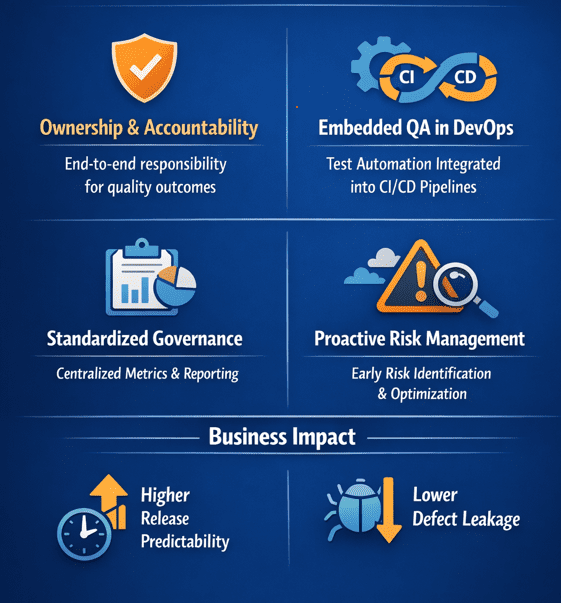
Managed testing services introduce a fundamentally different operating model. Instead of supplementing internal teams, they provide ownership, accountability, and continuous improvement.
A comprehensive managed testing model typically includes:
A defined quality assurance strategy for enterprises
Test automation and QA management embedded into DevOps pipelines
Centralized governance, metrics, and reporting
Proactive risk identification and optimization
This approach allows enterprises to standardize quality while remaining flexible enough to support innovation.
Insight: Organizations using managed testing models report higher predictability in release cycles and lower defect leakage into production.
Why Managed Testing Services Are Important for Enterprises Today
For enterprise leaders, the question is no longer whether testing is needed, but how it is delivered.
Understanding why managed testing services are important for enterprises starts with recognizing that quality failures carry real business consequences.
The Business Benefits of Managed Testing Services
Accelerated time to market through automation and continuous testing
Improved software stability and reduced production disruptions
Predictable costs compared to fluctuating in house QA expenses
Access to specialized expertise without long term hiring risk
These are not just technical gains. They directly support revenue growth, customer satisfaction, and operational resilience.
Enterprise Impact Across Industries
Different industries face different risks, but the role of quality remains universal.
QA testing services for enterprises are critical in:
Financial services, where regulatory compliance and system uptime are non-negotiable
Healthcare, where data accuracy and system reliability impact patient outcomes
Retail, where performance and user experience drive conversion and loyalty
Across industries, enterprise testing solutions help organizations reduce risk while supporting innovation at scale.
Insight: Enterprises with centralized quality governance outperform peers in both release velocity and production stability.
Managed Testing Services as a Foundation for Digital Transformation
Digital transformation initiatives introduce new layers of complexity that traditional testing models struggle to address.
Managed testing services for digital transformation support:
Validation of cloud migrations and platform modernization
Testing of complex integrations and data pipelines
Assurance for AI driven systems, models, and automated decisions
By embedding quality early, enterprises avoid costly rework and post-deployment failures that derail transformation programs.
What to Look for in a Managed Testing Partner
Choosing the right provider is essential to realizing value from managed QA services.
Enterprises should prioritize partners that offer:
An automation first approach aligned with modern delivery models
Proven experience across enterprise platforms and technologies
Strong governance, metrics, and transparency
A business outcome driven mindset
The right partner acts as a strategic extension of the enterprise, not just a testing vendor.
Final Perspective
At Prolifics, we believe quality assurance is no longer a downstream activity. It is a core component of business strategy. As enterprises scale digital initiatives, modernize platforms, and adopt AI driven solutions, testing must evolve to enable speed, trust, and long-term resilience.
Through our managed testing services, Prolifics helps organizations embed quality across the delivery lifecycle. Our approach focuses on automation, governance, and measurable business outcomes, enabling enterprises to reduce risk, accelerate transformation, and turn quality into a true competitive advantage.
For organizations navigating complexity at scale, Prolifics partners with clients to ensure quality becomes a foundation for sustained innovation and growth.
Modern businesses need a unified data platform to move faster with insights, reduce complexity, and scale AI initiatives -making data-driven decisions reliable, timely, and truly impactful. The Databricks Lakehouse has emerged as the definitive answer to that challenge.
According to Gartner, by 2026, more than 50% of enterprises will adopt a data lakehouse architecture as the foundation for their analytics and AI strategies – up from less than 15% in 2022. Forrester Research further notes that organizations deploying unified data and AI platforms report 40% faster time-to-insight and up to 35% reduction in data infrastructure costs compared to organizations running separate data warehouse and data lake environments. For CTOs and data leaders evaluating their next platform investment, the case for the Databricks Lakehouse has never been stronger.
What is Databricks Lakehouse?
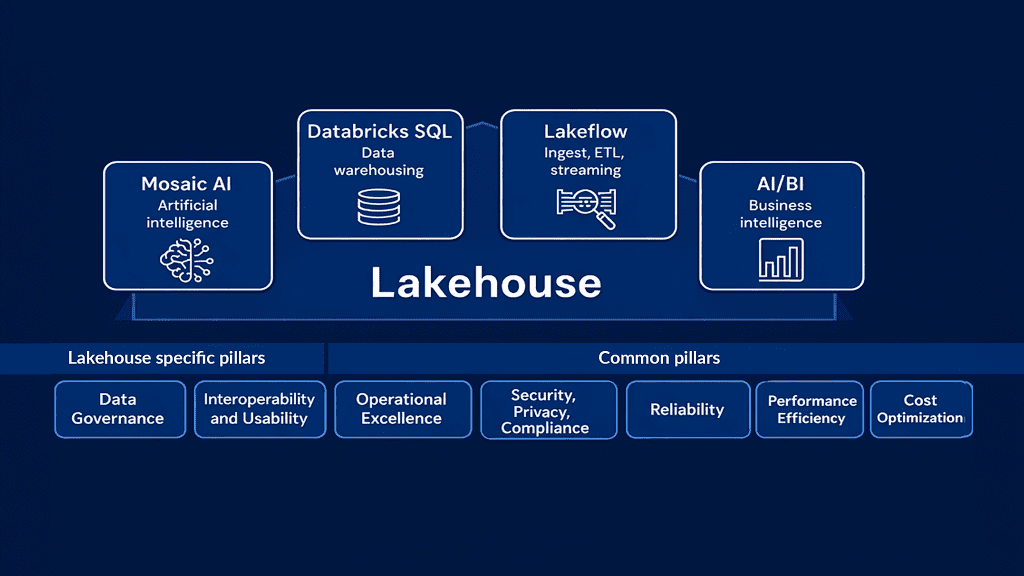
The Databricks Lakehouse is a modern data platform that combines the flexibility of data lakes with the performance and reliability of data warehouses. Built by Databricks, it allows organizations to store, process, analyze, and apply AI on all types of data in one place. Instead of managing separate systems for analytics, reporting, and machine learning, teams work on a single, unified data and AI platform.
This matters because it removes data silos, simplifies operations, and accelerates innovation across analytics and AI use cases delivering the speed and governance that enterprise data teams require in 2026.
Databricks Lakehouse Architecture: Built for Scale and Openness
The Databricks Lakehouse architecture is designed around a simple but powerful idea: keep data open, scalable, and accessible while delivering high-performance analytics and AI. At its core, the architecture is built on an open data lakehouse approach – where data lives in low-cost cloud storage and is governed by smart metadata and processing layers.
This architecture separates storage from processing power, allowing businesses to scale independently based on workload needs. Structured, semi-structured, and unstructured data coexist in the same environment. Tools for SQL analytics, data engineering, and machine learning all operate on the same data foundation – ensuring consistency and collaboration across teams.
The foundational elements of the Lakehouse include:
Native support for BI, data science, and engineering tools
Cloud object storage as the data foundation
Delta Lake for reliability, ACID transactions, and data quality
Scalable compute for analytics and AI workloads
Unified governance and security layer
How the Databricks Lakehouse Enables AI and Analytics
Imagine a world where analysts and data scientists don’t waste hours moving data between systems. On Databricks, everything happens in one place: data preparation, exploration, and modeling flow seamlessly – like chapters in the same story. No more copying files, no more delays, no more errors. Instead, teams work together on a single platform, turning raw data into insights faster than ever before.
According to IBM’s Data & AI Index, data teams that eliminate inter-system data movement reduce pipeline failure rates by 62% and cut model deployment timelines by an average of 3.4 weeks – directly translating to competitive advantage in AI-driven markets.
The lakehouse platform for AI also supports real-time and batch analytics together. This makes it easier to train models on historical data and apply them instantly to streaming or live data – enabling smarter and faster business decisions at enterprise scale.
Benefits for Machine Learning and Data Management
The Databricks Lakehouse simplifies how teams build, deploy, and manage AI solutions. It removes friction between data management and advanced analytics workflows delivering measurable advantages across the full data lifecycle:
Faster model development with Databricks for machine learning
A unified data analytics platform for SQL, Python, and ML
Consistent data quality using Delta Lake ACID guarantees
Lower costs with scalable cloud storage and compute
Better collaboration between analysts and data scientists
Strong governance across the full data lifecycle
Enterprise Use Cases for AI and Analytics on Databricks Lakehouse
Enterprises use the Databricks Lakehouse to turn raw data into intelligent action. Its flexibility supports both operational and strategic workloads across industries – from financial services and healthcare to retail, insurance, and the public sector.
Common Databricks Lakehouse use cases for enterprise AI include:
Predictive maintenance in manufacturing
Personalized recommendations in retail and media
Fraud detection and risk scoring in finance
Customer 360 analytics for sales and marketing
Demand forecasting and supply chain optimization
Real-time analytics for IoT data
Natural language processing for customer support insights
Real-World Use Case: Databricks Lakehouse in Financial Services
A regional U.S. bank managing over $18 billion in assets partnered with Prolifics to consolidate its fragmented data environment – spanning seven separate legacy systems – onto a single Databricks Lakehouse platform.
Key outcomes delivered within 9 months:
Time-to-insight reduced by 44% – enabling compliance and risk teams to access real-time regulatory reporting dashboards for the first time
Fraud detection model accuracy improved by 31% – powered by unified historical and streaming transaction data on Delta Lake
Data infrastructure costs reduced by 38% – by retiring three legacy data warehouses and consolidating onto cloud-native elastic compute
Model deployment cycle shortened from 6 weeks to 11 days – giving the data science team the agility to respond to market changes faster
Data governance coverage reached 100% of enterprise data assets within the unified platform – a critical requirement for OCC and Fed regulatory compliance
This transformation validated the Databricks Lakehouse vs traditional data warehouse value proposition in a highly regulated, data-intensive industry – demonstrating that the platform delivers not just analytics speed, but enterprise-grade governance and compliance readiness.
Databricks Lakehouse vs Traditional Data Warehouses
The Databricks Lakehouse vs data warehouse for analytics comparison shows a shift from rigid, siloed systems to open and flexible platforms.
Feature
Databricks Lakehouse
Traditional Data Warehouse
Data Types
Structured, semi-structured, unstructured
Mostly Structure
AI & ML Support
Native and integrated
Limited or external
Scalability
Elastic and cloud-native
Fixed and Expensive
Data Sharing
Open formats
Closed formats
Cost Efficiency
Optimized cloud storage
High storage costs
The Lakehouse delivers more flexibility, better AI support, and lower complexity than traditional warehouses — a distinction that becomes increasingly critical as generative AI workloads demand access to diverse, high-volume data at scale.
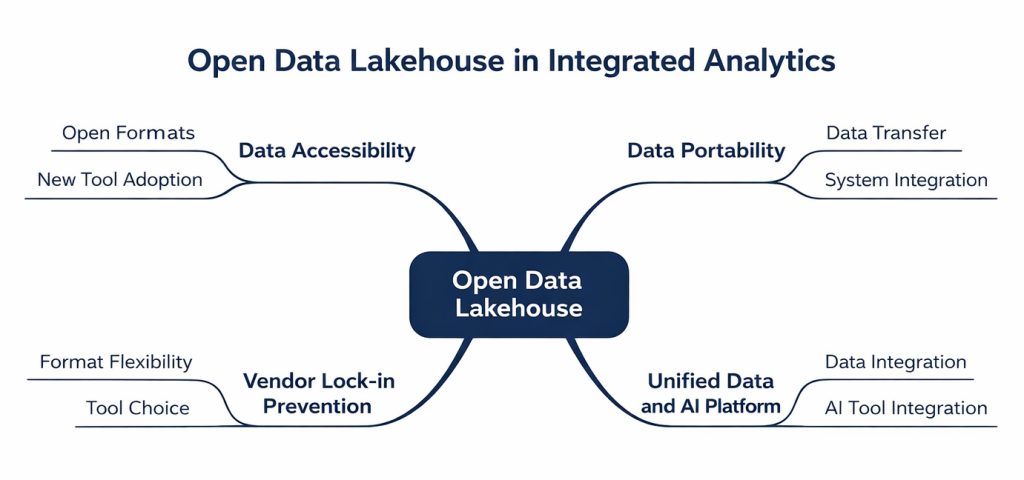
The Role of the Open Data Lakehouse in Integrated Analytics
An open data lakehouse plays a critical role in integrated analytics by keeping data accessible and portable. Open formats prevent vendor lock-in and allow organizations to adopt new tools while maintaining a unified data and AI platform. This openness is especially important as enterprises evaluate multi-cloud strategies and seek to future-proof their data investments against rapidly evolving AI tooling landscapes.
Future of AI Innovation with the Databricks Lakehouse Platform
The future of AI is about bringing data, analytics, and machine learning together on one platform. Lakehouse technology will drive real-time AI, smarter analytics, and intelligent applications at scale. As businesses embrace generative AI and advanced foundation models, the Databricks Lakehouse will provide a reliable, governed foundation that grows with their needs — without the complexity of maintaining disconnected data infrastructure.
Forrester projects that by 2027, enterprises running unified lakehouse architectures will outperform peers on AI initiative ROI by a factor of 2.3x driven by faster data access, reduced pipeline failures, and tighter integration between analytics and model deployment environments.
Conclusion: From Data to Decisions with Confidence
The Databricks Lakehouse is the next big thing because it brings data, analytics, and AI together on one powerful platform. It simplifies complex architectures and makes enterprise data management seamless. Businesses gain faster insights, better collaboration, and stronger AI capabilities. With open standards and cloud scalability, it supports both today’s analytics and tomorrow’s AI.
Most importantly, it helps organizations move from data to decisions with confidence – at the speed modern markets demand.
Real-world impact is already visible through this Databricks Lakehouse AI success story, showcasing how enterprises accelerate analytics and AI-driven outcomes. Whether you are modernizing a legacy data warehouse, scaling machine learning operations, or building a generative AI foundation, Prolifics has the expertise and accelerators to get you there faster.
As enterprises accelerate digital modernization, IBM Consulting has introduced a powerful solution designed to transform how organizations manage and evolve their SAP environments. The IBM Consulting Application Management Suite (ICAMS), launched amid rising demand for AI-driven innovation, is rapidly becoming a cornerstone of Intelligent SAP transformation initiatives and a core Enterprise SAP transformation strategy for global organizations.
With the global shift toward SAP S/4HANA and increasingly hybrid ERP landscapes, organizations face mounting complexity in SAP application management. Managing legacy systems, extensive custom code, and continuous operational demands has slowed adoption, with only a fraction of enterprises completing full SAP S/4HANA transformation programs due to scale, risk, and cost concerns key challenges addressed through AI-driven SAP modernization.
IBM addresses these challenges head-on with ICAMS, an AI-infused solution that simplifies the entire SAP application management lifecycle, from implementation to continuous operations. Built on generative and agentic AI, the suite enables AI-powered SAP operations that significantly reduce manual effort while improving system agility and resilience critical for any long-term enterprise SAP transformation strategy.
Key AI-Driven Capabilities of ICAMS
At its core, ICAMS applies AI across six critical areas of SAP operations, positioning it as an AI-driven SAP application management suite that supports scalable modernization:
Synthetic data generation for accelerated and reliable regression testing
Automated documentation to reduce dependency on manual knowledge transfer
Process flow reverse engineering for improved system understanding
Comprehensive impact analysis to minimize risks during changes
Proactive monitoring with AI-driven remediation to prevent disruptions
Adaptive script and story generation to support ongoing development needs
Together, these capabilities position IBM ICAMS as a powerful accelerator for intelligent SAP transformation, delivering measurable productivity gains, faster time-to-value, and stronger SAP application management outcomes across complex enterprise environments.
Client-aligned delta code generation: ICAMS translates complex change requirements into compliant, client-specific delta code, significantly reducing development cycles while mitigating regression risks, critical during SAP S/4HANA migrations and ongoing AI-powered SAP operations.
Automated testing and impact analysis: Built-in automation enhances release confidence by proactively identifying dependencies and risks, ensuring stability across every SAP release cycle.
Strategic enablement through IBM Consulting Advantage: More than a management tool, ICAMS serves as a scalable innovation platform that evolves with business needs, supporting AI-driven SAP modernization and automated SAP lifecycle management beyond static maintenance models.
Designed for hybrid enterprise ecosystems: As highlighted by recent Forbes insights, enterprises increasingly require seamless integration between SAP and non-SAP analytics platforms. ICAMS supports this shift through strong governance, cross-platform alignment, and optimized architectures, especially in Generative AI–enabled SAP environments.
Intelligent automation for enterprise resilience: By reducing operational overhead and improving integration across SAP and adjacent systems, ICAMS enables faster insights, smarter decision-making, and stronger operational resilience, demonstrating how AI simplifies SAP S/4HANA migration while future-proofing the enterprise.
Future-ready SAP transformation: As SAP support timelines evolve and system landscapes grow more complex, ICAMS plays a critical role in unlocking sustained business value post–go-live, leveraging Agentic AI to power continuous SAP operations and long-term enterprise modernization.
Where Prolifics Fits In
As organizations adopt solutions like ICAMS, Prolifics serves as a trusted transformation partner, helping enterprises operationalize intelligent SAP transformation at scale. With deep expertise in SAP application management, AI-driven SAP modernization, analytics integration, and enterprise transformation, Prolifics enables clients to maximize the value of IBM’s innovations.
By combining IBM Consulting technologies with Prolifics’ delivery excellence, organizations can move confidently from SAP S/4HANA transformation to sustained business outcomes long after initial go-lives.
In today’s digital economy, data is the engine that powers innovation, intelligence, and competitive advantage. Yet, moving data, whether from legacy systems to modern cloud environments or between platforms, remains one of the most complex technical and business challenges that enterprises face. AI-driven data migration has emerged as a critical enabler for enterprises looking to modernize faster and smarter.
Data migration projects are notorious for overrunning timelines, exceeding budgets, and jeopardizing data quality and security without a clear enterprise data migration strategy. Gartner research indicates that a significant majority of data migration initiatives exceed budget or fail outright without careful strategy and execution.
This is where Prolifics AI Data Solutions plays a transformational role. Prolifics combines industry expertise, artificial intelligence (AI), automation, and deep engineering capabilities to not just migrate data, but to modernize data ecosystems through AI-powered data migration, boost business value, and accelerate digital transformation through AI-powered data migration approaches.
Why Data Migration Remains Challenging
Before we explore Prolifics’ solutions, it’s essential to understand why many data migrations falter:
1. Data Integrity and Loss Migrating large volumes of data across systems can lead to data loss or corruption if formats, schemas, or validation rules aren’t perfectly aligned. Such inconsistencies can disrupt analytics, reporting, and downstream processes, especially during cloud data migration for enterprises.
2. Compatibility and Schema Differences Legacy systems and modern platforms often use disparate data structures. Without thorough data mapping and transformation logic, data may become unusable after migration, weakening efforts toward data modernization with AI.
3. Downtime and Disruption Traditional migration techniques can cause systems to go offline, compromising business continuity and potentially leading to revenue loss, especially in mission-critical environments such as cloud data migration for enterprises.
4. Security and Compliance Risk Sensitive data moving between environments must remain secure at all times. Inadequate encryption, weak access control, or a lack of compliance governance can expose organizations to breach risks and regulatory penalties during AI-driven data migration.
5. Budget Overruns and Project Delays Analysts report that many data migration efforts exceed cost estimates by double digits, often due to unforeseen complexities and insufficient planning tied to an ineffective enterprise data migration strategy.
6. Post-Migration Challenges Even after successful transfer, organizations can face compatibility issues, missing data, and user adaptation problems if remediation and validation practices aren’t incorporated.
Best Practices for Successful Data Migration
To counter these challenges, market best practices help frame a successful migration driven by data modernization with AI:
Comprehensive Planning & Assessment: Establishing a clear roadmap with business and technical stakeholders ensures all data sources, quality issues, and dependencies are well documented.
Data Profiling & Cleansing: Identifying data quality issues early reduces the risk of migrating irrelevant or corrupt data.
Incremental Migration & Testing: Phased migration with ongoing validation minimizes risk and enables early error detection.
Security & Governance: Encrypting data in transit and at rest, enforcing access controls, and embedding compliance measures protect sensitive information throughout AI-powered data migration initiatives.
Automated Validation: Using AI-powered validation tools strengthens data migration automation and ensures data integrity is preserved before, during, and after migration.
Post-Migration Support: Organization readiness, user training, and production-level support ensure seamless adoption of the new environment.
While these practices are widely recognized, successfully applying them at scale requires intelligent tooling that clearly demonstrates how AI improves enterprise data migration outcomes.
Prolifics’ Approach to AI-Driven Data Modernization
Prolifics delivers end-to-end AI and data solutions that help enterprises not just move data, but unlock its full value through AI-driven data migration. With industry-leading capabilities spanning strategy, engineering, analytics, and governance, Prolifics accelerates data transformation while mitigating risk using AI-powered data migration capabilities.
1. AI-Powered Migration Automation: Prolifics ADAM
One of the signature offerings in the Prolifics portfolio is ADAM (Automated Data and Migration), an AI-accelerated framework that automates critical migration tasks and strengthens data migration automation such as:
Schema conversion and normalization
Data transformation and cleansing
Automated validation and reconciliation
Business continuity with minimal downtime
ADAM leverages AI to reduce manual effort, decrease errors, and drastically shrink migration timelines, supporting automated data migration solutions and often achieving over 50% faster execution compared to traditional approaches.
2. Cloud & AI Data Cloud Migrations
Prolifics specializes in moving data to leading cloud platforms such as Snowflake, ensuring that migrations deliver more than just a new home for data they deliver a modern analytics foundation through cloud data migration for enterprises. These cloud migrations include:
Legacy warehouse modernization
End-to-end pipeline transformation
Rebuilding or refactoring analytics stacks
Integration with BI tools and ML workflows
A structured, AI-augmented migration plan ensures minimal risk, optimized performance, and measurable ROI at every stage of an enterprise data migration strategy.
3. Intelligent Data Engineering & Analytics
Post-migration, the work of extracting business value begins. Prolifics’ AI-powered data engineering and analytics services help enterprises do just that through data modernization with AI:
Automated data preparation and enrichment
AI-enabled anomaly detection and data quality monitoring
Real-time analytics and predictive insights
Cloud-native, scalable data pipelines
These capabilities reduce manual effort by 60-70% and accelerate time-to-value for data insights, demonstrating how AI improves enterprise data migration outcomes.
4. Security, Compliance & Governance
Prolifics embeds robust data governance frameworks into every migration and analytics engagement, ensuring that data privacy, regulatory compliance, and security controls are upheld throughout secure AI-driven cloud data migration design, execution, and operations.
5. Industry-Focused Expertise
Whether in banking, healthcare, retail, manufacturing, or government, Prolifics brings domain knowledge that aligns data initiatives with unique industry challenges and regulatory landscapes, ensuring outcomes that are both strategic and achievable while advancing enterprise data modernization.
Business Impact: Turning Data Challenges into Strategic Advantage
By integrating AI with engineering rigor and business empathy, Prolifics helps organizations eliminate the friction typically associated with data migration and modernization through AI automation for legacy data migration. The result is more than a technical transition it’s a platform for competitive differentiation.
Reduced Costs and Faster Time-to-Value AI automation and repeatable frameworks preserve budget and schedule commitments by reducing manual toil and unexpected remediation cycles.
Improved Data Trust and Accuracy Automated validation, cleansing, and governance layers ensure that data remains consistent and reliable, amplifying confidence in analytics and reporting.
Enhanced Business Continuity Minimizing downtime and ensuring smooth cutovers means core business functions stay online during migrations, protecting operations and customer experience.
Tangible Outcomes and ROI Organizations that partner with Prolifics often see measurable improvements in agility, insight velocity, and strategic alignment, supported by AI-ready data ecosystems that fuel innovation.
Conclusion
Data migration doesn’t have to be a project burdened by risk, uncertainty, and hidden costs. By combining best practices with AI-driven data migration, automation, and deep engineering expertise, Prolifics AI Data Solutions turns data modernization into a strategic growth enabler.
Whether modernizing legacy systems, enabling cloud data migration for enterprises, or building a foundation for AI-driven analytics, Prolifics delivers a roadmap that is agile, secure, scalable, and aligned to business value.
Government agencies across federal, state, and local levels face growing pressure. Case volumes continue to rise. Eligibility rules are becoming more complex. Staffing constraints limit the ability to scale operations. At the same time, citizens expect services that are timely, transparent, and responsive. Many now compare government experiences to those they receive from AI-powered government services in the private sector.
Over the past decade, automation and workflow tools have helped streamline individual steps in government processes. These efforts supported early government automation with AI initiatives. However, many agencies remain locked in reactive operating models. Case backlogs grow faster than they can be resolved. Eligibility decisions take weeks or even months. Fraud and risk are often identified only after damage occurs.
Agentic AI in government represents a fundamental shift. Rather than automating isolated tasks, agentic AI enables systems to reason across policies, documents, and data. These systems act within defined guardrails and support human decision makers with transparency and accountability. This approach plays a key role in AI for public sector modernization.
Understanding Agentic AI in a Government Context
Agentic AI refers to AI systems designed to pursue defined objectives through reasoning, decision-making, and coordinated actions. Unlike rule-based automation, which follows fixed logic paths, agentic systems can interpret context, adapt to new information, and operate across multiple steps in a workflow.
This difference matters in government environments. Public-sector workflows are rarely linear. A single case may involve multiple programs, overlapping eligibility criteria, missing documents, and frequent policy changes. Agentic AI in government is designed to manage this complexity while remaining constrained by governance frameworks, compliance requirements, and human oversight.
Importantly, agentic AI does not replace public servants. It acts as a digital workforce. These systems support case workers, investigators, and administrators by handling repetitive analysis, surfacing insights, and documenting decisions. This directly strengthens intelligent case management in government and supports audit readiness.
Eligibility Determination Agents
The operational challenge
Eligibility determination is one of the most demanding government functions. Programs covering healthcare, income assistance, housing, education, and social services rely on detailed rules. These rules vary by jurisdiction and individual circumstances.
Case workers must gather data from multiple systems. They validate documents, interpret policy language, and ensure decisions are applied consistently. Manual processing increases delays and errors. These challenges directly contribute to backlogs, highlighting how agentic AI reduces government case backlogs.
How agentic AI supports eligibility determination
Eligibility determination agents interpret policy logic and apply it consistently across cases. These agents analyze structured and unstructured data from approved sources. They evaluate eligibility criteria, identify missing or conflicting information, and route exceptions to human reviewers. This approach reflects using agentic AI for eligibility determination in government.
Each step is fully documented. The agent records:
Which policy rules were applied
Which data sources were referenced
Why a recommendation was generated
This creates a clear audit trail. It supports transparency, compliance, and fairness through explainable AI for government.
Autonomous Document Routing and Summarization
The document burden in government
Government agencies manage large volumes of unstructured documents. These include applications, evidence, correspondence, and records. They arrive through many channels and formats. Manual review slows processing. It pulls staff away from higher-value work and increases compliance risk.
Agentic AI in document workflows
Agentic AI can classify and route documents automatically. It generates structured summaries while maintaining full case context and policy relevance. With clear document lineage and early detection of missing information, agencies reduce rework and improve accuracy. This strengthens government automation with AI while improving service delivery.
Fraud and Risk Detection with Transparent, Auditable Decisions
The complexity of fraud detection in government
Fraud and risk detection must balance effectiveness with fairness. Agencies must detect suspicious activity early. At the same time, they must avoid opaque models that cannot be explained to auditors, courts, or the public.
Agentic AI treats fraud and risk detection as a continuous and explainable process. Agents analyze patterns across cases, transactions, and documents. When anomalies are detected, they are flagged for review.
Each flag includes a clear explanation. The system shows why a case was identified, which indicators were used, and what evidence supports the finding. This enables transparent AI systems for public sector decision making and aligns with OECD and NIST guidance.
Where Prolifics Fits in the Agentic AI Journey for Government
Applying agentic AI in government requires more than technology. It demands a deep understanding of public-sector operations, regulatory environments, and real-world agency constraints.
Prolifics follows a policy-first, use-case-driven approach. Agentic systems are designed as part of a connected ecosystem that spans data, integration, automation, and governance. This supports AI for public sector modernization at scale.
A Practical and Responsible Approach
Prolifics works with agencies to identify high-impact, low-risk entry points, such as:
Eligibility screening
Document intake
Fraud risk analysis
Each use case is mapped to existing policies and compliance requirements before automation begins. Solutions are built as policy-driven AI systems and are designed to:
Operate within defined policy guardrails
Integrate with existing platforms
Support human decision makers
Maintain transparency and auditability
Engineering Trust and Scalability
Governance and trust are embedded into solution design. Every agent action is traceable. This includes data sources used, policy logic applied, and reasoning behind recommendations. This approach strengthens responsible AI in government without adding operational burden.
By aligning agentic AI with broader modernization initiatives, Prolifics helps agencies scale capabilities while maintaining control and consistency across programs.
Enabling Proactive Citizen Services
When agentic AI spans eligibility, documentation, and risk detection, agencies gain a holistic view of citizen needs. This allows a shift from reactive processing to proactive service delivery.
Agencies can:
Identify eligibility renewals before benefits lapse
Notify citizens of missing information earlier
Prioritize high-risk or high-impact cases
These outcomes improve equity, reduce frustration, and optimize resource allocation through AI-powered government services.
Governance, Guardrails, and Responsible AI
Responsible AI is essential in government. Agentic AI systems operate within strong governance frameworks. These include human-in-the-loop oversight, role-based access controls, continuous monitoring, and full audit trails.
This design aligns with standards such as the NIST AI Risk Management Framework and global governance models. It reinforces trust in explainable AI for government.
A Practical Path Forward for Agencies
Agencies do not need to replace existing systems. They can start with focused pilots and integrate agentic capabilities into current workflows. Over time, they can expand as maturity and confidence grow.
Well-defined use cases help agencies prove value, build internal trust, and establish governance practices that support long-term transformation in intelligent case management in government.
Key Takeaway
Government agencies are at a critical inflection point. Demand is rising. Resources are constrained. Citizen expectations continue to grow. New service models are required.
Prolifics helps agencies apply agentic AI in government responsibly. By combining intelligent automation with governance-driven design, agencies can move beyond backlogs toward proactive, citizen-focused services. When implemented thoughtfully, agentic AI strengthens integrity, reduces administrative burden, and empowers public servants to deliver lasting public value.
Modern manufacturing is changing fast. Factories are no longer limited by human work shifts or manual checks. Instead, they are moving toward lights-on manufacturing, where production runs all the time, without stopping, and makes smart decisions on its own. The key to this change is agentic AI in manufacturing, a new type of artificial intelligence that can think and act independently.
In this blog, we will explain how continuous autonomous operations work, why they are important, and how agentic AI in manufacturing is transforming the future of 24/7 smart manufacturing and intelligent industrial environments.
What Are Lights-On Operations in Modern Manufacturing?
Lights-on operations refer to manufacturing environments that function 24/7 with minimal or no human intervention, even during nights, weekends, or holidays. The term originates from the idea that factories no longer need constant human presence or even physical lighting to operate, a core principle of lights-on manufacturing.
In a lights-on factory, machines check their own health, and production lines adjust automatically to demand. Quality is monitored in real time, and issues are fixed or escalated without human help, enabling autonomous manufacturing systems to operate reliably at scale.
• Machines self-monitor performance and health • Production lines automatically adjust to demand • Quality checks happen in real time using vision systems • Exceptions are handled autonomously or escalated digitally
This approach is essential for AI-driven smart factories, where speed, accuracy, and reliability make all the difference. Continuous autonomous operations allow manufacturers to meet global demand, keep processes consistent, and handle disruptions instantly without waiting for human intervention, strengthening intelligent manufacturing operations across facilities.
Role of Agentic AI in Achieving 24/7 Efficiency
Agentic AI in manufacturing enables factories to run continuously without human involvement. Through real-time decision-making, adaptive responses, and seamless process coordination, agentic AI delivers the speed, precision, and resilience required for uninterrupted 24/7 smart manufacturing and large-scale autonomous manufacturing systems.
What Makes Agentic AI Different?
Agentic AI surpasses traditional rule-based systems by introducing adaptive, goal-oriented intelligence that evolves with every decision. It can be:
• Set goals and plan actions to achieve them • Learn from outcomes and improve decisions over time • Coordinate with other AI agents and machines for seamless operations • Act independently within defined safety and operational constraints
This intelligence layer is foundational for intelligent manufacturing operations that require minimal human oversight while maintaining high performance.
Key Benefits from Predictive Maintenance to Zero Downtime
Predictive maintenance allows manufacturers to address issues before equipment failure occurs, minimizing unplanned downtime. This supports smoother operations, improved efficiency, and more reliable production in AI-driven smart factories.
Predictive Maintenance
Agentic AI for predictive maintenance in factories analyzes sensor data, vibration patterns, and historical failures to predict breakdowns before they occur. Maintenance becomes proactive rather than reactive, significantly extending equipment life.
Reduced Downtime
By anticipating failures and optimizing schedules, factories move closer to near-zero unplanned downtime, a major cost saver in high-volume lights-on manufacturing environments.
Optimized Workflows
AI agents dynamically balance workloads across machines, adjust production sequences, and eliminate bottlenecks without manual planning, enabling self-optimizing manufacturing systems.
Cost and Energy Efficiency
Continuous optimization reduces waste, minimizes scrap, and lowers energy consumption by running machines only when needed and at optimal settings, strengthening 24/7 autonomous manufacturing operations with AI.
Consistent Quality
AI-driven inspection systems detect defects in real time, ensuring uniform quality even at high production speeds within autonomous manufacturing systems.
Challenges and Considerations for Implementation
Despite its promise, implementing lights-on operations powered by agentic AI in manufacturing is not without challenges. Organizations must address issues such as integrating data from legacy systems and ensuring strong cybersecurity measures. In addition, workforce upskilling and clear governance frameworks are essential to build trust in autonomous decision-making systems.
Data Integration
Factories often operate with fragmented legacy systems. Integrating PLCs, MES, ERP, and IOT platforms into a unified data fabric is complex but essential for intelligent manufacturing operations.
Cybersecurity Risks
Autonomous, connected systems expand the attack surface. Strong cybersecurity architectures, real-time monitoring, and zero-trust models are mandatory for AI-driven smart factories.
Workforce Adaptation
Lights-on manufacturing does not eliminate jobs; it changes them. Workers must transition from manual control to roles focused on supervision, AI training, system design, and exception handling.
Governance and Trust
Giving AI decision-making authority requires clear boundaries, explainability, and auditability to ensure safety and compliance.
Workforce Skills and Change Management
As factories adopt lights-on manufacturing and agentic AI in manufacturing, the role of the workforce shifts from manual execution to system supervision and decision support. Employees must be upskilled to work alongside intelligent systems, interpret AI-driven insights, and manage exceptions.
Effective change management, including training, clear communication, and leadership support, is essential to ensure smooth adoption and long-term success.
Scaling Agentic AI Across Global Manufacturing
As manufacturers scale globally, agentic AI in manufacturing will evolve from isolated deployments to networked intelligence across plants, regions, and supply chains.
Key trends shaping the future include:
• Digital twins that simulate entire factories in real time • Multi-agent systems coordinating across production, logistics, and procurement • Self-optimizing supply chains that adapt instantly to demand shocks • Deeper integration with Industry 4.0 standards and, eventually, Industry 5.0’s human-centric focus
In the coming years, competitive advantage will no longer come from automation alone but from autonomous intelligence at scale within 24/7 smart manufacturing ecosystems.
Conclusion
Lights-on operations powered by agentic AI in manufacturing represent a significant shift in modern manufacturing, enabling continuous, intelligent, and reliable production. By combining predictive maintenance, autonomous decision-making, and optimized workflows, manufacturers can reduce downtime, improve efficiency, and remain competitive in a rapidly evolving industrial landscape.
Learn how cloud-based ERP modernization supports scalable, intelligent manufacturing by exploring this SAP S/4HANA Cloud modernization case study.
While challenges around technology, security, and workforce adaptation remain, organizations that invest thoughtfully in these areas will be best positioned to lead the next phase of intelligent manufacturing operations.