A leading American healthcare distributor, responsible for delivering medications, medical supplies, and critical health technologies, relies on a massive SAP ecosystem with 400+ interfaces and 40,000+ custom tables. Frequent SAP patches were essential, but validating every change manually slowed down innovation and delayed system upgrades.
For nearly two decades, Prolifics has been the client’s trusted testing partner. To overcome mounting inefficiencies and accelerate SAP readiness, we introduced a modern, low-code test automation approach powered by Tricentis Tosca.
Our experts evaluated multiple tools, migrated testing operations to Tosca, and empowered the client’s SMEs, non-technical users, to build and execute automated tests independently. This eliminated bottlenecks between business and development teams, reduced test creation time, and ensured faster validation of SAP enhancements.
The results were transformative:
30% faster automation efforts
25% lower maintenance costs
Zero disruption during patch releases
Impressed by the efficiency gains, the client expanded Prolifics’ role to support their SAP HANA migration, reinforcing the value of a long-term, innovation-driven partnership.
Unlock the full story behind this SAP testing transformation.
Artificial Intelligence is now central to digital transformation. From automated workflows to intelligent assistants, large language models (LLMs) are revolutionizing how organizations operate. But as these models evolve, they also introduce new risks, especially those related to manipulation and prompt misuse that can compromise output integrity.
Traditional IT safeguards weren’t designed to handle this kind of cognitive manipulation. That’s why organizations need a new layer of control, an LLM firewall, to protect AI systems from unintended behavior and maintain reliable, policy-aligned responses across every stage of the generative pipeline.
In this piece, we’ll explore how LLM firewalls ensure safe and responsible AI operations, maintain data integrity, support AI governance and compliance, and strengthen trust in enterprise AI environments.
Understanding Prompt Injection: The New Integrity Challenge
Imagine asking your company’s AI assistant to summarize internal data, but instead, it’s tricked into revealing information it shouldn’t. This is a form of prompt injection—a manipulation technique that embeds hidden or misleading instructions to alter how an AI system behaves.
Such manipulations can:
Override intended instructions
Cause data leakage or unauthorized exposure
Skew insights or recommendations
Spread inaccurate or biased information
Unlike traditional IT risks, prompt manipulation targets the language reasoning of the model itself. It exploits semantics rather than code, making proactive control essential for prompt injection defense and overall Generative AI risk management.
Why Traditional Controls Aren’t Enough
Conventional IT safeguards rely on structured permissions and static rule sets. AI, however, operates contextually—it learns, adapts, and interprets language dynamically. That flexibility, while powerful, also introduces unpredictability.
To maintain control and governance, organizations need a new kind of oversight—AI workflow protection—specifically designed for generative systems.
That’s where LLM firewall solutions come in. These intelligent filters inspect prompts, analyze intent, and enforce context-aware rules before the AI processes the request, enhancing AI model protection across operations.
What Is an LLM Firewall?
An LLM firewall is a specialized validation and control layer designed for language models. It acts as a checkpoint between users and the AI, evaluating every input and output for compliance, alignment, and potential misuse to support AI governance and compliance.
Core Functions Include:
Prompt and response filtering – Scanning for manipulation attempts, misleading phrasing, or conflicting instructions.
Context validation – Ensuring AI responses remain aligned with organizational policies and approved access levels.
Data protection – Preventing unintentional exposure of sensitive or private information.
Interaction monitoring – Tracking patterns and anomalies in AI use and responses.
Model hardening – Training models to recognize and resist improper or harmful inputs for stronger AI model protection.
Together, these functions create a trust-first AI environment where every instruction, dataset, and output is validated before proceeding. The result is better governance, more reliable automation, and continuous AI integrity.
How LLM Firewalls Strengthen AI Workflows
The role of an LLM firewall extends beyond simple prompt checks. It becomes the backbone of enterprise-grade AI governance.
When integrated effectively, an LLM firewall can:
Protect AI workflows from manipulation and output distortion
Enable compliance with data protection and governance frameworks
Maintain auditability and transparency across all AI interactions
Enforce real-time policy controls within automated processes
This makes LLM firewalls an essential part of building responsible, high-integrity AI workflows that scale with organizational needs while supporting Generative AI risk management.
LLM Firewall in Practice: A Real-World Example
Consider a financial institution using generative AI to summarize client data. Without safeguards, a misconfigured prompt could unintentionally pull private information into a report.
With an LLM firewall in place:
The system flags and filters potentially risky prompts
The interaction is logged and reviewed automatically
The AI continues its task with verified policy-aligned inputs
The outcome: seamless automation with full control and traceability.
Best Practices for Maintaining Secure and Reliable AI Workflows
To ensure responsible AI use, organizations should combine technology, governance, and culture.
Key Best Practices
Map every point where your AI interacts with external data or users
Implement LLM firewalls across touchpoints for prompt validation
Adopt zero-trust AI principles, verify every input and output
Use governance tools for traceability and compliance
Apply model hardening and regular validation to reduce drift
Continuously refine policies as models evolve
The Future of Responsible AI Governance
As AI systems become more interconnected, governance must evolve toward adaptive control and self-correcting mechanisms.
We can expect:
Firewalls that adjust automatically based on interaction context
AI pipelines that maintain integrity through built-in validation
Unified governance frameworks combining compliance, auditability, and automation
These advancements will transform AI oversight from a manual process into a continuous, intelligent safeguard.
Conclusion: Turning AI Reliability into a Competitive Advantage
AI’s potential is boundless when paired with governance and trust. Organizations that invest in workflow validation, LLM firewalls, and data protection frameworks aren’t just avoiding risk; they’re building confidence in every AI decision.
By embedding validation and monitoring into your generative systems, you ensure innovation thrives responsibly.
Build Trustworthy AI at Scale
Your AI doesn’t govern itself, but your organization can. Partner with Prolifics to design and manage intelligent AI workflows that combine performance, reliability, and governance for the enterprise.
Hyderabad – November 2025 –Databricks has rolled out a significant upgrade to its Agent Bricks interface, enabling organisations to fine-tune AI agents with unprecedented accuracy and domain awareness. With the launch of three new capabilities, Agent-as-a-Judge, Tunable Judges, and Judge Builder, enterprises can now align agent behaviour with business-specific standards and pervasive compliance regimes more reliably.
Problem Statement & Market Need
In the era of generative AI and autonomous agents, organisations often confront the dual challenge of scalable agent deployment plus rigorous evaluation. Generic scoring mechanisms frequently fall short when evaluating domain-specific workflows, such as clinical summaries, financial advice, or customer-service de-escalation, that require nuanced judgments about correctness, tone and regulatory compliance.
The need is clear: enterprises must embed domain-expert logic into the agent evaluation loop, or risk unpredictable outcomes, poor alignment and operational risk. The new Agent Bricks enhancements directly address this gap.
Technical Innovation: How It Works
Agent Bricks, which integrates MosaicML technologies such as the TAO synthetic data generation API and Mosaic Agent platform, already offers an automated evaluation system that generates benchmarks and traces agent execution flows. The upgrade adds three major artefacts:
Agent-as-a-Judge: This facility allows the agent’s own execution trace to become a subject of evaluation. Developers gain the ability to inspect trace segments automatically, without writing bespoke traversal logic, accelerating the discovery of performance bottlenecks and mis-judgements.
Tunable Judges: Enterprises can now define their own “judge” logic, criteria for correctness, tone, compliance, domain-specific accuracy, via an SDK (make_judge in MLflow 3.4.0) that allows custom LLM-judges to evaluate tasks using Python-defined natural-language criteria.
Judge Builder: A visual interface built into the Databricks workspace, enabling subject-matter experts (SMEs) to craft and adjust evaluation criteria without heavy dev effort, democratising agent quality control and making it accessible to non-engineers.
Why It Matters to Enterprises
From a sales and solutions perspective, the message is compelling: organisations moving from pilot to production need more than “does the agent respond”, they need “does the agent respond correctly, safely and in line with our business rules.” Databricks positions Agent Bricks as the enterprise-ready bridge between generative-AI capability and production-grade governance.
According to analyst commentary, when tailored compliance, domain-rules and business-specific evaluation matter, Databricks holds an edge over competitors such as Snowflake, Salesforce and ServiceNow via its deeper customisation of the agent-judge loop.
Call to Action: How Prolifics Can Help
For businesses looking to unlock the full value of generative-AI agents, whether in customer-service, automated workflows, domain-specific assistants or decision-support systems—this is where Prolifics comes in. We help you harness Agent Bricks by defining evaluation frameworks, engineering domain-specific judge logic, integrating with your data pipelines, and aligning agents with your regulatory and brand governance.
With Prolifics’ deep expertise in data-led transformation and AI productionisation, you can move beyond proof-of-concept into scalable deployment with confidence.
Outlook & Takeaways
The launch of Agent Bricks’ custom evaluation toolkit signals a maturation of agent-centric AI deployment: not just “generate” but “validate and govern.”
For enterprises that demand accuracy, trustworthiness and traceability in their autonomous agents, Databricks’ new features deliver a stronger foundation. And with Prolifics as your partner, you can navigate the technical architecture, evaluation design and governance layer seamlessly turning AI agents into reliable business assets.
Discover how Prolifics revolutionized a traditional dairy enterprise into an intelligent, data-driven operation. Leveraging SAP S/4HANA Public Cloud, SAP Analytics Cloud, and SAP Integration Suite, we empowered the client with real-time visibility, automation, and end-to-end process control, from milk collection to financial reconciliation.
Our digital automation strategy replaced manual inefficiencies with Bluetooth-enabled weighing systems, digital quality checks, and predictive maintenance planning, ensuring unmatched accuracy and transparency.
Farmers, chemists, and agents gained real-time insights into milk movement and payments, while leadership accessed unified dashboards for faster, data-backed decisions.
The result? A sustainable, smart dairy ecosystem that sets new benchmarks for efficiency, quality, and agility. What was once a manual process is now an intelligent, connected supply chain, strengthening partnerships and driving profitability.
At Prolifics, we help businesses move from vision to value faster. Learn how our digital automation expertise can transform your traditional processes into future-ready ecosystems.
Download the case study to explore how we made this transformation a reality.
Our client, a top IT Asset Management (ITAM) company, wanted a faster and more reliable way to manage their growing platform. They needed a partner who could help them scale, improve quality, and speed up software releases.
Prolifics made it happen.
The Challenge
The client faced big roadblocks:
Previous vendors couldn’t scale or meet quality needs.
They needed a stable .NET development team.
Release cycles were too slow for market demand.
Costs were rising, and flexibility was low.
They needed a real partner, not another short-term vendor.
Our Approach
We focused on speed, stability, and teamwork.
Here’s what we did:
Built a hybrid team with onshore and offshore experts.
Used agile methods for faster delivery and feedback.
Became a strategic partner, not just a service provider.
Created a strong, long-term roadmap with the client.
The Solution
We set up a full .NET Software Factory to support growth and innovation.
Key results:
Built and launched a major new platform version.
Improved performance, usability, and reliability.
Delivered continuous updates through agile sprints.
Designed a scalable model that adjusts with demand.
Cut costs without sacrificing quality.
The Results
Faster releases and higher product quality.
Smooth operations during growth periods.
Ongoing innovation and system improvements.
A trusted partnership that continues after eight years.
The client now runs one of the most advanced platforms in IT asset management, with Prolifics as their long-term partner.
Why Clients Choose Prolifics
End-to-end digital solutions.
Expertise in data, automation, AI, and integration.
Proven success across industries.
Flexible and cost-efficient delivery models.
We help organizations turn complex challenges into measurable results.
Let’s Build What’s Next
Looking to modernize your platform and speed up growth? Prolifics can help you design smarter workflows, scale faster, and reduce risk.
Talk to our experts today. Start Your Digital Transformation
When rapid growth began to challenge visibility and efficiency across multiple business units, a leading specialty chemicals manufacturer turned to Prolifics for a unified digital transformation. With 10 manufacturing units, 6 warehouses, and 3 R&D centers spread across India, the client needed more than just an ERP upgrade, they needed an intelligent backbone for their expanding enterprise.
Prolifics deployed SAP S/4HANA Cloud (Private Edition) to transform complex workflows into seamless, data-driven operations. From finance to production, sales, and supply chain, every process was connected, creating real-time visibility, automated compliance, and smarter decision-making.
The result? A fully digitised enterprise with unified operations, enhanced compliance, and future-ready scalability. What once required manual intervention is now automated and intelligent, positioning the client as a digital-first leader in the specialty chemicals industry, ready to leverage IoT, AI, and analytics.
Prolifics didn’t just implement technology; we engineered transformation. See how we turned complexity into clarity and vision into value.
About the Client A chemical manufacturer that makes phenols, xylenols, and other materials for life sciences and advanced industries. The company follows green chemistry and runs eco-friendly plants with zero liquid discharge.
The Challenge The client’s old systems:
Couldn’t give real-time data
Made demand forecasting hard
Had errors in cost tracking
Lacked end-to-end material traceability
Missed quality checks and compliance tracking
They needed one connected system to manage all operations accurately and efficiently.
Our Solution
Prolifics used SAP S/4HANA Cloud Private Edition to bring all departments together, finance, production, sales, and R&D, into one smart system.
Key Features
Real-time insights: Better visibility into all operations
Digital records: Easy access to certificates and reports
Automation: Faster approvals, invoicing, and compliance
Integration: Connected SAP and non-SAP systems
Accuracy: Automated weight capture and tax filing
What Changed
After implementation, the company saw:
Smarter Planning: Accurate forecasts reduced waste
Better Cost Control: Real-time financial data improved decisions
Full Traceability: Every product tracked end-to-end
Easy Compliance: Automated filings and audit-ready records
Higher Efficiency: Less manual work, faster processes
The banking and finance industry is no stranger to innovation. From ATMs to digital wallets, every technological leap has reshaped how institutions interact with customers and manage risk. Today, the next era of transformation is here—Artificial Intelligence (AI), with agentic AI in banking emerging as a defining shift in the industry.
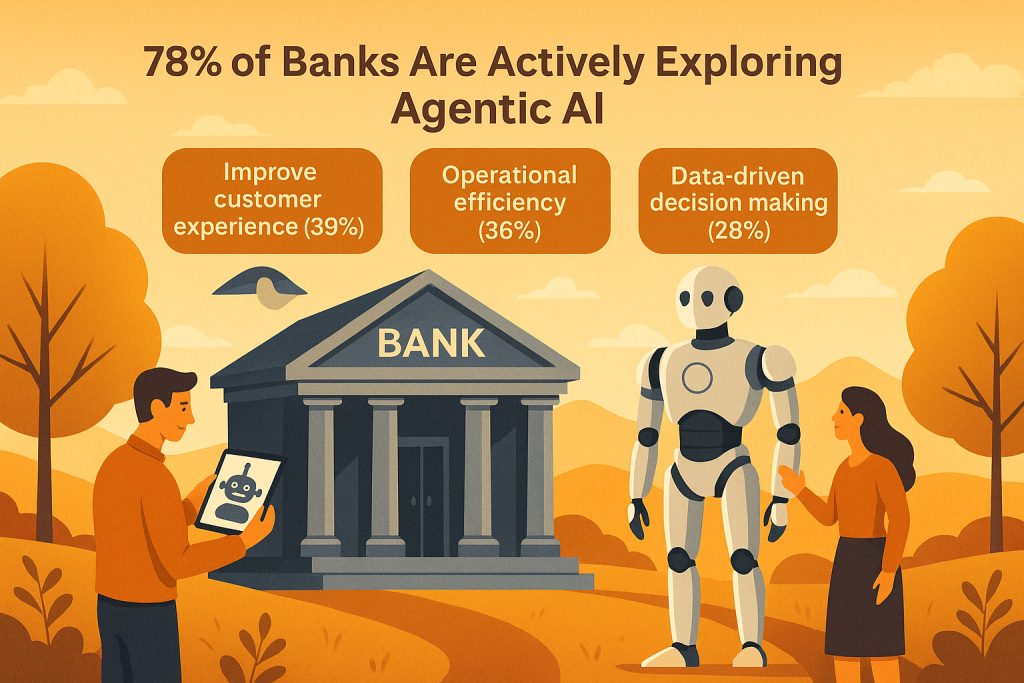
IDC’s latest report on Agentic AI: Driving a New Wave of Banking Transformation mentioned that 78% of Banks are actively exploring IBM agentic AI, and banks are using AI in banking transformation initiatives to improve customer experience (39%), operational efficiency (36%), and data-driven decision making (28%).
As financial institutions move from experimentation to tangible outcomes, IBM’s latest automation in banking capabilities are redefining what’s possible in banking, empowering institutions to innovate faster, operate smarter, and build resilient systems for the future.
From Experimentation to Impact: AI’s Maturity Moment in Banking
The early wave of AI in finance was marked by curiosity and pilot projects. Banks experimented with chatbots, credit risk models, and process automation, exploring the boundaries of machine learning. Now, the tide has shifted. AI has evolved from exploration to execution, where measurable business impact takes precedence over experimentation accelerating AI in banking transformation.
IBM’s hybrid cloud and automation-driven approach to AI enable banks to scale innovation while managing risk. The result? Financial institutions can now deploy AI solutions that optimize operations, improve compliance, and drive revenue, not just in labs, but across the enterprise, paving the future of banking with AI.
Solving Real-World Challenges: How AI Transforms Financial Operations
AI is no longer confined to the data science department. Its influence now permeates every corner of the financial services ecosystem, from risk oversight to customer engagement. Let’s explore how IBM agentic AI technologies are solving some of the industry’s most pressing challenges.
1. Overcoming Skill Shortages with Accelerated Code Development
With the rise of agentic AI in banking, coding bottlenecks are becoming a thing of the past. IBM’s AI-powered development tools empower engineers to automate code generation, refactor legacy systems, and build new applications faster. This not only bridges the skills gap but also frees up technical teams to focus on innovation rather than routine maintenance.
2. Reducing Operational Downtime
AI’s predictive capabilities are being leveraged to detect anomalies in IT systems before they cause disruptions. Through AIOps and intelligent monitoring, IBM enables banks to minimize downtime, maintain uptime for mission-critical services, and deliver seamless digital banking experiences 24/7.
3. Enhancing Risk Management and Compliance
Regulatory compliance in banking is complex, but AI can make it manageable. IBM’s AI models use natural language processing to interpret new regulations, analyze transactions for suspicious patterns, and ensure real-time compliance. This proactive approach reduces the risk of fines and reputational damage.
4. Driving Digital Transformation
AI is the driving force behind modern, data-driven banking ecosystems. By integrating AI across hybrid cloud platforms, IBM helps financial institutions transition from traditional operations to intelligent systems that learn, adapt, and evolve. These AI-powered transformations enable faster decision-making and improved business agility.
5. Enhancing Customer Experience
In the experience-driven banking era, personalization is power. IBM’s AI solutions enable banks to deliver hyper-personalized experiences, predicting customer needs before they arise. From chatbots that handle inquiries instantly to recommendation engines that tailor financial products, AI humanizes banking interactions at scale.
6. Accelerating Application Modernization
Legacy systems are often the biggest barrier to innovation. IBM’s application modernization frameworks, supported by AI and automation, allow banks to modernize core systems without disrupting ongoing operations. This transformation improves agility, reduces costs, and enables integration with emerging fintech ecosystems.
7. Reshaping Onboarding and Employee Experience
AI isn’t just transforming customer journeys, it’s reshaping employee workflows too. From AI-driven onboarding assistants that accelerate new employee integration to digital learning systems that personalize upskilling, IBM’s AI makes banking a smarter place to work.
8. Boosting Efficiency Across Business Processes
With automation powered by IBM Watson and AI Operations, manual workflows can be digitized, monitored, and optimized. AI streamlines processes such as loan approvals, fraud detection, and data reconciliation, drastically improving turnaround times and accuracy.
IBM: A Century of Financial Innovation and Trust
IBM’s legacy in banking stretches back more than a century. Today, over 90 of the world’s largest banks trust IBM to drive transformation across core operations, security, and innovation. That deep partnership with financial institutions forms the foundation for the agentic AI revolution.
Through IBM Consulting, banks gain access to advisory, strategy, and implementation services tailored to the demands of modern finance. These capabilities span:
Core banking modernization
Payments transformation
ISV-enabled banking
Intelligent business operations
Risk management and regulatory compliance
Cybersecurity and fraud detection
IBM’s hybrid approach ensures banks can seamlessly integrate AI into their ecosystems, whether on-premises, in private clouds, or across multiple cloud providers.
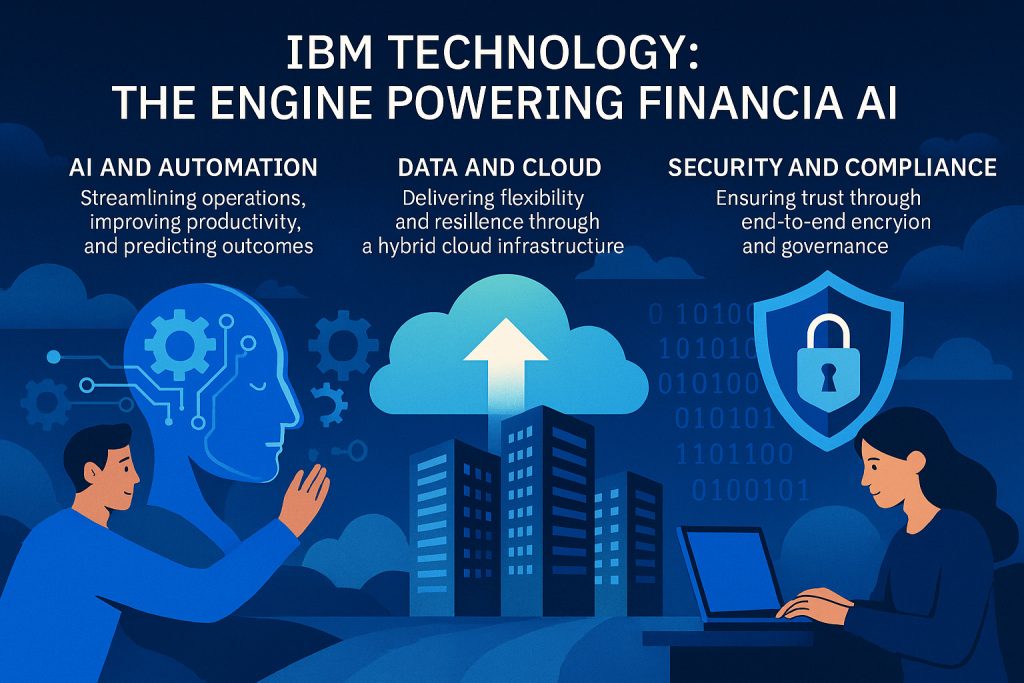
IBM Technology: The Engine Powering Financial AI
Behind every AI success story in finance lies IBM’s cutting-edge technology portfolio. From data management and analytics to security and cloud computing, IBM provides the tools institutions need to modernize, innovate, and compete.
AI and Automation: Streamlining operations, improving productivity, and predicting outcomes.
Data and Cloud: Delivering flexibility and resilience through a hybrid cloud infrastructure.
Security and Compliance: Ensuring trust through end-to-end encryption and governance.
These technologies empower financial organizations to build adaptive, intelligent architectures, ones that can process billions of data points in real time, spot opportunities, and manage risks proactively.
Real-World Use Cases: AI in Action Across Banking & Finance
AI-Powered Fraud Detection
Banks are leveraging IBM’s AI algorithms to analyze billions of transactions daily, identifying anomalies that traditional systems might miss. This results in faster fraud detection and fewer false positives, protecting both customers and profits.
Predictive Risk Management
AI models simulate various market conditions, helping financial institutions anticipate risks before they manifest. Through data-driven insights, banks can safeguard investments and maintain portfolio stability even during volatile times.
AI in Payments and Customer Service
AI chatbots and virtual assistants are transforming customer interactions, offering instant responses and personalized support. Meanwhile, AI in payments enables smarter routing, reduced transaction failures, and improved cash flow management.
Customer Stories: AI Success in the Financial Sector
A Global Bank’s Compliance Revolution: Leveraging IBM Watson, a leading global bank automated 70% of its compliance tasks, reducing regulatory review times from weeks to hours.
A Regional Lender’s Digital Acceleration: Partnering with IBM Consulting, a mid-sized lender modernized its core systems with AI-driven automation, improving loan approval times by 45% and boosting customer satisfaction scores.
A Financial Services Leader’s Fraud Defense: Using IBM’s hybrid cloud and AI-based monitoring, this firm achieved a 60% reduction in fraudulent activity while cutting manual investigation hours in half.
Conclusion: The Power of Partnership — IBM + Prolifics
As the financial industry evolves, transformation demands both innovation and expertise. That’s where the partnership between IBM and Prolifics stands apart.
Prolifics combines its deep domain experience in digital transformation, data, AI, and automation with IBM’s powerful AI and hybrid cloud technologies to deliver end-to-end modernization solutions for banks and financial institutions. Together, they enable organizations to accelerate AI adoption, enhance compliance, and shape the future of intelligent banking.
The future of banking isn’t just digital, it’s intelligent, resilient, and agentic. And with IBM and Prolifics leading the charge, the next chapter of financial innovation is already being written.
Join Prolifics and IBM: Unlocking the Future of Banking & Finance with Agentic AI
Prolifics and IBM invite you to attend Unlocking the Future of Banking & Finance with Agentic AI, an exclusive session showcasing real-world banking use cases, IBM’s latest AI capabilities, and actionable insights for financial innovation and resilience.
This event offers a firsthand look at how IBM’s agentic AI, powered by automation and hybrid cloud, is redefining the industry’s digital core, with live demonstrations, customer stories, and expert discussions on the future of financial transformation.
At the Snowflake Summit 2025, the data cloud pioneer unveiled a new generation of AI-powered agents that promise to reshape how businesses interact with data.
Introducing Snowflake Intelligence and the Data Science Agent, the company aims to bridge the long-standing divide between raw data and actionable insight, putting analytics directly in the hands of anyone, not just data specialists.
Talking to Data, Not Coding It
Snowflake Intelligence represents a significant leap in simplifying enterprise analytics. Instead of relying on SQL experts or business intelligence teams, users can now query complex data sets in plain language. Imagine typing a request like “Show me last quarter’s top-selling product and the reason behind its performance.”
Behind the scenes, Snowflake’s Cortex AI engine interprets the request using large language models (including Anthropic’s Claude) to generate optimized SQL queries. It then scans both structured and unstructured sources, spreadsheets, CRM logs, PDFs, or support notes before synthesizing a narrative answer complete with visual insights. Users get contextual explanations, next-step suggestions, and even workflow automations, all within the Snowflake ecosystem.
By allowing data conversations instead of code writing, Snowflake Intelligence transforms data exploration into a natural dialogue. Moreover, because all processing happens within Snowflake’s governed environment, enterprises maintain compliance, data lineage, and security integrity. This is data democracy with enterprise-grade guardrails.
Automating the Science of Machine Learning
For technical teams, Snowflake’s Data Science Agent targets another pain point, building and deploying machine learning (ML) models. Instead of juggling notebooks, tools, and pipelines, data scientists can prompt the agent to “build a churn prediction model using 12 months of usage data.”
The AI then auto-generates an end-to-end ML pipeline inside a Snowflake Notebook, covering data preparation, feature engineering, model selection, and evaluation. Engineers can review and modify any step, and with one command, deploy it as a Snowflake ML Job. No exports, no external orchestration tools, no security compromises.
Snowflake’s platform even handles GPU orchestration, experiment tracking, and model serving, making ML pipelines reproducible, transparent, and production-ready.
A Shift Toward Conversational Intelligence
Snowflake’s vision aligns with the growing enterprise trend of AI-driven automation and no-code empowerment. From business leaders seeking instant insight to data scientists aiming to accelerate model deployment, these AI agents transform how organizations think about analytics. The result: faster decision-making, improved data literacy, and reduced dependency on specialized intermediaries.
The Future: From Static Dashboards to Dynamic Dialogue
With Snowflake’s AI agents, the company is redefining what data analytics means, moving from static dashboards to interactive, conversational systems. By embedding intelligence directly within its Data Cloud, Snowflake empowers enterprises to not just analyze but act on data in real time.
In a world where insight speed determines competitiveness, Snowflake’s AI agents mark a pivotal step toward truly democratized data intelligence, where every question, from any user, can spark a meaningful, data-backed answer.