Every day, across multiple grow houses, a mushroom producer worked to get one thing right; the perfect substrate mix. Some batches delivered excellent yields, while others fell short. The difference was subtle, often hidden in small variations in ingredient ratios and chemical composition. But without clear visibility, these patterns remained difficult to understand.
As production scaled, this uncertainty grew. Teams relied on experience and manual tracking, but consistency became harder to maintain. The same process could produce different outcomes, making it challenging to predict yield and optimize performance.
To bring clarity to this complexity, the organization partnered with Prolifics to introduce a more structured, data-driven approach to cultivation.
By using data-driven insights, the organization transformed substrate preparation into a more precise and performance-driven process.
Analyzed historical production data alongside substrate composition to identify previously hidden patterns.
Connected yield outcomes with chemical properties and ingredient combinations to uncover key performance drivers.
Shifted substrate preparation from a trial-and-error approach to a more controlled and predictable process.
Identified optimal ingredient ranges that consistently deliver higher yields.
Enabled yield forecasting and established practical guidelines to improve consistency across growing houses.
What once felt uncertain is now measurable and manageable. The producer can make more confident decisions, reduce variability, and maintain consistent yield performance even as operations continue to grow.
At Prolifics, we turn data into meaningful action. With over 45 years of experience in digital engineering and consulting, we help organizations across industries build smarter, more efficient, and scalable operations through data, analytics, and intelligent transformation.
Download the full case study to see how Prolifics is helping agricultural enterprises turn insight into impact.
The race to operationalize generative AI is accelerating, and Microsoft has taken another major step forward. The company recently announced the integration of Fireworks AI into Microsoft Foundry, enabling organizations to deploy and scale open AI models faster and more efficiently within the Azure ecosystem.
For enterprises exploring AI adoption, this development signals an important shift. Open models are becoming easier to deploy, govern, and scale in production environments.
Simplifying the Enterprise AI Lifecycle
Microsoft Foundry serves as a unified platform designed to streamline the entire AI development lifecycle.
It enables model evaluation, deployment, and governance within a centralized environment.
The platform integrates model management, agent development, deployment pipelines, and governance into a single control plane.
This unified approach eliminates the need for fragmented tools and infrastructure layers. It helps organizations move beyond experimentation and transition AI initiatives from pilot projects to production-ready solutions faster.
Fireworks AI Brings High-Performance Inference
Fireworks AI introduces advanced inference capabilities into the Foundry ecosystem.
Its infrastructure is optimized to serve large AI models at high speed and scale.
The platform processes over 13 trillion tokens daily and supports around 180,000 requests per second.
It can generate more than 1,000 tokens per second for large models.
With this integration, developers can access high-performance inference directly through Azure endpoints. This removes the need to build custom serving architectures, reducing complexity and accelerating deployment.
Expanding Access to Leading Open Models
Foundry provides access to a growing catalog of open AI models.
Developers can evaluate and deploy models such as DeepSeek V3.2, GPT-OSS-120B, Kimi K2.5, and MiniMax M2.5.
Models can be tested, compared, and deployed within the same governed environment.
This flexibility allows organizations to select the most suitable model for their use cases while maintaining enterprise-grade control and compliance.
Flexible Deployment for Experimentation and Production
Microsoft is introducing flexible deployment options for different stages of AI adoption.
Developers can use serverless, pay-per-token inference for rapid experimentation.
This approach eliminates the need for upfront infrastructure provisioning.
As projects scale, organizations can seamlessly transition from experimentation to full production workloads without changing platforms.
A Strategic Move in Microsoft’s Open AI Ecosystem
The integration aligns with Microsoft’s broader strategy to support open AI models within Azure.
Enterprises are increasingly adopting open models for better customization, cost control, and compliance.
Foundry simplifies the infrastructure required to deploy and manage these models at scale.
By combining high-performance inference with governance capabilities, Microsoft is positioning Foundry as a central hub for enterprise AI development.
What This Means for Enterprises
Organizations can accelerate AI adoption with simplified deployment pipelines.
Access to scalable infrastructure reduces operational complexity.
Integrated governance ensures compliance and trust in AI systems.
As AI adoption grows across industries such as finance, healthcare, retail, and manufacturing, the ability to deploy open models quickly and securely will become a key competitive advantage.
Microsoft’s integration of Fireworks AI into Foundry reflects a broader industry trend. The future of enterprise AI lies in platforms that combine model innovation with operational simplicity and scalability.
A global pharmaceutical manufacturing organization partnered with Prolifics to modernize its root cause analysis (RCA) processes, transforming manual, fragmented investigations into a faster, more intelligent, and compliance-driven framework.
Operating in a highly regulated environment, the organization faced increasing pressure to maintain strict quality standards while accelerating investigations and improving compliance reporting. However, legacy processes made it difficult to connect insights across RCA reports, SOPs, and regulatory requirements.
Prolifics brought an engineering-first, AI-driven approach to redefine how RCA is performed. By combining generative AI with knowledge graph intelligence, we designed a scalable, data-driven solution that enables faster investigations, deeper insights, and stronger compliance alignment, setting a new benchmark for AI-powered root cause analysis pharmaceutical manufacturing standards.
Key Highlights of the Transformation
AI-powered analysis of RCA reports, SOP documentation, and regulatory data
Knowledge graph integration to uncover hidden relationships across quality events and compliance requirements
Automated identification of root causes and recommended corrective actions
Semantic intelligence layer to unify regulatory and operational data
Intelligent investigation support to improve speed, accuracy, and decision-making
Beyond technology, the engagement introduced a new way of working advancing pharmaceutical quality investigation automation by shifting RCA from a manual, reactive process to a proactive, intelligence-driven capability.
Business Impact Achieved
60 to 80 percent reduction in investigation effort through AI and knowledge graph automation
10 to 15 percent improvement in RCA accuracy by identifying hidden relationships across datasets a direct result of knowledge graph RCA compliance integration
Faster identification of compliance risks and root causes
Improved transparency and efficiency across quality investigation workflows
Today, the organization has a modern RCA framework that not only accelerates investigations but also strengthens pharmaceutical manufacturing AI compliance and quality management at scale.
Download the full case study to see how Prolifics helps pharmaceutical organizations modernize quality processes with AI and build a foundation for smarter, faster decision-making.
Artificial intelligence has evolved from passive assistants to agentic systems that think, decide, and act autonomously. These systems do not just generate responses. They execute workflows, trigger actions, and influence real-world outcomes.
But here is the uncomfortable truth. Without AI guardrails, agentic AI becomes a risk at scale.
From hallucinated outputs and biased decisions to data leaks and compliance violations, the risks of unchecked AI are real and growing. Enterprises rushing into AI adoption often overlook one critical layer: governance embedded into the AI lifecycle through a strong AI governance framework.
This is where AI guardrails come in not as restrictions, but as enablers of trust, scale, and responsible AI governance for enterprise-grade AI transformation.
What Are AI Guardrails?
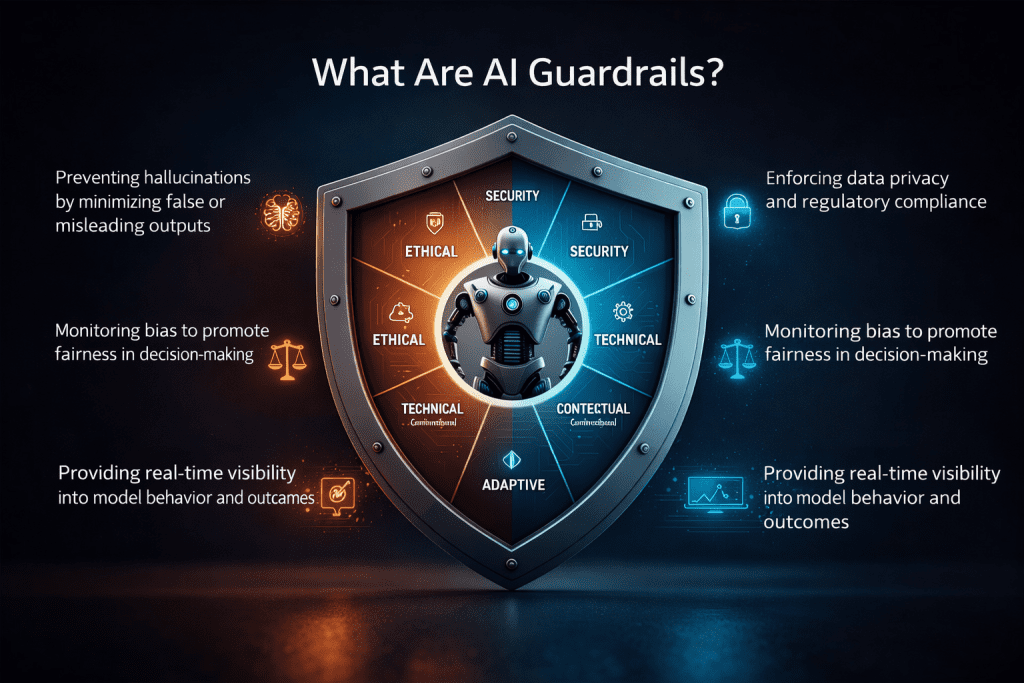
If you’re wondering what are AI guardrails in generative AI, they are mechanisms designed to ensure AI systems operate safely, ethically, and within defined boundaries.
Guardrails AI is an open-source platform designed to help developers and enterprises mitigate risks when deploying AI-driven solutions. It establishes a structured validation layer around both inputs and outputs, ensuring that AI models operate within defined boundaries and adhere to acceptable standards. They establish acceptable behaviors, define boundaries, and ensure AI systems operate within ethical, legal, and operational frameworks. In essence, AI guardrails enable the responsible and controlled use of AI.
They encompass a wide range of capabilities, including:
Preventing hallucinations by minimizing false or misleading outputs and helping prevent AI hallucinations and bias in LLMs
Enforcing AI compliance and data privacy and regulatory standards
Monitoring bias to promote fairness in decision-making using ethical AI frameworks
Providing real-time visibility into model behavior and outcomes
Importantly, AI guardrails are not limited to technical controls. They also include policies, processes, and human oversight that work together to guide AI systems from ideation through deployment and beyond.
The Critical Need for AI Guardrails in Development
AI has rapidly transformed software development. Tools such as GitHub Copilot, ChatGPT, and AWS CodeWhisperer are accelerating coding, automating testing, and streamlining bug resolution.
However, this increased speed introduces new risks, especially in the absence of strong governance and AI risk management practices.
One key challenge is over-reliance on AI-generated code without adequate validation. Research from Stanford and NYU indicates that developers who depend heavily on AI-generated solutions are more likely to introduce security vulnerabilities compared to those who do not.
This underscores the growing need for a robust AI governance framework that delivers real-time oversight, traceability, and accountability.
AI guardrails play a critical role in mitigating risks such as:
Hallucinations, by ensuring outputs are accurate and verifiable
Compliance violations, through continuous monitoring of regulations like GDPR and HIPAA
Bias and discrimination, by auditing outcomes for fairness across diverse user groups
Intellectual property risks, by detecting potential copyright or licensing issues
In enterprise environments, AI cannot function as a black box. Transparency, control, and trust are essential, and AI guardrails make this possible while strengthening LLM security and safety.
1. Input Guardrails: Securing the Front Door of Your AI
Every AI interaction starts with an input, and that is where risks begin. Agentic systems are vulnerable to prompt injection, malicious queries, and exposure of sensitive data. Without input validation, AI can be manipulated to produce harmful or unauthorised outputs.
Input guardrails act as the first line of defense and are a key part of AI guardrails for LLM security and compliance.
They ensure:
Harmful or irrelevant queries are blocked
Sensitive data requests are restricted
Context remains aligned with business objectives
They define what your AI should never respond to, creating a strong foundation for safe interactions.
LLMs are powerful, but they are not always accurate. They can hallucinate facts, produce biased content, or generate misleading information. Output guardrails act as a real-time quality control layer and are critical in how to prevent AI hallucinations and bias in LLMs.
They:
Filter harmful or biased language
Validate factual accuracy
Enforce brand tone and compliance standards
For enterprises, this is not just about accuracy. It is about protecting reputation, customer trust, and regulatory alignment.
3. Data and Privacy Guardrails: Protecting What Matters Most
Data fuels AI, but it is also its biggest vulnerability. Without proper controls, LLMs can expose personally identifiable information, leak confidential data, or violate compliance frameworks.
Data guardrails ensure strict control over what AI can access, process, and share, strengthening AI compliance and data privacy.
They:
Mask sensitive data
Restrict access to secure datasets
Prevent data leakage
These guardrails act as a policy enforcement layer, ensuring data usage aligns with governance standards and business policies.
Agentic AI can trigger workflows, call APIs, and execute multi-step decisions. Without behavioral guardrails, these systems may operate beyond their intended scope. This highlights why AI governance is important for agentic AI systems.
Behavioral guardrails define:
What actions the AI can take
When it can act
Which systems or tools it can access
They ensure AI remains within defined roles and responsibilities, reducing operational risks and unintended consequences.
5. Monitoring and Audit Guardrails: Enabling Transparency and Accountability
AI systems must be observable, traceable, and auditable. Monitoring guardrails provide real-time visibility into AI behavior and support enterprise-level AI risk management.
They include:
Logs of prompts, responses, and system actions
Audit trails for compliance and governance
Alerts for anomalies or unexpected behavior
This transforms AI from a black box into a transparent and controllable system, enabling enterprises to build trust and maintain accountability.
6. Human-in-the-Loop Guardrails: Keeping Humans in Control
No matter how advanced AI becomes, human oversight remains essential. Human-in-the-loop guardrails are a core component of responsible AI governance and modern ethical AI frameworks.
This is especially important in industries like healthcare, finance, and the public sector.
Human oversight ensures AI augments human intelligence rather than replacing it. It balances automation with accountability.
Why Guardrails Are the Backbone of Agentic AI
Agentic AI represents a shift from assistance to autonomous execution. This increases both opportunity and risk. Guardrails act as the control layer between innovation and enterprise risk.
They:
Reduce hallucinations and misinformation
Enforce compliance and ethical standards
Protect sensitive data
Align AI behavior with business goals
In simple terms, guardrails transform AI from a risky experiment into a scalable enterprise capability.
From Guardrails to Autonomous AI Governance
The future of AI is not just about smarter models. It is about smarter governance.
Leading organizations are adopting autonomous AI governance, where guardrails are embedded into development pipelines and enforced automatically.
This approach enables:
Continuous compliance
Real-time risk mitigation
Scalable AI adoption
Guardrails become a combination of policies, processes, and technologies working together to manage AI responsibly across its lifecycle.
The Business Impact: Why This Matters Now
Organizations that ignore guardrails face serious consequences:
Reputational damage
Regulatory penalties
Security vulnerabilities
Loss of customer trust
Organizations that invest in AI governance gain:
Faster and safer AI adoption
Improved accuracy and decision-making
Strong compliance posture
Greater stakeholder confidence
How Prolifics Can Help You Build Responsible Agentic AI
At Prolifics, we help enterprises move from experimentation to enterprise-grade AI adoption securely and responsibly.
Our approach combines:
AI governance frameworks
Data security and compliance controls
Intelligent automation and monitoring
Scalable cloud and AI architectures
We ensure your AI systems are not only powerful, but also explainable, secure, compliant, and aligned with your business goals.
Because success in AI is not just about capability. It is about control, trust, and responsible execution.
Conclusion
Agentic AI is not just the future, it’s already reshaping how enterprises operate, decide, and innovate. But its true potential can only be realized when it is built on a foundation of trust.
Guardrails are not constraints, they are enablers. They empower organizations to scale AI responsibly, ensure compliance, and maintain control in an increasingly autonomous digital landscape.
Before deploying your next AI solution, ask yourself one critical question: Do you have the right guardrails in place?
At Prolifics, we help organizations design and implement robust AI governance frameworks, combining strategy, technology, and security to ensure your AI initiatives are not only powerful, but also ethical, compliant, and future-ready.
Build AI with confidence. Build it with Prolifics.
AI is evolving faster than most teams can manage, and hybrid cloud environments only add to that pressure. Many organizations are excited about scaling AI, yet quietly deal with scattered controls, unclear responsibilities, and security concerns that keep resurfacing no matter how much progress is made.
If your AI initiatives ever feel like they are moving ahead without the structure to guide them, you are not alone and it is more common than most teams admit. Prolifics helps by bringing clarity and discipline to AI governance, building a framework that keeps your initiatives compliant, transparent, and aligned with what your business actually needs.
What Is AI Governance in Hybrid Cloud Environments
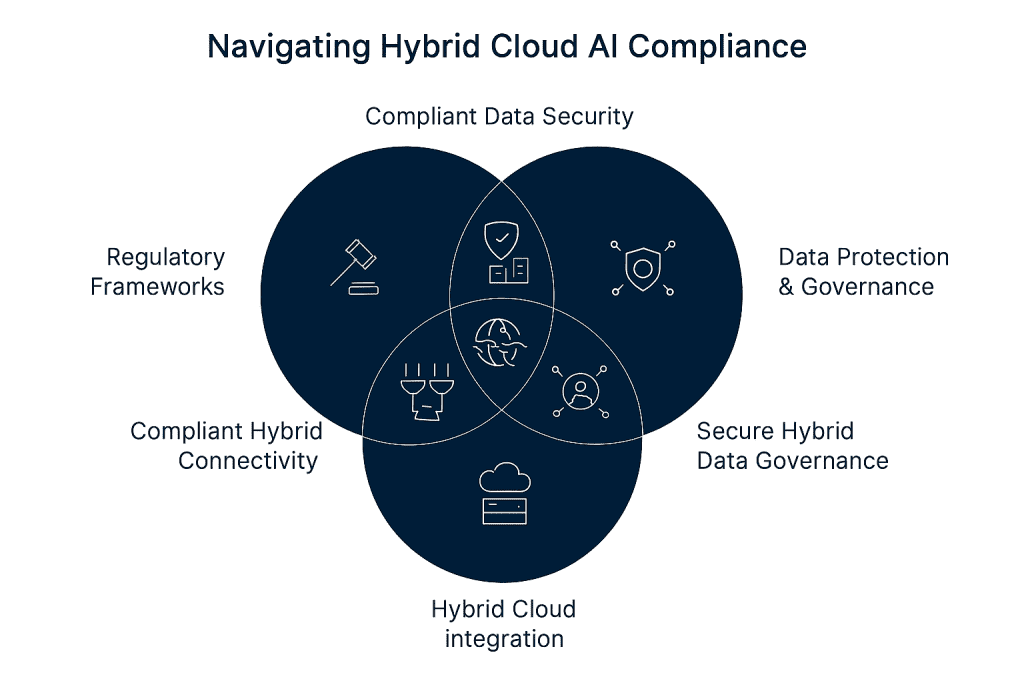
AI governance in hybrid cloud refers to the policies, processes, and technologies used to manage AI systems across cloud and on-premise environments. It ensures that AI models operate securely, comply with regulations, and align with business objectives. Effective AI governance in hybrid cloud environments supports scalability while maintaining control over data, models, and decision-making processes.
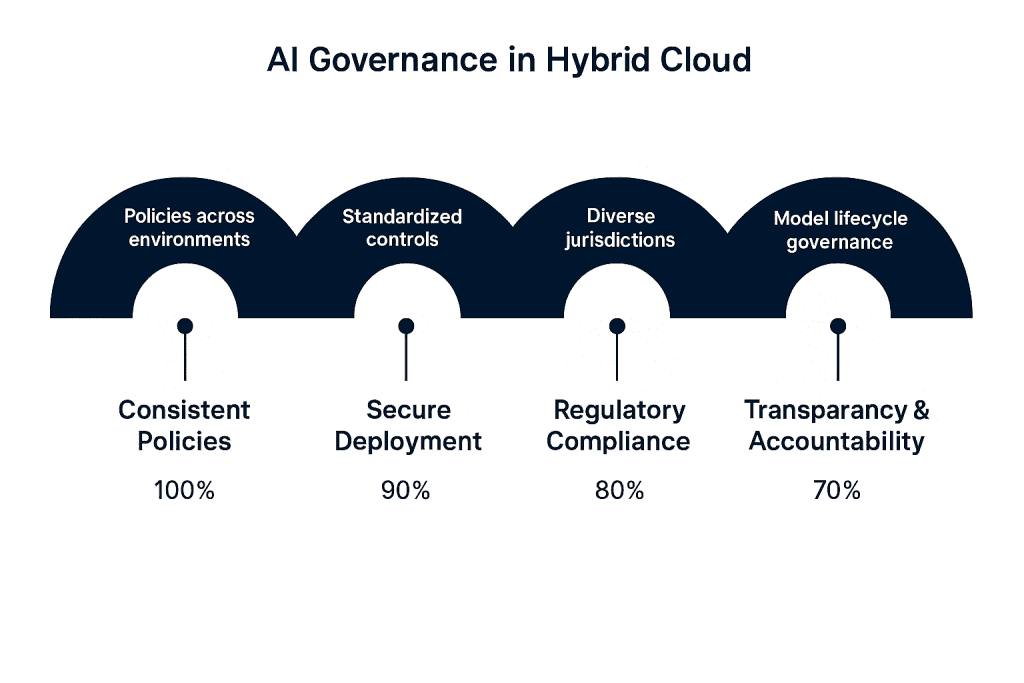
To successfully scale AI across hybrid environments, organizations need a governance framework that ensures security, compliance, and consistency.
Ensures consistent governance policies across multi-cloud and on-premise environments.
Enables secure AI model deployment with standardized operational controls.
Supports regulatory compliance across diverse geographic and cloud jurisdictions.
Improves transparency and accountability across AI model lifecycle governance.
Why This Matters and How Prolifics Helps
AI governance in hybrid cloud environments is critical as enterprises scale AI across multi-cloud and on-premise systems while managing risk, compliance, and performance. Without a structured approach, organizations face fragmented controls, inconsistent policies, and increased exposure to security threats. Prolifics helps organizations implement a robust enterprise AI governance framework that ensures compliance, visibility, and business-aligned AI outcomes.
Key Challenges of AI Governance in Hybrid Cloud Setups
Organizations face significant AI governance challenges when operating across hybrid cloud environments. Different cloud providers introduce varying security models, compliance requirements, and operational standards. Data movement between environments increases complexity in enforcing governance policies. Additionally, managing AI risk management in hybrid cloud becomes difficult without centralized visibility and control.
Data Security and Compliance Risks Across Hybrid Cloud
Hybrid cloud environments create a complex landscape for AI compliance in cloud environments, especially when handling sensitive and regulated data. Organizations must navigate multiple regulatory frameworks while ensuring data protection and governance consistency.
Data sovereignty and AI workloads further complicate governance as data crosses regional boundaries. Businesses must also ensure secure integration between on-premise and cloud systems. Without strong governance, hybrid cloud AI security risks can significantly impact operations and trust.
Data sovereignty laws vary across regions affecting AI workloads.
Inconsistent security policies create vulnerabilities across hybrid cloud environments.
Regulatory compliance requirements differ across cloud and on-premise systems.
Sensitive data exposure increases due to fragmented governance controls.
Lack of unified security monitoring limits threat detection capabilities.
Lack of Visibility and Control Over AI Models
In hybrid cloud environments, organizations often struggle with limited visibility into AI model performance and behavior. AI models deployed across multiple platforms operate in silos, making governance difficult. Without centralized tracking, enforcing AI model lifecycle governance becomes inconsistent and inefficient.
Limited visibility across distributed AI models reduces governance effectiveness.
Lack of centralized monitoring impacts AI model lifecycle governance processes.
Inconsistent model tracking leads to compliance and audit challenges.
Disconnected systems reduce control over AI decision-making processes.
Fragmented governance tools limit enterprise-wide AI oversight capabilities.
Managing AI Performance and Model Drift Across Environments
AI models deployed across hybrid environments require continuous monitoring to maintain accuracy and reliability. Model drift occurs when data patterns change, impacting performance and decision outcomes. Without proper governance, organizations cannot effectively detect or manage these changes.
Model drift impacts AI accuracy across hybrid cloud environments.
Lack of monitoring reduces visibility into AI performance degradation.
Inconsistent data sources create unreliable AI model outcomes.
Poor governance delays detection of performance and model issues.
How to Build a Unified AI Governance Framework
Building an enterprise AI governance framework requires aligning policies, tools, and processes across hybrid environments. Organizations must establish centralized governance models to ensure consistency and compliance. Integration of governance tools across platforms enables better control and visibility. A unified approach also supports scalable AI adoption while reducing operational risk.
Implement centralized governance policies across hybrid cloud environments.
Integrate monitoring tools for end-to-end AI lifecycle management.
Standardize compliance frameworks across multi-cloud and on-premises systems.
Best Practices to Strengthen AI Governance in Hybrid Cloud
Organizations should adopt best practices for AI compliance in hybrid cloud 2026 by focusing on standardization, automation, and continuous monitoring. Establishing clear governance policies and aligning them with business goals improves outcomes. Leveraging advanced tools for AI risk management in hybrid cloud enhances control, security, and scalability.
Conclusion
AI governance in hybrid cloud environments is no longer optional but essential for enterprises aiming to scale AI responsibly. Addressing AI governance challenges requires a structured approach that combines security, compliance, and performance management. With the right strategy and support from partners like Prolifics, organizations can confidently implement AI governance in hybrid cloud environments and drive sustainable business value.
A leading national water utility in the Middle East partnered with Prolifics to drive digital transformation in water utilities by reimagining its workforce platform. The goal was to transform a legacy, maintenance-heavy system into a future-ready foundation for innovation. With growing pressure to deliver API-driven government services and demonstrate progress to government stakeholders, the organization needed more than a technology upgrade; it needed a clear and scalable vision.
Prolifics brought an engineering-first, strategic approach to define that vision. Through collaborative workshops and deep architectural assessment, we designed a modern, cloud-native utility architecture built for agility, scalability, and long-term growth. This approach provided a proven model for legacy system transformation for utilities looking to modernize their core operations.
Key highlights of the transformation include:
Modern, modular architecture for improved flexibility and scalability
API-driven integrations to enable seamless connectivity across systems
Cloud-ready infrastructure to support future digital services
Introduction of public sector AI solutions in the Middle East for enhanced employee productivity.
AR-enabled capabilities for improved field workforce support
Beyond technology, the engagement delivered a structured transformation roadmap and governance framework, enabling confident decision-making and sustainable innovation.
Business impact achieved:
Clear and actionable modernization strategy
Strong alignment with national digital transformation initiatives
Improved scalability for evolving workforce needs
Foundation for adopting emerging technologies like AI and AR
Today, the utility is equipped with a clear path to modernization and is ready to unlock new possibilities with emerging technologies.
Download the full case study to explore how Prolifics helps public sector organizations modernize with confidence and build platforms for the future.
A major theatre chain relied on Azure Data Factory and Azure Synapse to power business-critical analytics, from ticket sales insights to operational reporting. As their data environment grew more complex, maintaining reliable pipelines and ensuring consistent performance became increasingly challenging.
Disruptions in data workflows risked delays in reporting and decision-making, while internal teams faced mounting pressure to manage and troubleshoot the system without dedicated support.
Prolifics introduced a managed services model built to keep analytics environments stable, efficient, and continuously optimised. With proactive monitoring, routine maintenance, and ongoing performance improvements, the theatre chain gained more reliable data pipelines, faster issue resolution, and greater confidence in its reporting. This also reduced the burden on internal teams, allowing them to focus on strategic initiatives instead of day-to-day operational issues.
If your data pipelines are critical to your business, they need to run without disruption. Prolifics helps you stay ahead with managed services that keep your analytics environment performing at its best.
Schedule a conversation today and see how we can support your data and analytics operations.
IBM has announced the upcoming launch of the OpenRAG framework, an open and agentic retrieval solution designed to unlock enterprise knowledge and significantly enhance AI performance. Built for modern enterprises, this innovation will be available on the watsonx.data, marking a major advancement in enterprise AI data retrieval and intelligent data utilization.
Key Highlights
OpenRAG is built to transform unstructured enterprise data into meaningful context for AI systems.
It supports smarter, more accurate AI-driven insights and decision-making.
The solution is integrated with IBM watsonx.data to streamline data accessibility and usage.
The Growing Need for Context-Rich Data
As organizations expand their use of generative AI, the demand for high-quality and context-rich data has become critical. IBM estimates that nearly 90 percent of enterprise data exists in unstructured formats such as emails, documents, PDFs, and transcripts. Much of this data remains underutilized.
The OpenRAG framework addresses this gap by converting fragmented information into structured context, enabling context-aware AI systems to interpret and act on data more effectively. This shift is essential for organizations aiming to build scalable and intelligent AI solutions.
Agentic Retrieval for Better AI Performance
Unlike traditional retrieval augmented generation enterprise approaches that rely on static pipelines, OpenRAG introduces a more advanced agentic RAG model.
This agentic retrieval framework for unstructured data allows AI systems to dynamically adapt how they retrieve and process information. As a result, organizations benefit from improved relevance, deeper insights, and stronger performance—especially when handling complex, multi-source queries.
For businesses evaluating OpenRAG vs traditional RAG systems, the key difference lies in adaptability and intelligence. OpenRAG’s dynamic retrieval significantly enhances output quality and efficiency.
Open and Modular Architecture
OpenRAG features a modular design that promotes flexibility and control.
Organizations can customize how data is ingested, retrieved, and analyzed.
It avoids dependency on a single vendor ecosystem, supporting open innovation.
This approach aligns with IBM’s strategy of enabling open, hybrid AI environments for enterprises.
Powered by Open-Source Technologies
The framework integrates key open-source tools to deliver a scalable solution:
Docling for document processing
OpenSearch for hybrid data retrieval
Langflow for workflow orchestration
These technologies provide the foundation for building transparent, flexible, and high-performing AI pipelines within a hybrid data lakehouse AI environment.
Seamless Integration with watsonx.data
OpenRAG is natively integrated into watsonx.data, IBM’s open data lakehouse platform. This integration allows organizations to unify structured and unstructured data across environments including cloud, on-premises, and multi-cloud setups.
It eliminates the need for extensive data migration while ensuring that data is readily available for AI applications.
Governance, Security, and Compliance
The platform includes built-in governance, security, and monitoring capabilities. These features ensure that AI systems operate using trusted and compliant data.
This is particularly valuable for industries with strict regulatory requirements where data accuracy and traceability are critical.
Improved Accuracy and Outcomes
IBM reports that its agentic retrieval approach can significantly enhance AI performance. Internal testing shows that solutions built on watsonx.data can achieve up to 40% higher accuracy compared to traditional RAG systems.
This demonstrates the impact of better data context and advanced retrieval methods on AI effectiveness.
Conclusion
OpenRAG addresses one of the biggest challenges in enterprise AI, which is turning large volumes of unstructured data into actionable insights. By combining open architecture, adaptive retrieval, and strong governance, IBM positions watsonx.data as a powerful platform for scalable and trustworthy AI solutions.
As AI adoption continues to grow, OpenRAG highlights a shift toward more context-aware systems where data plays a central role in delivering meaningful business value.
In today’s digital economy, data is the most valuable asset an enterprise owns. Yet many organizations struggle to unlock its full potential because their data ecosystems are built on outdated architectures, fragmented systems, and legacy platforms, highlighting the urgent need for enterprise data modernization.
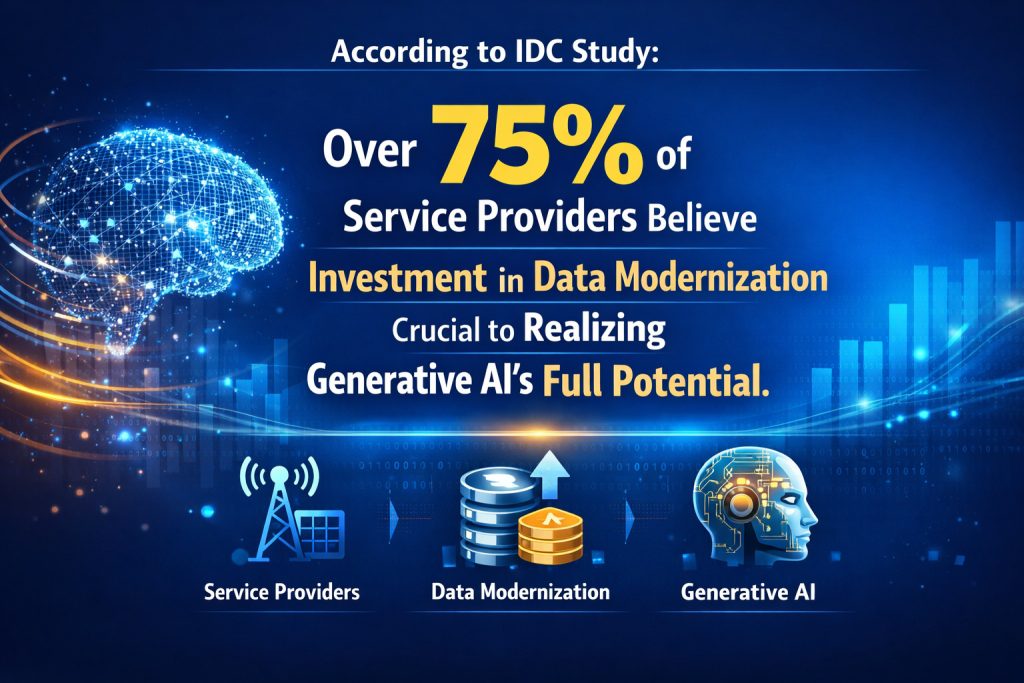
As businesses accelerate AI adoption, the question is no longer whether to modernize data but how quickly organizations can transform their data foundations to support AI-driven innovation through data modernization for AI.
This is where data modernization strategy becomes the critical first step in any successful data and AI strategy.
As per the IDC white paper, “AI Demands More: Enterprises Are Playing Catch-Up on Mission-Critical Data Modernization,” highlights the critical need for robust data modernization efforts to fully leverage the power of hybrid AI.
At Prolifics, we help enterprises modernize their data ecosystems to unlock real-time insights, scalable analytics, and AI-powered decision-making through cloud data modernization and advanced capabilities. With more than four decades of experience in digital transformation, our engineering-first approach enables organizations to build future-ready modern data architecture that drive measurable business outcomes.
Why Data Modernization Matters for AI Success
Artificial intelligence promises smarter decisions, predictive insights, and automation at scale. However, without a modern data foundation, AI initiatives often fail to deliver meaningful results, making data modernization for AI essential.
Data modernization refers to the transformation of legacy data infrastructure, tools, and processes into agile, cloud-ready environments that enable analytics and AI workloads as part of a strong data modernization strategy.
Many enterprises still operate with:
• Legacy data warehouses • Siloed departmental databases • Slow batch-processing pipelines • Inconsistent data governance frameworks
These outdated systems make it difficult to deliver high-quality, trusted data to AI models and analytics platforms, limiting the benefits of data modernization for AI initiatives.
Modernizing data infrastructure allows organizations to integrate data sources, improve quality, strengthen governance, and make information accessible across the enterprise.
Without modernization, organizations risk building AI initiatives on unstable and fragmented data foundations, emphasizing the importance of enterprise data modernization.
The Hidden Challenges of Legacy Data Ecosystems
Legacy data environments were designed for a different era, when data volumes were smaller, analytics was slower, and AI-driven decision-making was not yet mainstream.
Today’s organizations face several major challenges with traditional data architectures.
Data Silos and Fragmentation
Over time, enterprises accumulate data across multiple systems and business units. This results in data silos that prevent a unified view of information and limit enterprise-wide insights.
Without integrated data ecosystems, organizations struggle to achieve a single source of truth, leading to inconsistent analytics and slower decision-making, making legacy system modernization a necessity.
Performance and Scalability Limitations
Legacy systems often rely on batch processing and on-premise infrastructure, which cannot scale to support modern analytics workloads.
As data volumes grow exponentially, these systems become costly to maintain and difficult to expand, reinforcing the need for cloud data modernization.
Poor Data Accessibility
When data is locked inside legacy systems, business teams cannot access insights quickly. Instead, they rely heavily on IT teams for reporting and analytics.
This dependency slows innovation and delays critical business decisions.
Governance and Compliance Risks
Modern enterprises operate in highly regulated environments. Legacy systems frequently lack the governance, security, and monitoring capabilities required to manage sensitive data effectively.
Data modernization is not just about upgrading infrastructure. It is about transforming data into a strategic business asset through data modernization for AI.
Organizations that modernize their data ecosystems unlock several key advantages.
Faster Insights and Better Decision-Making
Modern data architectures support real-time analytics and AI-driven insights, allowing organizations to respond faster to market changes and operational risks.
Machine learning algorithms can analyze vast datasets and uncover patterns that would be impossible to detect manually.
Improved Operational Efficiency
Automated data pipelines reduce manual data processing tasks and eliminate redundant workflows.
This enables organizations to streamline operations while freeing up resources to focus on innovation and strategic initiatives.
Scalable Infrastructure
Cloud-native architectures provide elastic scalability, allowing enterprises to process large volumes of data without costly infrastructure upgrades.
This ensures organizations can support advanced analytics, AI workloads, and future growth through modern data architecture.
Stronger Data Governance and Security
Modern data ecosystems incorporate automated governance frameworks, encryption, and role-based access controls to protect sensitive information and ensure regulatory compliance.
Key Components of a Modern Data Architecture
A successful data modernization strategy requires more than migrating data to the cloud. It involves building a holistic data ecosystem that supports analytics, AI, and innovation, often leveraging data lakes and lakehouse architecture.
Key components include:
Unified Data Platforms
Modern enterprises consolidate structured, semi-structured, and unstructured data into unified platforms such as data lakes or lakehouse architectures.
These platforms eliminate silos and enable consistent analytics across the organization.
Cloud-Native Infrastructure
Cloud environments provide the scalability and flexibility needed to process large volumes of data while supporting AI and advanced analytics workloads, strengthening AI-ready data infrastructure.
Data Governance and Observability
Strong governance ensures that data is accurate, secure, and compliant. Modern platforms also provide metadata management, lineage tracking, and data quality monitoring.
AI-Ready Data Pipelines
Automated pipelines enable seamless ingestion, transformation, and processing of data for analytics and machine learning models.
Together, these capabilities create a robust foundation for enterprise AI initiatives and support data modernization roadmap for enterprises.
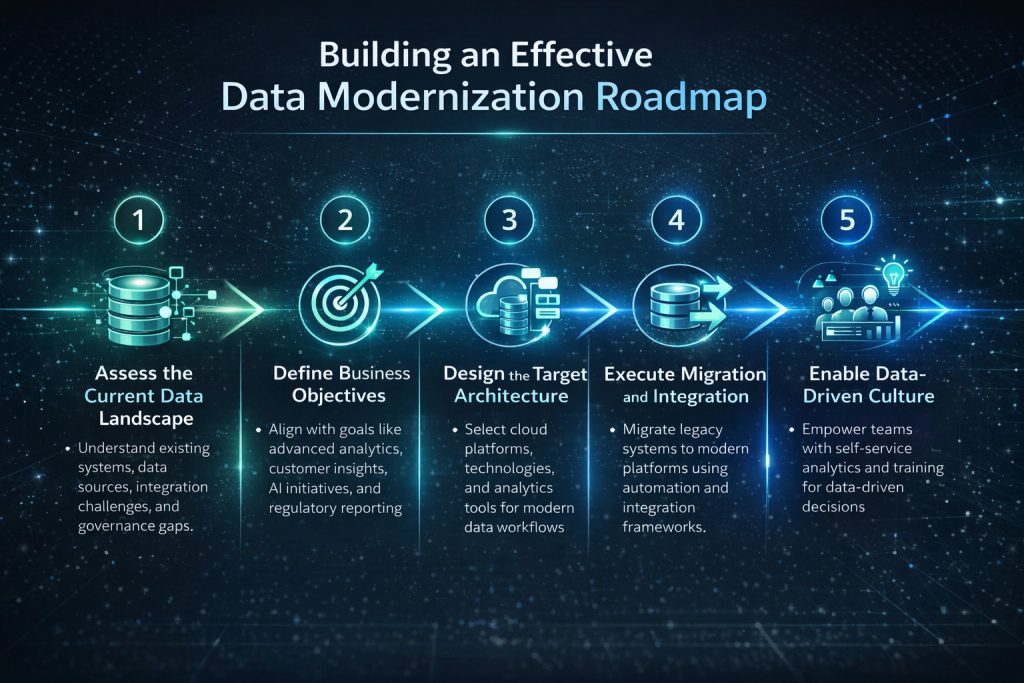
Building an Effective Data Modernization Roadmap
Organizations that succeed with data modernization follow a structured approach.
Step 1: Assess the Current Data Landscape
The first step is understanding the existing data ecosystem, identifying legacy systems, data sources, integration challenges, and governance gaps as part of how to modernize legacy data systems for AI.
Step 2: Define Business Objectives
Data modernization must align with clear business goals, such as:
This phase focuses on selecting the right technologies, cloud platforms, and analytics tools to support modern data workflows.
Step 4: Execute Migration and Integration
Legacy data systems are gradually migrated to modern platforms while maintaining operational continuity.
Automation tools and integration frameworks can accelerate migration and reduce risk, especially in legacy system modernization.
Step 5: Enable Data-Driven Culture
Technology alone is not enough. Organizations must empower teams with self-service analytics tools and training to encourage data-driven decision-making.
How Prolifics Accelerates Data Modernization
At Prolifics, we combine deep data engineering expertise, AI innovation, and cloud platform partnerships to help organizations modernize their data ecosystems through enterprise data modernization.
Our capabilities include:
Data platform modernization across AWS, Google Cloud, Salesforce, and other leading technologies
Enterprise data integration and governance frameworks
Advanced analytics and AI enablement
Migration of legacy data environments to cloud-native architectures
With over 45 years of digital transformation experience, Prolifics helps organizations move beyond fragmented data infrastructures and build scalable, AI-ready data platforms aligned with data modernization for AI.
Our approach focuses on delivering measurable business outcomes, from improved operational efficiency to enhanced decision intelligence.
The Future of Enterprise Data and AI
The future of business will be driven by data-powered intelligence.
Organizations that modernize their data ecosystems today will gain the agility to adopt emerging technologies such as:
• Generative AI • Predictive analytics • Autonomous decision systems • Real-time data intelligence
Data modernization ensures enterprises are not just storing data but turning it into a powerful engine for innovation and growth through cloud data modernization.
Unlock the Full Value of Your Data with Prolifics
Modernizing data is the foundation of every successful digital transformation initiative.
With the right strategy, architecture, and technology partners, organizations can transform legacy data environments into agile, AI-ready ecosystems that deliver real business value using a robust data modernization strategy.
At Prolifics, we help enterprises modernize data, accelerate AI adoption, and unlock insights that drive smarter decisions and long-term growth.
Ready to start your data modernization journey?
Connect with Prolifics to build a scalable data foundation that powers your AI future.
AI is everywhere today. From boardroom discussions to product roadmaps, organizations are investing heavily in artificial intelligence. Yet despite this momentum, many are still struggling to achieve true AI business impact.
Pilots are launched, proofs of concept are built, and models are trained. But when it comes to measurable outcomes, results often fall short. The gap is no longer about access to technology. It is about execution.
The real challenge is not experimentation. It is turning AI into scalable, outcome-driven success.
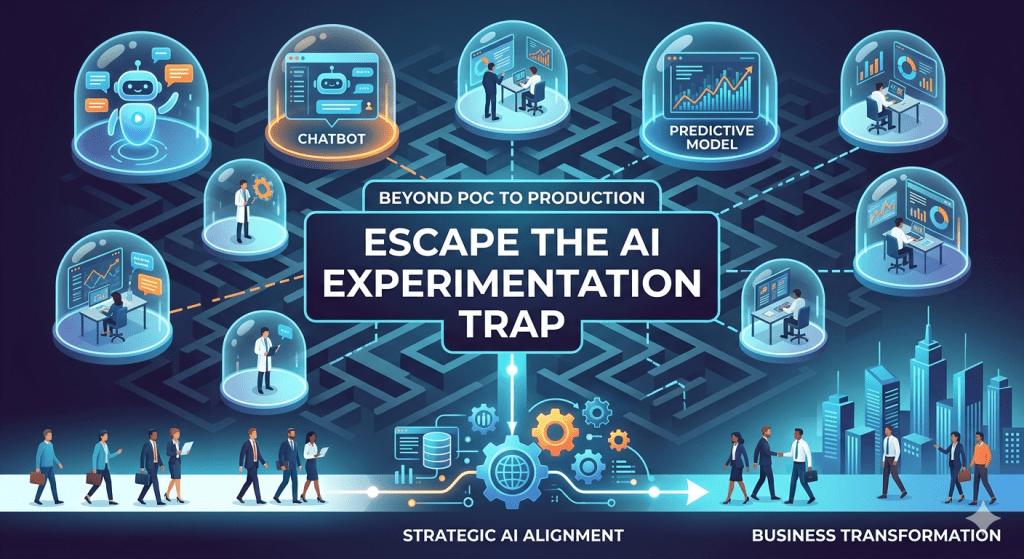
The Experimentation Trap in Enterprise AI Adoption
Over the past few years, organizations have accelerated enterprise AI adoption with urgency, leading to a surge of disconnected initiatives.
A chatbot here. A predictive model there. A dashboard somewhere else.
While each effort may show promise, they often lack alignment with business priorities. Teams focus on what AI can do instead of what the business needs.
This results in:
Siloed solutions that do not scale
Limited adoption across teams
Difficulty demonstrating AI ROI for businesses
AI becomes a collection of isolated efforts instead of a driver of AI for business transformation. This is why many organizations struggle with how to move AI from POC to production. Without alignment and structure, even strong use cases stall.
What Real AI Business Impact Looks Like
To unlock AI business impact, organizations must redefine success. It is not about model accuracy or technical sophistication. It is about measurable outcomes that move the business forward.
That includes:
Increasing revenue through smarter decision-making
Reducing costs by automating manual processes
Improving operational efficiency
Enhancing customer experience with faster, more personalized interactions
These are the metrics that matter when measuring the business value of generative AI.
We have seen this shift in action.
A nationwide distributor of healthcare products reduced inventory costs using AI-driven demand forecasting.
An international energy company improved planning and performance through digital twins.
A plumbing company increased revenue using computer vision to automate its plan-to-quote process.
These are not isolated enterprise AI use cases.
They are measurable outcomes.
Why Scaling AI Across Enterprises Remains a Challenge
If the value is clear, why do organizations struggle with scaling AI across enterprises?
The issue is rarely the technology itself. It is the foundation surrounding it.
Weak Data Foundations
AI depends on reliable data. Siloed and inconsistent data limits its effectiveness.
Lack of Machine Learning Integration
AI that sits outside core systems rarely drives adoption. Strong machine learning integration is critical.
Talent and Collaboration Gaps
AI success requires coordination across business, IT, and operations.
No Clear AI Implementation Strategy
Without a defined AI implementation strategy, initiatives remain stuck in pilot mode. This is one of the biggest challenges of scaling AI in the enterprise.
Lack of Ownership
Without accountability, progress stalls and momentum is lost.
How Companies Move from AI Experimentation to Production
Organizations that succeed are not doing more AI. They are doing it differently.
They focus on operationalizing AI and aligning it with business priorities.
Start with Business Outcomes
Define the problem first. Align AI efforts to measurable goals.
Build a Strong Data Foundation
Connected, high-quality data is essential.
Integrate AI into Workflows
AI must be embedded into everyday systems, not treated as an add-on.
Scale What Works
Identify high-impact enterprise AI use cases and expand them across the organization.
Measure What Matters
Focus on business metrics that prove AI ROI for businesses, not just technical performance.
This is how organizations successfully address how companies move from AI experimentation to production.
Turning AI Pilots into Real Business Value
Many organizations struggle with turning AI pilots into real business value.
The difference comes down to execution.
Leading organizations:
Move beyond isolated pilots
Align AI with business strategy
Invest in strong data and integration
Drive adoption across teams
Scale proven solutions
They recognize that AI is not just a technology initiative. It is a transformation effort.
This shift is central to AI for business transformation.
The Future of Enterprise AI Adoption
The next phase of enterprise AI adoption will not be defined by how many models organizations build.
It will be defined by how effectively they operationalize AI and embed it across their business.
Organizations that lead will:
Integrate AI into core operations
Align leadership, strategy, and technology
Focus on outcomes instead of activity
Continuously refine their AI implementation strategy
They will move from experimentation to execution with clarity and purpose.
From Vision to AI Business Impact
At Prolifics, we help organizations bridge the gap between ambition and execution.
We accelerate AI business impact by connecting:
Data platforms
AI and advanced analytics
Automation and integration
Modern applications
Our focus is on scaling AI across enterprises and delivering measurable outcomes.
Because success with AI is not about how many models you build. It is about the value those models deliver.
Make AI Work for You
The shift from experimentation to impact is not about doing more. It is about doing what matters and doing it well.
Organizations that succeed will:
Align AI with business strategy
Invest in strong foundations
Focus on outcomes over activity
Prioritize execution over experimentation
AI has already proven what it can do. Now it is time to prove what it can deliver.
The organizations that act now will be the ones that lead what comes next.