Citizens today expect the same seamless, digital-first experiences from government agencies that they receive from private sector organizations. Whether it is applying for permits, accessing healthcare benefits, or paying taxes, the demand for fast, intuitive, and accessible e-government services is higher than ever.
However, there is still a noticeable gap between public and private sector digital experiences. While businesses have rapidly embraced innovation, many government systems remain fragmented, manual, and outdated.
This is where digital transformation in government becomes critical. It is not just about digitizing paperwork or moving services online. It is about reimagining how governments operate, engage, and deliver value to citizens in a truly modern, connected way.
What Digital Transformation Means for the Public Sector
At its core, public sector digital transformation is the integration of digital technologies across services, operations, and policymaking to improve outcomes for citizens and agencies alike.
This transformation represents a fundamental shift:
From siloed systems to connected, interoperable platforms
From reactive service delivery to proactive, citizen-centric government services
It also enables governments to transition from process-heavy operations to agile, data-driven ecosystems powered by smart government technology.
Key Drivers Accelerating Government Modernization
Several forces are pushing governments to rethink their government modernization strategy:
Rising Citizen Expectations – Citizens expect anytime, anywhere access to services, with minimal friction and maximum transparency.
Cost Optimization and Efficiency – Digitization reduces operational overhead, improves service delivery speed, and minimizes manual errors.
Policy and Regulatory Pressure – Governments are being pushed to modernize through compliance requirements, transparency mandates, and innovation initiatives.
Need for Resilience – Recent global disruptions have highlighted the need for scalable, adaptable systems that can respond quickly to crises.
Core Pillars of Public Sector Digital Transformation (Prolifics POV) – A successful digital transformation strategy for local government and broader public institutions is built on five key pillars:
Citizen-Centric Digital Experience
Delivering intuitive, accessible, and inclusive digital services is essential.
Omnichannel engagement across web, mobile, and in-person touchpoints
Accessibility-first design to bridge the digital divide
Personalized experiences that improve engagement
Data-Driven Government
Data is the foundation of modern governance.
Unified data platforms for end-to-end data visibility
Adoption of cloud computing public administration models
Scalable and resilient systems powered by GovTech digital infrastructure
AI and Intelligent Automation
AI is transforming how governments operate and serve citizens.
AI-driven citizen support systems
Fraud detection and risk analysis
Workflow automation to reduce bureaucratic delays
Integration and Interoperability
Disconnected systems create inefficiencies and poor user experiences.
API-led connectivity across departments
Seamless data exchange
Unified service delivery platforms
Challenges Slowing Down Transformation
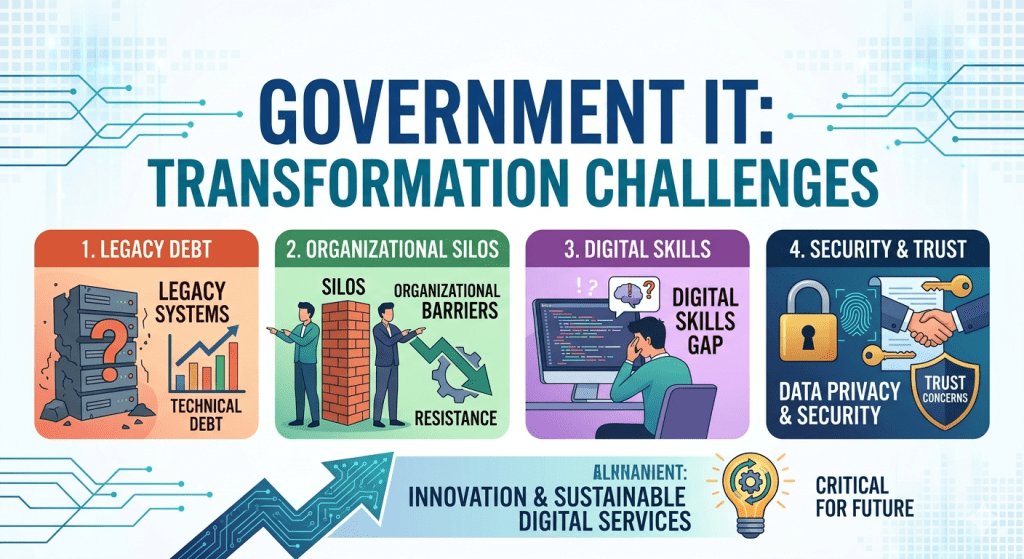
While the benefits are clear, modernizing government IT infrastructure remains a complex and multifaceted challenge. Agencies must navigate outdated systems, internal resistance, and evolving technology demands, all while maintaining trust, security, and accessibility for the public.
Transitioning from legacy systems while managing accumulated technical debt and minimizing disruption to existing services.
Breaking down organizational silos and addressing resistance to change to enable more agile and collaborative operations.
Closing the digital skills gap within agencies to effectively adopt, implement, and sustain modern technologies.
Strengthening data privacy, security frameworks, and public trust in an increasingly digital service environment.
Ensuring accessibility and addressing the digital divide so that all citizens can equally benefit from digital public services.
Best Practices for Successful Government Modernization
To overcome these barriers, governments should adopt proven strategies:
Prioritize a citizen-first design approach
Build a phased, agile transformation roadmap
Invest in strong data foundations and governance
Enable cross-department collaboration
Upskill the workforce for digital readiness
Leverage public-private partnerships for innovation
These approaches directly answer a key question many agencies ask: How can government agencies improve digital services for citizens.
Emerging Technologies Shaping the Future of the Public Sector
The future of public sector digital transformation is being shaped by several transformative technologies:
Generative AI and advanced analytics
Digital Public Infrastructure (DPI)
IoT for smart governance and urban management
Open data ecosystems for transparency and collaboration
Platform-based “Government-as-a-Service” models
These innovations are accelerating digital public services innovation and enabling governments to deliver more value at scale.
Real-World Impact: What Modern Governments Achieve
Governments that embrace digital transformation in government are seeing measurable outcomes:
Faster service delivery through digital applications and approvals
Improved citizen satisfaction and engagement
Enhanced transparency and trust
Increased operational efficiency and cost savings
Stronger crisis response capabilities
These outcomes highlight the clear benefits of digital transformation in the public sector.
Globally, examples of successful e-government transformation projects include digital identity systems, smart city platforms, and AI-powered public services that streamline citizen interactions.
How Prolifics Enables Public Sector Transformation
At Prolifics, we help governments move from vision to execution with a comprehensive approach to government modernization strategy.
End-to-End Capabilities
Cloud transformation across AWS, GCP, and Salesforce
Data and AI-driven insights for smarter decision-making
Integration and API-led modernization
Automation and digital workflows for efficiency
What Sets Us Apart
Accelerated modernization frameworks
Industry-specific solutions tailored to public sector needs
Proven expertise in complex system integration
We partner with agencies to deliver scalable, secure, and citizen-first solutions that drive lasting impact.
Conclusion: Building a Future-Ready Government
Digital transformation is no longer optional for governments. It is foundational to delivering efficient, transparent, and responsive services.
Success comes from combining: Technology, data, people, and strategy.
The governments that embrace this shift today will define the future of public service. The future of governance is intelligent, connected, and citizen-first, and organizations that act now will lead that transformation.
In Investment Banking, risk does not always announce itself. It often hides inside normal-looking transactions, subtle behavioral shifts, and activity patterns that are easy to miss at scale. Detecting financial crime requires more than oversight; it demands speed, precision, and the ability to separate meaningful signals from constant noise.
For one investment banking organization, that challenge was becoming increasingly difficult to manage. Existing fraud monitoring systems were generating high volumes of alerts, but too many lacked real investigative value. Teams were spending significant time reviewing false positives, while increasingly sophisticated fraud patterns made it harder to identify genuine threats early enough to act decisively.
As transaction volumes increased and regulatory pressure intensified, the organization needed a smarter approach to identifying suspicious activity, improving alert quality, and strengthening financial crime controls across its operations. To move beyond traditional detection methods, the organization partnered with Prolifics to build a more adaptive and intelligence-driven fraud analytics framework.
By combining advanced analytics with machine learning, the organization modernized its fraud detection strategy and created a more focused, risk-aware monitoring process.
Examined historical transaction activity and behavioral data to uncover patterns associated with fraudulent and suspicious activity.
Built AI-driven models to detect anomalies and surface high-risk transactions with greater speed and precision.
Improved alert quality by reducing unnecessary noise and helping teams focus on the most relevant threats.
Enabled faster detection of suspicious activity through more intelligent monitoring and analysis.
Delivered decision-support dashboards to strengthen investigations, reporting, and compliance oversight.
What was once a high-volume alert environment is now a more targeted and manageable fraud detection process. The organization can make faster risk decisions, improve operational efficiency, and strengthen its ability to respond to evolving financial crime threats.
At Prolifics, we help financial institutions turn complexity into control. With over 47+ years of experience in digital engineering and consulting, we help organizations modernize risk operations, improve decision-making, and build scalable, data-driven strategies through analytics, AI, and intelligent transformation.
Download the full case study to see how Prolifics is helping investment banks strengthen fraud detection and financial crime prevention with AI-driven intelligence.
Every day, healthcare providers depend on timely access to the right products, from essential medical supplies to critical equipment. Behind that reliability is a complex inventory operation working to keep stock levels balanced across multiple facilities. But when demand shifts unexpectedly, even well-managed systems can struggle to keep pace.
For one healthcare distribution organization, maintaining this balance became increasingly difficult. Some products were overstocked, tying up capital and increasing holding costs, while others ran short, creating delays and risking service disruptions. With fluctuating demand patterns and growing supply chain complexity, traditional forecasting methods no longer delivered the accuracy needed to plan with confidence.
As operational pressure increased, the organization needed a more intelligent way to anticipate demand, optimize inventory planning, and improve responsiveness across its healthcare supply network. To address this challenge, the organization partnered with Prolifics to build a more predictive and data-driven approach to inventory forecasting.
By applying AI and machine learning, the organization transformed inventory planning from a reactive process into a more proactive and insight-led strategy.
Analyzed historical product usage and purchasing patterns to uncover recurring demand trends.
Developed AI-driven forecasting models using advanced machine learning techniques to predict product demand more accurately.
Identified optimal reorder timing, quantities, and inventory requirements across healthcare products.
Enabled demand-driven inventory planning to reduce both excess stock and stock shortages.
Delivered analytics dashboards and reporting tools to support better procurement and inventory decisions.
What was once difficult to predict is now easier to manage with greater precision. The organization can now improve inventory efficiency, reduce unnecessary costs, and maintain stronger product availability across healthcare providers and facilities.
At Prolifics, we turn complex operational challenges into data-driven opportunities. With over 45 years of experience in digital engineering and consulting, we help organizations build smarter, more resilient, and scalable operations through data, analytics, AI, and intelligent transformation.
Download the full case study to see how Prolifics is helping healthcare organizations improve inventory planning and strengthen supply chain performance.
Many organizations invest heavily in AI with the expectation that better models will automatically lead to better business outcomes. But in reality, even the most advanced AI systems can underperform when the data behind them lacks structure, consistency, and context.
That’s where integrated data semantics becomes critical. AI models do not understand your business the way your teams do. They do not naturally know that “customer ID”, “client number”, and “account reference” may refer to the same thing across systems. They do not know whether one dataset uses “revenue” before discounts while another reports it after adjustments. Without semantic clarity, AI operates on fragmented interpretations of reality.
Integrated data semantics helps bridge that gap by aligning data across systems, departments, and platforms around shared business meaning. The result is not just cleaner data; it is more trustworthy AI, stronger model performance, and better ROI from every AI investment.
What is integrated data semantics?
Integrated data semantics is the practice of ensuring that data from different systems carries consistent meaning, relationships, and business context. It goes beyond traditional data integration. Instead of simply moving or combining data, semantic integration ensures that the data is also understood in the same way everywhere it is used.
For example:
A “customer” in sales should mean the same thing in marketing, service, finance, and AI workflows.
Product categories should follow the same logic across analytics and recommendation engines.
Operational metrics should have a shared definition across dashboards, predictive models, and automation systems.
In simple terms, integrated data semantics helps organizations answer an essential question:
“Are all our systems, teams, and AI models speaking the same language?”
If the answer is no, AI performance usually suffers.
Why AI projects often fail to deliver expected ROI
A lot of AI underperformance is not caused by weak algorithms. It is caused by data inconsistency, disconnected systems, and poor contextual understanding.
Organizations often face issues such as:
Duplicate or conflicting records create inconsistency across enterprise systems.
Inconsistent business definitions lead to confusion and unreliable analytics.
Missing metadata obscures context and weakens data relationships significantly.
Data pipelines move records but often fail to preserve meaning.
AI models learn from data that is correct, yet flawed.
This creates a hidden problem: models may appear functional, but they are learning from misaligned business truth. It leads to:
Poor prediction quality leads to weaker business decisions and outcomes.
Low trust in AI outputs slows adoption across teams.
Slower deployment cycles delay value realization from AI investments.
More time is spent cleaning and validating unreliable data.
Reduced returns limit the impact of enterprise AI initiatives.
In other words, when semantics are weak, AI becomes expensive experimentation instead of measurable transformation.
How integrated data semantics improves AI model performance
Integrated semantics creates a stronger foundation for AI by helping models learn from data that is not only available, but also consistent, connected, and meaningful.
Here’s how that directly improves model performance:
1. It improves data quality at the source
AI models are only as good as the data they learn from.
When semantic integration is in place, organizations can standardize definitions, reconcile duplicates, and reduce ambiguity across datasets. This gives models cleaner and more reliable training data.
Why this matters:
If one system labels a customer as “active” after one purchase and another labels them “active” only after three purchases, your churn or retention model may learn the wrong behavior patterns.
Result:
Better feature consistency ensures reliable inputs across all AI models.
Less noise in training data improves accuracy and model learning.
More stable model behavior delivers consistent and predictable outcomes.
This directly improves accuracy, precision, and confidence in outputs.
2. It gives AI business context, not just raw inputs
Most enterprise AI problems are not purely mathematical—they are contextual.
Integrated semantics helps models interpret data through the lens of real business relationships, such as:
Which products belong to which category hierarchy?
How customer interactions relate across channels?
Which operational events influence service performance?
How supply chain variables impact fulfillment outcomes?
This context allows AI to move beyond surface-level pattern recognition and become more aligned with actual business logic.
Result:
Smarter recommendations help businesses deliver more personalized customer experiences.
More relevant predictions improve planning, efficiency, and strategic outcomes.
Better decision support enables faster, more confident business actions.
AI becomes more useful because it is grounded in how the business actually works.
3. It reduces feature engineering complexity
Feature engineering often becomes difficult when data from multiple systems is inconsistent or poorly documented.
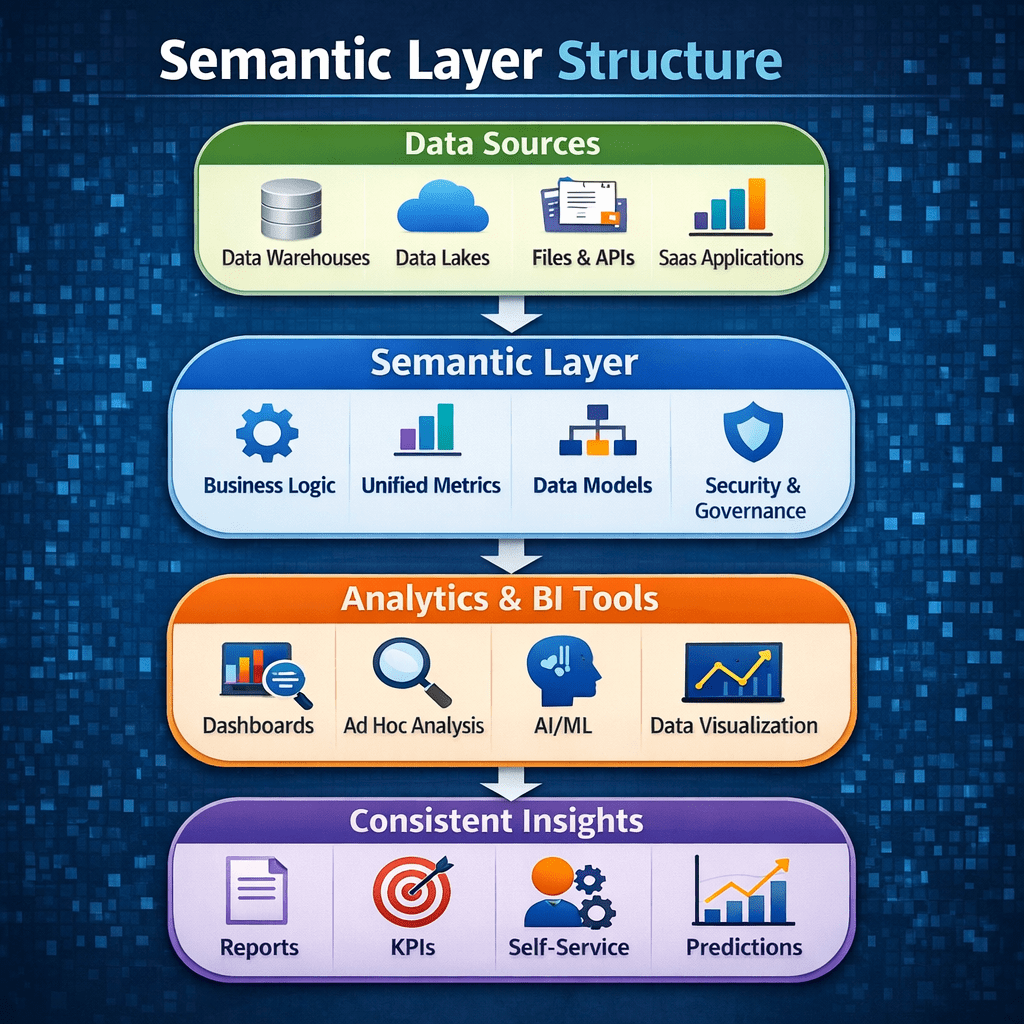
Semantic integration simplifies this by creating a common business layer across datasets. Instead of manually interpreting columns from every source system, data teams can work from clearly defined entities, relationships, and attributes.
Result:
Faster model development accelerates AI initiatives and business value delivery.
Less time spent preparing data improves overall productivity and efficiency.
Easier collaboration strengthens alignment between business and technical teams.
This not only improves efficiency but also helps organizations scale AI faster across use cases.
4. It improves cross-system AI consistency
Many organizations deploy AI across multiple business functions—marketing, operations, customer service, finance, and supply chain.
But when each team uses differently defined data, the same customer, product, or KPI can be interpreted in conflicting ways. This creates inconsistent outputs across models and platforms.
Integrated data semantics ensures that AI systems are trained and deployed using a shared business understanding.
Result:
More consistent outputs improve reliability across departments and business functions.
Better alignment connects dashboards, analytics, and AI with clarity.
Reduced confusion supports faster, smarter, and more confident decisions.
That consistency is essential for building trust in enterprise AI.
5. It supports explainability and governance
As AI adoption grows, organizations need to understand why a model made a decision, not just what the output was.
Semantic integration improves explainability by making the lineage, meaning, and relationships of data easier to trace.
For example, if a model predicts a drop in demand, semantic frameworks can help answer:
Which business variables influenced the prediction?
How were those metrics defined?
Did the source data come from sales, supply chain, or market signals?
Result:
Better AI transparency improves understanding of model-driven business decisions.
Easier compliance and governance reduce risk across AI initiatives.
Stronger stakeholder trust increases confidence in AI-led outcomes.
This becomes especially important in regulated industries or high-impact decision environments.
How Integrated Data Semantics Improves AI ROI
Better model performance is valuable—but businesses ultimately care about measurable returns. Integrated data semantics improves AI ROI by helping organizations generate value faster, with less rework, lower costs, and reduced operational friction across the AI lifecycle.
Here’s where the ROI becomes visible:
1. Faster Time to Value
When data is semantically aligned, AI teams spend less time fixing definitions, reconciling systems, and validating inconsistencies.
That allows teams to focus more on experimentation, deployment, and business impact. This leads to:
Faster experimentation improves learning cycles and accelerates innovation.
Faster model deployment shortens the path from concept to value.
Faster business adoption increases enterprise-wide use of AI solutions.
Organizations can move from pilot to production more efficiently and with fewer delays.
2. Lower Operational Costs
Poor data semantics often creates expensive downstream work that slows teams and reduces efficiency. Teams frequently spend time and resources on avoidable tasks such as:
Manual data cleanup consumes time and increases operational inefficiency.
Rebuilding features repeatedly slows development and wastes technical effort.
Rechecking reports delays insights and reduces confidence in analytics.
Explaining inconsistent AI outputs creates confusion across business teams.
Retraining models repeatedly increases cost and reduces AI scalability.
Integrated semantics helps reduce this hidden cost by improving data reliability and reuse.
ROI impact:
Less engineering rework improves efficiency and speeds AI delivery.
Lower maintenance overhead reduces long-term costs of AI operations.
More scalable AI operations support sustainable enterprise-wide growth.
3. Better Adoption and Business Trust
A technically strong model still fails if business users do not trust the output. When AI outputs are based on consistent definitions and understandable business logic, teams are more likely to rely on them in daily decisions. That matters because AI only creates value when people actually use it.
ROI impact:
Higher stakeholder confidence increases trust in AI-driven business outcomes.
Better decision support enables faster, smarter, and informed actions.
Greater enterprise-wide AI adoption expands impact across business functions.
4. More Reusable AI Assets
Many organizations build AI solutions that solve one problem but are difficult to reuse across departments or future initiatives. Integrated semantics creates a reusable foundation that supports multiple AI use cases without rebuilding from scratch.
This foundation can support use cases such as:
Customer segmentation improves targeting and enhances personalized engagement strategies.
Demand forecasting strengthens planning and reduces supply chain uncertainty.
Predictive maintenance helps prevent downtime and improve asset reliability.
Fraud detection identifies suspicious activity and reduces financial risk.
Personalization improves customer experiences through more relevant interactions.
Supply chain optimization increases efficiency and improves fulfillment performance.
ROI impact:
More reuse across teams increases efficiency and reduces duplication.
Lower cost per initiative improves long-term AI investment efficiency.
Higher return from data investments strengthens overall business value.
Real-world example: why semantics matters in AI outcomes
Imagine a manufacturer using AI to predict equipment downtime across multiple plants.
At first glance, the organization appears to have all the right ingredients: machine data, maintenance logs, sensor readings, and historical performance records. But when that data is not semantically aligned, the AI model is forced to learn from fragmented operational meaning instead of a unified business reality.
Without semantic alignment:
One facility logs machine status as “inactive.”
Another records the same condition as “offline.”
A third tracks maintenance interruptions in a separate system.
Sensor and maintenance data lack shared definitions and relationships.
The model may still function, but the outputs are far less reliable. Instead of learning from consistent operational signals, the AI is exposed to disconnected interpretations of the same events.
As a result, predictions may become inconsistent, incomplete, or misleading.
Key components of a strong semantic foundation for AI
Organizations looking to improve AI ROI through data semantics should focus on a few foundational capabilities:
1. Common business definitions
Ensure that key entities like customers, products, orders, assets, and KPIs are defined consistently across systems.
2. Metadata and lineage
Track where data comes from, how it is transformed, and what it means.
3. Master data alignment
Reduce duplication and create trusted reference points for critical business entities.
4. Semantic modeling
Build relationships between datasets in a way that reflects real business operations.
5. Cross-functional governance
Bring business and technical teams together to define and maintain semantic consistency over time.
This is not just a data engineering exercise. It is a strategic capability for enterprise AI.
Why this matters even more in the era of generative AI
With the rise of generative AI, semantic integration has become even more important. Large language models and enterprise copilots are only as useful as the data and context they can access. If enterprise knowledge is fragmented, mislabeled, or inconsistently structured, even advanced generative AI tools can produce irrelevant or unreliable outputs.
Integrated semantics helps generative AI by enabling:
More accurate enterprise search improves discovery across connected business knowledge.
Better retrieval-augmented generation strengthens relevance and response quality significantly.
More trustworthy AI assistants improve confidence in enterprise interactions.
Stronger context-aware responses deliver more meaningful and useful outputs.
Reduced hallucination risk improves reliability in business-critical AI use cases.
As AI becomes more embedded into enterprise workflows, semantic clarity will increasingly determine whether those systems create value or confusion.
Conclusion
Integrated data semantics ensures that AI systems operate on consistent, meaningful, and connected data rather than fragmented or conflicting inputs, allowing models to better understand business context and deliver more accurate outcomes. This alignment improves model performance, accelerates deployment timelines, and builds stronger trust among business users.
It also reduces operational inefficiencies by minimizing data rework and lowering the overall cost of AI initiatives. Ultimately, by creating a reliable and reusable data foundation, integrated semantics enables organizations to scale AI effectively across use cases, turning AI from isolated experimentation into a true driver of measurable business value.
Frequently Asked Questions
1. What is integrated data semantics in AI?
Integrated data semantics ensures that data across systems has consistent meaning, relationships, and business context, allowing AI models to interpret and use data accurately.
2. Why do AI projects fail to deliver expected ROI?
Many AI initiatives fail due to inconsistent data definitions, lack of context, and disconnected systems, which lead to unreliable insights and low business trust.
3. How does Prolifics help improve AI ROI through data semantics?
Prolifics helps organizations align data definitions, implement semantic modeling, and establish governance frameworks to ensure AI systems operate on accurate, business-aligned data.
4. How can businesses get started with semantic data integration?
Prolifics recommends starting with defining common business entities, improving metadata and lineage tracking, and aligning master data across systems to create a strong foundation for AI.
5. How does integrated data semantics support generative AI use cases?
It enhances enterprise search, improves retrieval-augmented generation, and reduces hallucinations by ensuring AI systems access consistent and well-structured business knowledge.
Every day, across multiple grow houses, a mushroom producer worked to get one thing right; the perfect substrate mix. Some batches delivered excellent yields, while others fell short. The difference was subtle, often hidden in small variations in ingredient ratios and chemical composition. But without clear visibility, these patterns remained difficult to understand.
As production scaled, this uncertainty grew. Teams relied on experience and manual tracking, but consistency became harder to maintain. The same process could produce different outcomes, making it challenging to predict yield and optimize performance.
To bring clarity to this complexity, the organization partnered with Prolifics to introduce a more structured, data-driven approach to cultivation.
By using data-driven insights, the organization transformed substrate preparation into a more precise and performance-driven process.
Analyzed historical production data alongside substrate composition to identify previously hidden patterns.
Connected yield outcomes with chemical properties and ingredient combinations to uncover key performance drivers.
Shifted substrate preparation from a trial-and-error approach to a more controlled and predictable process.
Identified optimal ingredient ranges that consistently deliver higher yields.
Enabled yield forecasting and established practical guidelines to improve consistency across growing houses.
What once felt uncertain is now measurable and manageable. The producer can make more confident decisions, reduce variability, and maintain consistent yield performance even as operations continue to grow.
At Prolifics, we turn data into meaningful action. With over 45 years of experience in digital engineering and consulting, we help organizations across industries build smarter, more efficient, and scalable operations through data, analytics, and intelligent transformation.
Download the full case study to see how Prolifics is helping agricultural enterprises turn insight into impact.
The race to operationalize generative AI is accelerating, and Microsoft has taken another major step forward. The company recently announced the integration of Fireworks AI into Microsoft Foundry, enabling organizations to deploy and scale open AI models faster and more efficiently within the Azure ecosystem.
For enterprises exploring AI adoption, this development signals an important shift. Open models are becoming easier to deploy, govern, and scale in production environments.
Simplifying the Enterprise AI Lifecycle
Microsoft Foundry serves as a unified platform designed to streamline the entire AI development lifecycle.
It enables model evaluation, deployment, and governance within a centralized environment.
The platform integrates model management, agent development, deployment pipelines, and governance into a single control plane.
This unified approach eliminates the need for fragmented tools and infrastructure layers. It helps organizations move beyond experimentation and transition AI initiatives from pilot projects to production-ready solutions faster.
Fireworks AI Brings High-Performance Inference
Fireworks AI introduces advanced inference capabilities into the Foundry ecosystem.
Its infrastructure is optimized to serve large AI models at high speed and scale.
The platform processes over 13 trillion tokens daily and supports around 180,000 requests per second.
It can generate more than 1,000 tokens per second for large models.
With this integration, developers can access high-performance inference directly through Azure endpoints. This removes the need to build custom serving architectures, reducing complexity and accelerating deployment.
Expanding Access to Leading Open Models
Foundry provides access to a growing catalog of open AI models.
Developers can evaluate and deploy models such as DeepSeek V3.2, GPT-OSS-120B, Kimi K2.5, and MiniMax M2.5.
Models can be tested, compared, and deployed within the same governed environment.
This flexibility allows organizations to select the most suitable model for their use cases while maintaining enterprise-grade control and compliance.
Flexible Deployment for Experimentation and Production
Microsoft is introducing flexible deployment options for different stages of AI adoption.
Developers can use serverless, pay-per-token inference for rapid experimentation.
This approach eliminates the need for upfront infrastructure provisioning.
As projects scale, organizations can seamlessly transition from experimentation to full production workloads without changing platforms.
A Strategic Move in Microsoft’s Open AI Ecosystem
The integration aligns with Microsoft’s broader strategy to support open AI models within Azure.
Enterprises are increasingly adopting open models for better customization, cost control, and compliance.
Foundry simplifies the infrastructure required to deploy and manage these models at scale.
By combining high-performance inference with governance capabilities, Microsoft is positioning Foundry as a central hub for enterprise AI development.
What This Means for Enterprises
Organizations can accelerate AI adoption with simplified deployment pipelines.
Access to scalable infrastructure reduces operational complexity.
Integrated governance ensures compliance and trust in AI systems.
As AI adoption grows across industries such as finance, healthcare, retail, and manufacturing, the ability to deploy open models quickly and securely will become a key competitive advantage.
Microsoft’s integration of Fireworks AI into Foundry reflects a broader industry trend. The future of enterprise AI lies in platforms that combine model innovation with operational simplicity and scalability.
A global pharmaceutical manufacturing organization partnered with Prolifics to modernize its root cause analysis (RCA) processes, transforming manual, fragmented investigations into a faster, more intelligent, and compliance-driven framework.
Operating in a highly regulated environment, the organization faced increasing pressure to maintain strict quality standards while accelerating investigations and improving compliance reporting. However, legacy processes made it difficult to connect insights across RCA reports, SOPs, and regulatory requirements.
Prolifics brought an engineering-first, AI-driven approach to redefine how RCA is performed. By combining generative AI with knowledge graph intelligence, we designed a scalable, data-driven solution that enables faster investigations, deeper insights, and stronger compliance alignment, setting a new benchmark for AI-powered root cause analysis pharmaceutical manufacturing standards.
Key Highlights of the Transformation
AI-powered analysis of RCA reports, SOP documentation, and regulatory data
Knowledge graph integration to uncover hidden relationships across quality events and compliance requirements
Automated identification of root causes and recommended corrective actions
Semantic intelligence layer to unify regulatory and operational data
Intelligent investigation support to improve speed, accuracy, and decision-making
Beyond technology, the engagement introduced a new way of working advancing pharmaceutical quality investigation automation by shifting RCA from a manual, reactive process to a proactive, intelligence-driven capability.
Business Impact Achieved
60 to 80 percent reduction in investigation effort through AI and knowledge graph automation
10 to 15 percent improvement in RCA accuracy by identifying hidden relationships across datasets a direct result of knowledge graph RCA compliance integration
Faster identification of compliance risks and root causes
Improved transparency and efficiency across quality investigation workflows
Today, the organization has a modern RCA framework that not only accelerates investigations but also strengthens pharmaceutical manufacturing AI compliance and quality management at scale.
Download the full case study to see how Prolifics helps pharmaceutical organizations modernize quality processes with AI and build a foundation for smarter, faster decision-making.
Artificial intelligence has evolved from passive assistants to agentic systems that think, decide, and act autonomously. These systems do not just generate responses. They execute workflows, trigger actions, and influence real-world outcomes.
But here is the uncomfortable truth. Without AI guardrails, agentic AI becomes a risk at scale.
From hallucinated outputs and biased decisions to data leaks and compliance violations, the risks of unchecked AI are real and growing. Enterprises rushing into AI adoption often overlook one critical layer: governance embedded into the AI lifecycle through a strong AI governance framework.
This is where AI guardrails come in not as restrictions, but as enablers of trust, scale, and responsible AI governance for enterprise-grade AI transformation.
What Are AI Guardrails?
If you’re wondering what are AI guardrails in generative AI, they are mechanisms designed to ensure AI systems operate safely, ethically, and within defined boundaries.
Guardrails AI is an open-source platform designed to help developers and enterprises mitigate risks when deploying AI-driven solutions. It establishes a structured validation layer around both inputs and outputs, ensuring that AI models operate within defined boundaries and adhere to acceptable standards. They establish acceptable behaviors, define boundaries, and ensure AI systems operate within ethical, legal, and operational frameworks. In essence, AI guardrails enable the responsible and controlled use of AI.
They encompass a wide range of capabilities, including:
Preventing hallucinations by minimizing false or misleading outputs and helping prevent AI hallucinations and bias in LLMs
Enforcing AI compliance and data privacy and regulatory standards
Monitoring bias to promote fairness in decision-making using ethical AI frameworks
Providing real-time visibility into model behavior and outcomes
Importantly, AI guardrails are not limited to technical controls. They also include policies, processes, and human oversight that work together to guide AI systems from ideation through deployment and beyond.
The Critical Need for AI Guardrails in Development
AI has rapidly transformed software development. Tools such as GitHub Copilot, ChatGPT, and AWS CodeWhisperer are accelerating coding, automating testing, and streamlining bug resolution.
However, this increased speed introduces new risks, especially in the absence of strong governance and AI risk management practices.
One key challenge is over-reliance on AI-generated code without adequate validation. Research from Stanford and NYU indicates that developers who depend heavily on AI-generated solutions are more likely to introduce security vulnerabilities compared to those who do not.
This underscores the growing need for a robust AI governance framework that delivers real-time oversight, traceability, and accountability.
AI guardrails play a critical role in mitigating risks such as:
Hallucinations, by ensuring outputs are accurate and verifiable
Compliance violations, through continuous monitoring of regulations like GDPR and HIPAA
Bias and discrimination, by auditing outcomes for fairness across diverse user groups
Intellectual property risks, by detecting potential copyright or licensing issues
In enterprise environments, AI cannot function as a black box. Transparency, control, and trust are essential, and AI guardrails make this possible while strengthening LLM security and safety.
1. Input Guardrails: Securing the Front Door of Your AI
Every AI interaction starts with an input, and that is where risks begin. Agentic systems are vulnerable to prompt injection, malicious queries, and exposure of sensitive data. Without input validation, AI can be manipulated to produce harmful or unauthorised outputs.
Input guardrails act as the first line of defense and are a key part of AI guardrails for LLM security and compliance.
They ensure:
Harmful or irrelevant queries are blocked
Sensitive data requests are restricted
Context remains aligned with business objectives
They define what your AI should never respond to, creating a strong foundation for safe interactions.
LLMs are powerful, but they are not always accurate. They can hallucinate facts, produce biased content, or generate misleading information. Output guardrails act as a real-time quality control layer and are critical in how to prevent AI hallucinations and bias in LLMs.
They:
Filter harmful or biased language
Validate factual accuracy
Enforce brand tone and compliance standards
For enterprises, this is not just about accuracy. It is about protecting reputation, customer trust, and regulatory alignment.
3. Data and Privacy Guardrails: Protecting What Matters Most
Data fuels AI, but it is also its biggest vulnerability. Without proper controls, LLMs can expose personally identifiable information, leak confidential data, or violate compliance frameworks.
Data guardrails ensure strict control over what AI can access, process, and share, strengthening AI compliance and data privacy.
They:
Mask sensitive data
Restrict access to secure datasets
Prevent data leakage
These guardrails act as a policy enforcement layer, ensuring data usage aligns with governance standards and business policies.
Agentic AI can trigger workflows, call APIs, and execute multi-step decisions. Without behavioral guardrails, these systems may operate beyond their intended scope. This highlights why AI governance is important for agentic AI systems.
Behavioral guardrails define:
What actions the AI can take
When it can act
Which systems or tools it can access
They ensure AI remains within defined roles and responsibilities, reducing operational risks and unintended consequences.
5. Monitoring and Audit Guardrails: Enabling Transparency and Accountability
AI systems must be observable, traceable, and auditable. Monitoring guardrails provide real-time visibility into AI behavior and support enterprise-level AI risk management.
They include:
Logs of prompts, responses, and system actions
Audit trails for compliance and governance
Alerts for anomalies or unexpected behavior
This transforms AI from a black box into a transparent and controllable system, enabling enterprises to build trust and maintain accountability.
6. Human-in-the-Loop Guardrails: Keeping Humans in Control
No matter how advanced AI becomes, human oversight remains essential. Human-in-the-loop guardrails are a core component of responsible AI governance and modern ethical AI frameworks.
This is especially important in industries like healthcare, finance, and the public sector.
Human oversight ensures AI augments human intelligence rather than replacing it. It balances automation with accountability.
Why Guardrails Are the Backbone of Agentic AI
Agentic AI represents a shift from assistance to autonomous execution. This increases both opportunity and risk. Guardrails act as the control layer between innovation and enterprise risk.
They:
Reduce hallucinations and misinformation
Enforce compliance and ethical standards
Protect sensitive data
Align AI behavior with business goals
In simple terms, guardrails transform AI from a risky experiment into a scalable enterprise capability.
From Guardrails to Autonomous AI Governance
The future of AI is not just about smarter models. It is about smarter governance.
Leading organizations are adopting autonomous AI governance, where guardrails are embedded into development pipelines and enforced automatically.
This approach enables:
Continuous compliance
Real-time risk mitigation
Scalable AI adoption
Guardrails become a combination of policies, processes, and technologies working together to manage AI responsibly across its lifecycle.
The Business Impact: Why This Matters Now
Organizations that ignore guardrails face serious consequences:
Reputational damage
Regulatory penalties
Security vulnerabilities
Loss of customer trust
Organizations that invest in AI governance gain:
Faster and safer AI adoption
Improved accuracy and decision-making
Strong compliance posture
Greater stakeholder confidence
How Prolifics Can Help You Build Responsible Agentic AI
At Prolifics, we help enterprises move from experimentation to enterprise-grade AI adoption securely and responsibly.
Our approach combines:
AI governance frameworks
Data security and compliance controls
Intelligent automation and monitoring
Scalable cloud and AI architectures
We ensure your AI systems are not only powerful, but also explainable, secure, compliant, and aligned with your business goals.
Because success in AI is not just about capability. It is about control, trust, and responsible execution.
Conclusion
Agentic AI is not just the future, it’s already reshaping how enterprises operate, decide, and innovate. But its true potential can only be realized when it is built on a foundation of trust.
Guardrails are not constraints, they are enablers. They empower organizations to scale AI responsibly, ensure compliance, and maintain control in an increasingly autonomous digital landscape.
Before deploying your next AI solution, ask yourself one critical question: Do you have the right guardrails in place?
At Prolifics, we help organizations design and implement robust AI governance frameworks, combining strategy, technology, and security to ensure your AI initiatives are not only powerful, but also ethical, compliant, and future-ready.
Build AI with confidence. Build it with Prolifics.
AI is evolving faster than most teams can manage, and hybrid cloud environments only add to that pressure. Many organizations are excited about scaling AI, yet quietly deal with scattered controls, unclear responsibilities, and security concerns that keep resurfacing no matter how much progress is made.
If your AI initiatives ever feel like they are moving ahead without the structure to guide them, you are not alone and it is more common than most teams admit. Prolifics helps by bringing clarity and discipline to AI governance, building a framework that keeps your initiatives compliant, transparent, and aligned with what your business actually needs.
What Is AI Governance in Hybrid Cloud Environments
AI governance in hybrid cloud refers to the policies, processes, and technologies used to manage AI systems across cloud and on-premise environments. It ensures that AI models operate securely, comply with regulations, and align with business objectives. Effective AI governance in hybrid cloud environments supports scalability while maintaining control over data, models, and decision-making processes.
To successfully scale AI across hybrid environments, organizations need a governance framework that ensures security, compliance, and consistency.
Ensures consistent governance policies across multi-cloud and on-premise environments.
Enables secure AI model deployment with standardized operational controls.
Supports regulatory compliance across diverse geographic and cloud jurisdictions.
Improves transparency and accountability across AI model lifecycle governance.
Why This Matters and How Prolifics Helps
AI governance in hybrid cloud environments is critical as enterprises scale AI across multi-cloud and on-premise systems while managing risk, compliance, and performance. Without a structured approach, organizations face fragmented controls, inconsistent policies, and increased exposure to security threats. Prolifics helps organizations implement a robust enterprise AI governance framework that ensures compliance, visibility, and business-aligned AI outcomes.
Key Challenges of AI Governance in Hybrid Cloud Setups
Organizations face significant AI governance challenges when operating across hybrid cloud environments. Different cloud providers introduce varying security models, compliance requirements, and operational standards. Data movement between environments increases complexity in enforcing governance policies. Additionally, managing AI risk management in hybrid cloud becomes difficult without centralized visibility and control.
Data Security and Compliance Risks Across Hybrid Cloud
Hybrid cloud environments create a complex landscape for AI compliance in cloud environments, especially when handling sensitive and regulated data. Organizations must navigate multiple regulatory frameworks while ensuring data protection and governance consistency.
Data sovereignty and AI workloads further complicate governance as data crosses regional boundaries. Businesses must also ensure secure integration between on-premise and cloud systems. Without strong governance, hybrid cloud AI security risks can significantly impact operations and trust.
Data sovereignty laws vary across regions affecting AI workloads.
Inconsistent security policies create vulnerabilities across hybrid cloud environments.
Regulatory compliance requirements differ across cloud and on-premise systems.
Sensitive data exposure increases due to fragmented governance controls.
Lack of unified security monitoring limits threat detection capabilities.
Lack of Visibility and Control Over AI Models
In hybrid cloud environments, organizations often struggle with limited visibility into AI model performance and behavior. AI models deployed across multiple platforms operate in silos, making governance difficult. Without centralized tracking, enforcing AI model lifecycle governance becomes inconsistent and inefficient.
Limited visibility across distributed AI models reduces governance effectiveness.
Lack of centralized monitoring impacts AI model lifecycle governance processes.
Inconsistent model tracking leads to compliance and audit challenges.
Disconnected systems reduce control over AI decision-making processes.
Fragmented governance tools limit enterprise-wide AI oversight capabilities.
Managing AI Performance and Model Drift Across Environments
AI models deployed across hybrid environments require continuous monitoring to maintain accuracy and reliability. Model drift occurs when data patterns change, impacting performance and decision outcomes. Without proper governance, organizations cannot effectively detect or manage these changes.
Model drift impacts AI accuracy across hybrid cloud environments.
Lack of monitoring reduces visibility into AI performance degradation.
Inconsistent data sources create unreliable AI model outcomes.
Poor governance delays detection of performance and model issues.
How to Build a Unified AI Governance Framework
Building an enterprise AI governance framework requires aligning policies, tools, and processes across hybrid environments. Organizations must establish centralized governance models to ensure consistency and compliance. Integration of governance tools across platforms enables better control and visibility. A unified approach also supports scalable AI adoption while reducing operational risk.
Implement centralized governance policies across hybrid cloud environments.
Integrate monitoring tools for end-to-end AI lifecycle management.
Standardize compliance frameworks across multi-cloud and on-premises systems.
Best Practices to Strengthen AI Governance in Hybrid Cloud
Organizations should adopt best practices for AI compliance in hybrid cloud 2026 by focusing on standardization, automation, and continuous monitoring. Establishing clear governance policies and aligning them with business goals improves outcomes. Leveraging advanced tools for AI risk management in hybrid cloud enhances control, security, and scalability.
Conclusion
AI governance in hybrid cloud environments is no longer optional but essential for enterprises aiming to scale AI responsibly. Addressing AI governance challenges requires a structured approach that combines security, compliance, and performance management. With the right strategy and support from partners like Prolifics, organizations can confidently implement AI governance in hybrid cloud environments and drive sustainable business value.
A leading national water utility in the Middle East partnered with Prolifics to drive digital transformation in water utilities by reimagining its workforce platform. The goal was to transform a legacy, maintenance-heavy system into a future-ready foundation for innovation. With growing pressure to deliver API-driven government services and demonstrate progress to government stakeholders, the organization needed more than a technology upgrade; it needed a clear and scalable vision.
Prolifics brought an engineering-first, strategic approach to define that vision. Through collaborative workshops and deep architectural assessment, we designed a modern, cloud-native utility architecture built for agility, scalability, and long-term growth. This approach provided a proven model for legacy system transformation for utilities looking to modernize their core operations.
Key highlights of the transformation include:
Modern, modular architecture for improved flexibility and scalability
API-driven integrations to enable seamless connectivity across systems
Cloud-ready infrastructure to support future digital services
Introduction of public sector AI solutions in the Middle East for enhanced employee productivity.
AR-enabled capabilities for improved field workforce support
Beyond technology, the engagement delivered a structured transformation roadmap and governance framework, enabling confident decision-making and sustainable innovation.
Business impact achieved:
Clear and actionable modernization strategy
Strong alignment with national digital transformation initiatives
Improved scalability for evolving workforce needs
Foundation for adopting emerging technologies like AI and AR
Today, the utility is equipped with a clear path to modernization and is ready to unlock new possibilities with emerging technologies.
Download the full case study to explore how Prolifics helps public sector organizations modernize with confidence and build platforms for the future.