As digital transformation accelerates across industries, enterprises are facing a common challenge: disconnected systems that slow innovation and limit growth. In response, Prolifics is helping organizations break down these barriers with advanced MuleSoft Integration Services that unify applications, data, and processes into a seamless digital ecosystem.
By combining deep integration expertise with Anypoint Platform Consulting, Prolifics enables businesses to modernize faster, innovate smarter, and unlock measurable operational efficiency. In an era where speed, scalability, and customer experience define competitive advantage, Prolifics is positioning enterprise API management solutions not as an IT function but as a strategic growth engine.
With the Anypoint Platform at the heart of its integration strategy, Prolifics empowers organizations to unify applications, data, and customer experiences. From Legacy System Modernization MuleSoft projects to cutting-edge cloud apps, we ensure everything works with speed, reliability, and scale.
A Unified Integration Advantage for Real Business Outcomes
Modern enterprises run countless applications, including CRMs, ERPs, e-commerce platforms, and more. Without smart MuleSoft integration services, IT teams are stuck in a cycle of point-to-point connections that are brittle and costly. Prolifics changes that with:
Prolifics changes that with:
API-Led Connectivity Strategy: A structured way to accelerate digital transformation with API-led connectivity, designing reusable APIs that expose data and accelerate innovation.
Anypoint Platform Expertise: Through specialized Anypoint Platform Consulting, we consolidate integration design, deployment, and monitoring onto a single platform, reducing risk.
Automated Workflows and RPA: Beyond integration, we leverage MuleSoft RPA for automated enterprise workflows to deliver faster time to value.
Why Prolifics + MuleSoft
Prolifics brings decades of leadership and is a recognized Salesforce MuleSoft integration partner. Our team includes experts who provide comprehensive MuleSoft managed services to ensure your composable IT infrastructure remains agile. This experience translates into outcomes that matter:
Faster Time to Market: Projects that once took months can be completed in weeks, enabling businesses to launch digital services ahead of competitors.
Reduced Operational Overhead: By reusing APIs and utilizing MuleSoft Managed Services, companies lower maintenance costs and free IT to innovate.
Scalable, Secure Architecture: We provide robust enterprise API management solutions with flexible deployment options cloud, on-premises, or hybrid.
Enterprise-Wide Connectivity: Whether you need to hire certified MuleSoft architects for healthcare integration or retail solutions, our tailored approaches meet industry-specific challenges.
Importantly, a strong integration strategy does more than connect systems; it drives agentic enterprise transformation by unlocking data value. When data flows freely, organizations see smarter decisions and more personalized engagement.
Turning Vision Into Value
Prolifics partners with businesses to reimagine how they operate. Through expert MuleSoft consulting, strategic architectural design, and robust automation frameworks, Prolifics helps organizations:
Simplify complex IT landscapes
Reduce dependency on custom point-to-point coding
Standardize integration best practices
Empower teams with reusable assets
Accelerate digital transformation journeys
Ready to transform your enterprise with MuleSoft? Connect with Prolifics and start your integration journey today.
In modern software development, API testing plays an important role in ensuring applications are reliable, secure, and high-performing. As APIs form the backbone of communication between services, systems, and applications, validating their behavior before deployment is essential to delivering seamless digital experiences and strengthening API quality engineering practices.
Unlike UI testing, which focuses on the user interface, API testing targets the underlying service layer, where business logic and data exchanges occur. It ensures that endpoints behave as expected, data is transmitted accurately through API Data Contract Validation, integrations remain stable, and systems continue to perform reliably, even under heavy loads or unexpected conditions. Strong performance testing for APIs further ensures that service layers remain resilient and scalable.
Modern applications rarely operate in isolation. APIs enable:
Communication between mobile apps and back-end services
Integration with third-party partners, data sources, and service providers
Real-time updates, transactions, and business logic enforcement
Scalable microservices architectures in cloud environments supported by Microservices Integration Testing
That means APIs are responsible for critical business workflows, and failures here directly translate into customer frustration, lost revenue, and brand risk. A structured shift-left API testing approach ensures issues are caught early before they escalate into production incidents.
Yet traditional testing approaches often fall short. GUI or UX testing alone cannot uncover the kinds of defects, performance issues, or compliance gaps that lurk beneath the surface. This is why API testing shines it gets below the UI and tests the business logic, data contracts, reliability, performance, and security of the system itself. Modern API quality engineering integrates API security and compliance testing alongside functional validation to ensure complete coverage.
What Effective API Testing Looks Like in Practice
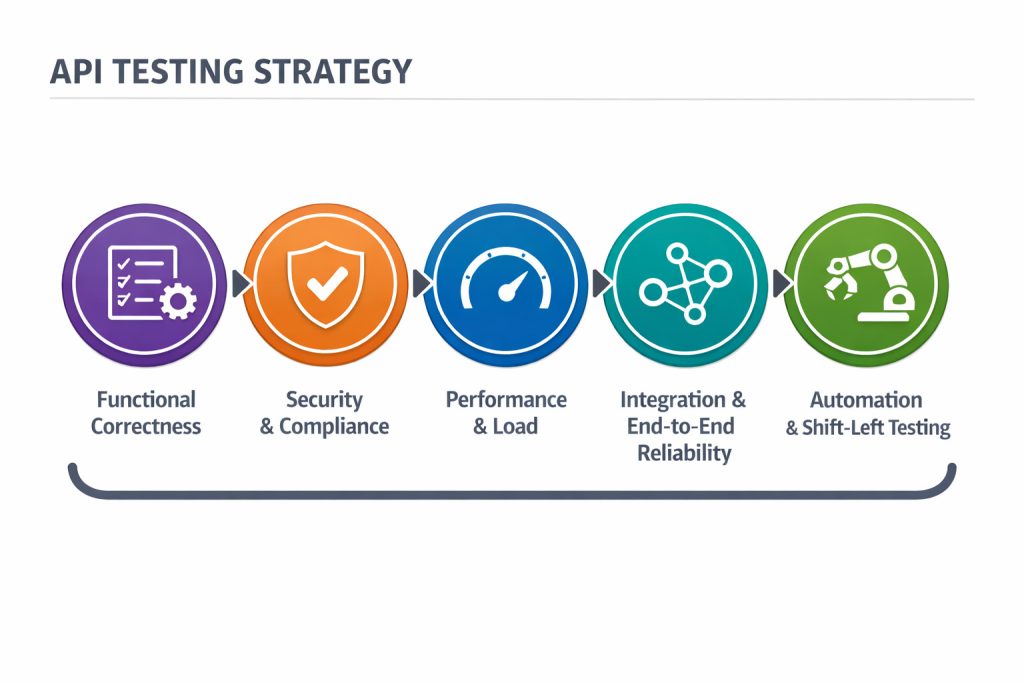
A robust API testing strategy should cover many dimensions and align with a strong shift-left testing strategy:
🔹 Functional Correctness — Does the API do what it’s supposed to? 🔹 Security & Compliance — Is access controlled? Are data protections enforced? 🔹 Performance & Load — Can it handle peak traffic volumes? 🔹 Integration & End-to-End Reliability — Do all parts of the system work together without failure? 🔹 Automation & Shift-Left Testing — Are tests integrated into CI/CD so defects are caught early?
But quality isn’t just about testing; it’s about engineering quality into the process. That means embedding tests early in development cycles through Shift-Left API Testing, leveraging AI-Driven Test Automation, and analyzing test results using predictive models to prevent failures rather than simply detecting them after the fact. This is the foundation of advanced API quality engineering.
The ROI of Quality Engineering
When API testing and quality practices are done right, organizations realize measurable business outcomes and see tangible ROI of AI-powered predictive analytics in quality engineering initiatives:
Faster Time-to-Market: Automated API tests integrated into CI/CD pipelines reduce cycle times and accelerate releases.
Lower Development Costs: Catching defects early costs far less than fixing issues in later stages or post-release.
Higher Customer Trust: Reliable, secure APIs reflect directly on user experience and customer satisfaction.
Reduced Operational Risk: Performance and security testing break down failure modes before they impact production.
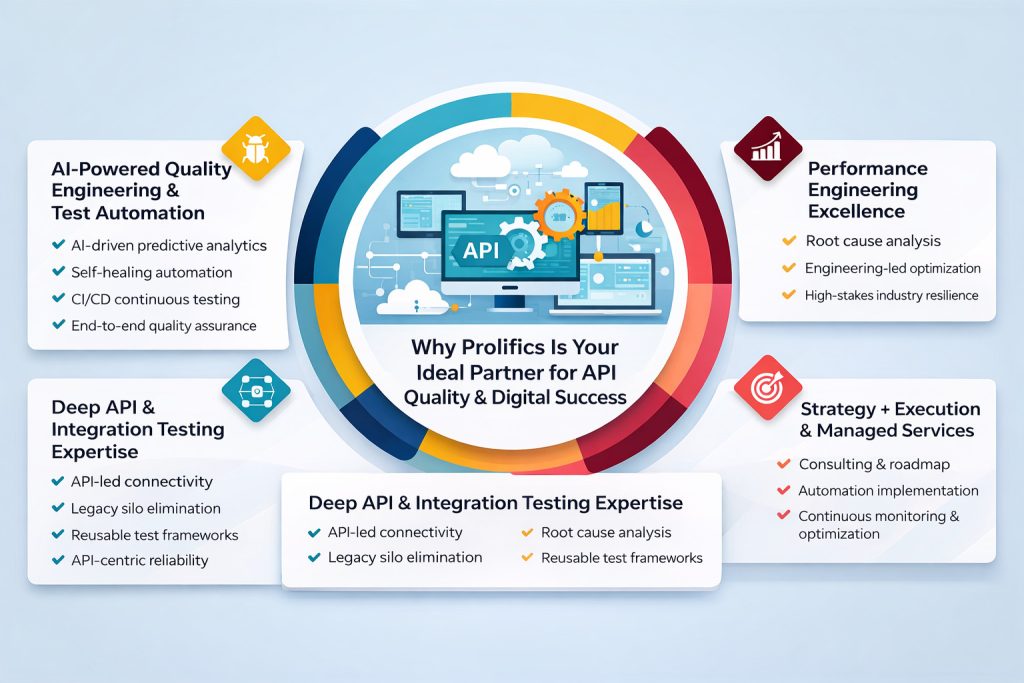
Why Prolifics Is Your Ideal Partner for API Quality & Digital Success
Here’s how Prolifics doesn’t just test but transforms how you deliver software:
1. AI-Powered Quality Engineering & Test Automation
AI-driven predictive analytics that forecast issues before they occur
Self-healing test automation that adapts as systems evolve
Continuous testing integrated into CI/CD pipelines
End-to-end assurance that improves test coverage and reduces risk
This combination accelerates delivery, lowers maintenance costs, and ensures quality is built in, not bolted on.
2. Deep API & Integration Testing Expertise
APIs don’t exist in a silo, they connect systems, partners, cloud services, and microservices. Prolifics’ Digital Integration and Platform Solutions help you:
Streamline API-led connectivity across enterprise systems
Eliminate legacy data silos for unified data access
Accelerate integration testing with reusable frameworks
Enable robust API-centric testing strategies that improve reliability
Reduce development costs and speed delivery without compromise
This breadth ensures that regardless of environment, cloud, hybrid, or on-prem, your critical interfaces hold up under pressure.
3. Performance Engineering, Not Just Performance Testing
Many providers test performance. Prolifics goes further by offering Continuous Performance Engineering, meaning they identify root causes and propose engineering solutions, not just surface-level reporting.
This is crucial in high-stakes environments like finance, healthcare, and retail, where latency or instability can directly affect revenue, compliance, or trust.
4. Strategy + Execution + Managed Services
Prolifics doesn’t just provide tools; they offer end-to-end quality strategies, including:
Managed services that continuously monitor, optimize, and innovate
This lifecycle approach ensures sustainable API quality engineering maturity across the organization.
Real Results, Real Impact
Clients partnering with Prolifics have seen:
✔Reduced software defects before release ✔ Automation that scales with CI/CD velocity ✔ Improved test coverage across API layers ✔ Reduced downtime and faster recovery from issues ✔ A quality engineering culture that empowers teams
In today’s digital-first world, mediocre quality isn’t acceptable; it’s expensive. Organizations that invest in comprehensive API quality engineering, backed by performance testing for APIs and AI-driven test automation, unlock faster innovation, happier users, and greater business resilience.
Conclusion
APIs are the backbone of modern software. But without rigorous testing, performance engineering, and AI-enabled quality practices, they’re also a risk vector. The difference between an API that supports your growth and one that hinders it can come down to the sophistication of your testing and quality strategy particularly your adoption of API Quality Engineering, Shift-Left API Testing, and Continuous Performance Engineering.
That’s where Prolifics steps in, transforming quality from a cost center into a competitive edge. From strategy and automation to performance engineering and managed services, Prolifics gives you the tools, expertise, and partnerships you need to win in today’s digital age.
Partner with Prolifics to elevate quality, accelerate digital transformation, and unlock superior business outcomes.
In today’s digital economy, enterprises are no longer defined by a single technology stack or centralized infrastructure. Instead, they operate across hybrid environments, multi-cloud platforms, SaaS ecosystems, legacy systems, and expanding partner networks. While this evolution enables agility and innovation, it also introduces complexity. Without a cohesive enterprise integration strategy, organizations risk fragmented data, operational silos, inconsistent customer experiences, and stalled transformation efforts.
A modern enterprise integration strategy serves as the foundation for a connected enterprise. It enables seamless communication between applications, systems, data, and people, transforming technology from a collection of isolated assets into a unified, intelligent ecosystem built on a scalable Connected Enterprise Framework.
Why Integration Has Become a Strategic Imperative
Digital transformation has accelerated technology adoption at an unprecedented pace. Business units independently adopt SaaS applications. Cloud migrations introduce new infrastructure layers. APIs power customer-facing applications. Meanwhile, legacy systems continue to support mission-critical operations.
This rapid expansion creates disconnected environments where systems do not naturally communicate with one another. The result?
Manual workarounds
Data inconsistencies
Limited real-time visibility
Increased operational risk
Slower innovation cycles
According to McKinsey & Company, organizations that modernize their technology foundations significantly outperform competitors in speed, agility, and operational efficiency. However, modernization without a structured enterprise integration strategy often leads to complexity rather than clarity.
Integration is no longer just an IT concern. It is a business growth enabler that directly impacts customer experience, operational resilience, and competitive advantage.
The Core Pillars of a Modern Integration Strategy
A connected enterprise is built on a deliberate and scalable integration foundation. Several key pillars define modern integration success within a strong Connected Enterprise Framework.
1. API-First Architecture
APIs act as digital connectors that allow systems to exchange data securely and efficiently. An API-first architecture ensures that integration is intentional, not reactive, and supports modernizing legacy systems through API-led connectivity.
Platforms such as MuleSoft promote API-led connectivity, where reusable APIs are designed as modular building blocks. This API-first architecture approach allows enterprises to:
Accelerate development cycles
Reduce duplication of effort
Enable faster partner onboarding
Improve system scalability
API management also introduces governance, monitoring, and security controls that prevent integration sprawl. By embedding API-first architecture principles into an enterprise integration strategy, organizations create a flexible digital foundation capable of evolving with business needs.
2. Cloud and Hybrid Connectivity
Most enterprises today operate in hybrid or multi-cloud environments. Systems span on-premises data centers and public cloud platforms. Hybrid Cloud Connectivity ensures seamless communication across these environments without compromising performance or security.
Frameworks from Google Cloud emphasize automation, observability, and resilience as key components of operational excellence in cloud environments. Similarly, platforms from Microsoft and AWS provide integration services that support API management, event-driven architecture, and secure messaging across distributed systems, forming the backbone of scalable hybrid cloud connectivity.
Cloud-native integration enables:
Rapid deployment of services
Elastic scalability
Real-time data exchange
Simplified infrastructure management
Hybrid integration ensures legacy systems remain connected while organizations modernize incrementally. For enterprises seeking to build a scalable hybrid cloud integration roadmap, aligning cloud adoption with a well-defined enterprise integration strategy is critical.
3. Data Integration and Real-Time Intelligence
A connected enterprise is fundamentally data driven. However, disconnected systems create fragmented data landscapes that limit visibility and slow decision-making. Advanced Data Integration Solutions are essential for eliminating silos and supporting Real-Time Intelligence Systems.
Research from PwC highlights that organizations with integrated data ecosystems achieve faster, more informed decision-making and stronger operational transparency.
Modern integration strategies prioritize:
Real-time data synchronization
Event streaming architectures
Master data management
Unified analytics pipelines
The benefits of event-driven architecture for connected enterprises include improved responsiveness, reduced latency, and enhanced scalability across distributed environments.
When data flows seamlessly across applications through robust data integration solutions, enterprises gain a single source of truth. This unified data layer powers real-time intelligence systems and supports AI-driven insights.
Without strong data integration solutions and scalable real-time intelligence systems, AI initiatives struggle to scale, and digital transformation efforts fail to reach their full potential.
4. Security and Governance
As connectivity expands, so does exposure to risk. APIs, cloud services, and partner integrations introduce new security considerations across the digital landscape.
A robust enterprise integration strategy embeds governance from the start, ensuring secure hybrid cloud connectivity and standardized API-first architecture practices. Governance frameworks also strengthen digital ecosystem orchestration, ensuring systems, applications, and partners operate cohesively and securely.
Key governance components include:
Identity and access management
Encryption and tokenization
API security policies
Compliance monitoring
Continuous observability
Security is not an afterthought in a connected enterprise. It is a foundational design principle within a mature connected enterprise framework.
The Business Impact of a Connected Enterprise
A well-executed enterprise integration strategy delivers tangible, measurable outcomes.
Faster Innovation Reusable APIs and modular architecture under an API-First Architecture model reduce development time and accelerate new product launches.
Improved Customer Experience Integrated systems powered by hybrid cloud connectivity and real-time intelligence systems ensure consistent, real-time data across channels, enabling personalized and seamless interactions.
Operational Efficiency Automation and advanced data integration solutions reduce manual processes, eliminate redundancy, and lower maintenance costs.
Greater Agility Enterprises can quickly adapt to new market demands, partnerships, or regulatory changes through a scalable Connected Enterprise Framework.
Enhanced Resilience Event-driven architectures, intelligent monitoring, and cloud-native integration strengthen operational resilience and business continuity.
Integration transforms disconnected systems into a cohesive ecosystem that drives operational excellence.
The Future of Enterprise Integration
Integration is evolving beyond simple system connectivity. Emerging trends include:
Integration is becoming an intelligent backbone that dynamically supports business processes. As AI adoption accelerates, integration layers will increasingly automate decision-making, monitor system health, and optimize workflows in real time. The enterprises that succeed will be those that view integration not as middleware but as a strategic capability.
Key Takeaways
A connected enterprise does not happen by accident. It is architected through a deliberate enterprise integration strategy that aligns technology investments with business objectives.
A connected enterprise does not happen by accident. It is architected through a deliberate integration strategy that aligns technology investments with business objectives.
At Prolifics, we help organizations design and implement modern integration strategies that unify applications, data, and cloud environments into a cohesive digital ecosystem. By combining API-first architecture, cloud-native platforms, secure governance models, and deep domain expertise, we enable enterprises to reduce complexity, accelerate innovation, and unlock measurable business value.
Integration is not simply about connecting systems; it is about connecting strategy to execution, data to insight, and technology to transformation. The foundation of a connected enterprise begins with integration. And the future belongs to organizations that build it right.
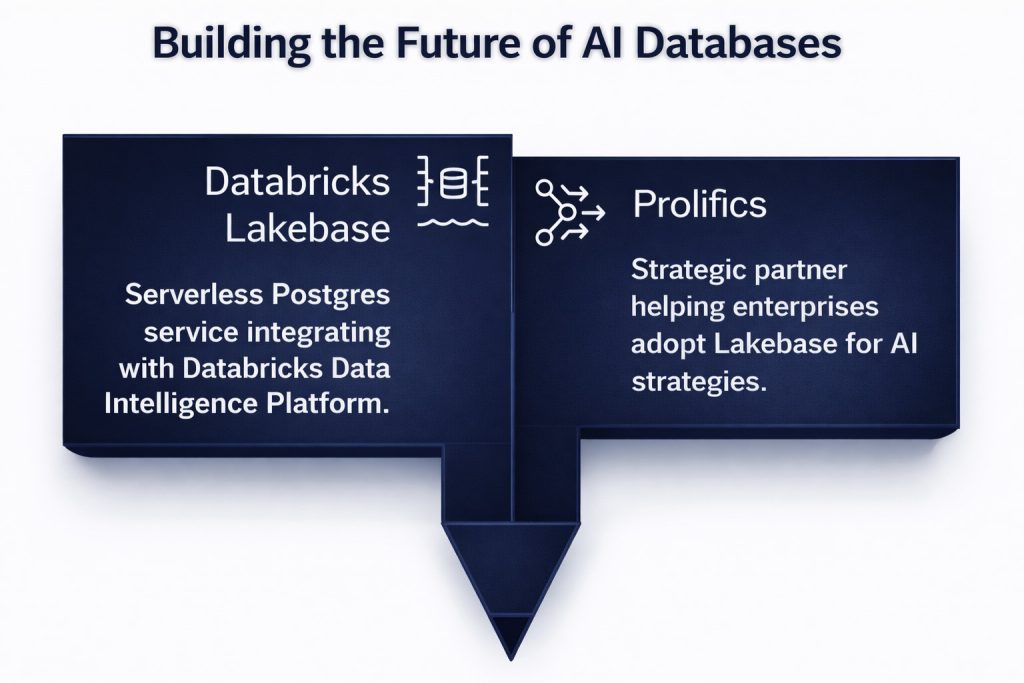
Databricks has announced the General Availability of Databricks Lakebase GA, a modern operational database architecture built to support intelligent applications, real time analytics, and AI driven workloads. Designed as a serverless Postgres service, Lakebase removes traditional infrastructure constraints while integrating natively with the Databricks Data Intelligence Platform. This launch positions Serverless Postgres for AI workloads at the center of enterprise innovation, reinforcing the impact of Databricks Lakebase GA for modern enterprises.
Prolifics, a strategic Databricks partner, helps enterprises adopt Databricks Lakebase GA through a clear modernization roadmap aligned to business goals. With expertise in data engineering, AI enablement, and cloud architecture, we maximize performance, governance, and scalability, while guiding clients in evaluating Databricks Lakebase vs Snowflake Unistore to support long-term AI strategies.
Addressing the Limitations of Traditional Databases
Most traditional operational databases tightly couple compute and storage, a design that has remained standard for decades. While familiar, this model creates limitations that impact scalability, performance, and long-term cost efficiency. As organizations scale digital initiatives, these architectural constraints become more visible and harder to manage, especially when pursuing OLTP and OLAP unification.
Infrastructure complexity often delays digital transformation progress.
Shared resources frequently limit scalability and slow performance.
Legacy systems increase operational costs over time.
Data silos make unified analytics and AI harder, preventing true OLTP and OLAP unification.
Manual management reduces team productivity and agility.
This architectural innovation removes the longstanding divide between transactional systems and analytics platforms. As a result, enterprises can reduce data silos, simplify governance, and accelerate development cycles with Databricks Lakebase GA.
Serverless Managed Postgres Built for Modern Workloads
Databricks Lakebase provides a fully managed, serverless Postgres environment optimized for production workloads. It supports automatic scaling based on demand and scales to zero when idle, helping organizations optimize cost without sacrificing performance. This makes it a powerful serverless operational database for AI agents memory and other real-time intelligent applications, further strengthening Serverless Postgres for AI use cases.
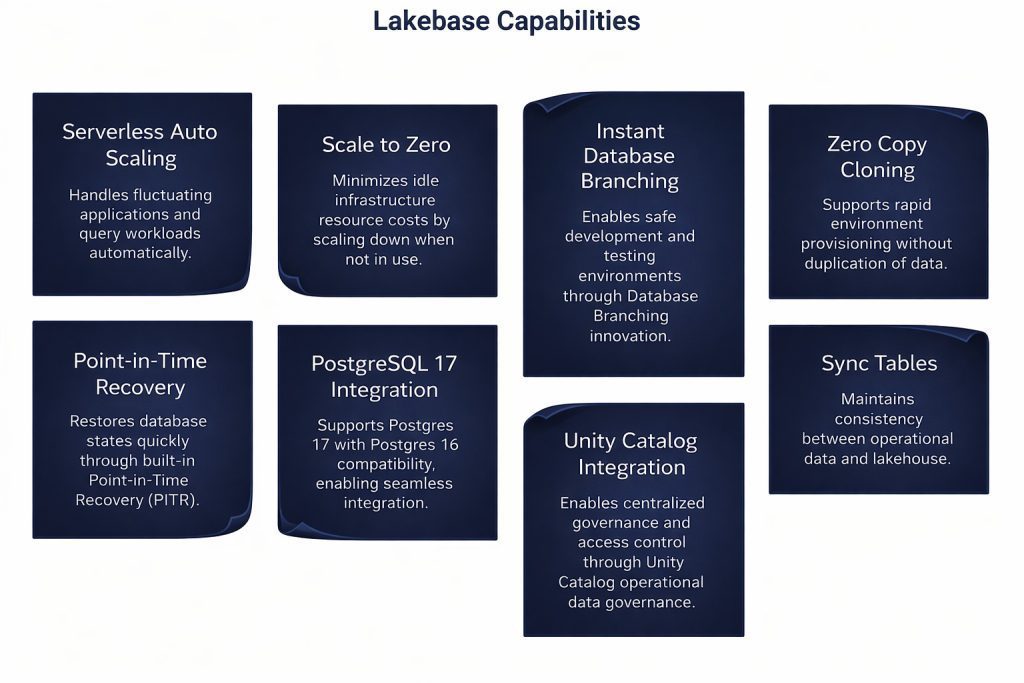
The following capabilities strengthen Lakebase for enterprise operational workloads:
Serverless auto scaling handles fluctuating applications and query workloads.
Scale to zero functionality minimizes idle infrastructure resource costs.
Instant database branching enables safe development and testing environments, powered by database branching innovation.
Zero copy cloning supports rapid environment provisioning without duplication.
Point in time recovery restores database states quickly through built in Point-in-Time Recovery (PITR).
Support for Postgres 17 with Postgres 16 compatibility, enabling seamless PostgreSQL 17 Databricks integration.
Unity Catalog integration enables centralized governance and access control through Unity Catalog operational data governance.
Sync tables maintain consistency between operational data and lakehouse.
These features make Databricks Lakebase GA suitable for mission critical applications, including real time feature serving, AI agent memory storage, and embedded analytics powered by Serverless Postgres for AI capabilities.
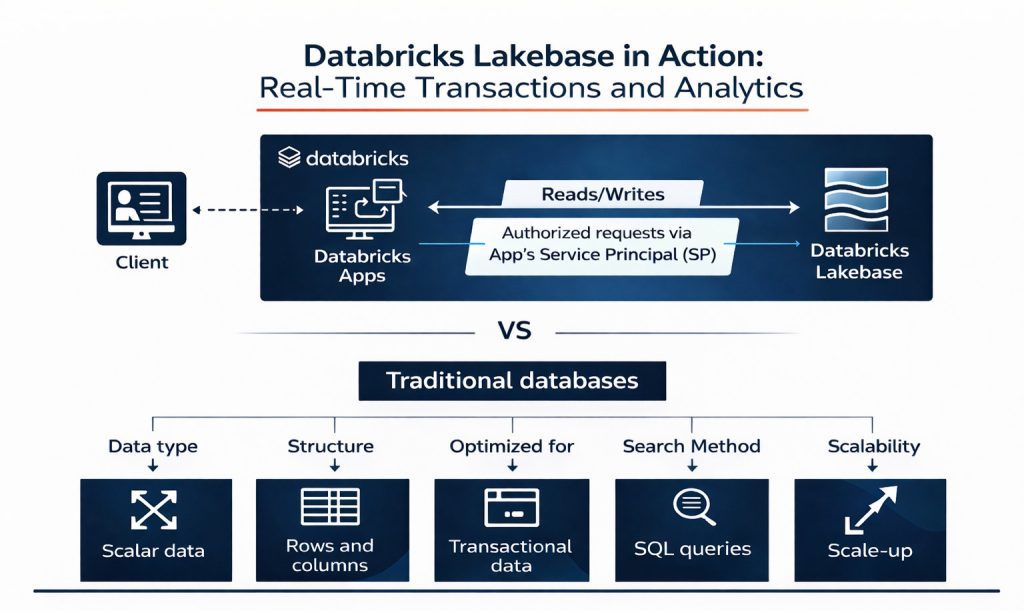
Databricks Lakebase vs Traditional Operational Databases
Databricks Lakebase GA separates compute and storage within a serverless Postgres architecture, enabling automatic scaling, unified governance, and seamless integration with analytics and AI workloads.
Traditional operational databases tightly couple compute and storage, require manual infrastructure management, and often create data silos that limit scalability, performance, and real time innovation.
Below are the key differences between Traditional Operational Databases and Databricks Lakebase GA:
Traditional Operational Databases
Databricks Lakebase
Compute and storage are tied together, which limits flexibility.
Compute and storage are separated for better flexibility.
Scaling requires manual planning and infrastructure changes.
Automatically scales based on real time demand.
Performance slows when multiple workloads compete for resources.
Workloads run independently with better performance stability.
Teams spend time managing servers and infrastructure.
Fully managed service reduces operational overhead.
Data must be copied into separate systems for analytics.
Directly connected to the Databricks lakehouse.
Security and governance are handled across multiple tools.
Unified governance through a single framework.
Backup and recovery processes require manual effort.
Built in recovery features protect against data loss.
Limited support for AI focused workloads.
Designed to support AI, analytics, and modern applications.
Enabling Intelligent Applications and AI Agents
Modern enterprises need operational databases that support AI, machine learning, and real time decision making without adding unnecessary complexity. Databricks Lakebase GA enables applications and AI agents to work directly on trusted, governed data within the Databricks ecosystem, helping teams move from experimentation to production with confidence.
At Prolifics, we work closely with organizations to design practical, scalable data architectures that turn AI strategies into real business outcomes. Our team also advises on how to migrate Postgres to Databricks Lakebase with minimal disruption and clear ROI alignment. We also help clients evaluate Databricks Lakebase vs Snowflake Unistore to determine the best architectural path.
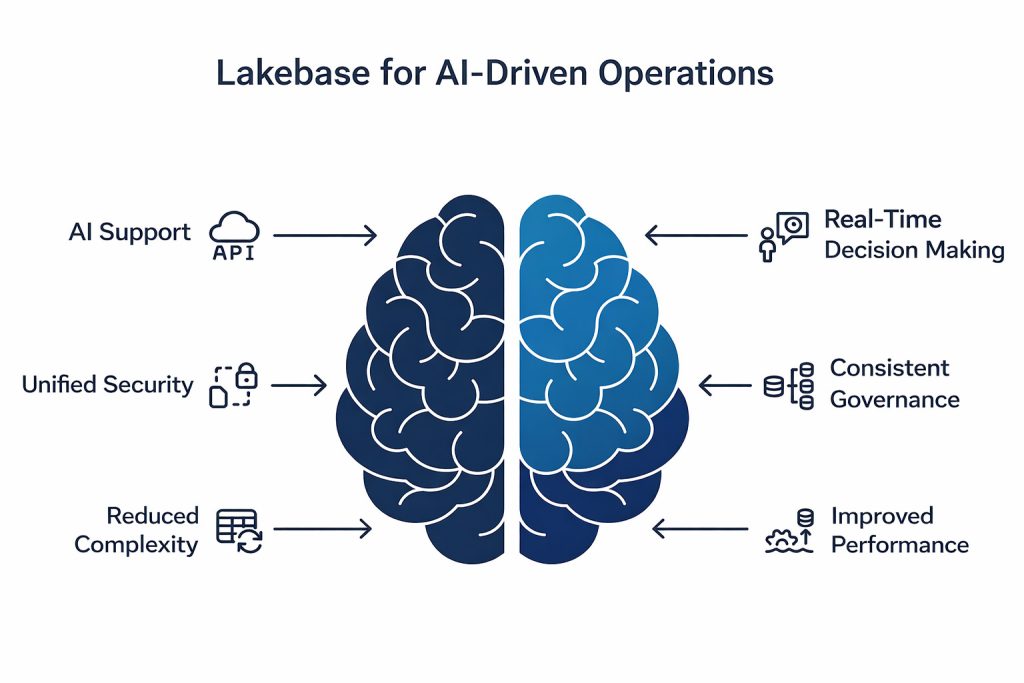
Because Lakebase runs natively on the Databricks platform, organizations benefit from:
Unified security and access control across enterprise environments.
Consistent governance across operational and analytical data assets through Unity Catalog operational data governance.
Reduced need for data replication or complex ETL pipelines.
Improved performance for low latency, real time workloads.
This unified architecture allows AI models, transactional systems, and analytics workloads to operate from a single source of truth, enabling effective OLTP and OLAP unification.
Enterprise Performance Without Complexity
Many enterprises still rely on legacy database systems that are costly to maintain and difficult to scale. Databricks Lakebase GA provides a streamlined modernization path by offering enterprise grade reliability, automated backups, and enhanced storage capacity.
Supports up to 8TB storage per instance for scalability.
Enables advanced Postgres extensions including pgvector for AI.
Handles demanding, high volume production workloads efficiently.
Optimized for secure, enterprise grade performance environments.
Organizations evaluating Databricks Lakebase storage limits and pricing 2026 can consider this scalability model when planning long term AI and modernization strategies.
These capabilities make Lakebase a strong foundation for organizations transitioning from legacy SQL Server or monolithic database environments to a modern, scalable platform. General Availability on AWS and beta availability on Azure further demonstrates Databricks’ commitment to delivering enterprise ready capabilities across multi cloud environments.
The Next Evolution of Operational Databases
Databricks Lakebase GA changes the way enterprises think about operational databases. By separating compute from storage and integrating directly with the lakehouse, it brings applications, analytics, and AI together on one connected platform.
Organizations that adopt this architecture can simplify infrastructure, speed up development cycles, and build intelligent applications with greater confidence. When data is unified and governed consistently, innovation becomes faster and more practical.
With the right implementation partner, this shift becomes more than a technical upgrade. It becomes a clear step toward long term digital transformation and measurable business impact.
At Prolifics, we help enterprises turn that vision into reality. From strategy to deployment, we guide organizations in using Databricks Lakebase GA, evaluating Databricks Lakebase vs Snowflake Unistore, and implementing Serverless Postgres for AI to modernize operations and scale AI initiatives.
Conclusion
Databricks Lakebase GA represents a meaningful step forward in operational database architecture, combining serverless Postgres, unified governance, seamless lakehouse integration, and strong support for PostgreSQL 17 Databricks integration within a single platform.
By separating processing resources from storage and aligning operational and analytical workloads, Databricks Lakebase GA enables enterprises to reduce infrastructure complexity, improve scalability, and support AI driven innovation with confidence through Serverless Postgres for AI capabilities.
Modernizing legacy systems or scaling AI requires more than technology, it demands the right execution partner. Prolifics combines strategic insight and technical expertise to implement Databricks Lakebase GA effectively and deliver measurable business value.
Salesforce has officially launched Salesforce Agentforce Vibes, a next-generation enterprise Salesforce AI coding assistant platform designed to transform how developers build applications by converting natural language into production-ready code.
The new tool embodies the emerging Enterprise Vibe Coding paradigm, where developers describe what they want in plain language, and advanced AI agents generate the code and workflows. This move marks a significant leap in autonomous Salesforce development and reflects Salesforce’s broader strategy to embed artificial intelligence into every layer of application delivery.
At its core, Salesforce Agentforce Vibes empowers teams to rapidly build and customize Salesforce applications, integrations, and AI agents without manually writing each line of code. Instead, developers use conversational prompts, and the AI, powered by an autonomous agent named Vibe Codey AI, interprets the intent, generates Salesforce Metadata Contextual AI, and assists throughout the entire software lifecycle.
Unlike earlier experimental coding assistants, Salesforce Agentforce Vibes is built with enterprise-grade security, governance, and a trusted infrastructure native to the Salesforce ecosystem.
Key Features of Agentforce Vibes
Natural Language to Code Developers can describe desired functionality in plain language, and the platform generates structured, context-aware Salesforce code. This is the ideal solution for teams learning how to use Agentforce Vibes for Apex development or building components in Lightning Web Components (LWC), HTML, and JavaScript, significantly reducing manual coding time.
Vibe Codey – Autonomous AI Partner The built-in AI agent, Vibe Codey AI, acts like a pair programmer that deeply understands an organization’s metadata, schema, and existing code patterns to produce reliable outputs aligned with internal standards. This level of autonomous Salesforce development ensures that the AI isn’t just guessing but is working with the specific DNA of your Salesforce environment.
Enterprise-Grade Security & Trust Layer Unlike consumer tools, Salesforce Agentforce Vibes features seamless Einstein Trust Layer integration, ensuring governance controls, audit logs, data masking, and compliance capabilities are embedded by default.
DevOps and Lifecycle Integration The tool works naturally within the Enterprise Vibe Coding framework, connecting with Salesforce Sandboxes, DevOps Center, Code Analyzer, and other Application Lifecycle Management (ALM) tools, covering ideation, build, testing, deployment, and observability.
Multi-IDE Support Developers can use Salesforce Natural Language Programming features in familiar environments such as VS Code, Code Builder, Cursor, and more, ensuring flexibility without disrupting existing workflows.
How Agentforce Vibes Benefits the Enterprise Audience
Accelerated Development and Innovation
Salesforce Agentforce Vibes dramatically shortens the time from idea to implementation. By letting developers describe functionality instead of manually coding it, teams can ship features faster. When evaluating Agentforce Vibes vs GitHub Copilot for Salesforce, enterprises find that the deep native integration allows for much faster digital transformation initiatives.
Reduced Labor on Repetitive Tasks
With this Salesforce AI Coding Assistant handling routine work like scaffolding and unit test creation, developers can refocus on high-value architectural design. This is especially useful when building Lightning Web Components with Agentforce Vibes prompts, as the AI handles the repetitive boilerplate code.
Enhanced Quality and Consistency
Because the platform utilizes Salesforce Metadata Contextual AI, the generated code adheres to internal conventions, reduces human error, and aligns with governance policies. This results in higher quality deliverables and fewer defects in production.
Stronger Security and Compliance
Enterprise Vibe Coding adoption often stalls due to concerns over code security. Salesforce Agentforce Vibes tackles this through its Einstein Trust Layer integration, ensuring that AI-generated code complies with regulatory and internal standards.
Looking Ahead
As enterprises look to translate this Salesforce AI Coding Assistant capability into real-world impact, partners like Prolifics play a critical role. With deep expertise across Salesforce Natural Language Programming, AI-driven automation, and enterprise application modernization, Prolifics helps organizations design, implement, and scale Salesforce Agentforce Vibes in alignment with business objectives and Autonomous Salesforce Development standards.
Together, Salesforce and Prolifics enable enterprises to move from experimentation to production faster, safer, and with measurable value, unlocking the full potential of AI-powered development.
As businesses become increasingly interconnected, software has become far more than code, it fuels the seamless interactions that power global commerce. To manage this complexity, many organizations are now investing in Enterprise Quality Engineering Services to ensure their customer experience platforms and mission-critical ERP systems work at scale.
From real-time analytics to IoT data pipelines, enterprises rely on complex applications that must just work, every time. But with complexity comes risk: bugs, performance bottlenecks, integration breakages, and security gaps can erode customer trust, expose sensitive data, and disrupt operations across the value chain.
This is where enterprise software testing becomes not just a technical necessity but a strategic differentiator. A robust risk-based testing strategy ensures reliability, performance, security, and scalability while enabling innovations that fuel growth. In fact, today’s leaders recognize that enterprise quality engineering services act as a business enabler, not a cost center.
In this post, we explore why enterprise testing matters, what modern enterprises are doing to stay ahead, and how Prolifics’ Digital Transformation QA Strategy empowers organizations to deliver resilient software with confidence.
Why Enterprise Testing Matters
Enterprise applications are vastly different from traditional software. They operate across geographies, devices, user roles, and integrations, every piece weaving into complex, business-critical processes. A failure in these systems can mean:
Operations grind to a halt
Revenue leakage
Reputational damage
Regulatory compliance issues
Because enterprise systems handle large volumes of data and transactions, every release, even a small update, introduces risk. This means testing must be systematic, scalable, and continuous, not ad-hoc or manual.
At its core, Enterprise Quality Engineering Services protect trust across users, customers, partners, and regulators. It ensures applications perform as intended, scale reliably under pressure, and safeguard sensitive data against evolving threats.
Modern Enterprise Testing: Beyond Bugs to Business Value
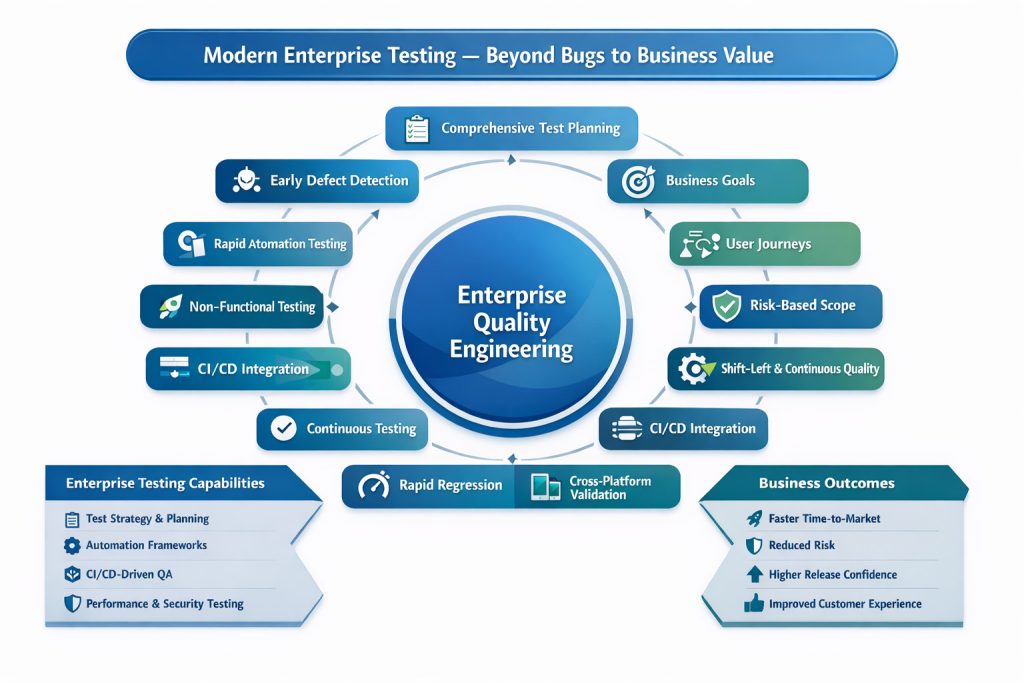
Today’s enterprise testing strategies are no longer limited to finding bugs. The goal has expanded to optimizing quality at every step of the software lifecycle using a comprehensive Digital Transformation QA Strategy. This includes:
1. Comprehensive Test Planning
Effective test planning begins with understanding business goals and user journeys. By implementing a risk-based testing strategy, organizations can align quality with business outcomes. A solid plan defines:
A solid plan defines:
Scope and objectives
Test types required (functional, performance, security, regression, etc.)
Resource and tooling needs
Risk-based priorities
This ensures testing isn’t just about checking boxes, it’s about assuring readiness for real-world use.
2. Shift-Left and Continuous Quality
The shift-left methodology-testing earlier in the lifecycle—is foundational to QA excellence. Integrating continuous testing in CI/CD pipelines catches defects early and accelerates release cycles. Modern enterprises adopt:
Modern enterprises adopt:
Continuous Testing in CI/CD Pipelines — validating code changes as they happen
Automated testing through pipelines — consistent, repeatable feedback
Risk-based test prioritization — focusing first on areas with the highest business impact
This mindset transforms quality into a predictable, measurable process rather than an afterthought.
3. Test Automation at Scale
Automation isn’t an optional add-on; it’s essential. AI-powered test automation frameworks allow enterprises to keep up with the speed of modern development cycles. Automation enables:
Automation enables:
Regression Testing Automation across various environments
Consistent cross-platform and cross-device validations
Early detection of integration regressions
Reduced human error
When done right, AI-powered test automation frameworks accelerate releases without compromising quality.
4. Non-Functional Testing for Real-World Assurance
Beyond simply verifying functionality, modern enterprises must ensure software meets expectations for:
Performance under load
Scalability with user growth
Security against evolving threats
Compliance with global regulations
These non-functional aspects determine whether systems can sustain business growth and protect critical data, especially in regulated industries like finance, healthcare, and government.
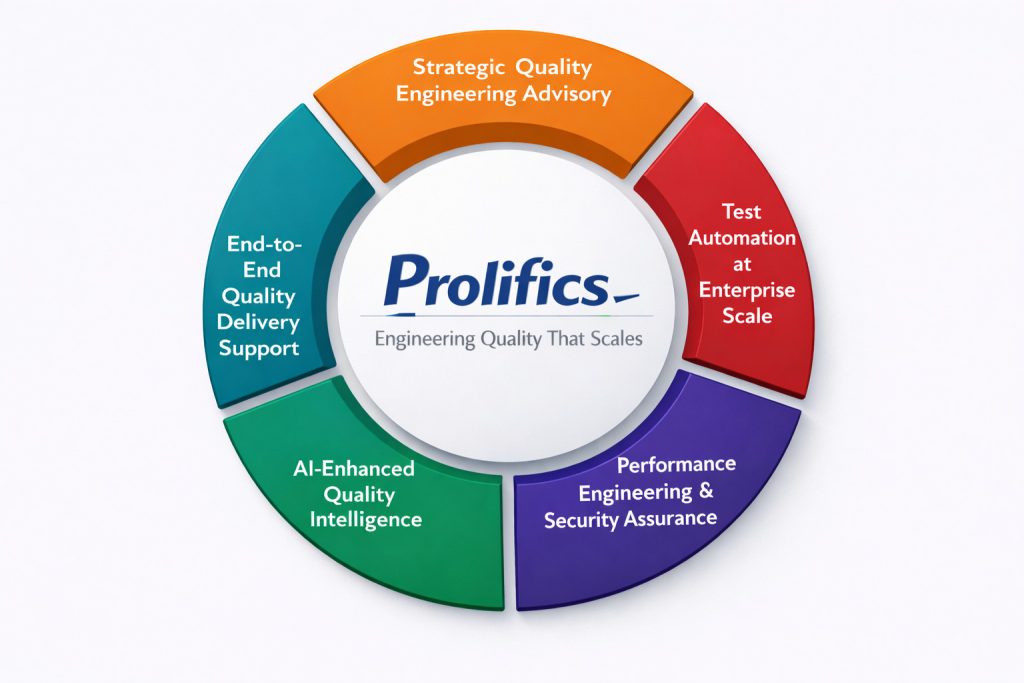
Prolifics: Engineering Quality That Scales
While many organizations struggle to execute testing strategies, Prolifics provides a complete suite of Enterprise Quality Engineering Services that meet the unique needs of large-scale digital initiatives.
Here’s how Prolifics empowers enterprises to elevate quality:
1. Strategic Quality Engineering Advisory
Prolifics partners early with clients to co-define testing goals. This alignment, often part of a Digital Transformation QA Strategy, accelerates feedback loops from ideation to deployment.
Whether your goal is to modernize legacy systems or adopt DevOps, Prolifics ensures testing is aligned with outcomes.
2. Test Automation at Enterprise Scale
Prolifics builds AI-powered test automation frameworks tailored to your stack and ecosystem. From API and functional automation to performance and regression automation, the goal is to free your team from repetitive tasks and maximize consistency and coverage.
By integrating Continuous Testing in CI/CD Pipelines, Prolifics helps your organization release faster and safer, enabling continuous delivery without quality trade-offs.
3. Performance Engineering and Security Assurance
In a world of 24×7 uptime, enterprise software scalability testing is vital. Enterprise applications must perform reliably under heavy load and defend against complex security threats.
Prolifics brings in:
Load and stress testing to validate performance at scale
These capabilities mitigate risk before it impacts customers or business operations.
4. AI-Enhanced Quality Intelligence
Prolifics leverages AI to drive intelligent testing decisions. By utilizing a risk-based testing strategy, high-risk areas can be identified early and tested thoroughly.
5. End-to-End Quality Delivery Support
From test strategy and planning to continuous execution and monitoring, Prolifics supports the full spectrum of quality engineering needs, including:
Test management and governance
Test data strategy
Cross-platform compatibility testing
Real-world user simulation
This end-to-end support model ensures that quality is not siloed, it’s embedded across teams and workflows.
Business Outcomes: Quality That Drives Growth
Investing in enterprise testing yields measurable results:
Fewer production defects
Lower cost of quality
Faster time-to-market
Higher user satisfaction
Reduced business risk and downtime
But in the digital economy, quality does more than prevent failure, it enables innovation. With reliable systems, enterprises can confidently roll out new experiences, adopt emerging technologies, and respond at market pace.
Conclusion: Quality as a Competitive Advantage
Quality is no longer optional; it’s strategic. The best enterprises treat software testing as a value engine, ensuring enterprise software scalability testing and security while accelerating release cycles. Whether you’re starting your journey or scaling practices, Prolifics provides the enterprise quality engineering services needed to turn quality into a competitive advantage.
Ready to elevate your enterprise quality strategy? Let’s engineer excellence together.
Artificial intelligence is reshaping financial technology. It is moving beyond basic automation. Instead of handling only repetitive tasks, AI agents in fintech help companies personalize services, improve security, and make faster, data-driven decisions.
From customer onboarding to transaction monitoring, AI agents in fintech strengthen every stage of the financial journey.
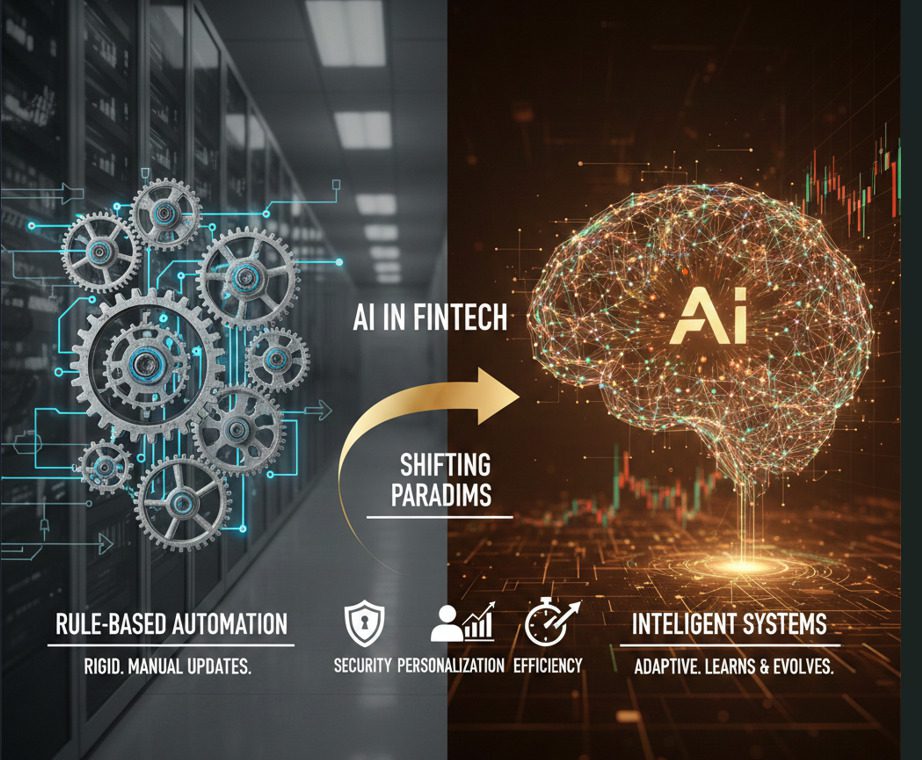
Traditional fintech systems depend on fixed rules. They need manual updates when conditions change. In contrast, modern AI platforms learn continuously from historical and live data. They detect patterns and anomalies automatically.
This shift transforms fintech from static execution to intelligent decision-making powered by real time AI decision making in fintech.
The measurable impact is clear. Many institutions have reduced fraud response times dramatically sometimes by up to 99%. AI-driven lending can now approve loans in minutes instead of days.
Beyond efficiency, AI agents in fintech create long-term strategic value. They improve risk evaluation, enable tailored advice, and support ongoing compliance monitoring. In complex markets, this intelligence becomes a competitive advantage.
Key Points
AI enhances demand forecasting and financial modeling with deeper predictive accuracy.
Risk assessment becomes more precise through advanced data analysis and behavioral insights.
AI-driven fraud detection systems can flag suspicious activity instantly.
Automated loan approvals reduce processing time from days to minutes.
AI supports personalized banking using AI recommendations.
Intelligent chatbots and virtual assistants improve 24/7 customer service experiences.
Algorithmic trading systems leverage AI to analyze market trends and execute trades efficiently.
Regulatory Compliance Automation helps firms adapt to rule changes.
AI reduces operational costs by minimizing manual intervention and errors.
Predictive analytics supports proactive risk management and strategic planning.
Understanding AI in Fintech
AI in fintech describes the use of intelligent technologies such as machine learning and advanced analytics to process financial data, detect patterns, and make predictive or automated decisions. Unlike traditional systems that rely on fixed rules and manual inputs, AI-driven solutions continuously learn from new information and improve their performance over time.
By processing massive volumes of structured and unstructured information, institutions enhance risk checks, streamline operations, and prevent fraud. This evolution marks the rise of agentic AI in financial services.
From Rule-Based Automation to Intelligent Systems
Although both traditional automation and AI improve operational efficiency, they function on fundamentally different principles. The distinction lies in adaptability, where automation follows instructions, AI interprets data and evolves with it.
Traditional Fintech Automation
Conventional fintech automation relies on predefined, rule-based workflows. These systems execute tasks according to programmed logic and require manual updates whenever business rules or market conditions change.
While this approach enhances speed and consistency for routine operations, it remains rigid. It cannot independently learn from new data, detect emerging patterns, or adjust its behavior without human intervention.
AI-Powered Fintech Platforms
AI-enabled fintech systems operate beyond fixed programming. They continuously analyze incoming data, identify patterns, and refine their models as new information becomes available.
Because these systems are trained to recognize trends, anomalies, and behavioral signals, they support dynamic outcomes such as real-time credit assessments, predictive risk scoring, and hyper-personalized banking services.
Key Applications of AI in Financial Technology
AI’s real value appears in three areas:
security
personalization
operational speed
Together, they demonstrate the growing benefits of agentic AI for financial institutions.
Fraud Detection and Risk Management
Fraud is one of the largest threats to financial organizations. Losses reach billions each year, along with investigation and compliance expenses.
AI-driven fraud detection systems monitor activity in real time. They identify unusual behavior before damage escalates.
For example, if a customer usually shops locally but suddenly makes a large overseas purchase, AI can react immediately. Transactions may be paused, or customers alerted.
This is exactly how AI agents improve fraud detection in banks while reducing false alarms.
Personalized Financial Experiences
AI enables financial institutions to tailor products and services based on individual customer behavior, preferences, and financial history. Rather than offering standardized rates or generic products, organizations can align recommendations with each customer’s unique financial profile.
Robo-advisory platforms extend this personalization further by creating customized investment strategies based on goals and risk tolerance. As market conditions shift, AI algorithms adjust recommendations dynamically, delivering adaptive financial guidance that was once accessible only through dedicated human advisors.
Intelligent Automation Across Financial Operations
Organizations that invest in intelligent automation in fintech report strong gains.
Efficiency can improve by up to 60%.
Costs may fall by nearly 40%.
Routine work like data entry becomes automated. Teams then focus on strategic activities that require expertise.
Accuracy also rises. Fewer mistakes mean stronger lending, better compliance, and improved outcomes.
How AI Is Reshaping Fintech Careers and Skills
AI is transforming both financial services delivery and the skills required in fintech roles. A large share of banking tasks can now be enhanced by generative AI, driving measurable productivity improvements.
Employers now seek professionals who understand finance, analytics, and platforms that support agentic AI in financial services. Critical thinking ensures responsible deployment.
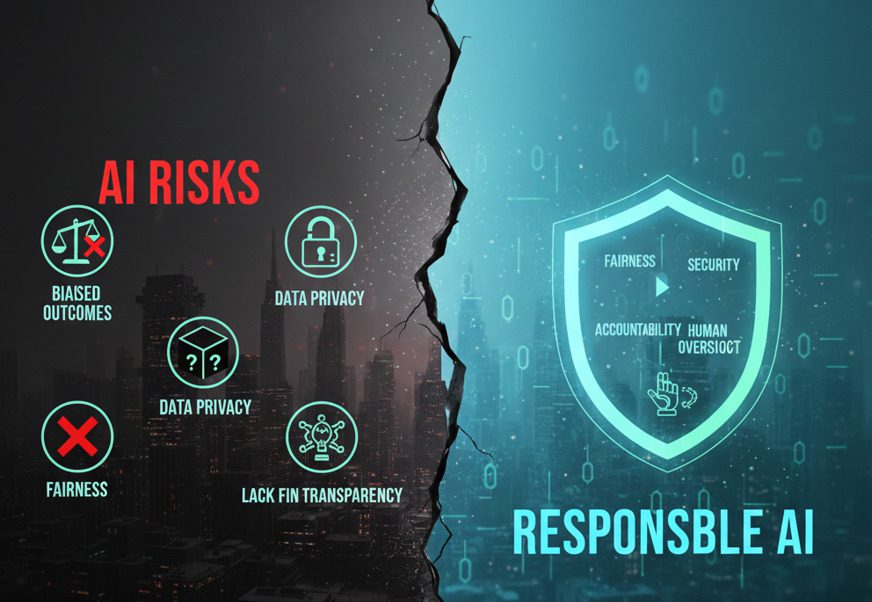
Risks, Ethics, and Responsible AI in Fintech
AI offers major benefits, but risks remain.
Potential issues include:
biased outputs
unclear decisions
privacy concerns
model inaccuracies
Strong governance, regular testing, and transparent frameworks are vital. Human judgment must always guide automated outcomes.
How Artificial Intelligence Is Redefining the Future of FinTech
AI’s influence will deepen. It will determine which firms lead and which fall behind.
One major development is the integration of AI with blockchain. Smart contracts may soon adjust terms automatically as risks evolve.
Instead of suggesting products, systems might soon select and manage them independently. This represents the next wave of AI agents in fintech.
Advancing Fintech Transformation Through Prolifics Intelligence
As fintech evolves, organizations need scalable, enterprise-ready AI to drive real impact. Prolifics helps financial institutions modernize operations, enhance security, and accelerate innovation through advanced AI, data, and cloud solutions.
From AI-driven fraud detection systems to cloud adoption and governance, organizations can transition from pilots to measurable value. The result is better compliance, stronger performance, and superior customer experience.
SAP Joule Agentic AI 2026 is redefining how enterprises approach ERP – moving beyond basic automation and chatbots toward intelligent systems that can reason, plan, and act across complex business environments. As organizations seek faster decisions and reduced manual effort, ERP systems require deeper, action-driven AI. SAP Joule Agentic AI enables this shift by embedding agentic intelligence directly into ERP workflows to understand context and take action.
At Prolifics, we help enterprises turn SAP Joule Agentic AI into real business value through intelligent automation, adaptive workflows, and greater operational agility as organizations prepare for Autonomous ERP 2026.
Evolution of Enterprise AI
Enterprise AI has progressed from rule-based automation to machine learning and generative AI. Today, the focus is on intelligent, goal-driven systems capable of reasoning across enterprise data, coordinating workflows, and executing decisions with minimal human input.
Why ERPs Need More Than Traditional Chatbots?
Chatbots are limited to reactive responses and scripted actions. ERP environments demand AI that understands business entities, relationships, and governance rules. Without deep business entity recognition and process awareness, chatbots fail to deliver sustained productivity gains.
Modern ERP systems require AI that reasons over dependencies, validates actions, and executes workflows securely, a core capability of SAP Joule Agentic AI.
2026 Data Point: Gartner predicts 40% of enterprise applications will include task-specific AI agents by end of 2026 – up from less than 5% in 2025 – making agentic ERP capability a competitive necessity, not a future option.
What Is SAP Joule?
SAP Joule is SAP’s AI-powered business assistant designed to operate across the SAP cloud portfolio. It delivers contextual insights, recommendations, and automated actions directly within enterprise workflows.
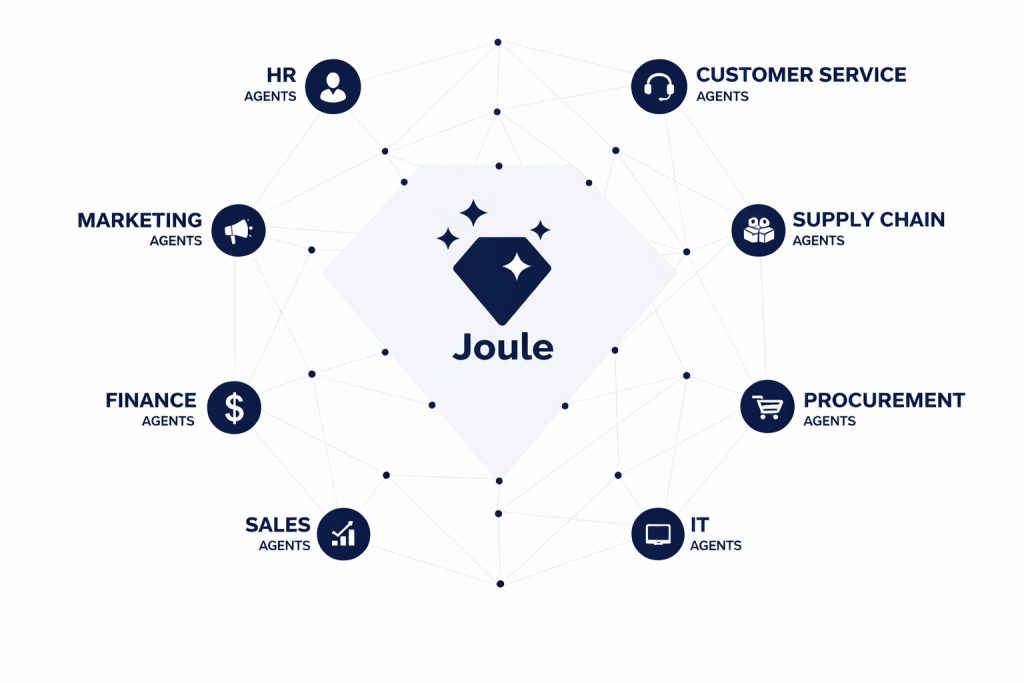
Joule is embedded across SAP’s cloud suite, including S/4HANA, SAP BTP, SuccessFactors, Ariba, and Sales and Service Cloud. This deep integration enables real-time enterprise intelligence built on the SAP BTP AI Foundation.
These capabilities continue to expand as part of SAP’s AI roadmap, reinforcing SAP Joule Agentic AI as a cornerstone of next-generation ERP.
What Makes SAP Joule Different?
SAP Joule is embedded natively into SAP’s application ecosystem and built on enterprise-grade data and process intelligence. Unlike conversational tools, Joule is designed to act within workflows, not just respond to prompts.
Its architecture leverages SAP Knowledge Graph reasoning to understand relationships across business objects, enabling AI-driven decisions grounded in enterprise context.
Understanding Agentic AI
Agentic AI refers to autonomous software agents that can plan, reason, and execute tasks independently. Unlike copilots, agentic systems are goal-driven and capable of multi-step decision-making without continuous user input.
This distinction becomes clear when comparing SAP Joule vs. traditional AI agents comparison, where Joule operates inside governed ERP workflows rather than as an external assistant.
SAP Joule’s Agentic AI Architecture
Joule Studio provides the foundation for building and managing custom AI agents. Using the Joule Studio Agent Builder, enterprises define goals, permissions, triggers, and workflows using low-code and no-code capabilities.
SAP supports Multi-agent orchestration SAP, allowing multiple agents to collaborate across finance, supply chain, and HR domains, resolve dependencies, and coordinate actions securely.
2026 Data Point: In Q1 2026, SAP Joule Studio Agent Builder became generally available (GA). SAP’s Cash Management Agent – also GA in Q1 2026 – reduces time spent on manual cash positioning by up to 80% by autonomously analysing daily bank statements and automating reconciliations.
This architecture is powered by SAP Business Data Cloud and semantic intelligence, enhanced with Retrieval-Augmented Generation to ensure responses and actions are grounded in trusted enterprise data.
From Assistants to Autonomous ERP
SAP Joule moves ERP systems from passive systems of record to active systems of execution. In finance, Joule agents automate accruals, reconciliations, and exception handling. In supply chain operations, agents support production planning, supplier onboarding, and disruption management.
These scenarios demonstrate Implementing SAP Joule agents in supply chain and finance as a practical path toward Autonomous ERP 2026, where systems operate continuously with minimal manual intervention.
Transform Operations with an Autonomous ERP
Joule enables context-aware reasoning by understanding enterprise data, governance rules, and business objectives. It supports end-to-end workflow execution across approvals, exceptions, and integrations.
The platform integrates seamlessly with SAP S/4HANA, SAP BTP, and external ecosystems, enabling cross-system intelligence while supporting testing AI agents in SAP S/4HANA for validation, security, and compliance.
Business Impact of Joule + Agentic AI
Organizations adopting SAP Joule Agentic AI experience reduced manual work, faster decision-making, and improved operational resilience. Autonomous agents identify issues proactively and respond in real time.
Industry research predicts that up to 80 percent of routine enterprise tasks can be automated through agentic systems, accelerating the shift toward Autonomous ERP 2026.
2026 Data Point: Gartner projects that by 2028, at least 15% of day-to-day enterprise work decisions will be made autonomously through agentic AI – up from 0% in 2024. SAP Joule’s 2026 agent portfolio positions SAP customers to lead this transition ahead of competitors.
Industry-Specific Use Cases
Manufacturers use Joule agents to optimize production schedules and manage supply disruptions. Retail and CPG organizations improve demand forecasting and inventory planning.
Life sciences benefit from compliant automation and research workflows, while oil and gas organizations use Joule agents for asset tracking and logistics visibility, often referred to as “Where is my stuff” scenarios.
Building Your Own Joule Agents
SAP’s Agent Builder enables enterprises to create custom agents using natural language. Users define goals, triggers, and actions without extensive coding.
Agents integrate with existing automations, MCP tools, and custom skills, forming a practical Agentic AI implementation roadmap for Enterprise adoption.
Future of Autonomous ERP with SAP
The future points toward modular AI workforces where specialized agents collaborate across domains. Agent interoperability standards such as A2A and MCP are gaining traction, enabling coordinated enterprise intelligence.
2026 Data Point: At NRF 2026, SAP announced a Storefront MCP server for SAP Commerce Cloud (planned Q2 2026), allowing AI agents to discover products and execute transactions autonomously. SAP’s Agent-to-Agent (A2A) interoperability protocol is also advancing for cross-platform agent coordination.
SAP’s roadmap continues to expand governance, orchestration, and integration capabilities, positioning SAP Joule Agentic AI as a central pillar of autonomous enterprise architecture.
Conclusion
SAP Joule combined with agentic AI represents a fundamental shift in ERP systems, moving from conversational interfaces to intelligent, autonomous execution.
The transition enables higher productivity, faster decisions, and resilient operations. Organizations that embrace SAP Joule Agentic AI today will be best positioned to succeed in an AI-driven enterprise future.
Frequently Asked Questions
What is SAP Joule Agentic AI?
SAP Joule Agentic AI refers to the autonomous agent capabilities built into SAP’s Joule platform enabling ERP systems to plan, reason, and execute multi-step workflows independently across finance, supply chain, HR, and procurement with minimal human intervention.
How is SAP Joule different from a traditional chatbot?
Chatbots respond reactively to prompts. SAP Joule Agentic AI perceives ERP context, plans multi-step workflows, and executes actions across connected SAP systems – acting within governed processes rather than just answering questions.
What SAP Joule agents are available?
Key 2026 launches include the Cash Management Agent (Q1 – 80% time saving on reconciliation), Production Planning Agent (Q1 – autonomously releases production orders), Order Reliability Agent (Q2 – detects fulfilment risks proactively), and Bid Analysis Agent for procurement.
What is Autonomous ERP?
Autonomous ERP refers to ERP systems like SAP S/4HANA powered by Joule that operate continuously with minimal manual intervention functioning as systems of execution, not just systems of record.
What is multi-agent orchestration in SAP?
Multi-agent orchestration in SAP allows multiple specialized Joule agents to collaborate across domains for example, a case classification agent routing a billing dispute to a cash collection agent, completing the full resolution workflow autonomously.
Snowflake has just launched Snowflake Cortex Code, a revolutionary AI coding agent for data teams built natively for the enterprise. This tool dramatically accelerates productivity by understanding the full context of an organization’s enterprise data environment schemas, including governance policies, compute constraints, and automated mission-critical workloads.
While Snowflake Cortex Code is a strategic enabler for enterprises looking to scale data engineering, analytics, and AI across the organization at speed, it also ensures Snowflake Cortex AI governance is built directly into the development cycle. By integrating this AI coding agent for data teams with our delivery expertise, Prolifics customers can unlock new levels of operational efficiency and innovation.
What Cortex Code Means for Modern Enterprises
Traditionally, coding assistants can generate snippets, but they don’t understand business data context, making it hard to move from prototype to production. Snowflake Cortex Code changes that by:
Understanding enterprise data context, such as sensitive tables, costly transformations, and pipelines.
Helping users translate natural language into production-ready data pipelines, analytics, and AI apps through efficient natural language to SQL pipelines.
Reducing data engineering backlogs with AI agents by embedding intelligence directly into developer workflows and enterprise data systems.
This means teams can go from idea → prototype → governed production deployment faster than ever before, with less manual configuration and more business impact.
Key Capabilities of Cortex Code
Cortex Code empowers organizations to build smarter and safer, including:
Context-aware code generation: Unlike generic assistants, Cortex Code knows your data, governance, and compute rules. When evaluating Snowflake vs GitHub Copilot for data, the native understanding of Snowflake’s architecture provides a significant edge.
Natural language to production outputs: Build complex natural language to SQL pipelines and data workflows simply by describing them in plain language.
Secure integration in local and cloud workflows: Works in Snowsight, VS Code, or your developer’s editor of choice.
Enterprise-ready governance and controls: Experience seamless Cortex Code integration with VS Code for Snowflake, or work directly in Snowsight or your developer’s editor of choice.
Business Impact for Prolifics Customers
At Prolifics, we help organizations operationalize emerging technologies. Snowflake Cortex Code fits perfectly into our enterprise transformation playbook by providing context-aware data engineering solutions:
Faster Insight to Action Teams can quickly build and deploy analytics and AI applications, reducing data engineering backlogs with AI agents and cutting months of manual hand-coding.
Governance Without Compromise Cortex Code understands governance requirements and enforces them, critical for regulated industries like finance, healthcare, energy, and government.
Democratized Development Business analysts can collaborate with data engineers more effectively, learning how to build governed data pipelines with Cortex Code to unlock quicker innovation cycles.
Prolifics + Snowflake Cortex Code, Business Value Realized
Here’s how Prolifics helps customers capture value with this native AI coding agent for data teams:
Accelerate Time to Value: Rapidly translate strategic use cases into production workloads using natural language to SQL pipelines.
Embed Security & Compliance Early: Ensure every pipeline, model, and app is governed from Day 1.
Enable Cross-Functional Teams: Business, analytics, and IT teams collaborate seamlessly on a unified platform.
Optimize Costs & Resource Productivity: Automate repetitive coding tasks so technical talent focuses on high-value outcomes.
The Future of Data & AI Engineering
The launch of Cortex Code signals a new era: AI-enabled engineering that understands real data, not just prompts. For enterprises striving to innovate in the AI era, partnering with Prolifics to adopt and expand such capabilities means faster transformation, higher ROI, and a competitive edge in a data-driven world.
Let’s talk about how Cortex Code and Prolifics can accelerate your enterprise-wide AI journey.
Agentic AI in Supply Chain has moved rapidly from experimentation to enterprise deployment, particularly in supply chain operations where decision speed, coordination, and accuracy are critical. What once existed as isolated pilots or rule-based automation has evolved into intelligent, goal-driven systems capable of reasoning, collaborating, and acting autonomously across complex supply chain networks.
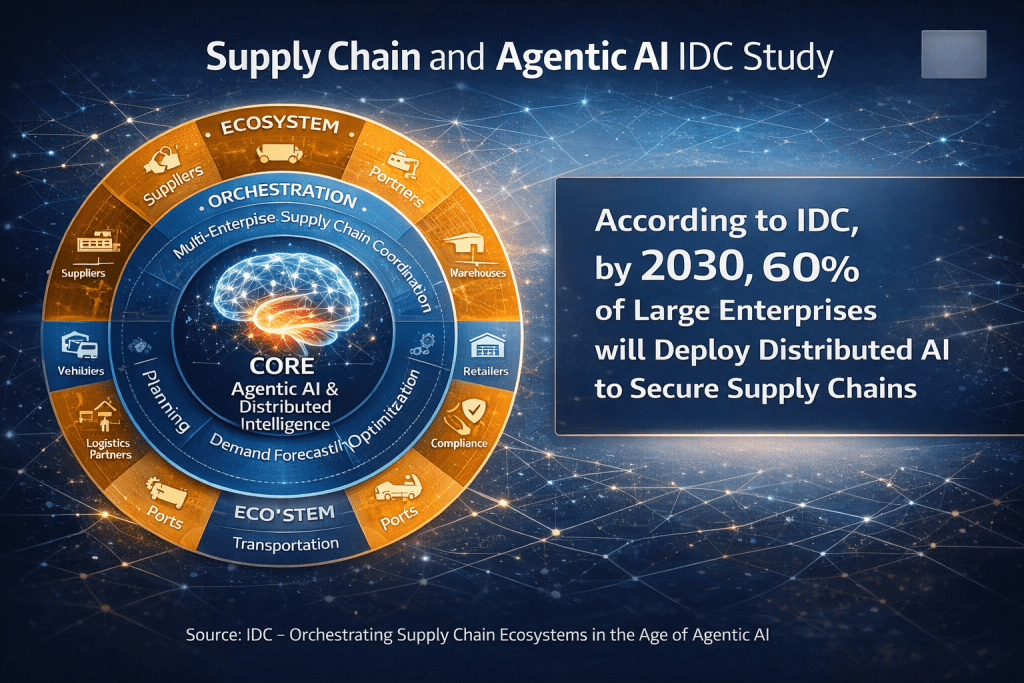
The IDC study on “Orchestrating Supply Chain Ecosystems in the Age of Agentic AI” highlights the shift from linear supply chains to a more complex, networked model. The study predicts that by 2030, 60% of large enterprises will deploy distributed AI to secure supply chains. It emphasizes the importance of multi-enterprise orchestration, which extends visibility beyond boundaries and addresses disruptions across extended supplier tiers and logistics partners.
As global supply chains face increasing pressure, from geopolitical volatility and demand uncertainty to labor shortages and sustainability mandates, organizations are no longer asking if they should adopt Agentic AI in Supply Chain, but how to scale agentic AI in enterprise supply chains responsibly and effectively. In 2026, clear patterns are emerging that distinguish enterprises achieving measurable business outcomes from those still struggling with fragmented automation.
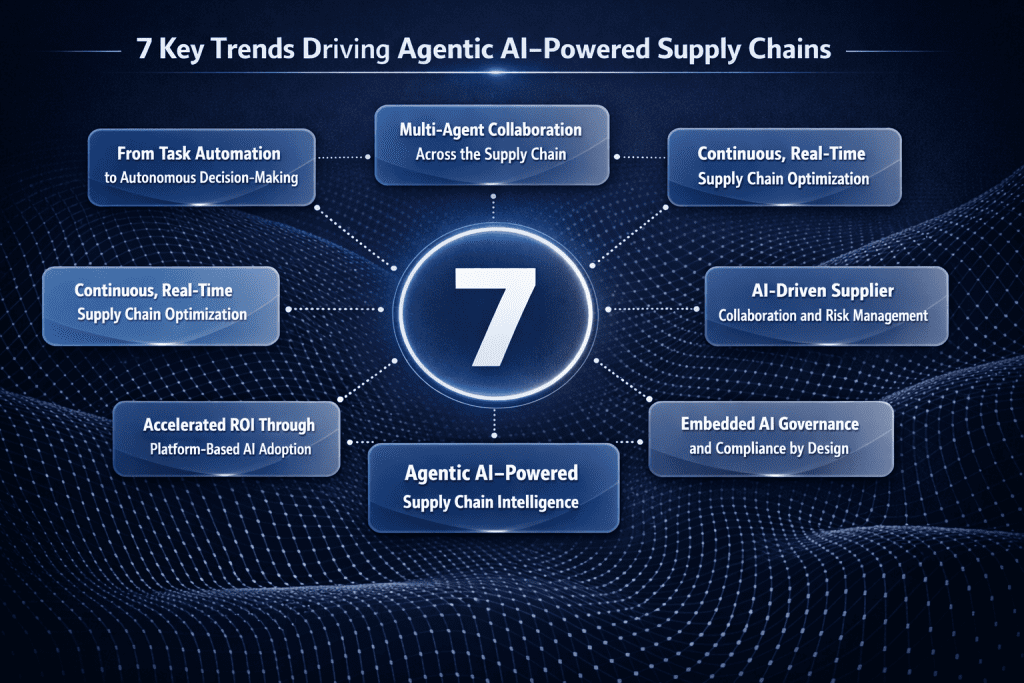
The 7 Agentic AI Trends Redefining Enterprise Supply Chains
The following seven trends define how Agentic AI in Supply Chain is reshaping enterprise supply chains, and how forward-looking organizations are turning these advancements into competitive advantage with the right technology and transformation partner.
1. From Task Automation to Autonomous Decision-Making
Traditional AI systems focused on automating individual tasks such as demand forecasting or inventory alerts. Agentic AI goes significantly further by transitioning from supply chain task automation to autonomous decisions. These systems are designed with goals, constraints, and decision authority, enabling them to evaluate scenarios, weigh trade-offs, and take action without constant human intervention.
In supply chains, this means AI agents can autonomously rebalance inventory, reroute shipments, adjust supplier orders, or respond to disruptions in real time. Rather than waiting for dashboards or approvals, decisions happen at machine speed through AI-Driven Decision Intelligence, guided by enterprise policies and business objectives.
Prolifics enables this shift by integrating Agentic AI in Supply Chain into core platforms, ensuring autonomy is paired with governance and traceability.
2. Multi-Agent Collaboration Across the Supply Chain
One of the most defining trends of 2026 is the rise of multi-agent systems for enterprise. Instead of a single monolithic AI system, enterprises are deploying specialized agents for procurement, logistics, manufacturing, quality, and finance, each with its own responsibilities and intelligence.
These agents communicate and collaborate, negotiating priorities and resolving conflicts dynamically. To realize the full benefits of multi-agent collaboration in global supply networks, a procurement agent may negotiate lead times with suppliers while a logistics agent optimizes transportation routes based on cost, emissions, and delivery risk.
Prolifics’ integration-first approach ensures these agents operate seamlessly across ERP, WMS, TMS, and partner systems, enabling true Autonomous Supply Chain Orchestration.
Static planning cycles are becoming obsolete. Agentic AI in Supply Chain thrives in environments where conditions change continuously and supply chains are among the most dynamic systems in the enterprise.
In 2026, leading organizations are using Agentic AI to continuously optimize supply chain performance across demand, inventory, production, and distribution. AI agents monitor live data streams, detect early signals of disruption, and proactively adjust plans before issues escalate.
This shift from reactive to predictive and autonomous operations often supported by supply chain digital twins delivers measurable benefits: reduced stockouts, lower carrying costs, and improved service levels.
Prolifics helps enterprises operationalize real-time intelligence by modernizing data pipelines, enabling AI-ready architectures, and embedding intelligence directly into operational workflows.
4. AI-Driven Supplier Collaboration and Risk Management
Supplier risk has become a board-level concern. Predictive supply chain risk management is transforming how enterprises assess and collaborate with their supplier ecosystems.
In 2026, AI agents continuously evaluate supplier performance using structured and unstructured data, contracts, delivery histories, financial signals, geopolitical events, and even news sentiment. When risks emerge, agents can recommend alternative suppliers, renegotiate terms, or rebalance sourcing strategies automatically.
Beyond risk mitigation, agentic AI in supply chain also enhances collaboration by enabling intelligent negotiations, automated compliance checks, and shared forecasting with suppliers.
Prolifics brings deep expertise in supply chain integration and governance, helping enterprises deploy AI-driven supplier intelligence while maintaining transparency, compliance, and trust.
5. Human-AI Collaboration, Not Replacement
Despite increasing autonomy, the most successful implementations are not about replacing humans; they are about augmenting them through a digital co-pilot for logistics.
Agentic AI acts as a digital co-pilot for supply chain leaders, planners, and operators. It explains decisions, presents alternatives, and escalates exceptions that require human judgment. This collaborative model improves decision quality while freeing teams from manual analysis and firefighting.
Enterprises that invest in explainable AI and human-in-the-loop governance are seeing faster adoption and higher ROI.
Prolifics focuses on responsible AI adoption, ensuring human-in-the-loop governance, explainability, and seamless user experiences that drive trust and adoption across the organization.
6. Embedded AI Governance and Compliance by Design
As Agentic AI in Supply Chain takes on greater decision authority, governance can no longer be an afterthought. In 2026, enterprises are embedding human-in-the-loop governance directly into AI agents through policies, guardrails, and auditability.
This includes ensuring compliance with regulatory requirements, ethical AI principles, data privacy standards, and internal risk controls. AI agents must know not only what to optimize, but how far they are allowed to go.
Prolifics’ AI governance frameworks help organizations deploy Autonomous Supply Chain Orchestration responsibly, balancing innovation with risk management and regulatory compliance.
7. Accelerated ROI Through Platform-Based AI Adoption
Finally, enterprises are moving away from custom, one-off AI projects toward scalable, platform-based Agentic AI in Supply Chain adoption. This approach enables faster deployment and lower total cost of ownership.
By leveraging supply chain digital twins for simulation and Multi-Agent Systems for Enterprise, organizations can scale incrementally while delivering quick wins.
Prolifics accelerates time-to-value through proven accelerators and deep partnerships with leading AI and cloud platforms. This allows for more effective Predictive Supply Chain Risk Management and ensures a digital co-pilot for logistics is embedded directly into operational workflows.
Conclusion: Turning Agentic AI into Supply Chain Advantage
In 2026, Agentic AI is no longer a futuristic concept, it is a strategic imperative for enterprises seeking resilient, intelligent, and adaptive supply chains. The organizations leading this transformation are those that move beyond experimentation and invest in autonomous supply chain orchestration.
With deep expertise across AI, data, and predictive supply chain risk management, Prolifics partners with enterprises to turn AI-driven decision intelligence into measurable business outcomes, driving efficiency and competitive advantage across the entire ecosystem.
The future of supply chains is autonomous, intelligent, and collaborative. With the right strategy and partner, that future is already within reach.